climax
American persimmon
Diospyros virginiana
International hardiness
- USDA 4-9
- RHS H6
- AU: Cool temperate, Warm temperate
Where it grows — regional guide
| Zones / rating | Regional notes |
|---|---|
USDA 4-9 | Native across the eastern and central United States (USDA Zones 4 to 9); adaptable to poor clay soils and rocky bluffs, producing sweet native fruit. |
| Zones / rating | Regional notes |
|---|---|
H6 (-20 to -15C) | Hardy across Britain rated RHS H6; requires the warmest, sunniest microclimates in southern England to ripen fruit successfully before winter chills. |
| Zones / rating | Regional notes |
|---|---|
Cool temperate, Warm temperate | Performs well across cool-temperate tablelands and Mediterranean zones of southern Australia; tolerates dry summers once deep taproots are established. |
| Zones / rating | Regional notes |
|---|---|
USDA 4-9 (USDA scale) Canada uses its own zone system; Canadian zones run roughly one lower than USDA. | Cold-tolerant in protected microclimates of southern Ontario (Zone 5b); deep taproot provides exceptional resilience to sub-zero winter temperatures. |
| Zones / rating | Regional notes |
|---|---|
No region-specific data yet | No region-specific data yet |
American persimmon (Diospyros virginiana), also known as common persimmon, eastern persimmon, or sugar plum, is a medium-sized, slow-growing deciduous fruit and timber tree belonging to the ebony family (Ebenaceae). Indigenous to the eastern and central United States, its natural distribution extends from southern Connecticut and southern New York westward to Kansas and south to the Gulf Coast and central Florida. Found thriving along old field successions, river terraces, rocky upland bluffs, and dry forest clearings, the tree has long been part of North American folk culture. Indigenous nations, including the Algonquin (from whose language the name pessamin or "dried fruit" originates), harvested and sun-dried enormous quantities of persimmons as an essential winter energy store. In modern regenerative agriculture and permaculture homesteading, Diospyros virginiana provides an ultra-hardy native fruit crop alongside dense timber.
Within temperate food-forest designs, American persimmon is primarily a long-lived, secondary or climax stratum canopy tree. Possessing a deep taproot that extracts water and trace minerals from deep subterranean strata, it exerts minimal competitive pressure on shallow-rooted understorey plants. It thrives harmoniously alongside companions such as Japanese persimmon, white mulberry, and even tough canopy partners like walnut, as persimmons resist juglone soil toxicity. In early summer, the tree produces fragrant, urn-shaped blossoms that attract dense swarms of native bees and honeybees, while its lustrous, leathery green foliage turns glowing golden-yellow or reddish-purple in late autumn.
Growing American persimmon
Diospyros virginiana has strong cold tolerance, thriving across USDA Hardiness Zones 4 through 9 and carrying an RHS hardiness rating of H6. Dormant mature trees readily endure severe midwinter temperatures down to -30 °C (-22 °F) without experiencing trunk cracking or branch mortality. Unlike its frost-tender Asian counterpart Diospyros kaki, the American persimmon requires a substantial period of winter chilling (typically 600 to 1,000 hours below 7 °C [45 °F]) to break dormancy cleanly and initiate flowering. Flowers emerge late in the spring season, generally late May to mid-June, meaning blossoms are virtually immune to late spring radiation frosts. The species thrives in hot, humid summers, requiring ample seasonal warmth and 150 to 180 frost-free days to ripen its late fruit crop to sweetness.
Diospyros virginiana flourishes in a wide range of substrates, from nutrient-poor, rocky hillside clays to dry sands, gravelly loams, and alluvial riverbottom silts. Once established, the extensive, carrot-like taproot anchors the tree firmly and confers remarkable drought resistance, permitting mature specimens to thrive during scorching, prolonged summer droughts without supplemental irrigation. Full sun is essential: plant trees in unshaded positions receiving at least six to eight hours of direct sunlight daily to promote sturdy wood formation and heavy fruit set.
In their wild state, American persimmons are predominantly dioecious—bearing male and female flowers on separate individual trees. Consequently, planting wild seedlings requires a ratio of at least one male tree for every four to five female trees to guarantee pollination. However, numerous outstanding named fruiting cultivars (such as 'Meader', 'Early Golden', 'Prok', and 'Yates') are partially or completely parthenocarpic, setting seedless, plump fruit without cross-pollination, although pollination by a compatible male tree often increases fruit size and overall yield. Propagation of named varieties is carried out by whip-and-tongue or bark grafting onto one- or two-year-old seedling rootstocks in spring. Space trees 5 to 6 m (16 to 20 ft) apart in orchard rows. Grafted cultivars begin cropping in their third to fifth year, whereas wild seedlings require six to eight years to initiate bearing.
Harvest and uses
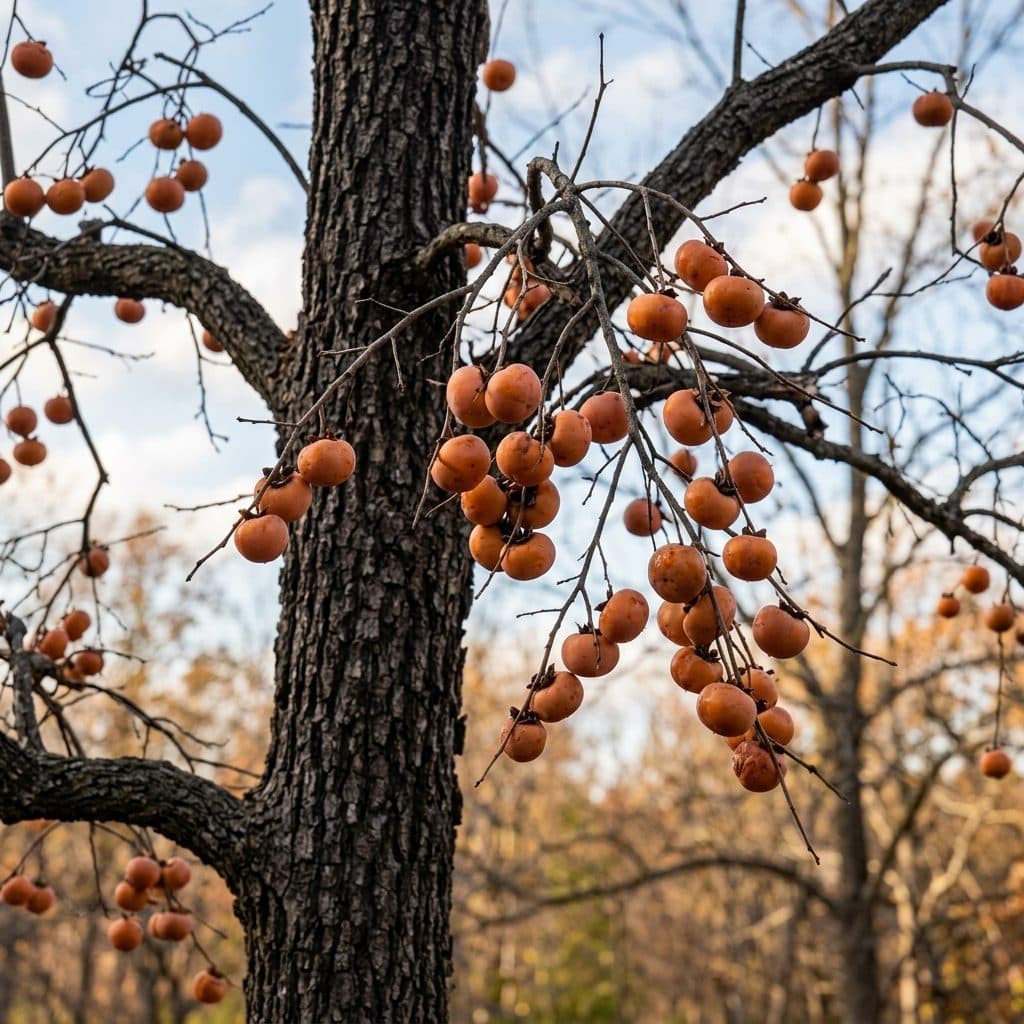
American persimmons ripen in mid to late autumn, typically between September and November, frequently persisting on bare branches well after all leaves have fallen. The fruit is a globose to obovoid berry measuring 2.5 to 5 cm (1 to 2 in) in diameter and weighing between 20 and 60 g (0.7 and 2.1 oz).
The fruit skin matures from pale green to dusty orange, yellowish-amber, and finally a deep, soft apricot hue overlaid with a delicate glaucous, pale lilac bloom. Unlike Asian non-astringent cultivars that can be eaten crisp like an apple, American persimmons are universally astringent until fully bletted. They must not be pulled forcibly from the tree; the fruit is fully ripe only when it softens completely to a fragile, jelly-like consistency, wrinkling slightly, and detaching freely into the hand with the slightest touch, or dropping onto clean mulch beneath the canopy.
Once fully bletted, the flavour is rich, honey-sweet, and complex, with notes of dark caramel, apricot, rum, and warm winter spices, and no lingering astringency. The soft pulp contains high levels of soluble sugars, dietary fibre, vitamin C, and beta-carotene.
In the kitchen, the soft pulp is pressed through a colander or food mill to remove flattened seeds and skin. This golden purée is used in traditional North American homestead dishes, including baked persimmon pudding, breakfast breads, autumn cakes, spiced cookies, and ice creams. The purée freezes exceptionally well, retaining its luscious flavour and bright colour for up to twelve months. A mature grafted tree yields 20 to 45 kg (44 to 99 lb) of fruit annually.
Identifying American persimmon
Diospyros virginiana is readily identified in the field across all seasons by several distinctive botanical features:
- Bark: One of the most unmistakable barks in temperate forestry. Mature trunks develop dark greyish-black, deeply furrowed bark broken into small, thick, squarish, blocky plates that closely resemble alligator hide or charred charcoal blocks. The inner furrows reveal subtle orange-brown undertones.
- Leaves: Alternate, simple, leathery, broadly oval to elliptic leaves measuring 8 to 15 cm (3.1 to 5.9 in) long and 4 to 8 cm (1.6 to 3.1 in) wide. The margins are completely entire. The upper surface is deep lustrous green, while the underside is paler and slightly downy when young. In autumn, foliage turns clear yellow, bronze-orange, or dusky reddish-purple.
- Flowers: Urn-shaped or bell-shaped blossoms borne in early summer. Female flowers are solitary, creamy-white to yellowish, measuring about 1.5 cm (0.6 in) long with four prominent, recurved calyx lobes. Male flowers are smaller, borne in clusters of two or three.
- Fruit: Globose, soft, orange-amber berries measuring 2.5 to 5 cm (1 to 2 in) across, crowned at the base by a prominent, woody, four-lobed persistent calyx.
American persimmon is easily distinguished from Japanese persimmon (Diospyros kaki), which produces much larger, tomato-sized fruits (6 to 10 cm [2.4 to 3.9 in] across), paler platy grey bark without blocky alligator ridges, and noticeably less cold hardiness.
Cautions
Growers cultivating Diospyros virginiana should note several physiological, gastrointestinal, and horticultural cautions:
- Risk of diospyrobezoars (phytobezoars): Consuming substantial quantities of firm, underripe, or unbletted persimmons poses a severe medical hazard. Unripe persimmons contain massive concentrations of soluble, monomeric tannins known as shibuol. Upon encountering gastric acid in the human stomach, shibuol polymerises rapidly into a sticky, coagulated resin that glues together cellular fibres and seeds into an indigestible gastrointestinal mass known as a diospyrobezoar. These concretions can cause acute gastric ulceration or complete mechanical bowel obstruction requiring surgical removal. Never consume firm, unbletted, or intensely astringent persimmons.
- Severe astringency: Eating even a small nibble of unripe fruit causes immediate, intense puckering, temporary loss of taste sensation, and oral dryness due to tannin precipitation of salivary proteins. Educate children and visitors to harvest only completely soft, fallen, or wrinkled fruits.
- Deep taproot transplant shock: American persimmon produces an exceptionally long, vigorous taproot in its first season. Field-dug, bare-root trees suffer high mortality rates during transplanting. Always plant young container-grown stock or graft directly in situ, and avoid disturbing established root zones.
- Prolific root suckering: When lateral roots are damaged by deep tilling, spade edging, or heavy grazing, the tree responds by producing aggressive colonies of root suckers. In lawn or orchard settings, suckers must be mowed or pruned promptly to prevent the formation of an unwanted scrub thicket.
Sources
- Royal Botanic Gardens, Kew. Diospyros virginiana L. Plants of the World Online.
- USDA PLANTS Database. Diospyros virginiana L.
- Plants For A Future. Diospyros virginiana - L.
- North Carolina State Extension Gardener Plant Toolbox. Diospyros virginiana
- Missouri Botanical Garden. Diospyros virginiana