Key takeaways
- St. Augustine grass is a warm-season choice for shaded areas in USDA zones 8-11, tolerating conditions with 4-6 hours of direct sunlight.
- Fine fescues are cool-season grasses, suitable for shaded spots in USDA zones 6-8, needing at least 4 hours of direct sun daily.
- Soil preparation, including pH adjustment to 6.0-6.5 and incorporating 2-3 inches of organic matter, is critical for successful establishment.
- Proper watering — delivering 1 inch of water per week through deep, infrequent irrigation — is essential, especially during establishment and dry periods.
- Mowing heights of 2-3 inches for fine fescue and 2.5-4 inches for St. Augustine help maintain vigor and health in shaded environments.
- Overseeding fine fescue every two to three years at a rate of 3-5 pounds per 1,000 square feet can maintain density in shaded areas.
Quick answer: Establishing shade-tolerant lawns in the US Southeast involves selecting appropriate grasses like St. Augustine (warm-season) or fine fescue (cool-season) and providing tailored care. Key practices include proper soil preparation, deep infrequent watering, and specific mowing heights to support growth in reduced sunlight.
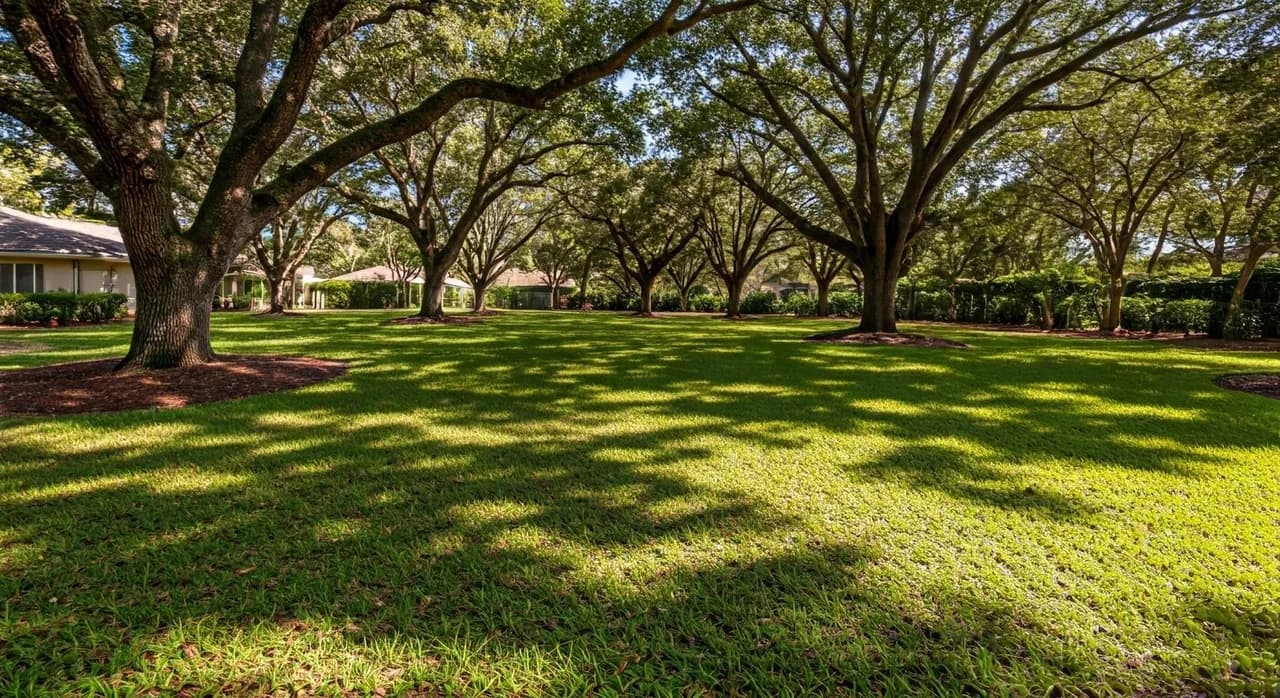
Growing a lush, green lawn in the shaded areas of the US Southeast can feel like a constant battle. The region, spanning from eastern Texas across to the Carolinas and Florida, experiences warm, humid summers and often features mature trees that cast significant shade. While many turfgrasses struggle with reduced sunlight, specific varieties like St. Augustine grass and fine fescue offer viable solutions for these challenging conditions, provided they receive tailored care.
Successfully establishing and maintaining a shaded lawn requires more than just picking the right seed or sod. It demands a strategic approach to soil preparation, watering, and ongoing maintenance practices. By understanding the unique needs of these shade-tolerant grasses, you can cultivate a healthy, dense turf even in spots receiving only four to six hours of direct sunlight each day.
The challenge of shade for turfgrass
Shade presents a significant hurdle for most turfgrasses, as sunlight is the primary engine for photosynthesis — the process by which plants convert light energy into food. In shaded environments, light intensity can drop by 50% or more, directly impacting a grass plant’s ability to produce the sugars it needs for sturdy growth and root development. Research indicates that shade can negatively affect the growth and nutritive value of tropical pasture grasses, reducing overall biomass production by 30% to 50% in some cases [3].
Understanding light requirements
Even grasses labeled “shade-tolerant” are not truly shade-loving; they simply tolerate lower light levels better than full-sun varieties. Most still require a minimum of four to six hours of direct or filtered sunlight daily to maintain adequate vigor. In areas with less than four hours of sun, even the best shade-tolerant grasses will thin out over time, becoming more susceptible to disease and insect pressure. Also, trees that create shade also compete for soil moisture and nutrients, further stressing the grass below their canopy.
- Reduced photosynthesis leads to weaker plants.
- Increased soil moisture can promote fungal diseases.
- Tree roots compete directly for water and nutrients.
- Lower light reduces the grass’s ability to recover from stress.
- Thinner turf allows weeds to establish more easily.
St. Augustine grass for southern shade
St. Augustine grass (Stenotaphrum secundatum) is a popular warm-season turfgrass known for its coarse texture and excellent heat tolerance, making it a staple in USDA zones 8 through 11 across the Southeast. While it generally prefers full sun, certain cultivars have been specifically bred for improved shade tolerance, allowing them to thrive with as little as four to six hours of direct sunlight or significant filtered light throughout the day. Varieties like ‘Palmetto’ and ‘Seville’ are often recommended for shaded areas due to their ability to maintain density and color under reduced light conditions.
Cultivar selection and care
When selecting St. Augustine for shade, choosing the right cultivar is paramount. These grasses establish well from sod or plugs, particularly in late spring or early summer when soil temperatures consistently reach 70°F or higher. Once established, St. Augustine in shade benefits from a higher mowing height, typically between 2.5 and 4 inches, which allows for more leaf surface area to capture limited sunlight. Fertilization should be lighter than for full-sun lawns, often around 0.5 to 1 pound of nitrogen per 1,000 square feet annually, split into two or three applications. Consistent moisture is also key, with 1 inch of water applied weekly, especially during dry spells, which can be monitored with a a calibrated soil pH or moisture test.
- ‘Palmetto’ and ‘Seville’ are leading shade-tolerant St. Augustine cultivars.
- Establishment is best with sod or plugs in late spring or early summer.
- Maintain a mowing height of 2.5 to 4 inches for optimal health.
- Apply nitrogen at 0.5 to 1 pound per 1,000 square feet annually.
- Ensure 1 inch of water per week, delivered through deep, infrequent irrigation.
Fine fescue varieties for cooler, shaded spots
For shaded areas in the northern parts of the Southeast, generally USDA zones 6 through 8, fine fescues offer a compelling cool-season option. This group includes several species such as creeping red fescue, chewings fescue, hard fescue, and sheep fescue, which are often blended to provide a resilient and aesthetically pleasing turf. Fine fescues are known for their fine texture, low maintenance requirements, and superior shade tolerance, capable of thriving with as little as four hours of direct sunlight daily. They also exhibit notable drought tolerance once established, a trait explored in research on shade-tolerant plants [5].
Blending for success
A blend of fine fescues typically performs better than a single species, offering a broader range of disease resistance and adaptability to varying microclimates within a shaded yard. Seeding is the primary establishment method, ideally performed in late summer or early fall when soil temperatures are between 55°F and 65°F, allowing for strong root development before winter. A seeding rate of 3 to 5 pounds per 1,000 square feet is common for renovation or new establishment. Mowing height should be kept between 2 and 3 inches, and these grasses generally require less nitrogen than other turf types, often benefiting from 0.5 pounds of nitrogen per 1,000 square feet annually. If your shaded area is too dense for even fescue, consider ground cover plants as an alternative.
- Creeping red, chewings, hard, and sheep fescues are common types.
- They thrive in USDA zones 6-8, needing at least 4 hours of sun.
- Best established by seeding in late summer or early fall.
- Mow at a height of 2 to 3 inches for best results.
- Require less nitrogen, typically 0.5 pounds per 1,000 square feet annually.
Preparing the site for success
Regardless of whether you choose St. Augustine or fine fescue, thorough site preparation is the cornerstone of a successful shaded lawn. The first step involves a comprehensive soil test, which can be obtained from your local extension office for a nominal fee. This test will show soil pH, nutrient levels, and organic matter content. Most turfgrasses prefer a soil pH between 6.0 and 6.5, and adjustments with lime (to raise pH) or sulfur (to lower pH) should be made according to soil test recommendations, typically several weeks before planting.
Addressing tree competition
Shaded areas are often found under mature trees, which present unique challenges. Tree roots aggressively compete with grass for water and nutrients, a phenomenon observed even in shade-tolerant invasive plants [4]. To mitigate this, consider pruning lower tree branches to increase light penetration and air circulation, or root pruning to create a buffer zone for grass establishment. Incorporating 2 to 3 inches of high-quality organic matter, such as compost, into the top 4 to 6 inches of soil will improve drainage, water retention, and nutrient availability. For heavy clay soils, this can significantly improve the soil structure, leading to better root development for your new lawn. Tools like a Wooden-Handle Garden Fork & Lawn Rake can assist in this process.
- Conduct a soil test to determine pH and nutrient levels.
- Adjust soil pH to 6.0-6.5 using lime or sulfur.
- Incorporate 2-3 inches of organic matter into the top 4-6 inches of soil.
- Prune lower tree branches to increase light and air circulation.
- Consider root pruning to reduce competition from mature trees.
Ongoing care for healthy shaded turf
Maintaining a healthy shaded lawn requires consistent, tailored care practices that differ from those for full-sun turf. Mowing frequency should be reduced, as shaded grass grows slower, but the height should be kept higher — 2.5 to 4 inches for St. Augustine and 2 to 3 inches for fine fescue. This increased leaf surface area allows the grass to capture more of the limited available sunlight. Sharpen your mower blades regularly, ideally after every 10 hours of use, to ensure a clean cut and prevent tearing, which can stress the grass.
Watering and fertilization strategies
Watering is critical, but overwatering can be detrimental in shade. Aim for deep, infrequent irrigation, providing about 1 inch of water per week, including rainfall. This encourages deeper root growth and helps prevent fungal diseases, which are more prevalent in damp, shaded conditions. You can measure 1 inch of water by placing a rain gauge or a straight-sided can in your irrigation zone. Fertilization should be conservative; shaded grass needs less nitrogen than sun-exposed areas. For St. Augustine, apply 0.5 to 1 pound of nitrogen per 1,000 square feet annually, split into two to three applications. Fine fescue generally needs even less, around 0.5 pounds of nitrogen per 1,000 square feet per year. Monitor for pests and diseases, as stressed grass in shade can be more susceptible, and consider annual aeration to alleviate compaction and improve water and nutrient penetration, especially in high-traffic areas.
- Reduce mowing frequency but maintain a higher cutting height (2-4 inches).
- Water deeply and infrequently, providing 1 inch of water per week.
- Fertilize conservatively with 0.5-1 pound of nitrogen per 1,000 square feet annually.
- Monitor for increased pest and disease pressure in damp, shaded conditions.
- Consider annual core aeration to improve soil health and root access.
St. Augustine vs. Fine Fescue for Shaded Lawns
Feature | St. Augustine Grass | Fine Fescue |
|---|---|---|
USDA Zones | 8-11 (Warm-season) | 6-8 (Cool-season) |
Minimum Light Needs | 4-6 hours direct or filtered sun | 4 hours direct sun |
Mowing Height | 2.5-4 inches | 2-3 inches |
Watering Needs | 1 inch per week, deep & infrequent | 1 inch per week, deep & infrequent |
Establishment Method | Sod or plugs | Seed |
Texture | Coarse | Fine |
St. Augustine Sun: St. Augustine grass cultivars like ‘Palmetto’ can thrive with as little as four to six hours of direct sunlight daily in USDA zones 8-11.
Fine Fescue Sun: Fine fescues are well-suited for shaded areas in USDA zones 6-8, requiring a minimum of four hours of direct sun per day.
References
- Fault tolerant, shade tolerant high voltage PV modules (2019).
- The nitrogen economy of tropical pasture grasses under shade (2023).
- Shade affects the growth and nutritive value of tropical pasture grasses (2023).
- Size-symmetric competition in a shade-tolerant invasive plant (2012).
- Are Shade-Tolerant Plants Also Drought-Tolerant (2024).
- USDA Natural Resources Conservation Service (2024).