Key takeaways
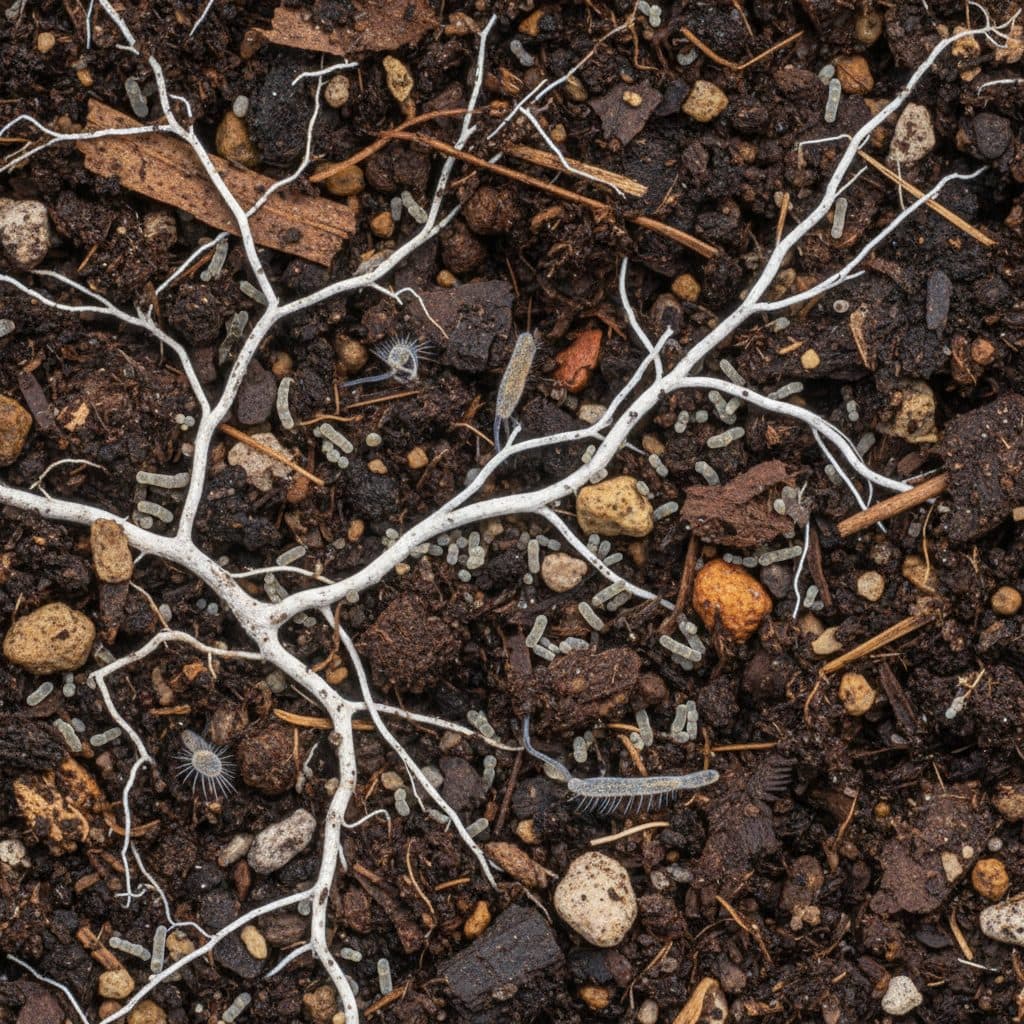
- The soil food web is a diverse biological community of microorganisms and macroorganisms that cycles nutrients directly to plant roots.
- Plants actively feed soil microbes by exuding carbon-rich sugars, amino acids, and proteins through their root tips.
- Bacteria and fungi immobilize nutrients in their bodies; predatory protozoa and beneficial nematodes release those nutrients as plant-available plant food.
- Early succession weeds and non-mycorrhizal brassicas thrive in bacterial-dominated soils, while garden crops prefer balanced soils and perennial trees require fungal dominance.
- Synthetic chemical fertilizers, excessive rototilling, and bare soil suppress biological nitrogen fixation, sever fungal networks, and degrade soil structure.
Quick answer: The soil food web is the complex network of organisms living in the soil, including bacteria, fungi, protozoa, nematodes, microarthropods, and earthworms. These organisms consume organic matter and each other, transforming locked-up minerals into plant-available nutrients right at the root zone, while simultaneously building soil aggregates and defending plants against root pathogens.
Healthy garden soil is not an inert growing medium; it is a thriving biological ecosystem teeming with billions of living organisms. Understanding the soil food web (a framework popularized in ecological agriculture by Dr. Elaine Ingham) allows gardeners to step away from synthetic chemical inputs and harness the natural ecological systems that have sustained terrestrial plant life for millions of years.
At the center of this underground economy is the symbiotic relationship between plant roots and soil microorganisms. Through photosynthesis, plants produce carbon compounds, channeling a substantial portion out through their roots as exudates. These exudates are food designed to attract beneficial bacteria and mycorrhizal fungi to the rhizosphere.
When gardeners support soil microbiology for gardeners rather than treating soil as a sterile substrate, plants develop greater resilience to drought, pest pressure, and disease. By examining the roles of different trophic levels, growers can manage their beds to support active biological nutrient cycling.
Trophic levels of the soil biological community
The soil food web functions through organized trophic levels, where energy flows from primary producers upward through specialized consumers and predators:
+-------------------------------------------------------------+
|               SOIL FOOD WEB TROPHIC LEVELS                  |
|                                                             |
|  1st TROPHIC LEVEL: Photosynthesizers (Plants & Root Exudates)|
|                           |                                 |
|                           v                                 |
|  2nd TROPHIC LEVEL: Decomposers (Bacteria, Saprophytic Fungi)|
|                           |                                 |
|                           v                                 |
|  3rd TROPHIC LEVEL: Grazers & Predators (Protozoa, Nematodes)|
|                           |                                 |
|                           v                                 |
|  4th TROPHIC LEVEL: Higher Predators (Arthropods, Earthworms)|
|                           |                                 |
|                           v                                 |
|  5th TROPHIC LEVEL: Apex Animals (Birds, Small Mammals)     |
+-------------------------------------------------------------+- First trophic level (Photosynthesizers): Plants capture solar energy and manufacture carbohydrates. Plant residues, leaf litter, and liquid root exudates provide the primary energy currency for all soil organisms.
- Second trophic level (Decomposers and mutualists): Bacteria and fungi consume organic residues and root exudates. They break down complex lignin and cellulose, immobilizing nitrogen, phosphorus, and trace minerals inside their cellular biomass.
- Third trophic level (Shredders, predators, and grazers): Protozoa (amoebae, flagellates, ciliates), beneficial nematodes, and microarthropods feed on bacteria and fungi. Because their bodies require less nitrogen than their prey contains, they excrete the excess as plant-available ammonium.
- Fourth trophic level (Higher-level predators): Predatory mites, rove beetles, spiders, centipedes, and earthworms consume smaller organisms, shredding organic matter and aerating soil pathways.
- Fifth trophic level (Vertebrate animals): Birds, moles, toads, and small mammals forage for larger soil invertebrates, completing the ecological loop.
Bacteria vs fungi: understanding the fungal-to-bacterial ratio
Different plant ecosystems depend on distinct biological balances, primarily measured by the fungal-to-bacterial (F:B) biomass ratio:
+-------------------------------------------------------------+
|             FUNGAL TO BACTERIAL RATIO CONTINUUM             |
|                                                             |
|  BACTERIAL DOMINANT                         FUNGAL DOMINANT |
|  (F:B 0.1:1 - 0.5:1)                        (F:B 5:1 - 100:1)|
|                                                             |
|  Pioneer Weeds/Brassicas -> Annual Crops -> Shrubs -> Trees |
+-------------------------------------------------------------+
Soil bacteria
Bacteria are single-celled organisms that thrive on simple sugars and easily digestible green organic materials. They produce sticky slime layers called glues that bind silt, clay, and sand particles together into micro-aggregates. Bacterial bodies have a very narrow carbon-to-nitrogen (C:N) ratio of approximately 5:1. When they die or get consumed, they cycle soluble nitrates that benefit fast-growing annual crops.
Soil fungi
Fungi grow in elongated microscopic strands called hyphae, forming extensive networks known as mycelium. Saprophytic fungi specialize in decomposing tough, woody materials rich in lignin and cellulose (such as wood chips, fallen leaves, and straw). Mycorrhizal fungi form mutualistic associations with plant roots, extending the root surface area by hundreds of times to mine distant phosphorus and water in exchange for plant carbon.
Matching F:B ratios to plant families
- Early successional plants and brassicas (F:B 0.1:1 to 0.5:1): Weeds and brassicas (which are non-mycorrhizal, such as kale, cabbage, and mustard) thrive in bacterial-dominated soils where nitrate nitrogen dominates.
- Annual vegetables and grasses (F:B 0.8:1 to 1:1): Tomatoes, peppers, corn, squash, and pasture grasses thrive in balanced soils with roughly equal parts bacterial and fungal biomass.
- Perennials, berries, and shrubs (F:B 2:1 to 5:1): Blueberries, raspberries, and perennial fruit bushes require fungal dominance.
- Orchard trees and mature forests (F:B 5:1 to 100+:1): Apple, pear, nut trees, and native woodlands demand highly fungal soils protected by woody mulches.
Protozoa and nematodes: driving the soil nutrient loop
Bacteria and fungi act as microscopic nutrient sponges, locking up minerals in their bodies so they do not leach away in heavy rains. However, plants cannot directly consume intact bacterial cells. The release of these locked nutrients depends entirely on predatory grazers.
The protozoan release mechanism
Protozoa are single-celled aquatic organisms classified into amoebae, flagellates, and ciliates. They swim through thin water films surrounding soil particles, consuming thousands of bacteria daily.
Bacteria maintain a narrow carbon-to-nitrogen (C:N) ratio of approximately 5:1, while the protozoa and bacterial-feeding nematodes that consume them have a wider C:N ratio (roughly 10:1 to 30:1). Because protozoa ingest more nitrogen than they require to build their own bodies, they excrete the excess nitrogen directly into the rhizosphere in the form of plant-available ammonium (NH4+), which plant roots readily absorb.
Beneficial nematodes
Soil nematodes are microscopic, unsegmented roundworms. Unlike the few parasitic species that damage root systems, the vast majority of soil nematodes are beneficial:
- Bacterial-feeders: Consume bacteria and excrete plant-available nitrogen.
- Fungal-feeders: Puncture fungal hyphae to consume fungal fluids, releasing immobilized minerals.
- Predatory nematodes: Hunt and consume root-knot nematodes and pathogenic soil organisms, serving as an organic pest control mechanism.
How the soil food web builds soil structure and suppresses disease
Beyond nutrient cycling, active soil biology creates physical soil architecture and protects plants from infection.
Building soil aggregation and water retention
Bacteria produce slime layers that cement fine mineral grains into micro-aggregates. Fungal hyphae then weave these micro-aggregates together into crumbly macro-aggregates, glued by glomalin—a persistent, carbon-dense glycoprotein produced by arbuscular mycorrhizal fungi (AMF). This aggregated crumb structure creates pore spaces that permit root penetration, oxygen infiltration, and exceptional moisture retention. Monitoring water infiltration with a simple soil moisture testing routine demonstrates how aggregated soil holds moisture without becoming anaerobic.
Competitive exclusion and pathogen defense
When beneficial microorganisms densely colonize the rhizosphere, they occupy all available root surface niches. If a fungal pathogen such as Pythium, Fusarium, or Rhizoctonia approaches a root, beneficial microbes outcompete it for space and food. Furthermore, many beneficial fungi and actinobacteria produce natural antibiotic compounds that actively inhibit pathogen spores.
Practical steps to feed and protect soil biology
Cultivating a resilient soil food web requires shifting from feeding plants directly to nurturing the underground ecosystem.
+-------------------------------------------------------------+
|               PRACTICES FOR SOIL BIOLOGY                    |
|                                                             |
|  DO:                                                        |
|  - Keep soil covered with organic mulches year-round        |
|  - Maintain living roots through cover cropping             |
|  - Apply diverse thermal compost and vermicompost           |
|                                                             |
|  DON'T:                                                     |
|  - Rototill beds and pulverize fungal hyphae networks       |
|   - Apply concentrated synthetic salt fertilizers           |
|  - Spray broad-spectrum soil sterilants or fungicides       |
+-------------------------------------------------------------+- Minimize soil disturbance: Mechanical tilling shreds fungal hyphae, crushes earthworm burrows, and injects excessive oxygen that burns off organic carbon. Adopt no-dig methods that layer organic matter on top.
- Maintain living roots: Living root systems pump carbon exudates into the soil throughout the year. Use multi-species cover crops to keep microbes fed between main vegetable crops.
- Apply biologically active compost: Inoculate garden beds with finished compost rich in fungal spores and protozoan cysts. Comparing vermicompost vs regular compost reveals how earthworm castings provide extraordinary microbial diversity.
- Use organic sheet mulches: Layer cardboard and arborists wood chips or clean straw across paths and beds. Implementing sheet mulching for weed control preserves soil moisture and feeds saprophytic fungi.
- Accelerate organic breakdown: Using natural compost accelerators speeds decomposition in cold piles, for a steady supply of rich humus.
By building a diverse soil biological community, you establish a self-feeding, self-protecting garden ecosystem. At agripure, understanding natural soil science empowers growers to cultivate healthy crops through biological harmony rather than chemical intervention.