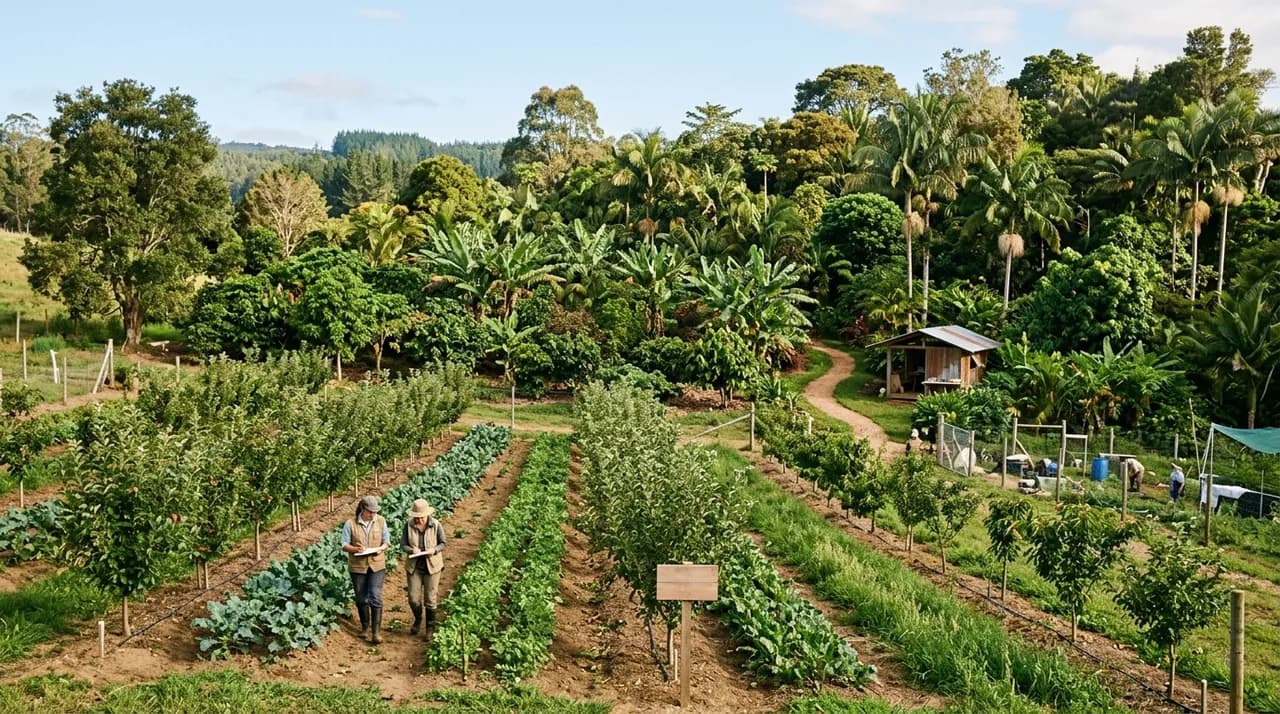
Climate zone dictates the biological velocity, physical architecture, and operational design of agroforestry systems worldwide. While tropical agroforestry leverages year-round solar radiation and rapid biological succession to build dense, multi-strata polycultures, temperate systems must navigate winter dormancy, shorter growing seasons, and lower sun angles through structured, linear arrangements. Understanding these bioclimatic contrasts reveals why specific practices dominate in each region and prevents land managers from attempting to copy tropical designs directly into temperate landscapes.
When evaluating diverse types of agroforestry, students must avoid treating agroforestry as a uniform set of practices. Ecological mechanics vary widely across biomes, dictating how trees interact with companion crops, livestock, and soil resources.
Bioclimatic drivers of agroforestry design
The structural differences between temperate and tropical agroforestry stem from foundational differences in solar geometry, thermal budgets, and hydrology:
- Thermal Regimes and Dormancy: Temperate systems experience a mandatory winter dormant season governed by freezing temperatures and short day lengths. Perennial woody plants cease active growth, drop foliage (in deciduous species), and rely on stored carbohydrate reserves. Tropical systems, outside of distinct seasonal dry periods, maintain continuous physiological activity, allowing multiple annual crop cycles under perennial canopies.
- Solar Geometry and Radiation: In equatorial regions, high solar elevation angles deliver direct solar radiation with minimal lateral shadow casting. In temperate latitudes, lower solar elevation angles produce long, oblique shadows, especially during spring and autumn shoulder seasons.
- Decomposition and Soil Dynamics: Tropical environments exhibit rapid biological turnover; high temperatures and humidity accelerate microbial decomposition, causing surface litter to mineralize rapidly. Temperate soils retain organic matter and humus over prolonged cold months, preserving soil carbon reserves but releasing plant-available nutrients more slowly in spring.
These physical constraints dictate what vegetation structures are biologically viable in each zone.
Succession speed and biomass turnover
Ecological succession operates on radically different timescales across biomes. In the humid tropics, biomass accumulation occurs rapidly. Fast-growing pioneer trees can reach reproductive maturity in a few seasons, producing massive volumes of leaf litter and woody material. As demonstrated in syntropic farming systems, tropical managers can repeatedly prune woody biomass to fuel rapid soil regeneration and feed fast-cycling annual crops.
In temperate climates, by contrast, woody perennials develop at a fraction of that biological speed. A hardwood timber seedling requires years to establish an expansive root system and decades to develop a commercial canopy. Biomass accumulation is constrained by the short summer window. Consequently, temperate agroforestry requires long-term planning horizons; errors in initial tree spacing or species selection cannot be rapidly corrected through vegetative re-growth, and biomass pruning generates far less annual organic matter than in tropical environments.
Canopy architecture and light management
The physical arrangement of agroforestry components directly reflects local solar geometry:
``` +-------------------------------------------------------------------------------+
| CANOPY ARCHITECTURE COMPARISON | +---------------------------------------+---------------------------------------+
| TROPICAL MULTI-STRATA | TEMPERATE LINEAR ALLEY | +---------------------------------------+---------------------------------------+
Overhead Sun (High Angle) | Angled Sun (Lower Oblique Path) |
\ | / | \ |
| | \ | | [Emergent Canopy Layer] | [Tree Row] [Wide Cropping] [Tree Row] | | | (North-South [Open Alley ] (Hardwoods)
[Medium Shade Layer] (Cacao/Coffee) | Orientation) [For Cereals ] |
| | | | | | | [Shrub / Herbaceous Layer] | v v v
|
| Linear rows maximize direct sunlight |
| Deep vertical light penetration | into broad alley floor | +---------------------------------------+---------------------------------------+ ```
In the tropics, multi-tiered systems naturally flourish. Because the sun passes directly overhead, sunlight filters down through multiple canopy layers. Farmers can successfully cultivate shade-tolerant understory crops such as coffee, cacao, vanilla, and ginger beneath a canopy of leguminous shade trees and emergent timber species without causing light starvation.
In temperate zones, attempting to recreate a multi-layered canopy for grain or vegetable production routinely fails due to light limitations. Lower solar angles cast expansive lateral shadows. If multiple tree and shrub layers are stacked together, the ground level receives insufficient photosynthetically active radiation to mature conventional crops. To maintain productive understories, temperate systems must rely on linear, widely spaced geometries, such as alley cropping configured in strict north-to-south rows, so crops receive adequate direct sunlight across the middle of the day.
Pest, weed, and disease pressure
Climate zones establish fundamentally different biological pressures on agricultural polycultures:
Tropical pest continuity
Without a killing winter freeze, tropical insect populations, fungal spores, and parasitic nematodes remain biologically active throughout the year. Monocultural crops in the tropics are exceptionally vulnerable to rapid pest outbreaks. In these environments, agroforestry polycultures provide primary biological defense. Diverse canopies create physical barriers to pest dispersal, maintain continuous populations of beneficial predators, and disrupt visual and chemical host cues.
Temperate seasonal synchronization
Temperate winters act as an annual biological reset, suppressing insect populations and interrupting fungal lifecycles. However, temperate crops face acute pest and disease windows during warm, humid summer months. Late spring frosts present severe risks to early-flowering fruit and nut trees. Furthermore, because temperate understory crops often require maximum airflow to prevent foliar fungal diseases (such as powdery mildew and blight), temperate designs require wider tree spacing and deliberate understory ventilation instead of dense vegetative crowding.
Dominance across the core agroforestry practices
The recognized five core practices codified in broad agroforestry literature distribute unequally across global biomes based on climatic fit:
Practice Category | Temperate Realization | Tropical Realization | Primary Bioclimatic Driver |
|---|---|---|---|
Alley Cropping | Wide, linear rows of high-value hardwoods (walnut, pecan, chestnut) with mechanized grain or hay alleys | Narrow contour hedgerows of fast-growing nitrogen fixers pruned for mulch and green manure | Need for tractor access and sun penetration in temperate zones vs. erosion and biomass needs in tropics |
Silvopasture | Conifers or deciduous hardwoods over open cool-season pasture; provides livestock shade and winter shelter | Multilayered systems combining timber trees with browse shrubs (Leucaena, Gliricidia) directly grazed by livestock (Note: Leucaena leucocephala can self-seed invasively in frost-free regions and contains the amino acid mimosine; limit Leucaena foliage to no more than 20–30% of ruminant fodder rations.) | Year-round forage growth and intense solar heat stress in tropical rangelands |
Windbreaks | Extensive multi-row conifer and hardwood belts protecting fields from desiccating winds and soil drift | Living fences and boundary plantings stabilizing parcel borders and mitigating typhoon winds | Severe continental wind chill and blizzards across temperate plains |
Riparian Buffers | Multi-zone grass-shrub-tree strips filtering nutrient runoff from intensive fertilizer applications | Riverine forest corridors combined with edible crops to protect fragile tropical riverbanks | Heavy non-point source agricultural runoff and snowmelt dynamics in temperate watersheds |
Forest Farming | Cultivation of high-value shade botanicals (ginseng, goldenseal, culinary mushrooms) in existing woodlots | Extensive shaded agroforests producing global commodities (cacao, coffee, black pepper, cardamom) | Natural deciduous understory ecology in temperate zones vs. commercial shade crops in the tropics |
As detailed in silvopasture literature, livestock integration thrives in both regions but serves distinct functions. In temperate zones, tree canopies primarily reduce heat stress during summer heat spikes and offer wind shelter in winter. In the tropics, silvopastoral systems frequently incorporate high-protein woody fodder that cattle browse directly during seasonal dry periods when herbaceous pastures desiccate.
Avoiding false equivalencies in design
A frequent mistake among beginner students and enthusiastic designers is assuming that agroforestry techniques are directly portable across biomes. Attempting to install high-density, multi-layered tropical food forests in cool temperate regions frequently leads to disappointing crop yields, persistent fungal pressure, and stunted tree growth. Conversely, deploying sparse, widely spaced temperate alley systems in the humid tropics can leave exposed topsoils vulnerable to torrential rain erosion and rapid organic matter degradation.
At agripure, comparative agroforestry teaches that successful systems respect local bioclimatic realities. By analyzing solar angles, succession velocity, and seasonal temperature regimes, researchers and practitioners can design landscapes that harness natural ecological mechanics suited to their specific geographic latitude.