Key takeaways
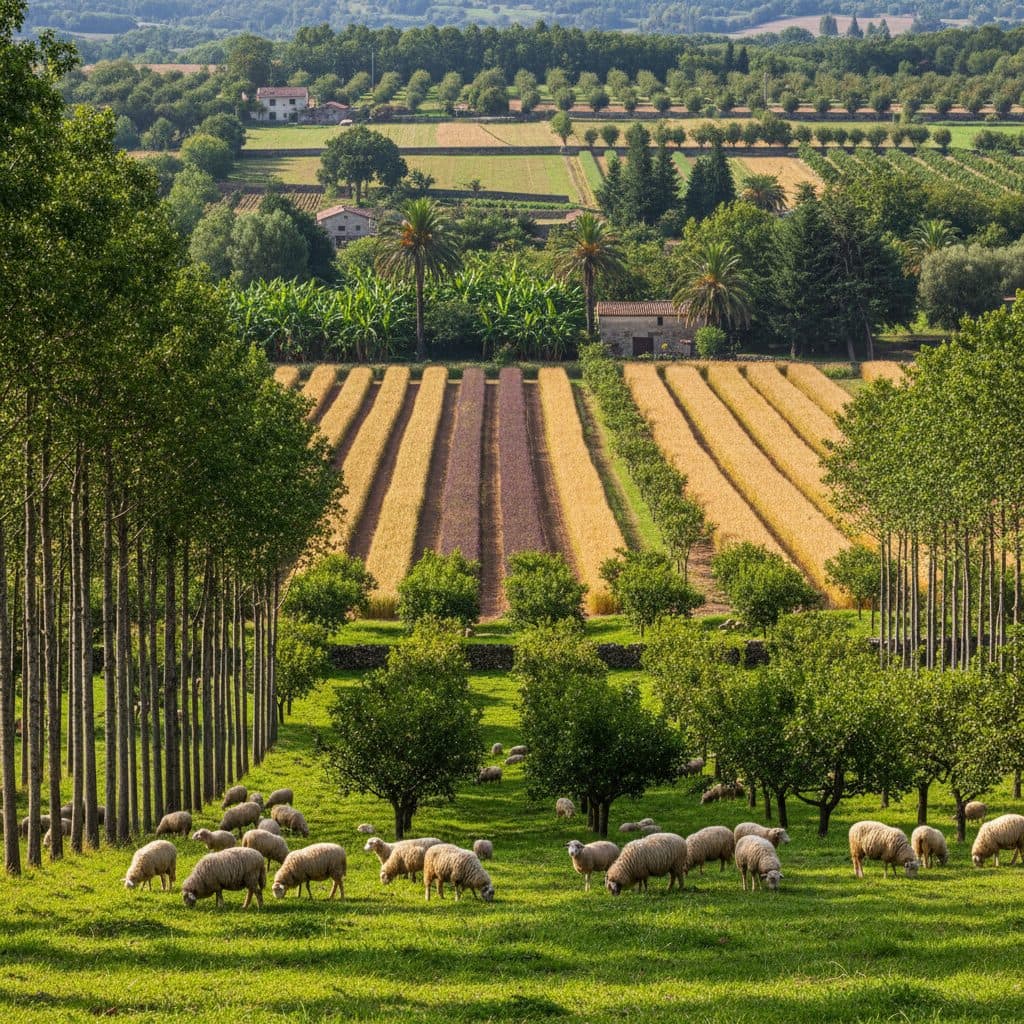
- Agroforestry is the intentional integration of woody perennials (trees and shrubs) with agricultural crops and livestock on the same land-management unit.
- The five universally recognized agroforestry practices are alley cropping, silvopasture, forest farming, riparian forest buffers, and windbreaks.
- Alley cropping cultivates annual crops between wide rows of high-value timber, nut, or fruit trees to generate short-term cash flow while long-term timber matures.
- Silvopasture combines managed grazing livestock with forage and widely spaced trees, reducing animal heat stress and enhancing pasture growth.
- Multi-story forest farming cultivates shade-tolerant specialty crops (such as mushrooms, ginseng, vanilla, and cacao) beneath managed forest canopies.
- Agroforestry systems sequester significant atmospheric carbon, stabilize soil microbiomes, enhance water infiltration, and provide diversified revenue streams.
Quick answer: The five primary types of agroforestry systems are alley cropping (planting crops between tree rows), silvopasture (integrating grazing livestock with trees and forage), forest farming (growing shade crops under a forest canopy), riparian forest buffers (planting trees along waterways), and windbreaks (shelterbelt tree lines that shield fields).
Modern agriculture faces the dual challenge of sustaining global food yields while reversing soil degradation, biodiversity loss, and water depletion. For decades, industrial agriculture relied on monoculture farming—clearing vast landscapes of trees to plant single annual crops dependent on heavy synthetic inputs.
Agroforestry bridges agriculture and forestry by deliberately combining trees and shrubs with crops and livestock. Understanding the different types of agroforestry allows land stewards, farmers, and homesteaders to design productive ecosystems that mimic the stability, resilience, and closed nutrient loops of natural forests while producing diverse food, timber, and medicinal harvests.
+-------------------------------------------------------------+
|              THE FIVE CORE AGROFORESTRY PRACTICES           |
|                                                             |
|   1. ALLEY CROPPING:                                        |
|   - Linear tree rows with arable crops grown in alleys      |
|                                                             |
|   2. SILVOPASTURE:                                          |
|   - Trees + pasture forage + managed grazing livestock      |
|                                                             |
|   3. FOREST FARMING (Multi-Story Systems):                  |
|   - Shade-tolerant high-value crops under canopy cover      |
|                                                             |
|   4. RIPARIAN FOREST BUFFERS:                               |
|   - Linear streamside tree plantings for water filtration   |
|                                                             |
|   5. WINDBREAKS & SHELTERBELTS:                             |
|   - Perimeter tree barriers that reduce wind erosion        |
+-------------------------------------------------------------+
1. Alley cropping: annuals between tree rows
Alley cropping (also known as intercropping) is the practice of planting agricultural or horticultural crops in wide alleys between parallel rows of trees or shrubs.
+-------------------------------------------------------------+
|                 ALLEY CROPPING ROW GEOMETRY                 |
|                                                             |
|   [ Tree Row A ] <------ 12 to 24 m (40 to 80 ft) -----> [ Tree Row B ]
|   (Timber/Nuts)             Wide Alleyway                (Timber/Nuts)
|        ||           ==============================            ||
|        ||           Annual Crops / Small Grains /             ||
|        ||           Vegetables / Berry Shrubs                 ||
|        ||           ==============================            ||
|   [ Tree Row A ]                                         [ Tree Row B ]
+-------------------------------------------------------------+
Design and crop interactions
The spacing between tree rows typically ranges from 12 to 24 metres (40 to 80 feet), calculated to accommodate standard agricultural machinery such as tractors, seed drills, and combine harvesters. In the early establishment years, the annual crops planted in the alleys (such as wheat, barley, soybeans, or vegetables) generate immediate seasonal revenue while the slow-growing timber or nut trees establish their root systems.
In cool temperate climates: Hardwood timber trees like black walnut (Juglans nigra — note juglone sensitivity for companion crops), chestnut (Castanea), oak (Quercus), and alder (Alnus spp.) are paired with winter grains, oilseeds, or hay.
In subtropical and tropical climates: Fast-growing nitrogen-fixing leguminous trees (such as Inga edulis or *Gliricidia sepium, or black locust *Robinia pseudoacacia with regional invasive and livestock toxicity caveats noted) are grown in alleys alongside maize, beans, or cassava. Deep tree roots access moisture below shallow crop zones, significantly reducing irrigation requirements once established, though newly planted trees require supplemental water during initial establishment.
For deeper agroforestry principles, explore our foundational overview on agroforestry systems and design.
2. Silvopasture: trees, forage, and livestock
Silvopasture is the deliberate integration of trees, pasture forage, and grazing livestock on the same parcel of land. It is not simply turning cows into an unmanaged native forest; rather, it is an intensively managed rotational grazing system.
+-------------------------------------------------------------+
|                 SILVOPASTURE SYSTEM DYNAMICS                |
|                                                             |
|   Trees (Timber / Fodder / Shade):                          |
|   - Lowers ambient summer heat by 5°C to 10°C (9°F to 18°F) |
|   - Reduces livestock heat stress; improves weight gain     |
|                                                             |
|   Pasture Forage (Grasses & Legumes):                       |
|   - Filtered sunlight extends cool-season grass growth      |
|   - Tree leaf litter enriches soil biology                  |
|                                                             |
|   Livestock (Cattle / Sheep / Poultry):                     |
|   - Manure fertilizes tree root zones                       |
|   - Rotational grazing prevents tree bark damage            |
+-------------------------------------------------------------+
Component | Management Focus | Key Function |
|---|---|---|
Tree Layer | Spaced 8 to 15 m (25 to 50 ft) apart; pruned lower branches | Provides dappled shade, timber, nuts, and tree fodder |
Forage Layer | Mix of cool-season grasses and nitrogen-fixing legumes | High-protein animal nutrition; deep soil carbon storage |
Livestock | Intensive rotational grazing (short stays, long recovery) | Natural weed suppression, nutrient cycling, meat/dairy |
Animal welfare and forage quality
Under intense summer heat, livestock grazing on open, treeless pastures suffer severe thermal stress, resulting in reduced feed intake, lower milk production, and compromised fertility. In silvopasture, tree canopies lower ground temperatures significantly, improving animal welfare. Cool-season pasture grasses beneath open tree canopies also retain higher moisture levels and protein concentrations later into the season.
When selecting silvopasture timber, match species carefully to grazing animals: for instance, black walnut (Juglans nigra) suits cattle systems but must be strictly avoided in horse paddocks due to juglone toxicity and equine laminitis risk, and should be paired only with juglone-tolerant forage grasses such as orchardgrass and Kentucky bluegrass.
To master rotational grazing and pasture design, read our comprehensive guide on silvopasture management.
3. Forest farming: multi-story specialty cropping
Forest farming involves the cultivation of high-value specialty crops beneath the shade of a managed, established forest canopy. Unlike wild foraging, forest farming modifies light levels through intentional thinning of canopy trees to create ideal growing conditions for understorey species.
+-------------------------------------------------------------+
|                 MULTI-STORY FOREST CANOPY LAYERS            |
|                                                             |
|   Layer 1: Overstorey Timber Canopy (Oak, Maple, Pine)      |
|   -------------------------------------------------------   |
|   Layer 2: Understorey Shade Trees (Dogwood, Hazel, Serviceberry)
|   -------------------------------------------------------   |
|   Layer 3: Shrub & Crop Layer (Ginseng, Goldenseal, Berries)|
|   -------------------------------------------------------   |
|   Layer 4: Ground Layer & Fungi (Shiitake Logs, Oyster, Ferns)
+-------------------------------------------------------------+
High-value forest crops:
- Medicinal herbs: American ginseng (Panax quinquefolius), goldenseal (Hydrastis canadensis), and black cohosh (Actaea racemosa) thrive in rich, shaded woodland soils.
- Gourmet mushrooms: Shiitake (Lentinula edodes) and oyster mushrooms cultivated on hardwood logs stacked in shaded forest understoreys.
- Understorey edibles: Ramps (wild leeks), fiddlehead ferns, and shade-tolerant berry shrubs.
In subtropical and tropical climates: Forest farming forms the basis of shade-grown coffee (Coffea arabica) and cacao (Theobroma cacao). Shade-grown coffee and cacao typically produce higher-quality beans with more complex flavour profiles due to slower fruit maturation under a 30% to 40% canopy, though total yields may be lower than in high-input, full-sun monocultures.
To scale multi-layered planting from woodlands down to backyard food systems, explore what is a food forest.
4. Riparian forest buffers: protecting aquatic waterways
Riparian forest buffers are strips of native trees, shrubs, and perennial vegetation planted along the banks of rivers, streams, lakes, and drainage wetlands.
+-------------------------------------------------------------+
|                 RIPARIAN BUFFER THREE-ZONE SYSTEM           |
|                                                             |
|   [ Crop Field ] -> [ Zone 3: Native Grass Filter Strip ]   |
|                     - Traps sediment runoff                 |
|                  -> [ Zone 2: Managed Shrub / Tree Buffer ] |
|                     - Nutrients absorbed by woody roots     |
|                  -> [ Zone 1: Undisturbed Streamside Trees ]|
|                     - Roots stabilize bank; shade water     |
|                  ================================ Waterway  |
+-------------------------------------------------------------+
Environmental functions and species selection:
- Water filtration: Dense root networks of native riparian species like willows (Salix spp.), alders (Alnus spp.), poplars (Populus spp.), and river birch (Betula nigra) intercept agricultural runoff, filtering out excess nitrates and phosphorus before they reach waterways. Avoid high-water-use exotics or heavy allelopathic species in riparian zones.
- Bank stabilization: Deep woody roots bind streamside soils, preventing stream bank erosion during heavy flood events.
- Aquatic habitat cooling: Overhanging tree branches shade the water surface, lowering water temperatures and preserving oxygen levels for native fish populations.
5. Windbreaks and shelterbelts: microclimate buffers
Windbreaks are linear plantings of single or multiple rows of trees and shrubs designed to reduce wind speed across open agricultural fields, homesteads, and livestock pastures.
+-------------------------------------------------------------+
|                 WINDBREAK AERODYNAMIC PROFILE               |
|                                                             |
|   Prevailing Wind ==> [ Dense Conifers ] [ Tall Deciduous ] |
|                       [ Dense Shrubs   ]                    |
|                       ====================================  |
|                       Protected Zone (Wind Reduced by 50%)  |
|                       Extends 10 to 20x the Height of Trees |
+-------------------------------------------------------------+
A well-designed shelterbelt with 40 to 50 percent porosity creates a protected microclimate on its leeward (downwind) side that extends for a distance of 10 to 20 times the mature height of the tallest trees.
Agricultural benefits:
- Soil erosion control: Prevents topsoil loss caused by strong prevailing winds.
- Moisture conservation: Lowers crop evapotranspiration rates by reducing drying winds, saving soil moisture for plant growth.
- Energy savings: Reduces home heating costs on farmsteads by up to 30 percent during freezing winter blizzards.
Modern extensions: syntropic agriculture and successional agroforestry
In recent decades, agroforestry has expanded to include dynamic ecological systems such as syntropic agriculture (developed by Ernst Götsch).
Syntropic farming mimics natural forest succession through high-density polycultures and intensive seasonal pruning ("chop-and-drop"). Biomass trees are heavily pruned to stimulate root exudates, accelerate soil building, and channel light to productive fruiting layers.
In the US and internationally, government conservation programmes (such as USDA EQIP and CSP) may offer cost-share funding for establishing agroforestry practices — check current programme rules, eligibility, and local payment schedules.
To understand successional layering and biomass pruning by climate zone, review our guide to syntropic farming principles and species selection in syntropic chop-and-drop species by zone.
Summary: selecting the right agroforestry system
System | Primary Goals | Labor & Capital Input | Revenue Realization |
|---|---|---|---|
Alley Cropping | Timber production + continuous annual cash crops | Moderate | Immediate annual returns; long-term timber |
Silvopasture | Livestock shade + forage yield + timber | Moderate to High | Annual meat/dairy/wool + long-term timber |
Forest Farming | High-value shade crops in existing woods | Low to Moderate | Medium-term (2 to 7 years for mushrooms/herbs) |
Riparian Buffers | Water quality protection + erosion control | Low after setup | Conservation cost-shares + ecosystem stability |
Windbreaks | Soil protection + crop yield boost + energy savings | Low to Moderate | Indirect yield boosts across adjacent fields |