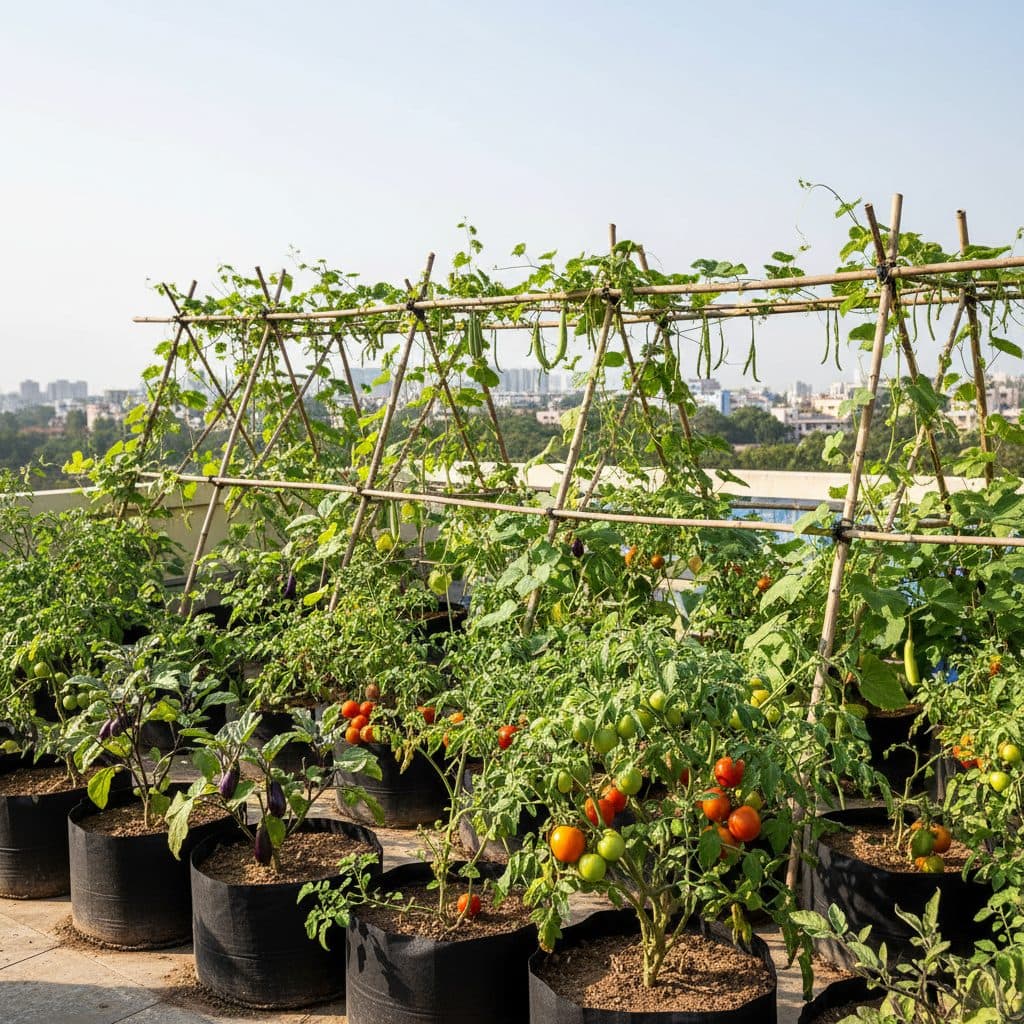
Key takeaways
- Waterproof your concrete roof slab and lay protective drain-cells before placing heavy containers.
- Formulate a lightweight potting mix based on cocopeat, vermicompost, red soil, and neem cake.
- Size your containers correctly: 30x30 cm minimum for fruiting vegetables and large 40x40 cm bags for creepers and fruit trees.
- Take advantage of Bangalore's mild plateau climate to cultivate both temperate exotics and traditional tropical vegetables.
- Install a simple gravity-fed drip irrigation kit to maintain steady moisture without daily manual hose-pipe watering.
Quick answer: Starting a terrace garden in Bangalore takes advantage of the city's mild, high-altitude climate (around 900 metres elevation) to grow vegetables year-round. Setting up involves checking roof structural weight and waterproofing, using lightweight cocopeat and compost potting blends in UV-stabilised HDPE grow bags, and providing drip irrigation and bamboo trellising for climbing gourds.
Bangalore (Bengaluru)—celebrated as the Garden City of India—enjoys one of the most benign, hospitable microclimates for urban gardening in South Asia. Situated on the Deccan Plateau at an elevation of approximately 900 metres above sea level, Bangalore avoids the blistering 45°C summer extremes of the northern plains and the severe winter frosts of the Himalayas.
Establishing a terrace garden in Bengaluru lets urban residents turn a bare concrete rooftop into a productive, cooler green space. The city's moderate temperatures, combined with two distinct rainy seasons—the South-West monsoon (June to September) and the North-East retreating monsoon (October to November)—create a 12-month growing environment where an extraordinary variety of vegetables, herbs, and fruit trees flourish.
Success on a Bangalore rooftop requires addressing the unique structural, drainage, and soil requirements of container gardening while choosing cultivars that thrive in the city's gentle plateau weather.
Rooftop inspection, waterproofing and layout design
Before lifting a single bag of soil onto your roof, proper structural and moisture assessment is essential:
- Structural load capacity: IS 875 (Part 2) sets a design live load of about 1.5 kN/m² (roughly 150 kg/m²) for accessible roofs. That is a design allowance, not spare capacity: have a structural engineer check an older or unengineered slab before adding soil-filled containers, and keep the heaviest tubs directly over beams and load-bearing walls.
- Waterproofing and drainage: Ensure your terrace floor has functional elastomeric waterproof coating. Never let pots sit flat on bare concrete where pooling water can seep into hairline cracks. Lay modular interlocking plastic drain-cells covered with geotextile fabric, or place grow bags on elevated metal pot stands and brick runners.
- Sunlight mapping: Most fruiting vegetables (tomatoes, brinjals, chillies, gourds) require six to eight hours of direct sunlight daily. Leafy greens (palak, methi, coriander) tolerate dappled afternoon shade. Position tall climbing trellises along the southern or western perimeter so they do not cast shadows over smaller ground containers.
- Wind protection: Rooftops in Bangalore experience brisk winds during pre-monsoon storm transitions. Anchor larger planters together with bamboo battens to prevent containers from tipping over.
For broader urban container concepts, explore our guide to self-watering balcony planters.
The ideal lightweight potting soil mix
Using heavy native red earth alone in terrace containers leads to severe soil compaction, poor drainage, and dangerous structural roof loads. The standard Bangalore organic potting formulation uses lightweight, moisture-retentive cocopeat as its primary base:
- 40% washed, expanded cocopeat: Provides a light, airy structure that absorbs and holds moisture without waterlogging.
- 30% rich vermicompost or aged cow dung manure: Delivers slow-release macro- and micronutrients and beneficial soil biology.
- 20% native red soil (red earth): Adds essential mineral body, clay minerals, and trace elements.
- 10% aeration amendments (perlite, coarse river sand, or composted rice husk): Keeps the mix porous and free-draining.
- Organic amendments: Mix in 50 g of neem cake powder (neem khali) and 20 g of steamed bone meal or rock phosphate per 10-litre pot. Neem cake suppresses root-knot nematode numbers, deters some soil pests, and supplies slow-release nitrogen.
Every three to four months, top-dress each grow bag with two handfuls of fresh vermicompost to replenish nutrients leached by monsoon rains. Learn how to generate your own continuous nutrient supply with small space composting without odor.
Choosing grow bags and trellising systems
Using green or orange UV-stabilised HDPE (high-density polyethylene) woven grow bags (200 to 250 GSM) is far superior to heavy clay or brittle plastic pots. They are lightweight, durable for roughly three to five years under tropical sun, less on an unshaded roof, and allow root aeration:
- Small bags (15x15 cm to 20x20 cm): Perfect for shallow-rooted greens (palak, methi, amaranthus / cheera, coriander), mint, and radishes.
- Medium bags (30x30 cm / 12x12 inch, about 20 litres, as a minimum): for tomatoes, brinjals and capsicum. 24x24 cm (about 10 litres) suits chillies, bhindi and bush beans only.
- Large bags (40x40 cm to 50x50 cm): Required for heavy climbing gourds (bottle gourd / lauki, ridge gourd / torai, bitter gourd / karela) and dwarf fruit trees (guava, pomegranate, lime).
Trellis construction: Bangalore experiences strong pre-monsoon wind gusts. Erect sturdy bamboo poles or powder-coated iron mesh frames anchored securely to parapet walls. Train vining gourds and pole beans vertically to maximise vertical terrace space and keep developing vegetables off damp ground.
What grows best in Bangalore's climate
Bangalore's unique climate allows you to grow both traditional Indian vegetables and temperate exotics simultaneously:
- Traditional Indian staples: Brinjal (varieties like Mattu Gulla, Pusa Purple), green chillies, bhindi, cluster beans, yardlong beans, curry leaf (kadi patta), and moringa (drumstick).
- Leafy greens: Palak (spinach), methi (fenugreek), amaranthus (red and green cheera), gongura, and coriander. Sown every two weeks, greens provide fresh harvests within 25 to 35 days.
- Temperate & exotic crops: Because summer temperatures rarely exceed 36°C, Bangalore gardeners successfully cultivate capsicum (bell peppers), bush zucchini, cherry tomatoes, broccoli, cauliflower, beetroot, carrots, and strawberries during the cooler months from September to February.
- Potted fruits: Meyer lemon, sweet lime (mosambi), pomegranate, hybrid dwarf guava, fig, and dwarf papaya thrive in 50-litre grow bags on sunny rooftop corners.
To see how rooftop care contrasts with the extreme summer heat and cold winters of northern India, read our guide to terrace garden Delhi.
Seasonal management, irrigation and pest control
Managing seasonal shifts ensures your terrace garden remains productive throughout the year:
During peak summer (March to May), the concrete slab heats up, accelerating container evaporation. Lay a 50% green agro-shade net 2.5 metres above the terrace to cut the direct solar load on pots and slab, and apply a 5 cm sugarcane bagasse or dried leaf mulch over all grow bags.
During the monsoon months (June to November), heavy rain can overwhelm container drainage. Follow specific steps outlined in our guide on how to protect plants from heavy rain to elevate pots and prevent fungal collar rot.
Watering routine: Install a simple micro-drip irrigation system connected to an overhead sintex tank or tap timer. Drip irrigation delivers water straight to the root zone early in the morning, wastes far less than a hose, and keeps moisture steady when you are away.
Organic pest management: Spray your plants every 10 to 14 days with cold-pressed neem oil (5 ml neem oil plus 2 ml mild liquid soap per litre of water) as a preventative spray against common urban pests like mealybugs, whiteflies, aphids, and leaf miners.