Key takeaways
- Manage Delhi NCR's two distinct gardening seasons: the extreme scorching summer (April to June) and the crisp, productive winter (October to March).
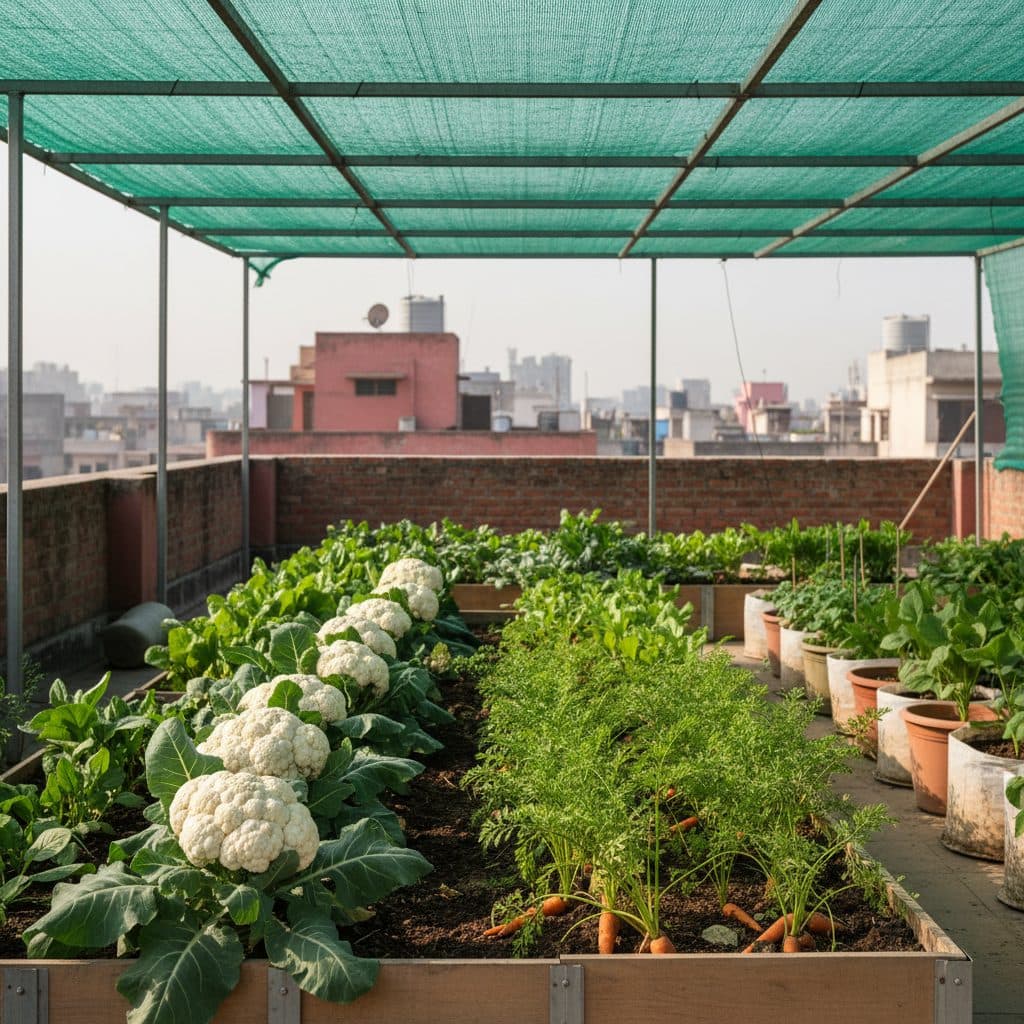
- Install a permanent 50% green agro-shade net frame 2.5 metres above the terrace to protect rooftop plants from 45°C summer heat and dry loo winds.
- Formulate a lightweight, highly porous potting mix with cocopeat, vermicompost, river sand, and neem cake (neem khali).
- Cultivate traditional heat-hardy gourds and okra in summer, shifting to exotic brassicas, root vegetables, and crisp salads in winter.
- Water twice daily during peak summer and elevate grow bags on bricks to ensure drainage during heavy monsoon rains.
Quick answer: Successfully running a terrace garden in Delhi NCR requires managing two extreme growing seasons: an intense 45°C summer with hot dry winds and a crisp, sunny winter. Rooftop gardeners install 50% green shade nets and drip irrigation to protect summer crops like gourds and okra, while taking advantage of mild winter weather to cultivate exceptional harvests of tomatoes, cauliflower, carrots, and leafy greens.
Gardening on a rooftop in the Delhi National Capital Region (NCR), which includes Delhi, Noida, Gurgaon, Ghaziabad, and Faridabad, presents one of the most intense climate tests in urban agriculture. Delhi experiences extreme continental temperature swings, ranging from searing summer heatwaves exceeding 45°C with scorching dry loo winds in May and June, followed by high monsoon humidity in July and August, and dropping to crisp, cool winter nights (5°C to 8°C) in December and January.
Despite these environmental challenges, establishing a terrace garden in Delhi can produce an abundance of organic vegetables, aromatic herbs, and potted fruit trees throughout the year. The concrete roof slab absorbs immense solar heat in summer and radiates warmth during winter days, creating dynamic rooftop microclimates.
By implementing summer shade protection, lightweight soil formulation, and synchronizing your planting calendar with Delhi's two natural growing cycles, you can turn a bare concrete rooftop into a flourishing urban food forest.
Managing Delhi's two distinct growing cycles
Unlike southern Indian cities with mild year-round weather, Delhi operates on two sharply defined cropping seasons:
Season 1: The summer & monsoon cycle (February to September)
- Early Summer (February to March): Sowing of warm-season vegetables begins as winter cold breaks. Sow seeds of bottle gourd (lauki), bitter gourd (karela), ridge gourd (torai), sponge gourd (ghiya torai), pumpkin, okra (bhindi), cluster beans (gawar phali), cowpeas (lobia), cucumber, and watermelon.
- Peak Summer (April to June): Scorching heat (40°C to 46°C). Focus on plant survival. Maintain 50% shade nets, water containers twice daily (early morning and late evening), and harvest heat-loving gourds and okra.
- Monsoon (July to September): High humidity and downpours. Shift to monsoon care: keep drainage in grow bags clear to prevent fungal root rot, following protocols in how to protect plants from heavy rain and fungus on plants in rainy season.
Season 2: The winter garden paradise (October to March)
Winter is the golden season for Delhi terrace gardeners. From mid-October through March, mild sunshine (20°C to 28°C daytime) and cool nights create Mediterranean-like conditions for heavy vegetable production:
- Sowing & Transplanting (September to November): Start seeds and transplant seedlings of cauliflower, cabbage, broccoli, knol khol (kohlrabi), tomatoes, capsicum (bell peppers), green chillies, peas (matar), carrots (gajar), radishes (mooli), beetroot, and turnips (shalgam). Tomatoes, capsicum and chillies are frost-tender. During December-January cold waves, cover them at night with a light cloth or a low plastic tunnel and lift it by mid-morning. Growth and fruit set stall in the fog and resume in February.
- Leafy Greens: Succession sow palak (spinach), methi (fenugreek), bathua, sarson (mustard greens), coriander (dhania), and leaf lettuce every two weeks for non-stop picking.
- Peak Winter Harvests (December to February): Daily harvests of fresh vegetables, leafy greens, and winter herbs.
To see how rooftop gardening differs in moderate southern climates, explore our overview of a terrace garden in Bangalore.
Rooftop protection against 45°C summer heat
Unprotected concrete rooftops in Delhi NCR can reach surface temperatures exceeding 55°C during May and June, cooking roots inside standard pots within hours.
Implement these essential heat-defense strategies:
- Install 50% green agro-shade netting: Erect a sturdy galvanized iron or bamboo frame 2.5 metres above the terrace floor, stretching a UV-stabilised 50% green shade net overhead. Shade netting filters harsh solar radiation, cuts the direct solar load on pots and slab, and breaks the desiccating force of hot loo winds.
- Thermal roof insulation & waterproofing: Paint the exposed concrete slab with reflective white solar-reflective roof paint or lay white ceramic tiles. This reduces rooftop heat absorption and keeps the rooms beneath significantly cooler.
- Double-potting and grouping: Group grow bags closely together so foliage creates a self-shading canopy over container root zones. Place smaller pots inside larger outer planters lined with damp coir to shield roots from direct side-scorch.
- Heavy organic mulching: Cover the surface of every grow bag with a 5 cm layer of dry sugarcane bagasse, crushed dry leaves, or coconut coir mulch to slow evaporation.
Formulating a resilient potting mix for Delhi rooftops
Delhi's extreme weather demands a potting mix that retains moisture during 45°C summer days while remaining free-draining during monsoon downpours:
- 40% washed, expanded cocopeat: Provides a lightweight, water-retentive sponge that keeps moisture available in extreme heat.
- 30% aged vermicompost or well-rotted cow dung manure (gobar ki khaad): Delivers steady organic fertility and beneficial microbes.
- 15% native garden soil (khet ki mitti): Adds mineral weight and clay body to anchor root systems.
- 15% coarse river sand (badarpur) or perlite: Ensures aeration and rapid drainage during monsoon rains.
- Organic amendments per 10-litre container: Mix in 50 g neem cake powder (neem ki khali), 20 g mustard cake powder (sarson ki khali), and 10 g steamed bone meal or rock phosphate. Neem cake deters soil grubs and termites while supplying slow-release nitrogen.
Generate your own continuous supply of rich organic matter on the roof with small space composting without odor.
Container selection, sizing and vertical trellises
Choosing the correct containers ensures plants develop deep, healthy root systems:
- HDPE Grow Bags (200 to 250 GSM): Far superior to terracotta or brittle plastic. They breathe and will not shatter like terracotta, but dark woven bags absorb heat and dry out fast in summer, so group them and shade the pot walls.
- Sizing guide:
- Leafy greens & radishes: 15x15 cm or shallow rectangular grow bags (60x30x15 cm).
- Fruiting vegetables (30x30 cm / 12x12 inch, about 20 litres, as a minimum): for tomatoes, brinjals and capsicum — smaller 10-litre (24x24 cm) bags dry out too fast in a Delhi summer, though they work for single plants of chilli or bhindi.
- Climbing gourds & squashes: 40x40 cm to 50x50 cm bags.
- Fruit trees (lemon, pomegranate, guava, fig): 50-litre to 100-litre heavy-duty tubs.
Vertical Trellising: Vertical growing is essential in Delhi to keep vining gourds off scorching concrete in summer and damp ground in monsoon. Construct sturdy trellises using bamboo poles (baans) and nylon climber netting, training gourds upward to maximize vertical space and airflow.
Irrigation schedules and organic plant nutrition
Water and nutrient management requires seasonal calibration:
In summer, water containers thoroughly twice a day—once early in the morning before 7:00 AM and once in the evening after sunset. Installing an automated micro-drip irrigation system connected to an overhead water tank prevents mid-day dehydration.
In winter, water moderately once every two to three days, checking that the top 3 cm of soil is dry before watering.
Seasonal Feeding Routine:
- Top-dress grow bags once a month with two handfuls of fresh vermicompost and a tablespoon of neem cake.
- Every two weeks during the active winter growing season, apply fermented liquid mustard cake fertiliser (sarson khali liquid diluted 1:20 in water) to provide an immediate burst of nitrogen and potassium for heavy flowering and fruiting.
- Spray foliage every 10 to 14 days with cold-pressed neem oil solution (5 ml neem oil + 2 ml liquid soap per litre of water) to prevent mealybugs, aphids, and whiteflies.