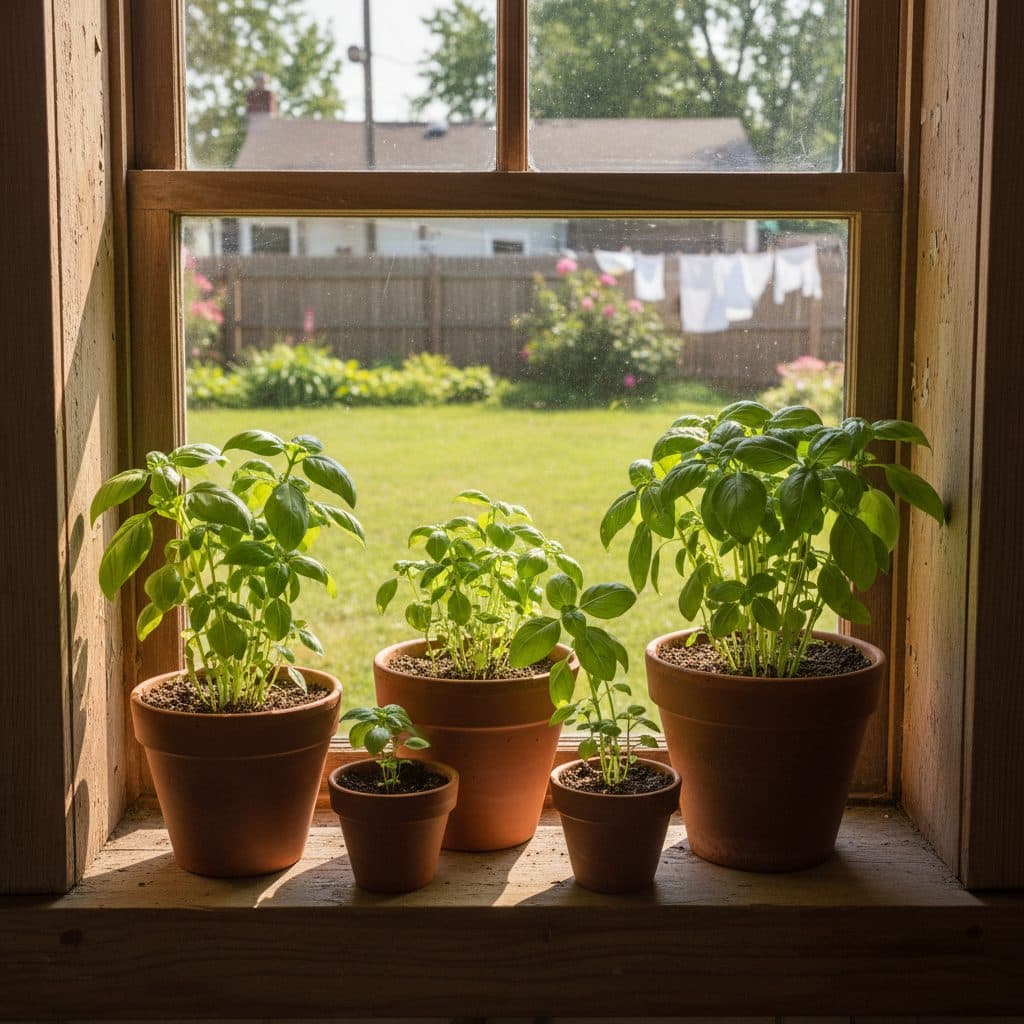
Key takeaways
- Select a south-facing windowsill providing 6-8 hours of direct sunlight daily, or supplement with 10-12 hours of LED grow light.
- Plant basil in 6-8 inch pots with well-draining soil (pH 6.0-7.0) to ensure proper root development and moisture management.
- Maintain consistent soil moisture by watering when the top 1 inch of soil feels dry, avoiding both waterlogging and complete drying out.
- Fertilize every 2-4 weeks with a half-strength liquid fertilizer, such as a 2-1-2 NPK ratio, to support vigorous growth.
- Regularly prune basil by pinching off the top two sets of leaves when plants reach 6-8 inches tall, encouraging bushier growth and preventing flowering.
- Maintain indoor temperatures between 65-75°F (18-24°C) and protect plants from drafts below 50°F to prevent stress and ensure continuous production.
Quick answer: To grow basil indoors year-round, provide 6-8 hours of direct sunlight (or 10-12 hours of LED grow light), plant in well-draining soil in 6-8 inch pots, and maintain consistent moisture and temperatures between 65-75°F. Regular pruning encourages bushy growth and continuous production.
For many US households, fresh basil is a culinary staple, but relying on seasonal outdoor growth or grocery store availability can be limiting. In USDA zone 7, for instance, outdoor basil production typically ceases with the first autumn frost, often around late October. However, with careful planning and consistent care, you can cultivate a thriving basil patch right on your windowsill, providing fragrant leaves year-round. This guide focuses on the practical steps and environmental controls needed to keep basil productive indoors, so you have access to this herb regardless of the outdoor climate.
Bringing basil cultivation indoors offers several advantages, from extending the growing season indefinitely to having immediate access to fresh herbs for cooking. A well-maintained indoor basil plant can yield several ounces of leaves over its lifespan, significantly reducing grocery expenses. We will cover everything from selecting the right variety and ensuring adequate light, to proper watering, feeding, and harvesting techniques, all grounded in practices that work for home growers across the United States.
Choosing the right basil and location
Selecting the appropriate basil variety and an optimal indoor location are the first critical steps for year-round success. Sweet basil (Ocimum basilicum) is a popular choice for indoor growing due to its robust flavor and relatively compact growth habit. Other varieties, like Holy basil (Ocimum tenuiflorum), also thrive indoors, offering distinct aromatic profiles. For sweet basil, look for cultivars such as ‘Genovese’ or ‘Dwarf Greek’ which are well-suited for container life. A mature plant can reach 12-24 inches in height, so consider the space available on your windowsill. For instance, a ‘Genovese’ plant can easily fill a 10-inch pot and stand 18 inches tall within 3-4 months of growth.
Light requirements for indoor basil
Basil is a sun-loving plant, requiring a minimum of 6-8 hours of direct sunlight daily to flourish. A south-facing windowsill in most US regions, such as those found in Arizona or Georgia, typically provides the most intense natural light. However, during shorter winter days, especially in northern states like Michigan or New York, natural light alone is often insufficient. Supplementing with artificial light is crucial; a full-spectrum LED grow light providing 10-12 hours of light per day can compensate for low natural light. Position the light 6-12 inches above the plant canopy to ensure adequate intensity, especially for seedlings which need about 14-16 hours of light for strong initial growth. This close proximity ensures the plant receives the necessary photosynthetic photon flux density (PPFD) for vigorous development, typically around 200-300 µmol/m²/s for basil. If a windowsill genuinely cannot supply enough light, a sheet of white board or a foil-faced panel propped behind the plant bounces light back onto its shaded side at no cost. Maintaining consistent light exposure is vital for preventing leggy growth and promoting dense foliage.
- Sweet basil (Ocimum basilicum) is a common and productive choice.
- Holy basil (Ocimum tenuiflorum) provides a different flavor profile and also grows well indoors.
- Aim for 6-8 hours of direct sunlight, or 10-12 hours with a grow light.
- A south-facing window is ideal for natural light exposure.
- Position LED grow lights 6-12 inches above the plant canopy.
Potting and soil considerations
Proper potting and soil choice are fundamental to the health and productivity of your indoor basil. Begin with a pot that is at least 6 inches in diameter for a single plant, ideally 8-10 inches for more established growth or multiple plants. Ensure the container has drainage holes to prevent waterlogging, which can lead to root rot. Terra cotta pots are often favored as they allow for better air circulation to the roots and help prevent overwatering, though plastic pots work well too if managed carefully. Move a plant up a pot size if roots start coming out of the drainage holes, though most indoor basil is spent before it gets that far. Indoor basil is still an annual: even in a large pot it usually turns woody and slows sharply after a few months, so start a fresh sowing every couple of months and treat each plant as a short-run crop.
Choosing the right potting mix
Basil thrives in a well-draining, fertile potting mix with a pH between 6.0 and 7.0. A standard organic potting mix designed for vegetables or herbs is generally suitable. Avoid heavy garden soil, as it compacts easily in containers and can restrict root development. Incorporating perlite or vermiculite at a 3:1 ratio (3 parts potting mix to 1 part amendment) can further improve drainage and aeration. Basil can also be grown hydroponically, but for windowsill growing a soil-based approach is simpler and more forgiving for beginners. Refresh the mix for each new sowing; potting mix slumps and compacts over time, and old mix drains and breathes noticeably worse than fresh.
- Use pots with drainage holes, at least 6-8 inches in diameter.
- Terra cotta pots offer good aeration and moisture regulation.
- Opt for a well-draining, fertile potting mix with a pH of 6.0-7.0.
- Amend potting mix with perlite or vermiculite at a 3:1 ratio for better drainage.
- Start a fresh sowing every couple of months rather than nursing one plant through the year.
Watering and feeding your indoor basil
Consistent watering and appropriate feeding are essential for maintaining a healthy, productive basil plant indoors. Basil prefers consistently moist soil but absolutely detests being waterlogged. A good rule of thumb is to water when the top 1 inch of soil feels dry to the touch. Depending on your pot size, ambient temperature, and humidity, this could mean watering every 2-3 days in warmer, drier conditions, such as those found in Nevada homes with low humidity, or once a week in cooler, more humid environments like coastal Oregon. A 6-inch pot might need water every 2 days, while a 10-inch pot could go 3-4 days between waterings. Always water thoroughly until you see water draining from the bottom of the pot, then discard any excess water from the saucer within 30 minutes to prevent root issues.
Nutrient management for sustained growth
Since your basil is confined to a pot, it will eventually deplete the nutrients in the potting mix. To ensure continuous, vigorous growth, especially after the first 4-6 weeks, regular feeding is necessary. Use a balanced liquid fertilizer, such as one with an NPK ratio of 2-1-2 or 3-1-2, diluted to half-strength. Apply this fertilizer every 2-4 weeks during periods of active growth. For instance, if your plant is producing new leaves rapidly, fertilize every 2 weeks. Reduce feeding frequency if growth slows, perhaps to once a month through the short days of winter when the plant is growing more slowly. Always dilute liquid fertilizers to half-strength, for example, mixing 1 teaspoon of concentrate per gallon of water, to avoid chemical burn to delicate roots. Consider the practices outlined in starting a herb garden for general herb care principles.
- Water when the top 1 inch of soil is dry, typically every 2-7 days.
- Ensure water drains from the pot bottom; remove excess from the saucer.
- Begin fertilizing 4-6 weeks after planting.
- Use a half-strength liquid fertilizer with a 2-1-2 or 3-1-2 NPK ratio.
- Apply fertilizer every 2-4 weeks during active growth periods.
Pruning and harvesting for continuous yield
Regular pruning and proper harvesting techniques encourage bushy growth and extend the life of your indoor basil plant. Without pruning, basil plants tend to grow tall and leggy, eventually flowering and producing seeds, which signals the end of their productive leafy phase. Begin pinching back your basil when the plant reaches 6-8 inches in height and has developed 3-4 sets of true leaves. This initial pruning is what turns a single leggy stem into a branching plant with several harvestable tips. Pinch off the top two sets of leaves just above a node (where two leaves emerge from the main stem). This encourages the plant to branch out: two new stems break from the leaf axils just below the cut, and each of those can be pinched again in turn.
Harvesting methods and pest management
When harvesting, aim to take no more than 30-50% of the plant’s foliage at any one time to avoid stressing it. You can harvest individual leaves as needed, or prune entire stems. For larger harvests, cut stems just above a leaf node, leaving at least 2-3 sets of leaves on the main stem to ensure continued growth. Regular harvesting, every 1-2 weeks, stimulates new leaf production. If you see flower buds forming, pinch them off immediately to redirect the plant’s energy into leaf production. Indoor environments, while protected, are not immune to pests. Keep an eye out for common houseplant pests like aphids or spider mites. If detected, a gentle spray of insecticidal soap or neem oil, applied weekly for 2-3 weeks, can help manage them. Mix 1-2 tablespoons of neem oil concentrate per gallon of water for an effective solution. Maintaining good air circulation, perhaps with a small fan running for a few hours a day, also discourages pests and helps leaves dry, which lowers the risk of foliar disease.
- Start pruning when plants are 6-8 inches tall with 3-4 sets of leaves.
- Pinch off the top two sets of leaves above a node to encourage branching.
- Harvest no more than 30-50% of the plant at once to prevent stress.
- Harvest regularly, every 1-2 weeks, to stimulate new growth.
- Pinch off any flower buds immediately to prolong leaf production.
Comparison of Indoor vs. Outdoor Basil Growing
Feature | Indoor Basil (Windowsill) | Outdoor Basil (Garden) |
|---|---|---|
Light Source | Natural (south-facing window) + LED grow light (10-12 hours) | Direct sunlight (6-8 hours) |
Temperature Range | Consistent 65-75°F (18-24°C) | Variable, 60-80°F (15-27°C) during growing season |
Seasonality | Year-round production | Seasonal, typically late spring to first frost (e.g., May-October in USDA zone 6) |
Pest Control | Easier to monitor and manage individual plants | Requires broader garden pest management strategies |
Watering | More frequent, smaller amounts (every 2-3 days) | Less frequent, heavier watering (every 5-7 days) |
Container Size | 6-10 inch pots | Open ground or larger containers (12+ inches) |
Optimal Temperature: Maintain indoor temperatures between 65-75°F (18-24°C) for best basil growth, avoiding drops below 50°F.
Light Duration: Basil requires 10-12 hours of supplemental LED light daily if natural light is insufficient, especially in winter months.
Harvest Yield: Regular pruning and harvesting of 30-50% of the plant’s foliage every 1-2 weeks can significantly increase overall yield.
Frequently asked questions
How much light does basil need indoors?
Indoor basil needs at least 6-8 hours of direct sunlight daily from a south-facing window. If natural light is limited, supplement with a full-spectrum LED grow light for 10-12 hours each day, positioned 6-12 inches above the plant.
What is the best temperature for indoor basil?
Basil thrives in consistent indoor temperatures between 65-75°F (18-24°C). It is sensitive to cold, so protect plants from drafts and temperatures dropping below 50°F, which can cause leaf damage.
How often should I water my windowsill basil?
Water your basil when the top 1 inch of soil feels dry to the touch. This typically means watering every 2-3 days, but can vary based on humidity and pot size. Ensure good drainage to prevent root rot.
When should I start fertilizing my indoor basil?
Begin fertilizing your indoor basil plant about 4-6 weeks after planting or transplanting. Use a half-strength liquid fertilizer with a balanced NPK ratio, like 2-1-2, every 2-4 weeks during its active growing season.
How do I keep my basil plant from flowering indoors?
To prevent flowering and encourage leaf production, regularly pinch off any flower buds as soon as they appear. Also, prune the plant by pinching back the top two sets of leaves when it reaches 6-8 inches tall, which promotes bushier growth.
References
- Growing Kratky Basil in Trombe Wall Cavity: Year-Round Thermal Effects Overview (2024). Growing Kratky Basil in Trombe Wall Cavity: Year-Round Thermal Effects Overview.
- Onset of Estrus in Dairy Cows Maintained Indoors Year-Round.
- USDA Natural Resources Conservation Service (2024). USDA Natural Resources Conservation Service.