secondary
Nanking cherry
Prunus tomentosa
International hardiness
- USDA 2-7
- RHS H7
- AU: Cool temperate
Where it grows — regional guide
| Zones / rating | Regional notes |
|---|---|
USDA 2-7 | Exceptional cold hardiness across the northern Plains, Upper Midwest, and mountain West; plant two or more bushes for reliable cross-pollination. |
| Zones / rating | Regional notes |
|---|---|
H7 (below -20C) | Grows well in sunny, free-draining positions across Britain, though early spring blossoms require protection from damp frosts. |
| Zones / rating | Regional notes |
|---|---|
Cool temperate | Suitable only for cold, elevated tablelands in Victoria, New South Wales, and Tasmania with high winter chilling hours. |
| Zones / rating | Regional notes |
|---|---|
USDA 2-7 (USDA scale) Canada uses its own zone system; Canadian zones run roughly one lower than USDA. | A proven favorite across the Canadian prairies from Alberta to Manitoba; withstands Zone 2 winters with zero tip dieback. |
| Zones / rating | Regional notes |
|---|---|
No region-specific data yet | No region-specific data yet |
Nanking cherry (Prunus tomentosa), also known as the Manchu cherry or Chinese bush cherry, is a compact, multi-stemmed deciduous shrub in the rose family (Rosaceae). Indigenous to northern and western China, Tibet, and Korea, this resilient woody perennial has extraordinary cold-hardiness and heavy annual crops of tart-sweet scarlet fruit. Unlike traditional orchard cherries like the tree-form sour cherry, Nanking cherry naturally adopts a bushy, multi-stemmed architecture that simplifies pruning, netting, and harvesting on homestead sites.
In an agroforestry design or permaculture planting, Nanking cherry fills several functional niches simultaneously. Positioned along outer perimeter lines, its dense twiggy growth creates an effective shelterbelt and windbreak, slowing drying winter gales and trapping drifting snow to insulate neighboring soil beds. In midsummer, its heavy fruit drop and annual leaf fall generate nutrient-rich organic mulch that enriches surrounding perennial understory zones.
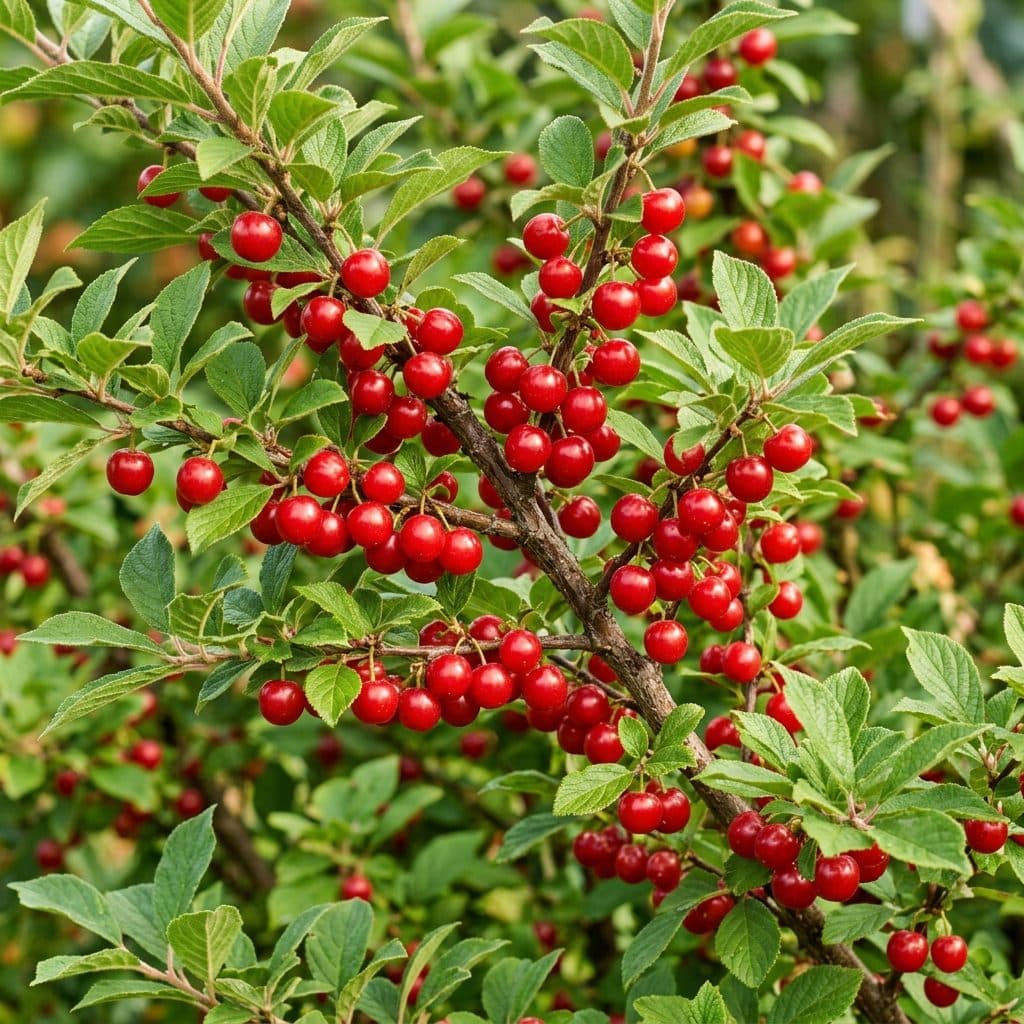
The shrub produces clouds of fragrant white to pale pink blossoms in early spring, followed closely by dense clusters of jewel-like red cherries that cling tightly to the stems. Because it bears fruit at a young age and requires minimal chemical intervention compared to tree stone fruits, it is a dependable fruit staple for cold-climate growers.
Growing Nanking cherry
Nanking cherry is one of the hardiest stone fruit species in cultivation, withstanding winter temperatures down to -40 °C (-40 °F) when fully dormant, making it suitable for USDA Hardiness Zones 2 through 7. It requires 800 to 1,000 hours of winter chilling below 7 °C (45 °F) to satisfy dormancy requirements. The species struggles in warm, humid regions such as the American Deep South, where high summer temperatures and chronic humidity foster fungal diseases and prevent necessary winter dormancy.
The shrub adapts to a wide variety of soil textures, including coarse sands, fertile loams, and rocky soils, provided drainage is unimpeded. The ideal soil pH ranges between 6.0 and 7.5. Wet feet and saturated soils are fatal to the root system, rapidly inducing root rot and fungal dieback. Full sun is necessary for vigorous growth, abundant blossom set, and high fruit sugar accumulation; while bushes survive in light partial shade, their flowering becomes sparse and fruiting drops significantly.
Cross-pollination is essential for dependable crops. Although occasionally described as partially self-fertile, solitary bushes typically set only a scattering of fruit. For full yields, plant at least two genetically distinct seedlings or two separate cultivars within 3 to 6 m (10 to 20 ft) of each other. Native solitary bees and honeybees transfer pollen across the bushes during early spring bloom.
Space shrubs 2 to 2.5 m (6.5 to 8 ft) apart when planting them as standalone specimen bushes in an orchard or forest garden. When establishing a continuous, dense fruiting hedge or shelterbelt, reduce spacing to 1.2 to 1.5 m (4 to 5 ft) between plants within the row. Plants reach 2 to 3 m (6.5 to 10 ft) in height and spread at maturity.
Propagate Nanking cherry from seed, softwood cuttings taken in early summer, or semi-hardwood cuttings. Seeds require 90 to 120 days of moist cold stratification at 2 to 4 °C (35 to 40 °F) to break embryo dormancy before spring sowing. Transplant bare-root or potted nursery stock in early spring before buds begin to swell.
Pruning should be performed in late winter while shrubs are dormant. Nanking cherry bears fruit primarily on short spurs along two- to three-year-old wood. To maintain bush vigor and prevent the canopy from becoming an impenetrable tangle of weak twigs, practice renewal pruning: remove one-third of the oldest, thickest canes near ground level every three to four years, opening the center to light and stimulating fresh, vigorous fruiting shoots.
Harvest and uses
Nanking cherry bushes are exceptionally precocious, often producing their first light crop in their second or third year from seed. Mature bushes yield between 5 and 10 kg (11 and 22 lb) of fruit annually. The cherries ripen in early to midsummer, typically from late June through July depending on local latitude and spring temperatures.
The fruit is a small, round drupe measuring 1 to 1.5 cm (0.4 to 0.6 in) in diameter, featuring thin, translucent scarlet skin and juicy, red to pink flesh surrounding a small central pit. The cherries are borne on very short stems (pedicels), causing them to nestle directly against the woody branches. Unlike standard tree cherries, which are picked by their long stems, Nanking cherries are gently pulled directly from the twig. Harvest when the fruit turns completely bright red and yields slightly to thumb pressure.
Because of their thin, delicate skin, fresh Nanking cherries have a short shelf life, holding for only two to three days at room temperature or up to a week under refrigeration at 0 to 2 °C (32 to 36 °F). They are delicious eaten fresh directly from the bush, offering a refreshing sweet-tart flavor. Homesteaders process surplus fruit into clear jellies, tart jams, syrups, and fruit leathers. The fruit also presses into rich cherry juice and ferments into artisan fruit wines and cordials.
Identifying Nanking cherry
Nanking cherry is distinguished by its compact shrubby growth, pubescent leaves, and sessile fruit:
- Growth habit: Upright, rounded, dense deciduous shrub growing 2 to 3 m (6.5 to 10 ft) tall, with dark reddish-brown to black bark that exfoliates in fine papery curls on older trunks.
- Foliage: Alternate, simple, obovate to elliptic leaves measuring 5 to 7 cm (2 to 2.8 in) long and 2.5 to 3.5 cm (1 to 1.4 in) wide, with serrated margins and acute tips. The species is characterized by dense, soft, woolly pubescence (tomentum) on the lower leaf surface, leaf stalks, and young twigs.
- Flowers: Fragrant, five-petaled blossoms measuring 1.5 to 2 cm (0.6 to 0.8 in) across, emerging singly or in pairs in early spring before or with the leaves. Petals are white to blush-pink with reddish-brown sepals and calyx tubes.
- Fruit: Bright scarlet-red, globose drupes measuring 1 to 1.5 cm (0.4 to 0.6 in) in diameter, sitting almost stalkless against the stems, containing a single smooth, hard endocarp pit.
Nanking cherry is distinguished from tree cherries such as sweet cherry (Prunus avium) and sour cherry (Prunus cerasus) by its multi-stemmed shrub form, velvety tomentose leaf undersides, and cherries held on extremely short pedicels against the bark.
Cautions
Growers should consider the following health, wildlife, and disease factors:
- Cyanogenic compounds in pits and foliage: Like all Prunus species, the seeds contained within the hard central pits, as well as wilted leaves and young twigs, contain amygdalin, a cyanogenic glycoside that breaks down into toxic hydrogen cyanide when crushed or ingested. While the ripe fruit flesh is completely wholesome and safe to eat, do not crack or consume the pits, and prevent livestock from browsing on wilted pruning debris.
- Wildlife and rodent damage: The thin, sweet bark is highly attractive to rabbits and meadow voles during winter, which can completely girdle stems beneath the snow line. Protect the base of young shrubs with wire hardware cloth cylinders. Netting may be required in midsummer to prevent wild birds from stripping ripening fruit.
- Fungal and bacterial diseases: The species is susceptible to brown rot (Monilinia fructicola), which infects spring blossoms and causes fruit to rot on the branch during wet weather. Prune bushes to ensure open airflow, avoid overhead watering, and remove mummified fruit over winter.
- Regulatory note: The plant is regulated in some jurisdictions; check your local list before planting.
Sources
- Royal Botanic Gardens, Kew. Prunus tomentosa Thunb. Plants of the World Online.
- NC State Extension Plant Toolbox. Prunus tomentosa
- University of Minnesota Extension. Growing stone fruits in the home garden
- USDA NRCS Plant Guide. Nanking Cherry (Prunus tomentosa)
- Missouri Botanical Garden. Prunus tomentosa