Key takeaways
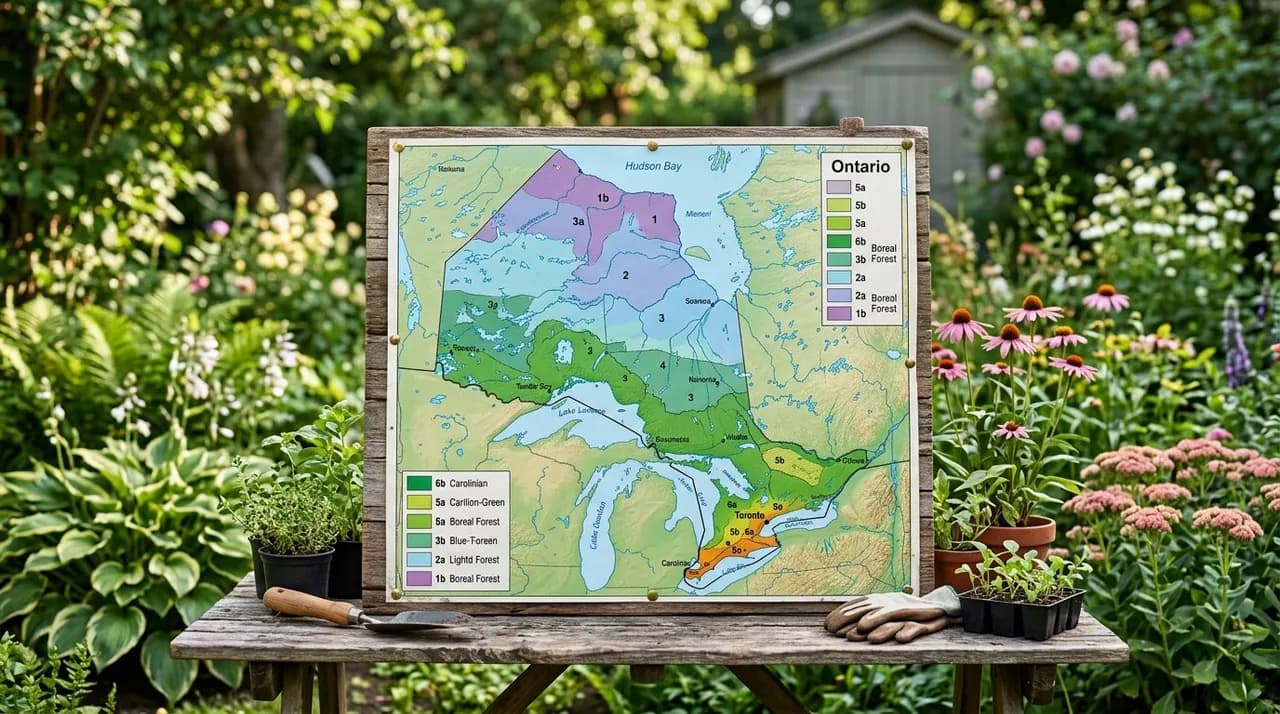
- Ontario spans hardiness zones from Zone 1 on the Hudson Bay coast to Zone 7b in the Carolinian zone around Lake Erie.
- Canada's Plant Hardiness system factors in minimum winter temperatures, frost-free days, rainfall, wind speed, and snow cover.
- Toronto and the Golden Horseshoe sit in moderated Zone 6a to 6b, with last spring frosts typically occurring in mid-May.
- Ottawa and Eastern Ontario reside in Zone 5a to 5b, requiring cold-hardy perennials and frost protection until late May.
- Northern Ontario (Zones 1 to 5a) has a compact 75-to-125 day growing season demanding cold frames and quick-maturing cultivars.
Quick answer: Ontario spans hardiness zones from Zone 7 in the southern Great Lakes basin to Zone 1 on the northern Hudson Bay coast. Toronto is in Zone 6b, Ottawa is in Zone 5a, and Northern Ontario ranges from Zone 5a in Sudbury down to Zone 1 in the far north. Understanding your specific zone and local frost dates ensures successful vegetable scheduling and perennial plant survival.
Understanding Ontario planting zones determines what you can grow, when to sow seeds, and which perennial fruit trees will survive winter. Because the province spans over one million square kilometres, stretching from the shores of Lake Erie north to Hudson Bay, growing conditions vary dramatically across the region.
A gardener tending a vineyard in the Carolinian climate of Windsor or Niagara enjoys a long 180-day frost-free season capable of ripening peaches, sweet cherries, and long-season melons. Meanwhile, a grower in Sudbury, Thunder Bay, or Timmins must navigate a compact 75-to-125 day season with winter temperatures plunging below -35°C (-31°F), relying on cold frames and fast-maturing crops.
Aligning your garden calendar with your regional plant hardiness zone prevents crop failure. Understanding Canada's hardiness rating system, regional frost schedules, and local Great Lakes microclimates helps plan the growing season from spring thaw to autumn harvest.
Canadian hardiness zones vs USDA ratings explained
When shopping for seeds, perennials, and nursery stock in Ontario, gardeners frequently encounter two different zone classification systems:
- Natural Resources Canada (NRCan) Model: Canada's official Plant Hardiness Zone map uses a comprehensive formula developed by Canadian forestry and agricultural scientists. It evaluates seven distinct climate variables: mean minimum temperature of the coldest month, frost-free period, rainfall from June to November, maximum temperature of the warmest month, winter rainfall, maximum wind gust speed, and mean maximum snow depth. Canadian zones range from 0 (coldest) to 9 (warmest), further subdivided into 'a' and 'b' subzones (e.g., Zone 5a is slightly colder than Zone 5b).
- USDA Hardiness System: The United States Department of Agriculture system bases its zones strictly on a single metric: the average annual extreme minimum winter temperature.
Because the Canadian formula accounts for winter snow insulation, wind desiccation, and summer heat units, a Canadian Zone 5a map location is often roughly half a zone to a full zone colder on winter minimums than the same number on a USDA map. Most plant tags in Canadian garden centres reflect the Canadian NRCan system, but imported American seed packets and plant labels use USDA numbers. Always verify which system a nursery label references before purchasing cold-sensitive fruit trees.
To plan your indoor seed starting schedule around these hardiness dates, consult our comprehensive guide on when to start seeds indoors canada.
Regional breakdown of Ontario gardening zones
Ontario is divided into distinct geographic and climatic growing regions:
1. Southwestern Ontario and Carolinian zone (zones 6b to 7b)
Covering Windsor, Essex County, Chatham-Kent, Leamington, and the Niagara Peninsula, this is Canada's southernmost agricultural belt.
- Climate characteristics: Moderated by Lake Erie and Lake Ontario, this region experiences the longest growing season in the province, with 170 to 190 frost-free days and hot, humid summers.
- Frost calendar: Average last spring frost occurs between April 25 and May 5; first autumn frost arrives between October 20 and November 5.
- Top crops: Tender orchard fruits (peaches, nectarines, apricots, European and Asian plums), sweet cherries, tender table and wine grapes, sweet potatoes, eggplants, and long-season winter squash.
2. Greater Toronto Area (GTA) and Golden Horseshoe (zones 6a to 6b)
This region covers Toronto, Mississauga, Oakville, Burlington, and Hamilton.
- Climate characteristics: Urban heat island effects combined with the deep thermal mass of Lake Ontario keep urban and lakefront microclimates in solid Zone 6b, while suburban areas 15 km inland sit in Zone 6a.
- Frost calendar: Average last spring frost occurs May 5 to May 15; first autumn frost arrives October 10 to October 20.
- Top crops: Standard orchard apples and pears, hybrid cherries, tomatoes, peppers, brassicas, and berries.
3. Eastern Ontario and National Capital Region (zones 5a to 5b)
This region covers Ottawa, Kingston, Brockville, Cornwall, and the Ottawa Valley.
- Climate characteristics: While Kingston benefits from Lake Ontario's moderating influence (Zone 5b), inland areas and the Ottawa Valley (Zone 5a) experience sharp continental winters with temperatures dropping to -30°C (-22°F). However, consistent winter snowpack provides natural insulation for perennial root crowns.
- Frost calendar: Average last spring frost occurs May 15 to May 25; first autumn frost arrives September 20 to October 1.
- Top crops: Cold-hardy apples (such as 'Honeycrisp', 'McIntosh', 'Cortland'), pears, cold-hardy plums, raspberries, garlic, and all standard garden vegetables.
4. Northeastern Ontario (zones 4b to 5a: Sudbury, North Bay, Sault Ste. Marie)
- Climate characteristics: Growing season: 100 to 125 frost-free days. Thinner soils over the Canadian Shield and cold winters.
- Frost calendar: Average last spring frost occurs late May; first autumn frost arrives mid to late September.
- Top crops: Cold-hardy greens, brassicas, root vegetables, short-season sweet corn, and early-ripening berries. Review our guide on cold-hardy fruit and nut trees for zones 4 to 6.
5. Far North and Northwestern Ontario (zones 1 to 3b: Thunder Bay, Kenora, Timmins, Kapuskasing and Hudson Bay Lowlands)
- Climate characteristics: Severe continental subarctic and boreal climates with winter lows between -35°C and -45°C (-31°F to -49°F). The growing season is brief, lasting 75 to 100 frost-free days (fewer along the Hudson Bay coast).
- Frost calendar: Average last spring frost occurs early June; first autumn frost arrives late August to early September.
- Top crops: Short-season root vegetables (carrots, beets, potatoes, rutabagas), cold-hardy brassicas, leafy greens, peas, bush beans, and super-hardy native berries (saskatoon berries, lingonberries, sea buckthorn — note: non-native, suckers aggressively; keep contained or plant native buffaloberry, Shepherdia argentea, as an alternative). Season extension (cold frames, row covers, high tunnels) is essential.
Great Lakes microclimates and backyard thermal zones
While broad provincial maps provide a general framework, local topography and water bodies create powerful microclimates that shift your effective planting zone by a full half-zone.
- The Great Lakes Buffering Effect: Large bodies of water heat up and cool down much slower than surrounding landmasses. In spring, cold lake water delays early bud break, protecting fruit orchards from devastating late spring radiation frosts. In autumn, warm lake water delays the first freezing temperatures by several weeks. Properties within 5 km of Lake Ontario, Lake Erie, or Lake Huron experience milder winters and later autumns than properties 20 km inland.
- Urban Heat Islands: Dense concrete, asphalt, and brick buildings absorb solar radiation during daylight and radiate warmth overnight. Downtown Toronto or Hamilton backyards often stay 2°C to 3°C warmer than rural surrounding valleys.
- Elevation and Cold Air Drainage: Cold air is dense and flows downhill like water, pooling in low valley bottoms and depressions (frost pockets). South-facing slopes warm up earlier in spring and give cold night air a downhill drainage path away from plants, which helps avoid the late frost pockets that settle at the bottom of a slope.
To protect vulnerable spring blossoms and tender autumn vegetables when unexpected freezing air rolls in, see our guide on how to protect plants from frost.
Selecting fruit trees and perennials for Ontario winters
When choosing perennial plants, match the variety to your regional winter minimums instead of planting at the absolute limit of your zone.
- Orchard Fruits: For Zones 5 and 6, standard rootstocks and classic cultivars thrive. For Zones 3 and 4, choose ultra-hardy Russian and Canadian prairie breeding lines, such as University of Saskatchewan dwarf sour cherries ('Carmine Jewel', 'Romeo', 'Juliet') and cold-hardy apples ('Goodland', 'Norland', 'Battleford').
- Nitrogen-Fixing Trees and Shrubs: Cold-climate food forest systems benefit from integrating resilient nitrogen-fixing species. Explore species selections in our guide to cold-hardy nitrogen fixers for zones 2 to 6.
- Overwintering Perennial Roots: In cold zones with fluctuating snow cover, freeze-thaw cycles heave shallow roots out of the soil. Apply a 10 cm layer of clean straw, shredded leaves, or arborist woodchips over perennial beds once the top 2 cm of ground freezes in late November.
Extending the short Canadian season
In Central and Northern Ontario, season extension methods help protect crops in short summers:
- Cold Frames and Row Covers: Heavyweight spun-bond floating row covers (agribon) or low plastic polytunnels raise daytime temperatures by 3°C to 6°C and protect young seedlings from light spring frosts down to -2°C (28°F).
- Raised Beds for Rapid Spring Warming: Raised timber beds filled with dark, compost-rich soil drain excess meltwater quickly and warm up 10 to 14 days earlier in spring than flat, compacted in-ground clay.
- Succession Sowing: Maximize every week of the summer by following spring radishes and spinach with warm-season bush beans, followed by autumn brassicas. Learn effective scheduling with our guide to succession planting for continuous harvest.
Understanding your local Ontario hardiness zone helps you choose suitable varieties, schedule planting dates accurately, and maintain steady harvests through the growing season.