secondary
Pawpaw tree
Asimina triloba
International hardiness
- USDA 5-9
- RHS H5
- AU: Cool temperate, Warm temperate
Where it grows — regional guide
| Zones / rating | Regional notes |
|---|---|
USDA 5-9 | Native to rich river valleys across eastern North America (USDA Zones 5 to 9); requires cross-pollination by flies or hand-pollination for dependable fruit set. |
| Zones / rating | Regional notes |
|---|---|
H5 (-15 to -10C) | Hardy throughout southern and central Britain rated RHS H5; plant in sheltered, warm microclimates to ensure sufficient summer heat to ripen late-autumn fruit. |
| Zones / rating | Regional notes |
|---|---|
Cool temperate, Warm temperate | No region-specific data yet |
| Zones / rating | Regional notes |
|---|---|
USDA 5-9 (USDA scale) Canada uses its own zone system; Canadian zones run roughly one lower than USDA. | Native to the Carolinian zone of southern Ontario; thrives in deep fertile bottomlands; protect young saplings from harsh winds during initial establishment. |
| Zones / rating | Regional notes |
|---|---|
No region-specific data yet | No region-specific data yet |
Pawpaw tree (Asimina triloba), commonly called American custard apple, Kentucky banana, or Hoosier banana, is a deciduous fruit tree in the custard apple family (Annonaceae). While nearly all other Annonaceae are restricted to tropical rainforests, Asimina triloba adapted to temperate North America, ranging natively from southern Ontario through the eastern and central United States to northern Florida and Texas. The tree yields the largest indigenous edible fruit on the continent: an aromatic, oblong berry boasting soft, custard-like pulp that bursts with tropical flavours of banana, mango, and pineapple.
Within temperate permaculture orchards and syntropic food forests, Asimina triloba occupies a valuable niche as a mid-storey fruit tree. Its large, drooping leaves evoke a lush appearance while functioning as an efficient solar collector beneath orchard standards like apple. The tree is naturally resistant to many mammalian herbivores due to insecticidal acetogenins in its twigs. However, successful production requires specific pollination strategies and strict food-safety protocols regarding its toxic seeds.
Growing pawpaw tree
Asimina triloba thrives in humid temperate continental and maritime climates, performing reliably within USDA Zones 5 through 9 and rated RHS H5. When dormant during winter, mature trees endure cold down to -25 °C (-13 °F) without injury. The tree requires 400 to 1,000 chill hours below 7 °C (45 °F) to satisfy dormancy, followed by a warm, frost-free season of 140 to 160 days to ripen fruit. Light requirements shift with age: first- and second-year saplings suffer severe sunburn under direct sunlight and require 50 percent shade. Once mature (over 1 m (3.3 ft) tall), pawpaws need full sun to produce heavy fruit crops.
Soil requirements mirror native river valleys. Pawpaw demands deep, friable, fertile alluvial loams rich in organic matter, with an acidic to neutral pH of 5.5 to 7.0. While the species requires consistent moisture throughout fruit sizing, soil must be well-drained; waterlogged clay leads to root asphyxiation. Pawpaw develops a fragile, deep taproot early, making bare-root transplants difficult to establish. Always plant container-grown stock to preserve the root system.
Pollination is the primary hurdle in cultivation. Pawpaw blossoms are protogynous: the female stigma ceases receptivity before male anthers release pollen, preventing self-fertilisation. Planting at least two genetically distinct cultivars or unrelated seedlings is mandatory for cross-pollination. Furthermore, flowers are not pollinated by bees; they emit a faint carrion scent that attracts sap beetles and blowflies. In home gardens where fly numbers are modest, hand-pollination using an artist's paintbrush—transferring pollen to receptive green stigmas—dramatically increases fruit set.
Propagation is achieved through stratified seed or grafting. Seeds are recalcitrant and perish if dried out. Store clean seeds in moist peat moss at 2 to 5 °C (36 to 41 °F) for 90 to 120 days before spring sowing. To ensure fruit quality and early bearing, graft named cultivars (such as 'Shenandoah', 'Susquehanna', and 'KSU-Atwood') onto seedling rootstocks. Seedlings require five to seven years to produce fruit, whereas grafted trees bear in three to four years. Space trees 3 to 4 m (10 to 13 ft) apart.
Harvest and uses
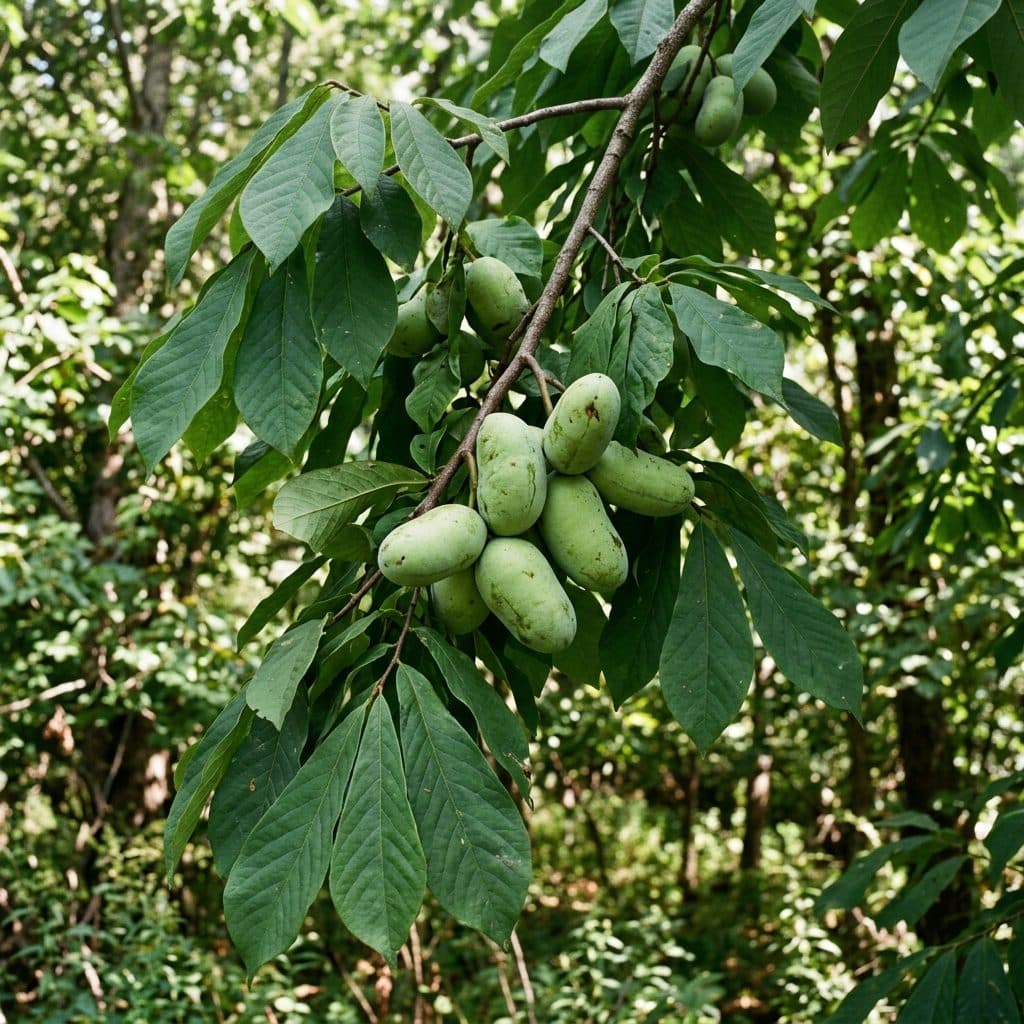
Pawpaw fruit ripens from late summer to mid-autumn. The fruit is an oblong berry measuring 7 to 15 cm (2.8 to 6 in) long and weighing 150 to 450 g (5.3 to 16 oz), borne singly or in clusters of two to five.
Determining ripeness relies on touch and aroma. The fruit peel remains yellowish-green, often developing brown freckles like a ripe banana. Ripe pawpaws yield softly to thumb pressure and release a powerful tropical aroma. Fruit that drops onto grass or detaches with the slightest upward touch is fully ripe. Never pick hard green fruit, as it will not ripen properly.
To eat, cut the fruit in half and scoop out the luscious custard flesh with a spoon, spitting out the large seeds. The pulp is rich, creamy, and sweet, possessing a tropical flavour reminiscent of banana, mango, vanilla custard, and melon. Pawpaw is eaten fresh, churned into ice cream, blended into custards, or baked into puddings. Because the fruit bruises easily, it has a short shelf life of two to three days at room temperature, though whole fruit keeps for a week in refrigeration. Extracted pulp freezes exceptionally well. A mature grafted tree yields 15 to 30 kg (33 to 66 lb) of fruit annually.
Identifying pawpaw tree
Asimina triloba is distinguished by several botanical features:
- Form and bark: A small deciduous tree or multi-stemmed shrub reaching 5 to 10 m (16 to 33 ft) in height. In full sun, it develops a symmetrical pyramidal crown; in shade, it grows loose, sending up root suckers that form clonal thickets ("pawpaw patches"). The bark is smooth, thin, light greyish-brown, with prominent lenticels.
- Leaves: Alternate, simple, obovate, drooping downward along horizontal branches, measuring 15 to 30 cm (6 to 12 in) long and 8 to 15 cm (3 to 6 in) wide. Margins are entire and the apex is short-pointed. Foliage flushes bright green, turning clear golden-yellow in autumn. Crushed leaves and bruised twigs emit a distinct aroma reminiscent of green bell peppers.
- Flowers: Nodding, solitary, bell-shaped blossoms measuring 2.5 to 5 cm (1 to 2 in) across, appearing along bare stems in mid-spring. Each flower possesses three small green sepals and six fleshy, dark maroon petals arranged in two whorls.
- Fruit: Large, oblong berries, occurring singly or in clusters. The skin is pale green to yellowish, freckled with brown spots at maturity. The interior consists of creamy yellow custard pulp enclosing two rows of 8 to 14 large, flattened, dark brown seeds.
The species is distinguished from native magnolias by its alternate leaves and dark, velvety vegetative buds that resemble tiny paintbrushes.
Cautions
Growers and foragers must observe critical toxicological cautions regarding Asimina triloba:
- Neurotoxic annonacin and acetogenins: Pawpaw seeds, bark, twigs, leaves, and unripe fruit skin contain high concentrations of annonacin and related polyketide acetogenins. These compounds are potent mitochondrial complex I inhibitors that act as neurotoxins. Chronic consumption of annonacin in related Annonaceae is clinically linked to neurodegenerative tauopathies and atypical parkinsonism. While ripe fruit pulp contains low levels and is safe for normal dietary consumption, seeds and peel must never be ingested. Chewing or swallowing crushed seeds causes acute gastrointestinal irritation. Never brew teas from pawpaw leaves, roots, or bark. Always spit out seeds and scoop pulp cleanly away from the skin.
- Severe choking hazard: The seeds are hard, smooth, and slippery, measuring 2 to 3 cm (0.8 to 1.2 in) long. They present a major choking hazard for toddlers and pets. Thoroughly de-seed pulp before serving children or incorporating it into recipes.
- Contact dermatitis: Compounds in the foliage, bark, and unripe skin provoke allergic contact dermatitis in sensitive individuals. Wear gloves when handling prunings.
- Rapid fruit perishability: Ripe pawpaws bruise on impact, triggering rapid browning and fermentation within 48 hours. Collect windfalls promptly and consume or freeze pulp without delay.
- Root suckering: In gardens, trees produce vigorous root suckers, colonising neighbouring beds unless suckers are routinely severed.
Sources
- Royal Botanic Gardens, Kew. Asimina triloba (L.) Dunal Plants of the World Online.
- Missouri Botanical Garden. Asimina triloba
- USDA PLANTS Database. Asimina triloba (L.) Dunal
- Plants For A Future. Asimina triloba - (L.)Dunal.
- North Carolina State Extension Gardener Plant Toolbox. Asimina triloba