secondary
Black chokeberry
Aronia melanocarpa
International hardiness
- USDA 3-8
- RHS H7
- AU: Cool temperate, Warm temperate
Where it grows — regional guide
| Zones / rating | Regional notes |
|---|---|
USDA 3-8 | Native to eastern North America across USDA Zones 3 to 8; thrives in wet bogs and acidic sands, suckering to form protective windbreak thickets. |
| Zones / rating | Regional notes |
|---|---|
H7 (below -20C) | Fully hardy across Britain rated RHS H7; produces reliable crops in neutral to acidic loams, providing striking crimson ornamental autumn colour. |
| Zones / rating | Regional notes |
|---|---|
Cool temperate, Warm temperate | Suited to cool-temperate tablelands and southern regions receiving adequate winter chilling; struggles with heat stress in hot, arid lowland zones. |
| Zones / rating | Regional notes |
|---|---|
USDA 3-8 (USDA scale) Canada uses its own zone system; Canadian zones run roughly one lower than USDA. | Tolerates severe continental winters down to -40 °C (-40 °F); valued across Canadian homesteads and shelterbelts for erosion control and hardy fruit. |
| Zones / rating | Regional notes |
|---|---|
No region-specific data yet | No region-specific data yet |
Black chokeberry (Aronia melanocarpa), also known simply as aronia berry, is an upright, multi-stemmed deciduous fruiting shrub belonging to the rose family (Rosaceae). Indigenous to eastern North America, the species ranges naturally from Newfoundland and Ontario south to Georgia and west to Minnesota and Michigan, inhabiting acidic swamps, low thickets, bog margins, and rocky barrens. Historically utilised by Native American communities as a winter dietary staple and cold remedy, the plant gained significant commercial prominence in Eastern Europe during the twentieth century, where cold-tolerant cultivars were refined for industrial juice, wine, and natural colourant production. For food-forest growers and permaculture homesteaders, black chokeberry is an exceptionally tough, disease-resistant secondary-layer shrub that delivers dependable yields where more delicate fruits struggle.
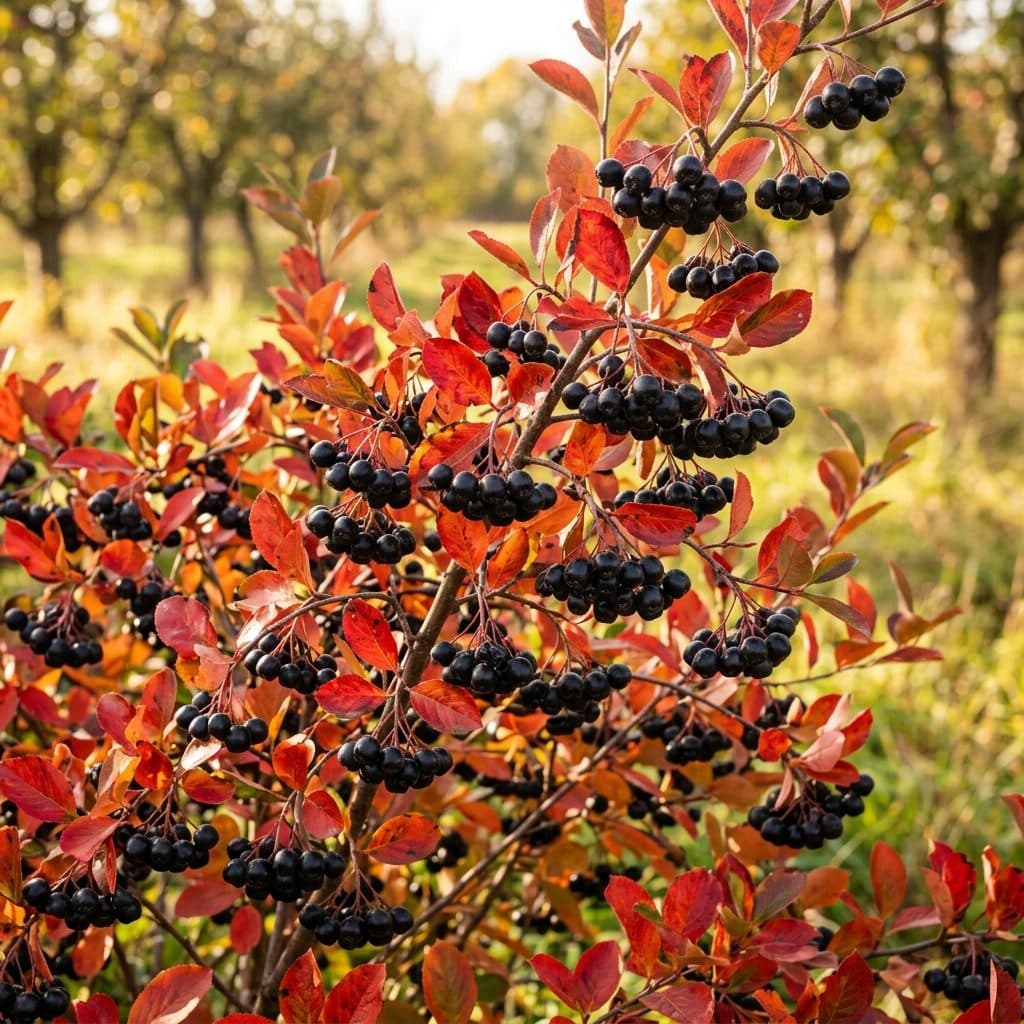
Within multi-strata agroforestry systems, Aronia melanocarpa occupies a valuable functional niche as an understorey or edge shrub. It performs admirably beneath the light canopy of standard orchard trees like apple and sour cherry, or as an exterior windbreak and wildlife barrier. Furthermore, it tolerates the juglone compounds exuded by walnut, allowing growers to integrate it into previously restricted tree zones. In late spring, abundant white corymbs provide early nectar and pollen to bumblebees and solitary bees, followed in autumn by a magnificent ornamental display as the glossy green leaves transition to fiery hues of apricot, crimson, and deep wine red.
Growing black chokeberry
Black chokeberry tolerates a remarkable range of conditions, growing across USDA Hardiness Zones 3 through 8 and holding the premier cold-hardiness rating of RHS H7. Fully dormant shrubs endure winter extremes of -40 °C (-40 °F) without experiencing twig dieback. It requires approximately 800 to 1,000 hours of winter chill below 7 °C (45 °F) to break dormancy uniformly, making it unsuited to subtropical lowlands. Flowering occurs relatively late in spring, typically mid to late May in the northern hemisphere, which cleanly avoids damaging late frosts that frequently wipe out early-blooming stone fruits. Although shrubs tolerate light partial shade, maximum flowering, fruit set, and sugar accumulation require full sun exposure receiving at least six to eight hours of direct sunlight daily.
In terms of soil, Aronia melanocarpa thrives across a wide spectrum of soil textures, including coarse sands, silty loams, and heavy clays. It prefers moist, moderately acidic to neutral substrates with a pH between 5.0 and 6.5, though it tolerates alkaline soils up to pH 8.0 without developing crippling chlorosis. Unlike many fruit bushes, aronia exhibits outstanding tolerance to seasonal waterlogging and temporary ponding, making it an ideal choice for rain gardens, bioswales, and low-lying hollows. Once established, the deep fibrous root network also withstands moderate summer drought, although consistent moisture ensures plump berries.
Propagation is predominantly achieved through hardwood cuttings, rooted suckers, or stratified seed. Seeds require 90 to 120 days of moist cold stratification at 2 to 4 °C (36 to 39 °F) to overcome physiological dormancy. Selected commercial cultivars—such as 'Viking', 'Nero', and 'McKenzie'—are universally propagated vegetatively to maintain fruit size, high polyphenol concentration, and compact form. Space individual shrubs 1.2 to 1.5 m (4 to 5 ft) apart within hedgerows, or 2 to 3 m (6.6 to 10 ft) apart in open orchard rows. Young plants establish rapidly and commence bearing in their second or third year, reaching peak production by year five.
Harvest and uses
The berries of black chokeberry ripen in late summer to early autumn, generally between late August and mid-September depending on latitude. Botanically, the fruit is a small pome measuring 8 to 12 mm (0.3 to 0.5 in) in diameter, hanging in pendulous clusters of 8 to 15. The fruits develop from green to reddish-purple before turning glossy purplish-black with a light waxy bloom. Because berries colour long before internal maturity, harvest should be timed by sugar and flavour development rather than skin pigmentation alone; testing soluble solids with a refractometer typically reveals sugar levels between 14 and 20 degrees Brix at true ripeness.
Despite elevated natural sugar content, fresh aronia berries taste intensely astringent, tart, and mouth-drying due to concentrated levels of anthocyanins, proanthocyanidins, and condensed tannins. Consequently, raw table eating is uncommon, and the fruit is overwhelmingly processed. Heat, sweetening, or fermentation softens this astringency, releasing a rich, full-bodied flavour profile reminiscent of blackcurrant and pomegranate.
In culinary contexts, homesteader kitchens transform black chokeberries into deep ruby syrups, spiced jams, fruit leathers, and jellies, where high natural pectin levels promote firm gelling without added commercial pectin. The juice is commonly blended with milder, sweeter juices such as apple or pear to balance tartness. Dried berries serve as a potent addition to granolas, pemmican, and winter herbal teas. Furthermore, aronia berries ferment into exceptional, deeply pigmented country wines, meads, and cider additives. A mature, well-tended bush produces an annual yield of 4 to 10 kg (8.8 to 22 lb) of fruit.
Identifying black chokeberry
Aronia melanocarpa possesses several definitive morphological markers that facilitate reliable field identification throughout the growing season:
- Habit and bark: A deciduous, upright, multi-stemmed suckering shrub growing 1.5 to 3 m (5 to 10 ft) in height with an equal or slightly narrower crown spread. Stems are slender, smooth, and greyish-brown, with lenticels visible on younger wood.
- Leaves: Alternate, simple, obovate to elliptic leaves measuring 4 to 8 cm (1.6 to 3.1 in) long and 2 to 4 cm (0.8 to 1.6 in) wide. The upper leaf surface is dark glossy green and leathery, while the lower surface is paler and glabrous. Margins are finely and crenately serrated. A critical diagnostic feature is the presence of small, raised, blackish-purple glands along the midrib on the upper surface of the leaf blade.
- Flowers: Borne in dense, flattened corymbs of 8 to 20 blossoms. Each flower measures 1 to 1.5 cm (0.4 to 0.6 in) across, featuring five rounded white or pale-pink-tinged petals and numerous prominent stamens tipped with pinkish-purple anthers.
- Fruit: Globose, firm, lustrous purplish-black pomes containing small seeds, crowned by the persistent remnants of the five-lobed calyx.
Black chokeberry is readily distinguished from red chokeberry (Aronia arbutifolia), which produces bright scarlet fruit, downy pubescent leaf undersides, and taller, more upright growth. It is also distinguished from wild chokecherry (Prunus virginiana), which bears single-seeded drupes on elongated cylindrical racemes rather than flattened corymbs.
Cautions
Growers should observe several practical cautions regarding the biochemical properties, growth habit, and disease liabilities of black chokeberry:
- Severe astringency and gastrointestinal upset: Ingesting substantial quantities of raw, unprocessed berries can cause temporary nausea, stomach cramps, and throat irritation due to the exceptionally high concentration of astringent tannins and polyphenols. Individuals prone to hyperacidity or sensitive digestive systems should consume aronia cooked, diluted, or incorporated into balanced meals.
- Trace cyanogenic glycosides: As with many members of the rose family, the tiny seeds within aronia pomes contain minute, trace amounts of amygdalin and prunasin, which can hydrolyse into hydrogen cyanide if crushed. In practical terms, eating whole culinary portions presents no hazard, as seeds pass intact through the human digestive system, and thermal cooking completely denatures active plant enzymes.
- Spreading and suckering: Black chokeberry spreads readily by subterranean rhizomes and basal suckers, gradually forming dense colonial thickets. While advantageous for erosion control and windbreaks, this suckering habit requires containment along garden borders through annual root pruning or mowing. In moist, peat-rich wetland habitats outside its native range in parts of Central Europe, escaped plants have exhibited naturalised weed potential.
- Pathological vulnerabilities: While vastly more resilient than orchard stone fruits, aronia remains susceptible to fire blight (Erwinia amylovora) and cedar-quince rust (Gymnosporangium clavipes). Plant bushes with good air circulation and avoid positioning immediately downwind of wild red cedar trees.
Sources
- Royal Botanic Gardens, Kew. Aronia melanocarpa (Michx.) Elliott Plants of the World Online.
- USDA PLANTS Database. Aronia melanocarpa (Michx.) Elliott
- Plants For A Future. Aronia melanocarpa - (Michx.)Elliott
- North Carolina State Extension Gardener Plant Toolbox. Aronia melanocarpa
- Missouri Botanical Garden. Aronia melanocarpa