secondary
Saskatoon serviceberry
Amelanchier alnifolia
International hardiness
- USDA 2-7
- RHS H7
- AU: Cool temperate
Where it grows — regional guide
| Zones / rating | Regional notes |
|---|---|
USDA 2-7 | Native across the Pacific Northwest, Northern Plains, and Rocky Mountains (USDA Zones 2 to 7); susceptible to cedar-apple rust when planted near red cedars. |
| Zones / rating | Regional notes |
|---|---|
H7 (below -20C) | Thrives across Britain rated RHS H7; requires acidic to neutral well-drained loams to prevent chlorosis, ripening sweet dessert berries by late June. |
| Zones / rating | Regional notes |
|---|---|
Cool temperate | No region-specific data yet |
| Zones / rating | Regional notes |
|---|---|
USDA 2-7 (USDA scale) Canada uses its own zone system; Canadian zones run roughly one lower than USDA. | Iconic native prairie fruit across Saskatchewan, Alberta, and Manitoba; key component of traditional pemmican and commercial Canadian berry orchards. |
| Zones / rating | Regional notes |
|---|---|
No region-specific data yet | No region-specific data yet |
Saskatoon serviceberry (Amelanchier alnifolia), also known as western serviceberry, juneberry, or alder-leaved shadbush, is a multi-stemmed deciduous fruiting shrub or small tree in the rose family (Rosaceae). Indigenous to western North America, its natural distribution extends from southern Alaska and the Yukon through the Canadian Prairie provinces to the Rocky Mountains, the Pacific Northwest, and the northern Great Plains of the United States. The city of Saskatoon, Saskatchewan, derives its name directly from the Cree word misâskwatômina, which honours this foundational native fruit. Long before European settlement, Indigenous peoples harvested vast quantities of saskatoon berries, drying them as a central preservation ingredient in pemmican. Today, it is celebrated as an exceptionally hardy commercial and homestead fruit crop.
Within cool-temperate agroforestry systems and cold-climate permaculture guilds, Amelanchier alnifolia occupies an indispensable niche as a secondary-stratum fruit shrub or living shelterbelt. Flourishing where frost tender species perish, it withstands sub-zero prairie blizzards and spring frosts, blooming alongside orchard partners like apple and sour cherry. The fibrous root system binds loose topsoil against wind erosion, while its masses of white spring flowers sustain emerging native pollinators. However, growers must understand its rust disease vulnerabilities and the subtle chemistry of its almond-scented seeds.
Growing saskatoon serviceberry
Amelanchier alnifolia is built for harsh northern and continental climates, thriving within USDA Hardiness Zones 2 through 7 and holding the maximum RHS rating of H7. Fully dormant bushes easily withstand winter extremes down to -45 °C (-49 °F) without structural damage. The shrub requires 700 to 1,000 winter chill hours below 7 °C (45 °F) to break dormancy and initiate even bud burst. Early spring blossoms tolerate light frosts down to -2 °C (28 °F) with minimal loss of fruit set. The species dislikes intense, humid subtropical heat, struggling in areas south of USDA Zone 7 where summer nights remain hot and muggy. Annual rainfall of 400 to 800 mm (16 to 31 in) is ideal, though mature bushes possess extensive root systems reaching 1.5 to 2 m (5 to 6.6 ft) deep that confer impressive drought resilience. Full sun produces the sweetest, highest-yielding berry crops, though bushes tolerate light partial shade.
Soil adaptation is broad, provided drainage is sound. The species thrives in sandy loams, silty loams, and well-aerated clay loams with a pH of 6.0 to 7.5. It performs poorly in dense, waterlogged soils or swampy clay pans, which induce root rot. While tolerant of low-fertility soils, amending planting rows with decomposed compost improves vegetative vigour and berry sizing.
Propagation is achieved through stratified seed, suckers, or soft-wood cuttings. Seeds require 90 to 120 days of cold, moist stratification at 2 to 4 °C (36 to 39 °F) to break embryo dormancy. However, seedlings are genetically variable and require three to five years to produce initial fruit. For commercial and homestead production, growers plant selected clonal cultivars (such as 'Smoky', 'Northline', 'Thiessen', and 'Martin') propagated through tissue culture or rooted suckers. Clonal stock bears harvestable crops in its second or third year. Space shrubs 1 to 1.5 m (3.3 to 5 ft) apart within rows for dense hedgerows, or 3 to 4 m (10 to 13 ft) between rows for accessible footpaths and netting installation.
Harvest and uses
Saskatoon berries ripen in early to mid-summer, typically late June through July, giving rise to the traditional folk name "juneberry". The fruit is botanically a pome—a miniature apple—measuring 10 to 15 mm (0.4 to 0.6 in) in diameter, borne in drooping clusters of 6 to 12.
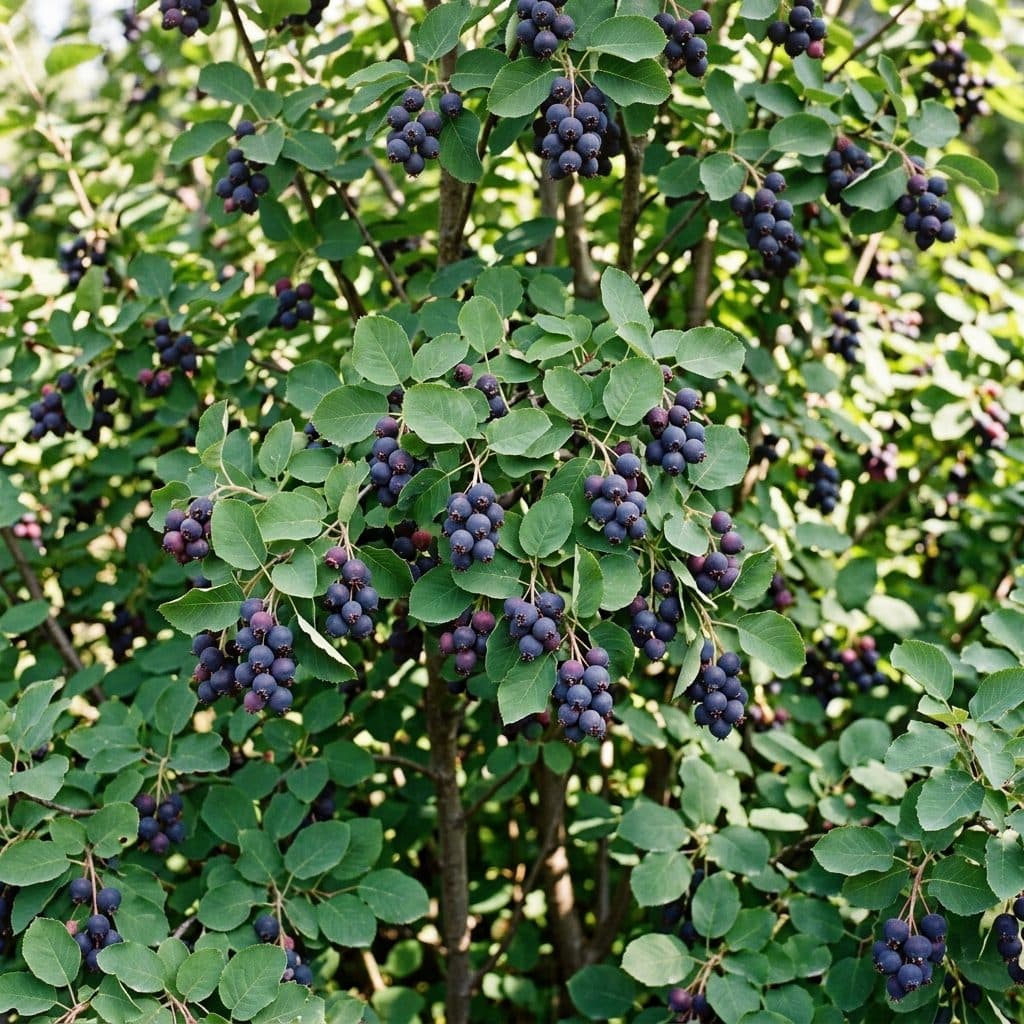
Berries progress from green to pink, magenta, and finally deep purplish-blue with a waxy, glaucous bloom at maturity. Harvest when berries are completely dark and yield softly to the touch; berries picked while still reddish contain lower sugar levels and taste astringent. Harvesting is conducted by hand-picking or shaking clusters gently into harvest trays.
The flavour of ripe saskatoons is distinct from true blueberries: they are sweeter, less acidic, and possess a rich, complex, nutty undertone reminiscent of sweet almond and marzipan. This characteristic flavour originates from trace benzaldehyde compounds in the tiny seeds. The fruit is eaten fresh by the handful, baked into traditional prairie saskatoon pies, crisps, and muffins, or processed into rich syrups, jams, and fruit wines. Because of their firm skin, saskatoons freeze exceptionally well, retaining their shape and flavour for months.
Historically, First Nations combined sun-dried saskatoons with pounded dried bison or venison and rendered tallow to create pemmican—a calorie-dense, shelf-stable survival ration that powered northern travel for centuries. Mature shrubs yield 4 to 8 kg (8.8 to 17.6 lb) of fruit annually.
Identifying saskatoon serviceberry
Amelanchier alnifolia is distinguished by several characteristic botanical features:
- Form and bark: A suckering, multi-stemmed deciduous shrub or small clump-forming tree reaching 2 to 5 m (6.6 to 16 ft) in height and 2 to 3 m (6.6 to 10 ft) in width, with an upright, vase-shaped architectural habit. The bark is thin, smooth, light greyish-brown, developing shallow vertical fissures on mature stems.
- Leaves: Alternate, simple, thick, round to broadly oval leaves measuring 2.5 to 5 cm (1 to 2 in) long and 2 to 4 cm (0.8 to 1.6 in) wide. The leaf base is rounded and entire, while the upper half to two-thirds is sharply and coarsely toothed (serrate-dentate). Emerging foliage is bronze-green and softly hairy, maturing to a dark matte green above and pale green beneath. In autumn, foliage turns yellow, orange, and fiery red.
- Flowers: Showy, star-shaped, pure white blossoms measuring 2 to 2.5 cm (0.8 to 1 in) across, arranged in dense, upright, terminal racemes of 5 to 15 flowers. Each flower possesses five narrow, strap-like white petals, twenty stamens, and five distinct styles.
- Fruit: Small, globose to obovoid pomes measuring 10 to 15 mm (0.4 to 0.6 in) across, crowned by five persistent, reflexed calyx lobes, ripening from red to dark purplish-blue.
The species is distinguished from eastern downy serviceberry (Amelanchier arborea) by its multi-stemmed suckering shrub form and oval leaves with teeth restricted to the upper half, whereas A. arborea forms a single-trunked tree with finely serrated leaves along the entire margin.
Cautions
Growers cultivating Amelanchier alnifolia should observe several biochemical, pathological, and agronomic cautions:
- Trace cyanogenic glycosides in raw seeds: The small, soft seeds inside saskatoon berries contain trace amounts of the cyanogenic glycosides prunasin and amygdalin, characteristic of the rose family. When seeds are chewed or crushed, plant enzymes liberate benzaldehyde (which provides the pleasant almond aroma) and trace hydrogen cyanide. While consuming normal culinary portions of fresh, whole berries is completely safe because whole seeds pass undigested through the human gastrointestinal tract, avoid consuming large quantities of crushed raw seeds. Thermal processing—including baking, stewing, and boiling into jams—deactivates the enzymes and volatilises trace cyanide compounds, rendering cooked products entirely safe.
- Cedar-apple and serviceberry rust: Fungi in the genus Gymnosporangium alternate between junipers (such as eastern red cedar Juniperus virginiana) and Rosaceae hosts. Symptoms appear as yellow-orange leaf spots and bizarre, spiky, horn-like fungal tubes (aecia) that protrude from distorted berries, rendering the crop woody and unmarketable. Avoid planting saskatoons within 300 m (1,000 ft) of cultivated or wild junipers.
- Fire blight: The bacterium Erwinia amylovora infects blossoms during warm, wet spring weather, causing shoots to wilt rapidly into a characteristic "shepherd's crook" with blackened, scorched foliage. Prune blighted shoots 30 cm (12 in) below visible damage using sterilised shears.
- Voracious bird predation: Songbirds—particularly cedar waxwings, robins, and starlings—are fiercely attracted to ripening saskatoon berries, frequently stripping an entire mature bush in hours. Install exclusion netting as soon as berries turn pink.
Sources
- Royal Botanic Gardens, Kew. Amelanchier alnifolia (Nutt.) Nutt. ex M.Roem. Plants of the World Online.
- USDA PLANTS Database. Amelanchier alnifolia (Nutt.) Nutt. ex M. Roem.
- Plants For A Future. Amelanchier alnifolia - (Nutt.)Nutt.ex M.Roem.
- Missouri Botanical Garden. Amelanchier alnifolia