secondary
Haskap berry
Lonicera caerulea
International hardiness
- USDA 2-7
- RHS H7
- AU: Cool temperate
Where it grows — regional guide
| Zones / rating | Regional notes |
|---|---|
USDA 2-7 | Excels across USDA Zones 2 to 7 in the Upper Midwest, northern Plains, and New England; requires protection from scorching heat in southern zones. |
| Zones / rating | Regional notes |
|---|---|
H7 (below -20C) | Grown extensively across northern and central Europe, Scandinavia, and Poland; open flowers withstand spring frosts down to -7 °C without injury. |
| Zones / rating | Regional notes |
|---|---|
Cool temperate | Restricted to cool-temperate highland microclimates in Victoria and southern Tasmania where winter chilling exceeding 1,000 hours breaks dormancy. |
| Zones / rating | Regional notes |
|---|---|
USDA 2-7 (USDA scale) Canada uses its own zone system; Canadian zones run roughly one lower than USDA. | Superbly adapted to Canadian prairie winters and boreal soils; thrives in Zone 2 to 6 gardens across Saskatchewan, Alberta, Ontario, and Quebec. |
| Zones / rating | Regional notes |
|---|---|
No region-specific data yet | No region-specific data yet |
The haskap berry (Lonicera caerulea), also known as the honeyberry, blue honeysuckle, or sweetberry honeysuckle, is an upright deciduous fruiting shrub in the honeysuckle family (Caprifoliaceae). Native to the circumpolar boreal forests and peat bogs of northern Canada, northern Europe, Siberia, and northern Japan, haskap is distinguished by exceptional winter hardiness and early fruit maturity. In temperate food forests and homestead plots, it fills a valuable early season niche by delivering the first fresh fruit harvest of the year, ripening its plump blue berries up to two weeks ahead of early strawberry beds.
Historically gathered by Indigenous peoples across Siberia and by the Ainu in Hokkaido, haskap remained uncultivated in Western orchards until recent breeding programmes at the University of Saskatchewan developed erect, high-yielding cultivars. For northern growers in harsh climates where tender fruits like sweet cherry fail, haskap provides a dependable berry crop.
The fruit combines the look of an elongated blueberry with a rich flavour blending raspberry, blackcurrant, and wild blueberry notes. Beneath the deep blue waxy skin lies crimson-purple juice loaded with anthocyanins and vitamin C, with tiny seeds unnoticeable during fresh eating.
Growing haskap
Haskap is celebrated for its ability to thrive where cold winter temperatures eliminate other small fruits. Fully dormant mature bushes withstand winter temperatures below -45 °C (-49 °F), placing the plant within USDA Hardiness Zones 2 to 7. A key horticultural trait is the frost resilience of its early blossom: open flowers endure late spring frosts down to -7 °C (19 °F) without floral damage or crop loss. Fruit set stays reliable despite erratic spring weather.
Unlike blueberries, which demand acidic peat soils with a pH below 5.0, haskap is adaptable across diverse soil types. It thrives in loamy, well-drained ground across a wide pH range from 5.5 to 7.5, with an optimal range between 6.0 and 6.8. Heavy clay soils benefit from the addition of compost to improve aeration, as standing water around dormant root crowns predisposes plants to root decline.
Plant in full sun to maximise fruit production and promote berry sugar accumulation. In northern regions with cool summers, bushes thrive in all-day sunlight; in regions near the warmer boundary of its hardiness range, light afternoon shade shields foliage from summer heat scorch. Bushes require consistent moisture during fruit swelling, needing approximately 25 to 35 mm (1 to 1.4 in) of water per week through rainfall or irrigation from flowering until harvest.
Cross-pollination is essential for fruit production. Haskap is self-incompatible; a single bush will produce abundant blossom but fail to set fruit. Successful pollination requires planting at least two genetically distinct, sexually compatible cultivars that bloom simultaneously. Varieties are classified into early, mid, and late flowering windows. For instance, early Russian varieties require synchronised early pollinators, whereas late Japanese cultivars such as 'Boreal Beauty' must be paired with compatible partners like 'Boreal Beast'. A standard orchard planting uses one pollinator shrub for every three to five primary fruiting shrubs.
Space individual bushes 1.2 to 1.5 m (4 to 5 ft) apart within rows, allowing 2.5 to 3 m (8 to 10 ft) between rows to facilitate maintenance. Set bare-root or containerised plants in early spring or autumn dormancy, placing them 2 to 5 cm (1 to 2 in) deeper than their nursery soil line to encourage vigorous basal shoot development. First yields begin in the second or third year, with mature bushes reaching peak yields of 3 to 5 kg (6.6 to 11 lb) of fruit annually by their fifth growing season.
Pruning during the first four years is minimal, limited to removing damaged or prostrate ground-level shoots in late winter. Mature bushes over five years old benefit from selective renewal: remove up to twenty percent of the oldest canes back to the crown to stimulate vigorous young fruiting wood and preserve an open canopy.
Harvest and uses
Haskap ripens in late spring to early summer, typically throughout June in southern Canada and the northern United States. Knowing when to harvest requires careful testing, as the berries exhibit a deceptive maturation pattern. The skin turns deep blue with a waxy bloom one to two weeks before the fruit reaches true ripeness. Harvesting fruit immediately after the colour change results in sour, astringent berries with green interior flesh.
To confirm ripeness, slice sample berries in half. True harvest readiness is achieved only when the inner flesh has turned completely deep purple-red throughout, with no green tissue remaining around the centre. Ripe berries detach readily from the stem with a gentle pull. Homesteaders harvest by hand-picking or gently rolling ripe fruit into shallow collection trays lined with cloth.
Fresh berries store under refrigeration at 2 °C to 4 °C (36 °F to 39 °F) for up to a week. For long-term storage, haskap freezes easily on flat baking trays before bagging. High pectin and acid make the berries ideal for jams, compotes, pies, and fermented fruit cordials.
Identifying haskap
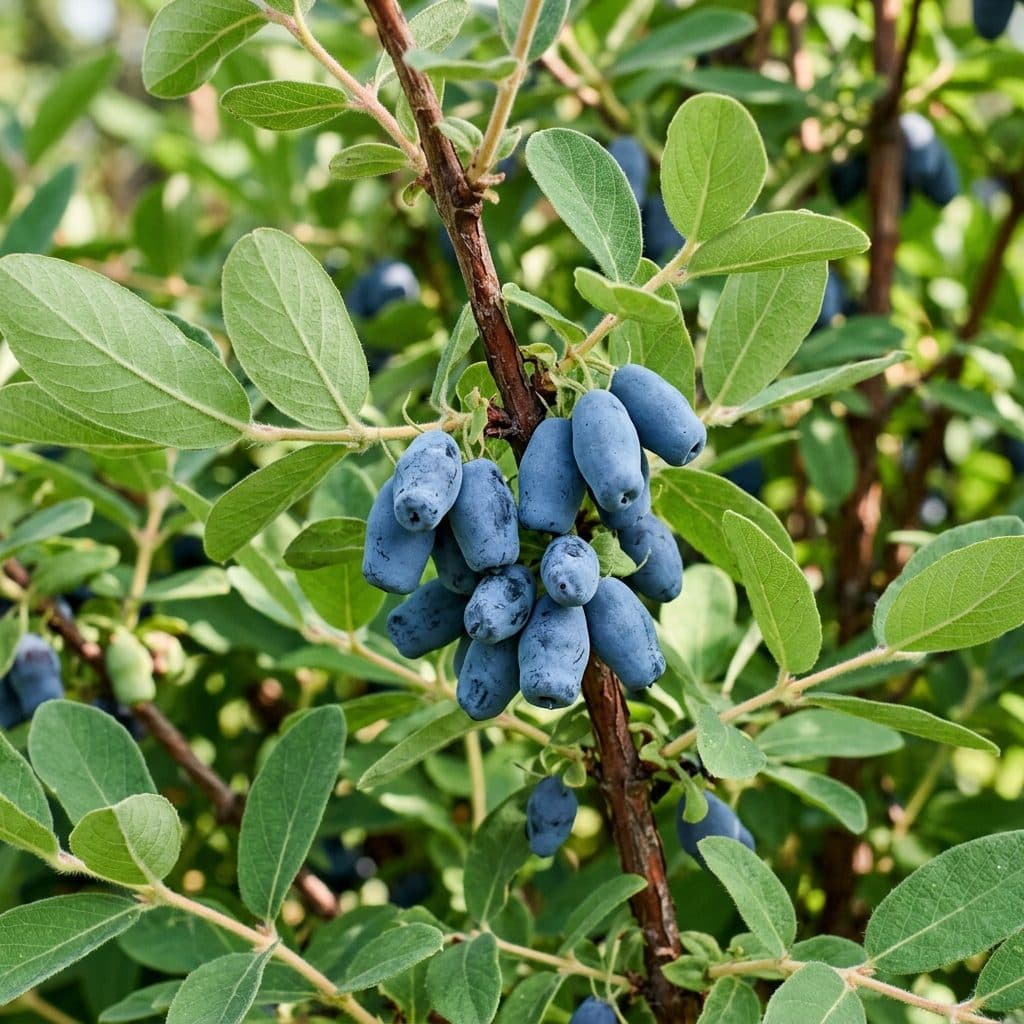
Lonicera caerulea is readily distinguished from other small fruit shrubs and wild honeysuckles by specific morphological characteristics:
- Growth habit: An upright to spreading, multi-stemmed deciduous shrub reaching 1.2 to 2 m (4 to 6.5 ft) in height and 1.2 to 1.8 m (4 to 6 ft) in canopy spread, developing reddish-brown bark that exfoliates in papery strips on mature wood.
- Foliage: Opposite, simple, oval to oblong-elliptic leaves measuring 3 to 8 cm (1.2 to 3.1 in) long and 1.5 to 4 cm (0.6 to 1.6 in) broad, with smooth (entire) margins. Leaves are dull grey-green above and paler with fine hairs beneath.
- Flowers: Paired, tubular to funnel-shaped blossoms measuring 1.2 to 1.8 cm (0.5 to 0.7 in) in length, creamy-yellow to greenish-white, borne on short nodding stalks in the leaf axils in early spring.
- Fruit: Distinctive elongated, cylindrical to barrel-shaped berries measuring 1.5 to 2.5 cm (0.6 to 1 in) long and 0.8 to 1.2 cm (0.3 to 0.5 in) in diameter, deep blue with a heavy glaucous bloom.
- Interior pulp: Deep burgundy to purplish-crimson pulp containing numerous microscopic, soft seeds that are unnoticeable during consumption.
Haskap differs from common blueberries (Vaccinium species) by its paired opposite leaf arrangement, earlier spring flowering, elongated cylindrical shape, and deep red internal juice (cultivated blueberries have translucent, pale greenish-white flesh). It is distinguished from ornamental shrub honeysuckles (Lonicera tatarica, Lonicera maackii) by its edible blue fruit; ornamental honeysuckles produce spherical, translucent red or orange berries that are toxic.
Cautions
Growers cultivating haskap must address specific bird predation, harvest timing, disease liabilities, and plant identification factors:
- Bird predation: Birds pose the greatest threat to a haskap crop. Cedar waxwings, robins, and starlings consume the berries voraciously, often stripping entire bushes bare within twenty-four hours before fruit reaches full human maturity. Erecting physical bird netting over sturdy supportive framework prior to the initial colour change is essential for preserving the harvest.
- Premature harvest and astringency: Inexperienced growers often harvest berries as soon as the skin turns blue, resulting in poor-tasting fruit with sour green flesh. Always inspect internal flesh colour before picking; the interior must be completely dark red-purple.
- Summer foliage decline and powdery mildew: In regions experiencing hot summer temperatures or high humidity, haskap shrubs frequently develop powdery mildew (Podosphaera myrtillina) or exhibit early brown leaf scorch and premature defoliation in late July or August. This is a natural evolutionary adaptation to brief boreal summers rather than plant death. Maintain adequate bush spacing, avoid overhead watering, and rake fallen leaves to minimise fungal inoculum.
- Look-alike honeysuckle toxicity: While Lonicera caerulea yields safe edible fruit, many other wild, climbing, and ornamental honeysuckle species produce toxic berries. Species such as Tartarian honeysuckle (Lonicera tatarica) and Japanese honeysuckle (Lonicera japonica) contain toxic saponins that induce severe vomiting, abdominal pain, diarrhea, and lethargy if ingested. Never consume honeysuckle berries from unverified landscape shrubs producing red, orange, or black fruit.
Sources
- Royal Botanic Gardens, Kew. Lonicera caerulea L. Plants of the World Online.
- Plants For A Future. Lonicera caerulea - L.
- USDA PLANTS Database. Lonicera caerulea L.
- University of Saskatchewan Fruit Program. Haskap Breeding and Cultivar Development