secondary
Strawberry guava
Psidium cattleyanum
International hardiness
- USDA 9-11
- RHS H2
- AU: Subtropical, Tropical, Warm temperate
Where it grows — regional guide
| Zones / rating | Regional notes |
|---|---|
USDA 9-11 | Prohibited from planting in South Florida and Hawaii due to catastrophic native forest invasion; plant strictly within contained containers in frost-free regions. |
| Zones / rating | Regional notes |
|---|---|
H2 (1 to 5C) | No region-specific data yet |
| Zones / rating | Regional notes |
|---|---|
Subtropical, Tropical, Warm temperate | Declared an environmental weed in Queensland and coastal New South Wales; restrict planting to sealed urban courtyards to prevent bushland bird dispersal. |
| Zones / rating | Regional notes |
|---|---|
USDA 9-11 (USDA scale) Canada uses its own zone system; Canadian zones run roughly one lower than USDA. | No region-specific data yet |
| Zones / rating | Regional notes |
|---|---|
No region-specific data yet | No region-specific data yet |
Strawberry guava (Psidium cattleyanum), often spelled Psidium cattleianum and known as Cattley guava or cherry guava, is an evergreen shrub or small tree in the myrtle family (Myrtaceae). Indigenous to the Atlantic coastal forest biome of eastern and southern Brazil and northeastern Uruguay, the species was named in honour of English horticulturist William Cattley. Distributed across the tropics and subtropics as an ornamental and fruit crop during the nineteenth century, the plant produces abundant crops of cherry-sized berries with an aromatic, strawberry-tinged sweetness. However, its exceptional vigour and unchecked seed dispersal have established it as one of the most destructive invasive alien plants on the planet.
In managed homestead orchards outside high-risk island ecosystems, Psidium cattleyanum is a durable secondary-stratum fruiting shrub or perimeter windbreak. Possessing significantly greater cold tolerance than common guava, it tolerates coastal winds and poor soils while yielding nutrient-rich fruit high in vitamin C and pectin. When grown alongside companion species like pigeon pea or bounded by deep-rooted vetiver barriers, it creates dense edible screens. Nonetheless, responsible cultivation requires uncompromising containment strategies to prevent wild escape into native bushland.
Growing strawberry guava
Psidium cattleyanum thrives in subtropical, tropical, and warm maritime climates within USDA Hardiness Zones 9 through 11, holding an RHS rating of H2. Mature bushes demonstrate notable cold resilience compared to other tropical myrtles, enduring short winter freezes down to -5 °C (23 °F) with only minor leaf singeing, though extended frosts below -7 °C (19 °F) kill stems back to the crown. The species prospers across a temperature range of 18 to 30 °C (64 to 86 °F) and requires adequate summer heat to ripen sweet, high-sugar berries. While thriving in humid zones receiving 1,200 to 2,500 mm (47 to 98 in) of rainfall, established plants possess leathery, drought-tolerant foliage that survives extended dry spells. Full sun promotes heavy flowering and fruit set, although bushes tolerate light understorey shade.
Soil requirements are modest. Strawberry guava tolerates an expansive range of substrates, including poor leached sands, acidic volcanic clays, rocky scree, and limestone soils across a pH range of 4.5 to 7.0. It demonstrates tolerance for periodic waterlogging as well as compacted urban soils. Minimal fertilisation is needed; excessive nitrogen produces rampant vegetative shoots at the expense of flowering.
Propagation is remarkably prolific from seed. Fresh seeds germinate within four to six weeks at 20 to 25 °C (68 to 77 °F), with frugivorous birds and mammals acting as highly effective dispersal vectors. Seedling bushes fruit rapidly, often bearing in their second or third year. To preserve superior fruit selections, such as the larger yellow-fruited lemon guava (P. cattleyanum var. littorale), growers employ semi-hardwood cuttings or air-layering. Space orchard specimens 3 to 4 m (10 to 13 ft) apart. In suburban settings, growers should restrict plants to 50 to 100 litre (13 to 26 gallon) containers fitted with root-barrier fabric to prevent aggressive underground suckering.
Harvest and uses
Strawberry guava bears fruit in late summer and autumn, roughly three to four months after spring flowering. The fruit is a small, globose to obovoid berry measuring 2.5 to 4 cm (1 to 1.6 in) in diameter, crowned by persistent calyx lobes.
Two distinct botanical varieties are harvested:
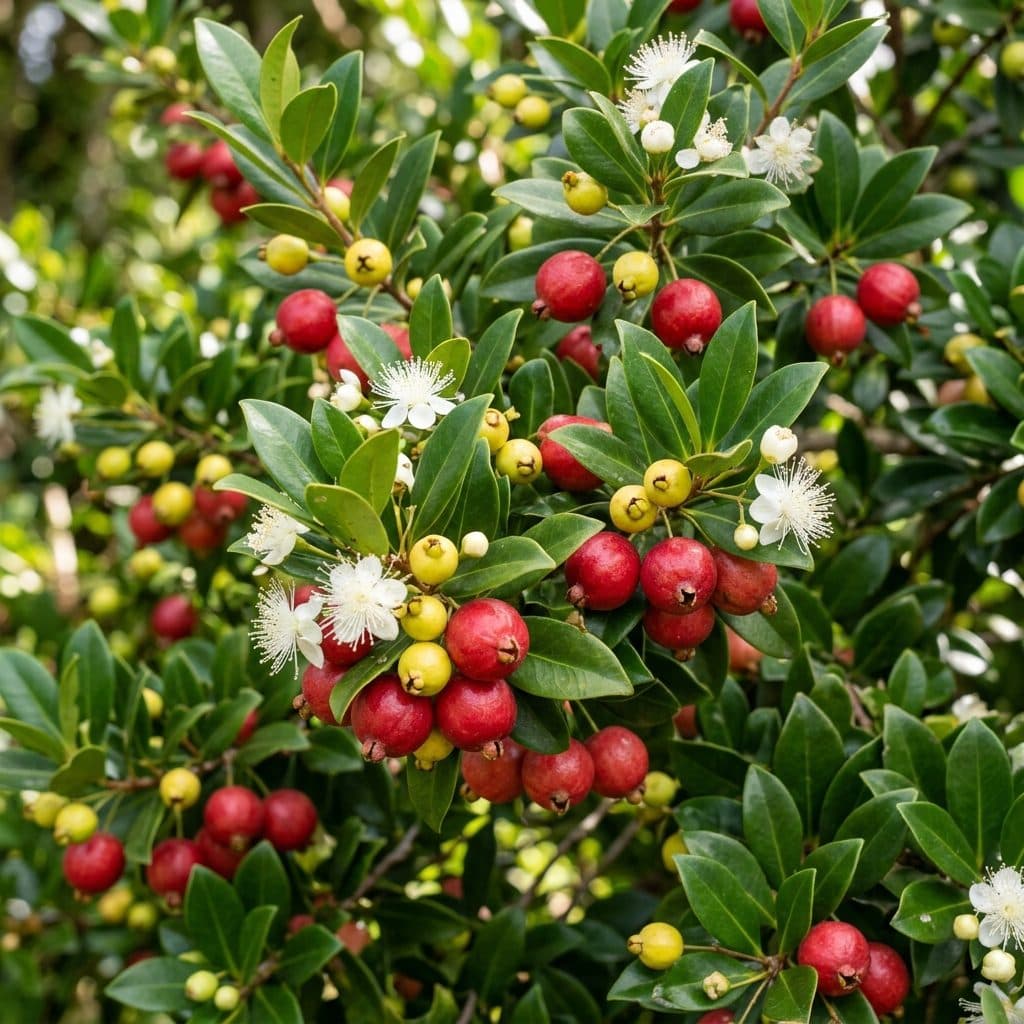
- Red strawberry guava (Psidium cattleyanum var. cattleyanum): The skin ripens from dark green to deep purplish-crimson. The translucent white or pinkish pulp is soft, juicy, and aromatic, offering a sweet-tart flavour reminiscent of strawberries and passionfruit.
- Yellow strawberry guava or lemon guava (Psidium cattleyanum var. littorale): The skin ripens to clear lemon-yellow. The creamy pulp is slightly larger, noticeably sweeter, and less musky than the red form, carrying a pleasant citrus tang.
Harvest fruit when it yields to gentle pressure and detaches easily with a slight twist. Because the thin skin bruises readily, handle harvests carefully and chill immediately. The fruit is consumed whole out of hand, seeds included. Due to exceptionally high natural pectin and citric acid concentrations, strawberry guavas are widely processed into gourmet jellies, jams, glazes, fruit pastes, and fermented fruit wines.
The wood is dense, fine-grained, hard, and flexible. Pruned branches are used for durable tool handles, walking sticks, and hot-burning homestead firewood. A mature bush produces 10 to 20 kg (22 to 44 lb) of fruit annually.
Identifying strawberry guava
Psidium cattleyanum is identified by its glossy foliage, smooth bark, and distinctive berries:
- Form and bark: A dense, multi-stemmed evergreen shrub or small upright tree reaching 2 to 6 m (6.6 to 20 ft) in height. The trunk and branches feature exceptionally smooth, pale copper-brown to greyish-brown bark that exfoliates in thin, paper-like plates, exposing pale green inner bark.
- Leaves: Opposite, simple, thick, leathery, obovate to elliptic leaves measuring 4 to 8 cm (1.6 to 3.1 in) long and 2.5 to 4.5 cm (1 to 1.8 in) wide. Both surfaces are glossy dark green, entirely hairless, with entire margins, a wedge-shaped base, and a rounded apex. Crushed leaves release a pleasant resinous myrtle aroma.
- Flowers: Solitary, fragrant white flowers measuring 2 to 2.5 cm (0.8 to 1 in) across, borne in the leaf axils of new shoots. Each blossom features five rounded white petals surrounding a prominent central brush of numerous white stamens tipped with pale yellow anthers.
- Fruit: A round or egg-shaped berry measuring 2.5 to 4 cm (1 to 1.6 in) across, turning deep claret-red or bright lemon-yellow when ripe, enclosing soft translucent pulp and multiple hard, flattened, yellowish seeds.
The species is easily distinguished from common guava (Psidium guajava) by its smooth, cylindrical twigs (common guava has prominently four-angled, winged stems), its smaller, glossy, hairless leaves lacking sunken veins, and its smaller, rounder fruit.
Cautions
Cultivating Psidium cattleyanum entails severe ecological, agricultural, and legal risks:
- Catastrophic invasive ecological threat: Psidium cattleyanum is internationally designated by the IUCN as one of the world's 100 worst invasive alien species. In tropical island ecosystems, including Hawaii, Mauritius, Réunion, and the Galápagos, it has devastated native rainforests. The plant forms impenetrable monotypic thickets that completely suppress the germination of native canopy trees and alter delicate soil hydrology. Feral pigs feed on windfall fruit, dispersing millions of viable seeds deep into pristine watersheds. Never plant this species in tropical island environments or near native forest reserves. Check local biosecurity and noxious weed lists before acquisition; in Hawaii and South Florida, the species is formally classified as a prohibited invasive weed subject to statutory control.
- Agricultural fruit fly reservoir: The fruit is a premier host and breeding reservoir for catastrophic agricultural pests, including the Mediterranean fruit fly (Ceratitis capitata) and oriental fruit fly (Bactrocera dorsalis). Unharvested fruit breeding cycles fuel explosive fly populations that attack nearby commercial fruit orchards. All fallen fruit must be collected daily and destroyed.
- Aggressive root suckering: The plant produces extensive lateral root runners that sucker vigorously when the parent stem is pruned, burned, or damaged, making mechanical eradication extremely challenging.
Sources
- Royal Botanic Gardens, Kew. Psidium cattleyanum Sabine Plants of the World Online.
- University of Florida IFAS Assessment of Non-Native Plants. Psidium cattleianum - Strawberry Guava
- USDA PLANTS Database. Psidium cattleyanum Sabine
- Plants For A Future. Psidium cattleyanum - Sabine.