secondary
Red currant
Ribes rubrum
International hardiness
- USDA 3-7
- RHS H6
- AU: Cool temperate
Where it grows — regional guide
| Zones / rating | Regional notes |
|---|---|
USDA 3-7 | Thrives in USDA Zones 3 through 7; check state Department of Agriculture regulations regarding white pine blister rust restrictions before planting. |
| Zones / rating | Regional notes |
|---|---|
H6 (-20 to -15C) | A traditional kitchen garden staple across Britain; train as cordons or bushes along cool north- or east-facing garden walls. |
| Zones / rating | Regional notes |
|---|---|
Cool temperate | Limited to cold, elevated zones of Tasmania, the Dandenong Ranges, and the Snowy Mountains; provide protection from hot drying winds. |
| Zones / rating | Regional notes |
|---|---|
USDA 3-7 (USDA scale) Canada uses its own zone system; Canadian zones run roughly one lower than USDA. | Widely adapted across Canadian provinces; cold winters provide ample chilling hours for vigorous flowering and heavy fruit set. |
| Zones / rating | Regional notes |
|---|---|
No region-specific data yet | No region-specific data yet |
Red currant (Ribes rubrum) is a compact, deciduous fruiting shrub in the gooseberry family (Grossulariaceae). Native to stream banks, damp thickets, and woodland margins across western, central, and northern Europe into Siberia, this cold-hardy perennial has been grown in temperate kitchen gardens for centuries. Growers plant red currant for its pendant racemes of gleaming scarlet fruit that ripen in early summer, delivering crisp acidity and abundant natural pectin.
In a homestead food forest, red currant fills the semi-shaded understory layer. Unlike sun-demanding crops like the sunflower, red currant thrives in cool, dappled light, making it suitable beneath fruit tree canopies or along eastern walls. The fibrous roots stabilize topsoil, while autumn leaf drop enriches the surrounding soil.
While black currant (Ribes nigrum) has pungent foliage and dark berries used mainly for cordials, red currant features mild foliage and brighter fruit. Red currant also fruits on spurs along two- and three-year-old wood, requiring a distinct pruning regimen.
Growing red currant
Red currant requires a cold-temperate climate with 800 to 1,500 hours of winter chilling below 7 °C (45 °F) to break dormancy. Dormant bushes endure winter lows of -40 °C (-40 °F), fitting USDA Zones 3 through 7. Its chief limit is summer heat; sustained temperatures above 30 °C (86 °F) cause leaf scorch and premature defoliation. In warmer zones, provide morning sun and afternoon shade.
The shrub prefers deep, moisture-retentive, well-drained loam rich in organic matter, with a pH of 6.0 to 6.8. It tolerates clay-loam better than most cane berries. Because shallow roots compete poorly with weeds, maintain a clean zone mulched with 7 to 10 cm (3 to 4 in) of woodchips or straw to cool the soil.
Propagate from dormant hardwood cuttings in late autumn or early spring. Take 20 to 25 cm (8 to 10 in) stems, cut below a node, and insert them into moist potting media or nursery beds with two buds exposed. Cuttings root reliably without hormones.
Space bushes 1.2 to 1.5 m (4 to 5 ft) apart in rows 1.8 to 2.4 m (6 to 8 ft) apart. Shrubs reach 1 to 1.5 m (3.3 to 5 ft) in height and width. Red currants also train readily against wire trellises as cordons or fans.
Prune annually in late winter. Red currants fruit best on short spurs on two- and three-year-old wood. Cut out dead, low, and four-year-old wood at ground level, leaving three to four stems each of one-, two-, and three-year-old canes to maintain an open, nine- to twelve-stem bush.
Harvest and uses
Red currant shrubs produce their first light crop in their second summer, reaching full bearing capacity of 3 to 5 kg (6.6 to 11 lb) of fruit per bush by their fourth year. The berries ripen progressively over two to three weeks from late June through July depending on latitude and cultivar. As berries mature, they transition from hard green spheres to translucent, luminous red globes through which the interior seeds are visible.
The fruit forms along pendant clusters known botanically as racemes and culinarily as strigs, each holding 10 to 20 berries. Do not harvest red currants by pulling individual berries from the bush, as this tears the delicate skins and releases juice. Instead, use sharp scissors or pruning shears to snip the entire strig stem from the cane. Whole strigs can be placed gently into shallow containers to avoid crushing. Freshly harvested strigs store under refrigeration at 0 to 2 °C (32 to 36 °F) for up to two weeks, or can be frozen whole on baking trays before transferring to airtight storage bags.
In the kitchen, strip berries from their stems by running the tines of a table fork gently down each strig. The fruit has a clean, bracing tartness that enlivens fresh summer fruit salads when mixed with sweeter fruits like the strawberry. Red currants are celebrated for their exceptionally high natural pectin and fruit acid concentrations. Cooked with sugar, the berries form firm, jewel-toned jellies without commercial gelling agents. Red currant jelly is a traditional accompaniment for roasted lamb and venison, while bakers incorporate fresh berries into tarts, pies, and glazes.
Identifying red currant
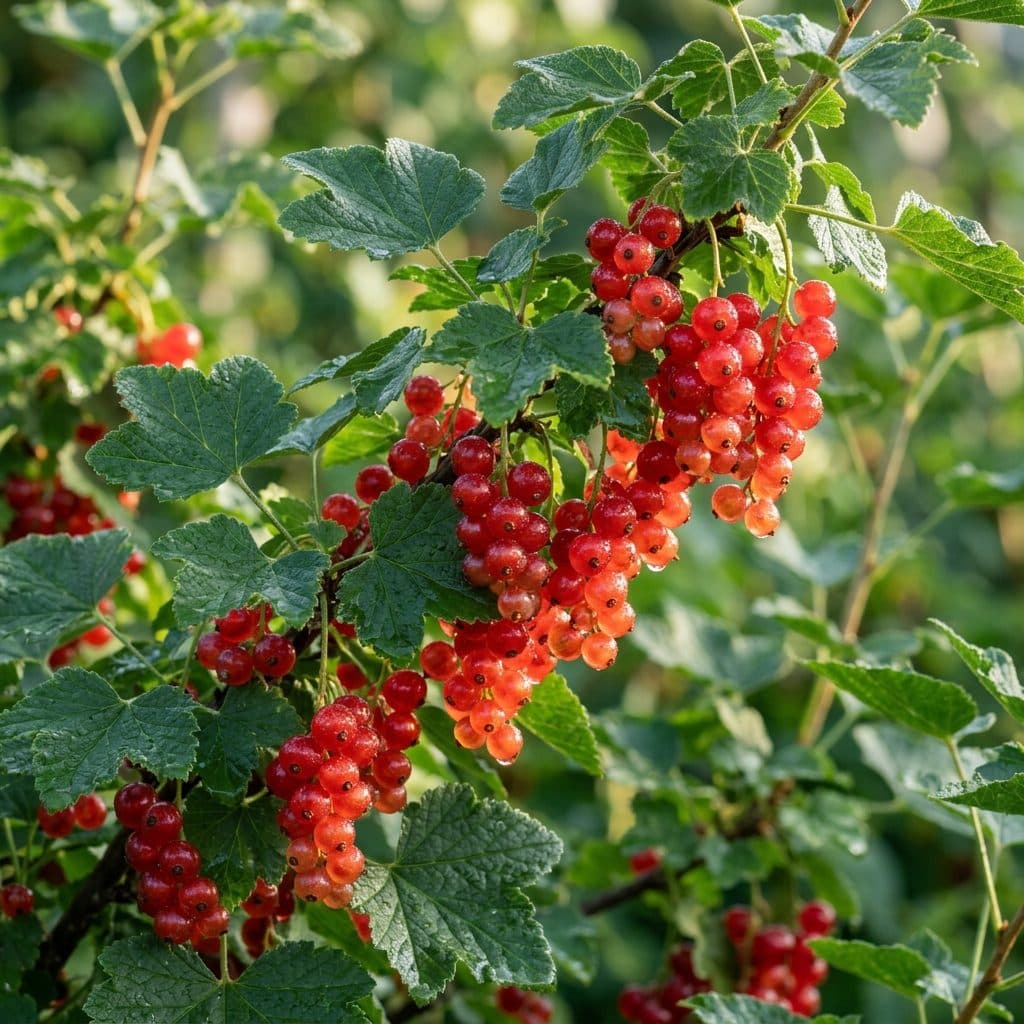
Red currant is easily distinguished by its vegetative form, flower clusters, and distinctive fruit:
- Growth habit: An upright, multi-stemmed deciduous shrub growing 1 to 1.5 m (3.3 to 5 ft) tall with smooth, reddish-brown to gray bark that peels lightly on mature stems, completely lacking thorns or spines.
- Foliage: Leaves are alternate, simple, palmately 3- to 5-lobed, measuring 4 to 8 cm (1.6 to 3.2 in) across, with coarsely serrated margins and heart-shaped bases. Crushed leaves produce a faint, clean vegetative scent, entirely lacking the pungent, musky aroma of black currant.
- Flowers: Small, saucer-shaped, greenish-yellow blossoms borne in pendant, hanging racemes 5 to 8 cm (2 to 3.2 in) long, emerging in early spring alongside expanding leaves.
- Fruit: Translucent, bright crimson to scarlet globose berries, 6 to 10 mm (0.24 to 0.4 in) in diameter, hanging in dense clusters with dried flower remnants persisting at the tip.
Red currant differs from gooseberry (Ribes uva-crispa) by its complete absence of nodal spines or prickles and its small berries borne on elongated multi-fruited racemes rather than solitary or paired fruit. It is distinguished from black currant (Ribes nigrum) by its translucent red coloration, lack of resin glands on the leaf undersides, and neutral foliage scent.
Cautions
Prospective growers must observe important regulatory, ecological, and horticultural cautions:
- White pine blister rust regulations: Ribes rubrum can serve as an alternate host for Cronartium ribicola, a non-native rust fungus that causes fatal stem cankers in five-needled pines, including eastern white pine (Pinus strobus) and western white pine (Pinus monticola). While red currants are far more resistant to the rust than black currants, several United States jurisdictions maintain strict planting bans, quarantine zones, or permit requirements to protect commercial timber and native forest stands. The plant is regulated in some jurisdictions; check your local list before planting.
- Heat vulnerability: The species suffers severe physiological stress in warm climates, displaying leaf necrosis and plant decline south of USDA Zone 7.
- Insect pests: The currant borer (Synanthedon tipuliformis) deposits eggs on stems; the larvae tunnel through the central pith, causing canes to wilt and break under fruit loads. Infested canes should be cut to ground level and burned. Currant aphids cause bright red blistering and curling on young foliage in spring.
- Pet safety: While red currant berries are entirely non-toxic to humans, fruit and trimmings must not be fed to dogs or pets, as many small dried and fresh berries can induce adverse gastrointestinal reactions in domestic animals.
Sources
- Royal Botanic Gardens, Kew. Ribes rubrum L. Plants of the World Online.
- Plants For A Future. Ribes rubrum - L.
- University of Minnesota Extension. Growing currants and gooseberries in the home garden
- Cornell University Cooperative Extension. Currants and Gooseberries
- Penn State Extension. Home Fruit Plantings: Gooseberries and Currants