secondary
Tea plant
Camellia sinensis
International hardiness
- USDA 7-9
- RHS H4
- AU: Warm temperate, Subtropical, Cool temperate
Where it grows — regional guide
| Zones / rating | Regional notes |
|---|---|
USDA 7-9 | Hardy across the humid Southeast and Pacific Northwest (USDA Zones 7 to 9); requires supplemental irrigation and light canopy shade during hot summers. |
| Zones / rating | Regional notes |
|---|---|
H4 (-10 to -5C) | Grown successfully in mild, high-rainfall regions of Cornwall, Devon, and western Scotland rated RHS H4; needs sheltered acidic ericaceous soils. |
| Zones / rating | Regional notes |
|---|---|
Warm temperate, Subtropical, Cool temperate | Thrives in the elevated hinterlands of Queensland, New South Wales, and Victoria; requires protection from dry, scorching summer winds. |
| Zones / rating | Regional notes |
|---|---|
USDA 7-9 (USDA scale) Canada uses its own zone system; Canadian zones run roughly one lower than USDA. | No region-specific data yet |
| Zones / rating | Regional notes |
|---|---|
No region-specific data yet | No region-specific data yet |
Tea plant (Camellia sinensis), a member of the tea family (Theaceae), is a prized evergreen shrub or small tree native to southwestern China, northern Myanmar, and northeastern India. Revered for thousands of years as one of the most culturally and economically influential botanical species in human civilization, Camellia sinensis is the singular botanical source behind all authentic green, black, oolong, white, and pu-erh teas. The profound diversity among global tea styles arises not from differing botanical species, but from variations in horticultural terroir, seasonal harvest timing, and meticulous post-harvest oxidation and rolling techniques. In contemporary permaculture design and cold-hardy food forestry, the tea plant is an elegant, multi-functional understorey shrub that supplies regular harvests of rich antioxidant foliage alongside aromatic autumn blossoms.
Within multi-layered agroforestry configurations, Camellia sinensis functions predominantly as a shade-tolerant secondary-layer shrub. Because wild ancestors evolved beneath the dappled, humid canopies of subtropical montane evergreen broadleaf forests, tea thrives when interplanted beneath open-canopied fruit and nitrogen-fixing trees. It combines well with aromatic companion plantings such as spearmint and ginger, and shares warm microclimates with orchard crops like Malta blood orange. In late autumn and early winter, when temperate deciduous trees have dropped their foliage, tea bushes produce an abundance of fragrant white blossoms that sustain late-flying honeybees and native solitary pollinators.
Growing tea plants
Camellia sinensis is adapted to warm-temperate and subtropical montane climates characterised by high humidity, generous rainfall, and mild winters, performing reliably across USDA Hardiness Zones 7 through 9 and holding an RHS rating of H4. Cold-hardy varieties (such as the sinensis variety native to northern China) endure winter drops down to -12 °C (10 °F) without experiencing defoliation, while juvenile shoots can be damaged by sudden spring frosts. The plant requires between 200 and 400 hours of winter chill below 7 °C (45 °F) to rest before pushing vigorous spring leaf flushes. Annual precipitation between 1,200 and 2,000 mm (47 and 79 in) is optimal; prolonged dry spells necessitate consistent drip irrigation to maintain vegetative flush. While bushes produce well in full sun in cool coastal climates, they benefit substantially from light, filtered partial shade in hot continental interiors.
Soil chemistry is paramount when cultivating tea. As an obligate calcifuge species, Camellia sinensis demands intensely acidic, well-aerated, humus-rich soils with a strict pH range of 4.5 to 5.5. Soils with a pH approaching 6.0 or higher induce severe iron deficiency and lime-induced chlorosis, marked by yellowing of interveinal leaf tissue and stunted root development. The soil must drain freely: stagnant, waterlogged ground fosters fatal root asphyxiation and fungal decline. Incorporating copious amounts of composted pine bark, leaf mould, and elemental sulphur into planting beds creates the porous, acidic environment essential for healthy root respiration.
Propagation is predominantly conducted via semi-ripe nodal cuttings taken in mid to late summer, or through fresh stratified seed. Cuttings root reliably within 8 to 12 weeks when provided with bottom heat and humid mist. Space tea shrubs 1 to 1.2 m (3.3 to 4 ft) apart within garden rows, or 1.5 to 2 m (5 to 6.6 ft) apart in open food-forest understoreys. For homestead tea production, bushes are pruned annually in early spring into a low, broad, flat-topped "plucking table" roughly 0.8 to 1 m (2.6 to 3.3 ft) high, which stimulates dense lateral branching and simplifies two-leaf-and-a-bud harvesting. Young shrubs establish steadily, offering initial leaf harvests in their third year.
Harvest and uses
Homestead tea harvest commences in spring as warming temperatures trigger the emergence of tender, pale green apical shoots. Commercial and home growers alike harvest the classic "two leaves and a bud"—consisting of the unopened terminal leaf bud and the two youngest, expanding leaves immediately below it. These young tissues contain the highest concentrations of invigorating caffeine, sweet theanine amino acids, and potent polyphenolic catechins (including epigallocatechin gallate, or EGCG). Older, leathery leaves lower on the stem are coarse, bitter, and fibrous, and are left on the bush to sustain photosynthesis.
Harvesting is performed by hand every 7 to 14 days throughout the active growing season, snapping the tender shoot tips cleanly between thumb and forefinger. Once picked, processing determines the finished tea category:
- Green tea: Freshly harvested leaves are immediately steamed or dry-roasted in a hot wok for several minutes to denature polyphenol oxidase enzymes, halting oxidation. Leaves are rolled to break cellular structures and dried until moisture drops below five percent, preserving emerald colouration and grassy, vegetal flavours.
- Black tea: Leaves are spread thinly to wither until limp, rolled vigorously to bruise cell walls and release juices, and allowed to fully oxidise in warm, humid air for two to four hours, turning dark coppery-brown, before final kiln drying.
- White tea: Tender spring buds are simply withered slowly in gentle sunlight and dried with minimal handling, yielding a delicate, floral, pale liquor.
Beyond the teapot, fresh tea leaves can be incorporated into salads, fermented into traditional Burmese lahpet, or infused into broths and soothing topical washes. A mature, well-maintained tea bush yields approximately 200 to 500 g (0.44 to 1.1 lb) of finished dry tea annually.
Identifying tea plants
Camellia sinensis is easily recognised by several definitive botanical traits:
- Habit: A dense, evergreen shrub or small tree growing 1.5 to 3 m (5 to 10 ft) in height when unpruned, though typically maintained at 1 m (3.3 ft) in cultivation. Branches are slender, greyish-brown, and glabrous or sparsely downy on young shoots.
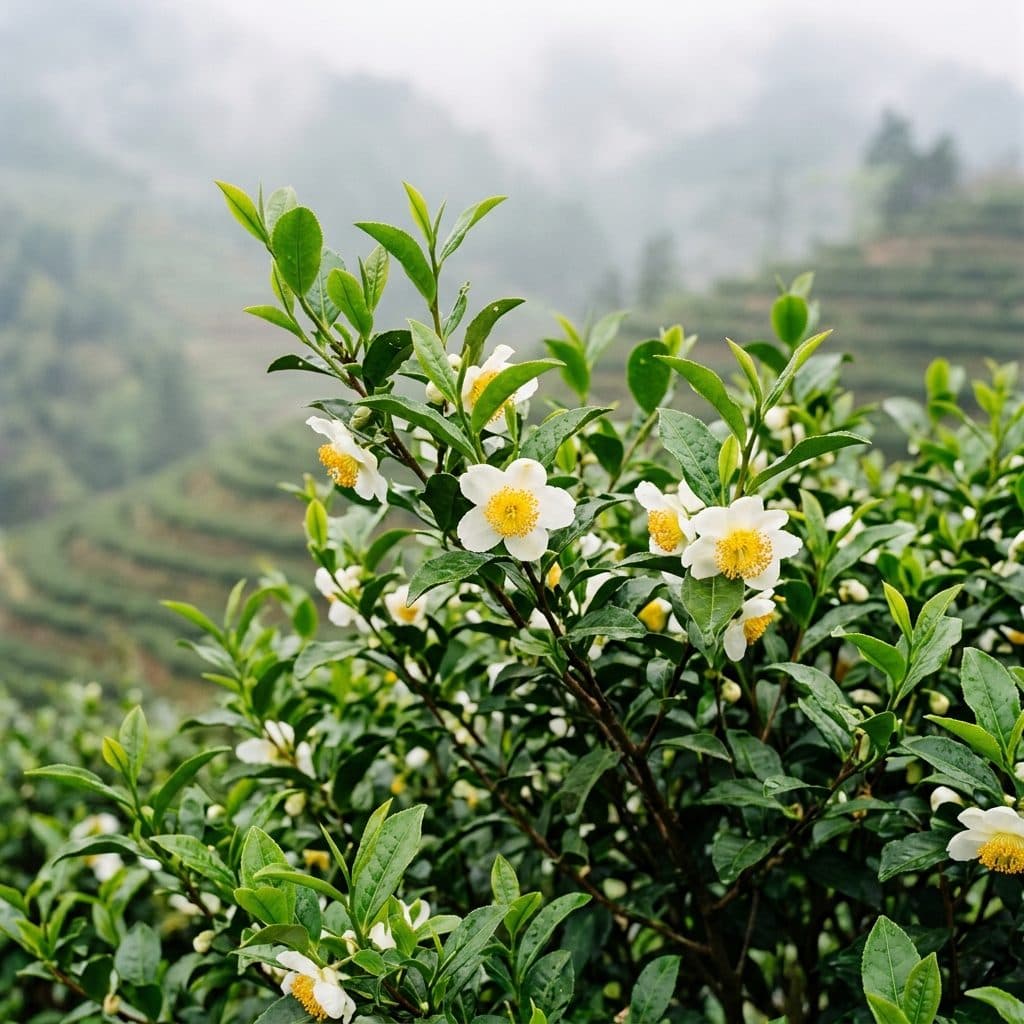
- Leaves: Alternate, simple, leathery, elliptic to oblong-lanceolate evergreen leaves measuring 5 to 12 cm (2 to 4.7 in) long and 2 to 4 cm (0.8 to 1.6 in) wide. Margins are finely serrated, with glandular teeth curving inward. The upper leaf surface is dark glossy green, while the lower surface is pale yellowish-green and dotted with tiny translucent glands. A distinctive field identification feature is the primary lateral veins, which curve gracefully upward and loop together just inside the leaf margin without running directly to the serration tips.
- Flowers: Nodding, solitary or clustered in groups of two to four in leaf axils during autumn and early winter. Blossoms measure 2.5 to 4 cm (1 to 1.6 in) across, consisting of seven to eight rounded, cupped white petals surrounding a central dome of numerous bright golden-yellow stamens.
- Fruit: A woody, three-lobed, trigonous capsule measuring 1.5 to 2 cm (0.6 to 0.8 in) across, splitting open when dry to release one to three rounded, dark brown seeds.
Tea is distinguished from ornamental camellias (Camellia japonica and Camellia sasanqua) by its smaller, simpler white flowers, relatively thinner, finely serrated leaves, and autumn-to-early-winter blooming habit.
Cautions
Cultivators and consumers of Camellia sinensis should heed several important chemical, physiological, and horticultural cautions:
- Caffeine and purine alkaloid toxicity: Tea leaves contain significant amounts of the central nervous system stimulant caffeine (1.5 to 3.5 percent of dry weight), alongside trace theobromine and theophylline. Ingestion of tea leaves, concentrated extracts, or tea grounds is toxic to domestic pets (dogs and cats) and livestock, causing acute restlessness, tachycardia, cardiac arrhythmias, muscle tremors, seizures, and potentially fatal cardiovascular collapse. In humans, excessive consumption of strong infusions can provoke insomnia, tachycardia, and anxiety.
- Inhibition of iron absorption: The concentrated polyphenols and condensed tannins in tea bind dietary non-heme iron in the human digestive tract, forming insoluble complexes that severely impede mineral absorption. Individuals suffering from iron-deficiency anaemia or pregnant individuals should avoid consuming strong tea with meals, allowing a one-to-two-hour buffer before or after eating.
- Oxalate content: Tea contains soluble oxalates, which can bind calcium to form insoluble calcium oxalate crystals. Individuals with a history of recurrent calcium oxalate kidney stones should consume tea in moderation and maintain adequate hydration.
- Root rot susceptibility: In poorly drained, heavy clay soils or over-irrigated containers, tea plants are highly susceptible to black root rot (Phytophthora cinnamomi). Always plant in raised beds or sloping ground to ensure rapid surface and subsoil drainage.
Sources
- Royal Botanic Gardens, Kew. Camellia sinensis (L.) Kuntze Plants of the World Online.
- USDA PLANTS Database. Camellia sinensis (L.) Kuntze
- Plants For A Future. Camellia sinensis - (L.)Kuntze.
- North Carolina State Extension Gardener Plant Toolbox. Camellia sinensis
- Missouri Botanical Garden. Camellia sinensis