secondary
Fiddleheads
Matteuccia struthiopteris
International hardiness
- USDA 2-7
- RHS H7
- AU: Cool temperate
Where it grows — regional guide
| Zones / rating | Regional notes |
|---|---|
USDA 2-7 | Common across the Northeast, Upper Midwest, and Pacific Northwest; must be harvested selectively to preserve wild stands and boiled thoroughly before eating. |
| Zones / rating | Regional notes |
|---|---|
H7 (below -20C) | Known widely as the shuttlecock fern; celebrated in damp woodland gardens and pond margins, but contain spreading rhizomes to protect neighbouring perennials. |
| Zones / rating | Regional notes |
|---|---|
Cool temperate | Grown as a shade ornamental in cool-temperate valleys of Tasmania and the southern mainland; requires continuous summer soil moisture to prevent frond scorch. |
| Zones / rating | Regional notes |
|---|---|
USDA 2-7 (USDA scale) Canada uses its own zone system; Canadian zones run roughly one lower than USDA. | Indigenous to river valleys and damp woods of Ontario, Quebec, and the Maritimes; harvest sustainably and boil thoroughly before eating to prevent acute foodborne illness. |
| Zones / rating | Regional notes |
|---|---|
No region-specific data yet | No region-specific data yet |
The ostrich fern (Matteuccia struthiopteris), widely celebrated in early spring culinary traditions as the source of true edible fiddleheads, is a crown-forming deciduous fern in the ostrich fern family (Onocleaceae). Indigenous across the cold-temperate Northern Hemisphere, including eastern and central Canada, the northern United States, northern Europe, and eastern Asia, the plant thrives in rich alluvial river bottoms, moist woodland hollows, and shaded stream banks.
In forest gardening, permaculture designs, and shaded homestead plots, the ostrich fern occupies a unique niche as a perennial gourmet vegetable and architectural groundcover. Known in Britain as the shuttlecock fern for the symmetrical, vase-like silhouette of its mature sterile fronds, a mature colony provides lush green canopy cover that suppresses weeds along damp pathways and water margins. It integrates seamlessly into damp woodland assemblies beneath canopy trees like white mulberry and alongside shade-tolerant groundcovers such as wild himalayan strawberry.
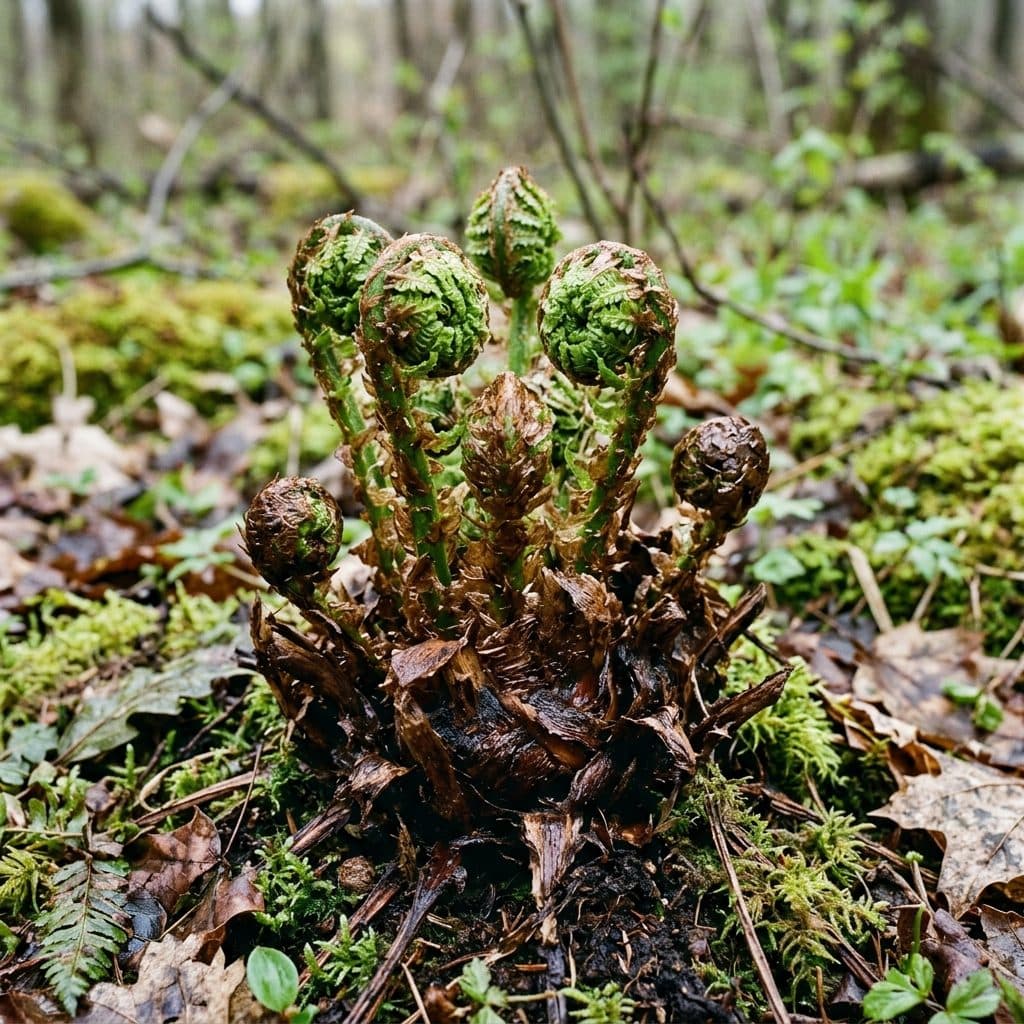
The tightly coiled emerging croziers—the fiddleheads—are harvested in spring as a celebrated wild delicacy. When properly prepared and cooked, fiddleheads offer a crisp, succulent texture and a refined flavour profile that evokes young asparagus, fresh green beans, and tender spinach with a subtle earthy undertone. Rich in iron, potassium, dietary fibre, and antioxidants, fiddleheads provide one of the earliest wild-harvested green foods of the northern growing season.
Growing ostrich fern
Ostrich fern is exceptionally cold-hardy, thriving across USDA Zones 2 to 7. Established crowns survive winter soil freezes down to -40 °C (-40 °F) under snow cover, bursting into growth as soon as soils thaw in early spring. However, the plant possesses little heat or drought tolerance. In hot summer climates or arid environments with low atmospheric humidity, the delicate sterile fronds scorch, brown around the margins, and senesce prematurely by midsummer.
Site plants in partial shade to full woodland shade. In northern latitudes with cool maritime summers, plants tolerate morning sun provided soil moisture is continuous; in warmer inland zones, full canopy shade is mandatory to maintain foliage quality. The ideal soil is rich, moist, organic-rich alluvial loam with a high proportion of decomposed leaf mould and a neutral to slightly acidic pH between 5.5 and 7.0. Ostrich fern is adapted to river floodplains and tolerates periodic seasonal flooding, but stagnant, foul, poorly aerated water should be avoided.
Consistent moisture is essential throughout the growing season. If rainfall is insufficient, provide supplemental watering to keep the root zone evenly moist. A generous mulch of shredded hardwood leaves or compost helps preserve soil moisture, cools the root run, and replicates the native forest floor.
Propagation is accomplished through crown division or by harvesting underground rhizomatous runners (stolons). While the fern reproduces by spores released from its specialised fertile fronds in late winter and early spring, vegetative propagation is vastly faster and more reliable for homesteaders. In early spring before croziers emerge, or in late autumn during dormancy, sever runner-connected crowns or lift established clumps using a sharp spade. Space individual crowns 60 cm to 1 m (2 to 3.3 ft) apart. The plants spread via creeping underground rhizomes, rapidly colonising suitable moist ground into dense, self-sustaining patches.
Harvest and uses
Fiddleheads emerge in early to mid-spring, typically during May across southern Canada and the northern United States. The harvest window is brief and demanding: croziers must be gathered when they are tightly curled, standing between 5 and 15 cm (2 to 6 in) above the soil crown. Once the coil begins to unfurl and separate into frond leaflets, the stem turns fibrous, bitter, and unpalatable.
Sustainable harvesting discipline is critical to preserve the health of the fern colony. Never harvest every fiddlehead from a crown; stripping an entire plant of its emerging fronds prevents it from producing foliage, depriving the rootstock of photosynthetic energy and causing the crown to die within one or two seasons. Adhere to the standard conservation rule: harvest no more than one-third of the croziers from any individual crown (typically two or three fiddleheads per plant), leaving the remaining coils to unfurl into the graceful summer fronds that sustain the root system.
Harvest by snapping or cleanly cutting the coiled croziers near the crown level. Place the harvest in cool containers shaded from sunlight. Fresh fiddleheads keep in cold refrigeration at 2 °C to 4 °C (36 °F to 39 °F) for up to seven days when stored in perforated plastic bags with moist paper towels.
Food safety preparation is mandatory: fiddleheads must never be eaten raw. Begin preparation by manually rubbing and washing away all loose, brown, papery parchment scales in several changes of cold water. Discard the wash water. Cook thoroughly by boiling in rolling boiling water for at least ten to fifteen minutes, or steam for ten to twelve minutes, and discard the cooking liquid completely. Boiled fiddleheads can then be sautéed with butter, minced garlic, and lemon juice, pickled in vinegar brine for autumn charcuterie, or added to quiches, risottos, and spring pasta dishes.
Identifying ostrich fern
Accurate botanical identification of Matteuccia struthiopteris is essential before harvesting wild fiddleheads:
- Growth form: Fronds emerge in a tight, circular, vase-shaped or shuttlecock cluster from an erect, stout, blackish woody rootstock standing slightly above the soil surface.
- Emerging crozier: The stem (stipe) of the emerging fiddlehead is smooth, completely hairless, and marked by a deep, distinct U-shaped groove down the inside, resembling a miniature stalk of celery.
- Scales: The curled head and upper stem are coated in thin, dry, papery, brown parchment-like scales that rub off easily between the fingers.
- Sterile summer fronds: Large, bright emerald-green, plumose, bipinnatifid fronds measuring 1 to 1.5 m (3.3 to 5 ft) in length and 20 to 35 cm (8 to 14 in) in width, tapering noticeably toward the base.
- Fertile fronds: Distinctive dimorphic fertile fronds appear in midsummer, standing 30 to 50 cm (12 to 20 in) tall. These are rigid, plume-like, dark brown to blackish spikes that persist erect through winter snow, releasing green spores the following spring.
Cautions
Anyone harvesting or cultivating ostrich ferns must rigorously adhere to food safety protocols and species identification:
- Foodborne illness and raw toxicity: Raw and lightly cooked ostrich fern fiddleheads contain an unidentified heat-labile natural toxin that causes acute, severe gastrointestinal illness. Symptoms include violent vomiting, nausea, abdominal cramping, and watery diarrhea developing within thirty minutes to twelve hours of ingestion, often requiring medical rehydration. Both Health Canada and the United States Food and Drug Administration (FDA) state that fiddleheads must never be consumed raw or lightly sautéed without prior thorough boiling (10 to 15 minutes) or steaming (10 to 12 minutes). Always discard the cooking water.
- Carcinogenic look-alike bracken fern (Pteridium aquilinum): The fiddleheads of common bracken fern are dangerous look-alikes. Bracken contains ptaquiloside, a potent, water-soluble, DNA-damaging carcinogen proven to induce stomach, bladder, and esophageal cancers in humans and livestock, as well as the enzyme thiaminase, which destroys vitamin B1. Bracken fronds emerge individually along creeping underground runners rather than from a central vase-shaped crown, lack the deep celery-like U-shaped groove, possess fuzzy or hairy stems, and lack papery brown scales. Never harvest bracken fiddleheads.
- Non-edible fern look-alikes: Cinnamon fern (Osmundastrum cinnamomeum) and interrupted fern (Claytosmunda claytoniana) also emerge in moist spring habitats. Their fiddleheads are covered in thick, woolly white or cinnamon hairs, and lack the clean U-shaped groove and papery scales of Matteuccia. Ingesting them causes gastrointestinal distress.
- Rhizomatous garden spread: In moist, loose soils, ostrich fern spreads aggressively by subterranean stolons. If planting in mixed perennial borders, establish edging or contain runners to prevent colonies from invading slower-growing shade perennials.
Sources
- Royal Botanic Gardens, Kew. Matteuccia struthiopteris (L.) Tod. Plants of the World Online.
- Health Canada. Food safety tips for fiddleheads
- Plants For A Future. Matteuccia struthiopteris - (L.) Tod.
- USDA PLANTS Database. Matteuccia struthiopteris (L.) Tod.