Key takeaways
- Hold root-zone pH at 4.5–5.5 for Ericaceae shrubs; above pH 6.0, iron locks into insoluble oxides and triggers interveinal chlorosis on newest shoots.
- Run the P0 free-lime gate before buying sulfur: fizzing soil (>2% CaCO3) or concrete drip-lines burn ~6 tons S/acre (~27.5 lb/100 sq ft) before pH moves—plant in raised 100% pine-bark or bark/peat mounds instead.
- Thiobacillus bacteria oxidize elemental sulfur over 60–90+ days in warm (>55°F), moist, aerated soil; cap established top-dressings at 1.0–1.5 lb/100 sq ft.
- Avoid aluminum sulfate (6× heavier than sulfur with Al3+ root toxicity), reserve iron sulfate for quick Fe2+ relief, and use ammonium (NH4+) nitrogen modestly for maintenance only.
- Treat every part of Rhododendron and azalea plants—leaves, flowers, nectar, and honey—as P0 grayanotoxin hazards for dogs, cats, children, horses, goats, sheep, and cattle.
Quick answer: Azaleas and rhododendrons need acidic, airy soil at pH 4.5–5.5 for shallow fibrous roots to absorb iron without salt burn. First run the white-vinegar test on dry soil: if it fizzes (>2% CaCO3) or borders concrete foundations, broadcast sulfur rebounds back to alkaline—build a 12–18 in. raised mound of aged pine bark and Canadian sphagnum peat instead. On non-calcareous soil above 55°F, mix elemental sulfur 6 in. deep by texture (1.5–1.9 lb/100 sq ft sand, 3.0–6.5 lb loam, 5.9–8.8 lb split over clay from pH 7.0) and allow 60–90+ days for Thiobacillus oxidation.
Why Ericaceae Roots Demand pH 4.5–5.5 and Low Soluble Salts
Azaleas and rhododendrons belong to the genus Rhododendron (Ericaceae). They anchor in the top 6 to 10 inches of forest duff via fine fibrous roots lacking root hairs, relying on ericoid mycorrhizal fungi for nutrient uptake. Woodland acid-lovers like ornamental camellias and tea plants (Camellia sinensis) share this architecture and thrive at pH 4.5–5.5.
Above pH 6.0, dissolved iron and manganese precipitate into insoluble hydroxides. Roots starve even in iron-rich red clay, turning new shoots bright yellow with dark-green veins—classic iron chlorosis. Our soil pH nutrient availability chart shows how rapidly micronutrient solubility collapses between pH 5.5 and 7.2.
Shallow Ericaceae roots also sit between two fast killers: salt burn and root rot. Over-applying soluble sulfate fertilizers spikes soil electrical conductivity (EC), scorching fine feeder tips. Salt-burned, poorly drained roots rapidly succumb to Phytophthora cinnamomi water mold in soggy clay, producing wilted gray-green foliage in wet ground as detailed in our root rot diagnosis guide.
The P0 Free-Lime Gate: Test Before Broadcasting Elemental Sulfur
Before applying acidifiers, pull 6-inch root-zone samples and submit a composite sample to a land-grant lab ($15–$35) via our Cooperative Extension soil testing guide. Cheap dye kits degrade quickly and misread alkaline soils; use how to read a soil test and pH, CEC, and organic matter targets to verify exact pH and buffer capacity.
The 30-second white-vinegar fizz test and concrete edge check
Calcareous soils across the Midwest, Great Plains, and West hold free lime (calcium carbonate, CaCO3). Submerge one heaping tablespoon of crumbled dry soil in household 5% white vinegar inside a glass cup and watch for 60 seconds:
- Zero bubbles: Free lime is absent; elemental sulfur lowers soil pH reliably for five or more years.
- Steady fizz or foam: Free CaCO3 exceeds ~1%–2%. Ohio State Extension (`AGF-507`) shows 2% free CaCO3 consumes 6 tons S/acre (~27.5 lb/100 sq ft) just to neutralize carbonates before pH moves.
- Concrete, mortar, and stucco edges: New sidewalks, foundations, and stucco leach calcium hydroxide for years, holding foundation beds at pH 7.4–8.2.
P0 Free-Lime / Calcareous Soil Futility Gate: If dry soil fizzes in vinegar, lab free lime exceeds 2%–5% CaCO3, or shrubs sit within 2–3 ft of concrete foundations, stop broadcasting sulfur. Carbonates neutralize acid amendments so soil rebounds alkaline while sulfur salts burn roots. Build a raised pine-bark mound or plant in acidic containers instead.
Building a raised 100% pine-bark or bark-peat mound on alkaline ground
Check subsoil drainage first using our soil drainage percolation test. Over tight clay or calcareous ground, construct a broad 12–18 in. tall, 3–4 ft wide raised mound directly atop native soil—following raised bed gardening drainage rules rather than digging a clay sump hole that drowns roots.
Fill the mound with 100% aged/composted pine bark fines (1/8–3/8 in.) or a 70% aged pine bark + 30% coarse Canadian sphagnum peat moss mix (`pH 3.8–4.8`). Ohio State pathologist Harry Hoitink proved composted pine bark maintains high air porosity while biologically suppressing Phytophthora root rot compared with peat alone. Set each root ball 1–2 in. proud of grade.
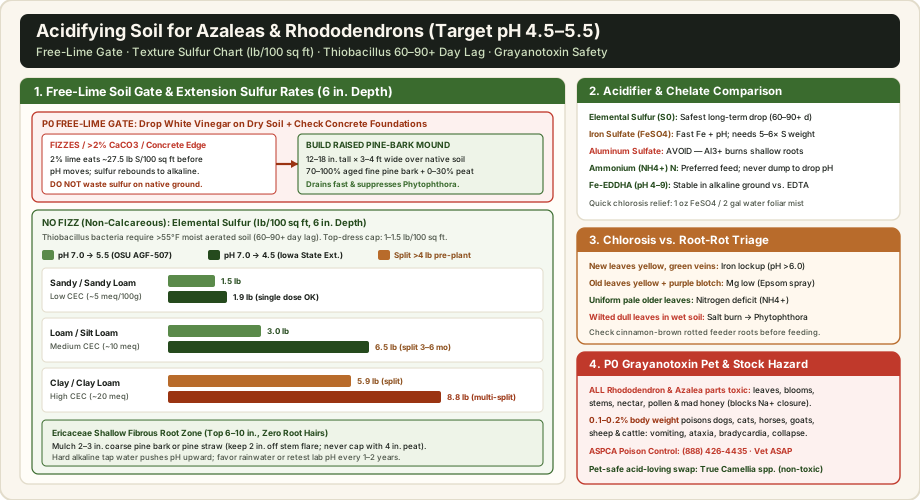
University Extension Elemental Sulfur Tables by Soil Texture
On non-calcareous soil passing the vinegar test, elemental sulfur (90%–99% S) gives the safest multi-year acidification. Because sulfur is insoluble, soil Thiobacillus bacteria must oxidize it into sulfuric acid (`H2SO4`, releasing `2 H+`). This biological reaction requires warm soil (>55°F), consistent moisture, and oxygen.
Plan on a 60–90+ day biological lag for early pH movement and 3–6 months for full equilibration; winter applications sit dormant until spring soil passes 55°F. Confirm texture via a lab report or our mason jar soil texture test and USDA soil texture triangle, since clay CEC resists pH shifts far more than sand.
University Extension Elemental Sulfur Rates (lb per 100 sq ft, 6 in. Depth) for Non-Calcareous Soil
Starting Soil pH | Target pH | Sandy / Sandy Loam (CEC ~5 meq) | Loam / Silt Loam (CEC ~10 meq) | Clay / Clay Loam (CEC ~20 meq) |
|---|---|---|---|---|
6.0 | 4.5–5.0 | 1.2 lb | 3.8 lb | 5.3 lb (split 2 doses) |
6.5 | 5.5 | 0.5–0.9 lb | 1.5–2.0 lb | 2.5–3.0 lb |
6.5 | 4.5–5.0 | 1.5 lb | 5.0 lb (split 2 doses) | 7.0 lb (split 2–3 doses) |
7.0 | 5.5 | 1.5 lb | 3.0 lb | 5.9 lb (split 2 doses) |
7.0 | 4.5–5.0 | 1.9 lb | 6.5 lb (split 2–3 doses) | 8.8 lb (split 3 doses) |
7.5 | 5.5 | 1.7 lb | 3.5 lb | 7.0 lb (split 2–3 doses) |
Pre-plant incorporation vs. established shrub safety limits
These Ohio State (`AGF-507`), Iowa State, and American Rhododendron Society baselines assume 6-inch mixing. Enforce single-dose limits to avoid root burn:
- Pre-plant beds: Incorporate up to 4–5 lb elemental sulfur per 100 sq ft max into the top 6–8 in. at least 3–6 months before planting in warm moist soil (`>55°F`), splitting larger clay totals across spring and autumn.
- Established shrubs: Never till deep near surface roots. Scratch 1.0–1.5 lb/100 sq ft max into the top 1 in. beneath mulch, water deeply, and wait 3–6 months to retest before repeating.
- Wettable vs. prilled sulfur: Fine wettable or micro-prilled sulfur (`80–90% S`) gives Thiobacillus higher surface area than coarse pellets, cutting lag time without increasing total poundage.
Compare these rates with our elemental sulfur guide, gypsum, lime, and sulfur guide, and blueberry acidification chart.
Elemental Sulfur vs. Iron Sulfate, Aluminum Sulfate & Ammonium Nitrogen
Rapid chemical acidifiers and nitrogen salts act differently in shallow root zones. Choosing the wrong sulfate burns fibrous roots or poisons nearby beds.
Soil Acidifiers & Iron Chelates Compared for Azaleas, Rhododendrons & Camellias
Amendment / Chelate | Mechanism & Speed | Weight vs. Sulfur & Rate | Root-Zone Trade-Off & Safety Verdict |
|---|---|---|---|
Elemental Sulfur (90%–99% S) | Thiobacillus oxidation; 60–90+ days (>55°F) | 1× baseline (1.0–1.5 lb/100 sq ft established max) | Safest, lowest-salt durable drop in non-calcareous soil |
Iron (Ferrous) Sulfate (FeSO4·7H2O) | Hydrolysis + Fe2+; fast (2–4 weeks) | 5–6× sulfur weight; foliar mist 1 oz / 2 gal water | Good short-term Fe relief; heavy soil rates spike EC salts and burn roots |
Aluminum Sulfate (Al2(SO4)3) | Hydrolysis releasing Al3+; fast (1–3 weeks) | ~6× sulfur weight | AVOID — soluble Al3+ causes severe root toxicity on azaleas and edibles |
Ammonium Sulfate (21-0-0, NH4+) | Nitrification releases H+; mild upkeep | Feed to N need (~0.5–1 lb/100 sq ft/yr max) | Preferred NH4+ N source, but bulk pH-drop dosing burns roots with salt |
Sphagnum Peat & Aged Pine Bark | Organic acidity (pH 3.5–4.5); immediate in mounds | 30%–100% mound volume; 2–3 in. bark mulch | Boosts aeration and suppresses Phytophthora; avoid >2 in. raw peat cap |
Chelated Iron: Fe-EDDHA / DTPA / EDTA | Protected Fe uptake; 5–14 days | Label drench (0.25–0.5 lb/100 sq ft) or foliar mist | EDDHA holds to pH 9.0; DTPA quits at 7.5; EDTA fails above pH 6.5 |
Why aluminum sulfate harms azaleas, rhododendrons, and edibles
Although aluminum sulfate drops pH rapidly to shift hydrangea bloom color, Clemson, Virginia Tech, Colorado State, and Iowa State Extensions warn against using it on azaleas or rhododendrons. It demands ~6× the weight of elemental sulfur, flooding the root zone with free Al3+ ions that blacken shallow root tips and contaminate adjacent blueberries or potatoes.
Iron sulfate vs. chelates and Ericaceae ammonium (NH4+) nitrogen preference
Ferrous sulfate delivers quick `Fe2+`—especially as a 1 oz per 2 gal water foliar mist—but needs 5–6× elemental sulfur weight for bulk soil drops, risking soluble-salt burn. For alkaline beds (`pH 6.5–8.5`), drench Fe-EDDHA (stable to pH 9.0) rather than Fe-EDTA (ineffective above pH 6.5).
Because Ericaceae shrubs lack strong nitrate-reductase enzymes, they prefer ammonium (`NH4+`) over nitrate (`NO3-`) nitrogen. Light spring feeds of ammonium sulfate (`21-0-0`) or cottonseed meal gently sustain acidity as `NH4+` oxidizes, whereas heavy ammonium sulfate dumps burn roots before shifting bulk pH, similar to western alkaline soils. Skip coffee grounds (`pH 6.2–6.8`); as shown in our peat and coffee grounds guide, they pack minimal acidifying buffer.
Diagnosing Leaf Chlorosis, Irrigation Alkalinity & Mulch Depth
Yellowing leaves do not always mean high pH. Applying sulfur onto root-rotted or magnesium-starved bushes worsens stress. Separate symptoms cleanly:
Azalea & Rhododendron Leaf Yellowing, Root Stress & Nutrient Triage Matrix
Visual Leaf & Root Pattern | Likely Cause | Confirming Check | Corrective Action |
|---|---|---|---|
New tip leaves yellow; veins crisp green | Iron chlorosis (pH >6.0 or soggy spring soil) | Lab pH >6.0 or concrete-edge fizz | Drench Fe-EDDHA + mist FeSO4 (1 oz/2 gal); lower pH or build pine-bark mound |
Old lower leaves yellow with purple-red blotches | Magnesium deficiency (leached sand) | New tips stay green; old leaves drop | Spray Epsom salts (1 oz MgSO4/gal water); amend dolomitic grit only if lab Mg is low |
Uniform pale yellow on older inner leaves | Nitrogen deficit or raw wood-chip tie-up | Short annual shoots (<2 in.) without green veins | Light NH4+ feed (cottonseed meal) at spring budbreak |
Dull gray-green wilt in wet soil; brown margins | Salt burn or Phytophthora root rot | Scratch root crown: cinnamon-brown dead tissue | Stop fertilizer; raise onto pine-bark mound; uncover buried stem flare |
Hard municipal water, rainwater harvesting, and pine mulch
Hard municipal or well water (`100–250+ ppm CaCO3`) steadily pushes acidified beds back above pH 6.0, just as seen in acidifying soil and water. Water with rainwater harvesting barrels (`pH 5.6–6.2`) when possible and retest soil every 1–2 years. Top beds with 2–3 in. of coarse aged pine bark, pine straw, or oak leaf mold—kept 2–3 in. off the stem flare—and skip thick peat surface caps that crust dry. Pair borders with acid-loving companions from our mulching guide like ostrich ferns, aronia, haskap, red currants, and strawberries.
P0 Safety Alert: Grayanotoxin Toxicity to Pets, Livestock & Children
P0 Toxic Plant Alert (Grayanotoxins): Every Rhododendron species—including all evergreen and deciduous azaleas—packs potent grayanotoxins in leaves, blooms, stems, nectar, pollen, and Rhododendron ('mad') honey. Ingesting just 0.1%–0.2% of body weight in leaves can fatally poison dogs, cats, horses, goats, sheep, and cattle, and severely poison children chewing flowers or nectar.
Grayanotoxins lock open voltage-gated sodium channels in nerve and cardiac muscle cells. Per the ASPCA Animal Poison Control Center and MSD Veterinary Manual, signs hit within minutes to hours: drooling, vomiting (dogs/cats; ruminants regurgitate froth while horses cannot vomit), diarrhea, colic, ataxia, weakness, transient blindness, bradycardia, hypotension, arrhythmias, seizures, and collapse.
- Emergency action: Call ASPCA Poison Control at (888) 426-4435, a vet, or human Poison Control at (800) 222-1222 immediately. Never induce vomiting at home without veterinary instruction due to aspiration risk.
- Pasture and pruning hygiene: Goats and sheep readily browse evergreen rhododendrons in winter; keep shrubs outside livestock fences and bag pruned clippings securely.
- Pet-safe substitute: True ornamental camellias and Camellia sinensis share the exact pH 4.5–5.5 woodland bed and are non-toxic to dogs, cats, and horses per ASPCA.