support
Yellow rattle
Rhinanthus minor
International hardiness
- USDA 3-8
- RHS H7
Where it grows — regional guide
| Zones / rating | Regional notes |
|---|---|
USDA 3-8 | Adaptable in northern and northeastern states for meadow conversion; must be sown into scarified turf with existing perennial grass hosts. |
| Zones / rating | Regional notes |
|---|---|
H7 (below -20C) | The fundamental ecological engine of British species-rich wildflower meadows; sow fresh seed in autumn to ensure cold winter stratification. |
| Zones / rating | Regional notes |
|---|---|
No region-specific data yet | No region-specific data yet |
| Zones / rating | Regional notes |
|---|---|
USDA 3-8 (USDA scale) Canada uses its own zone system; Canadian zones run roughly one lower than USDA. | Suitable across eastern Canada and cool temperate prairies down to Zone 3; requires sustained winter freeze-thaw cycles for spring germination. |
| Zones / rating | Regional notes |
|---|---|
No region-specific data yet | No region-specific data yet |
Yellow rattle (Rhinanthus minor), historically called hayrattle, cockscomb, or the meadow maker, is an upright annual forb in the broomrape family (Orobanchaceae). In ecological restoration, yellow rattle acts as a natural botanical biological control agent. The plant is a facultative hemiparasite: while its green foliage contains chlorophyll and conducts photosynthesis, its root system forms specialised penetrating structures called haustoria that tap into the roots of neighbouring grasses and legumes, drawing off water and dissolved mineral nutrients.
Native across the British Isles, Europe, and northern North America, yellow rattle thrives in unimproved grasslands, hay meadows, coastal machair, and alpine pastures. In an ordinary lawn or neglected pasture, vigorous perennial grasses quickly form a dense mat that smothers broadleaved wildflowers. By parasitising these dominant grasses, yellow rattle reduces their competitive vigour by 50 to 60 percent, creating physical gaps so that slower-growing meadow flowers like red clover, white clover, and wild carrot can germinate and establish.
For homesteaders and orchardists, establishing yellow rattle is the single most effective intervention for converting coarse pasture into a stable, species-rich wildflower sward. The yellow blossoms provide nectar for bumblebees throughout early summer, while drying seed pods create the distinctive rustling sound in late July that historically signalled to farmers that hay meadows were ready for the scythe.
Growing yellow rattle
Establishing yellow rattle requires adherence to its ecological lifecycle. Unlike standard pasture seed, yellow rattle cannot simply be scattered across untended grass; it requires specific host connections, scarified soil contact, and winter cold.
Yellow rattle thrives across well-drained loams, chalky soils, and sandy clays with a neutral to moderately calcareous pH between 6.0 and 7.5. Excessively fertile soils work against yellow rattle: high residual nitrogen encourages explosive grass regrowth that outpaces parasitic suppression. Avoid applying synthetic fertiliser, manure, or compost to meadow areas intended for yellow rattle.
Full sunlight is essential. Yellow rattle naturally inhabits open grassland; shaded woodland edges or heavy canopies cause seedlings to weaken and die before flowering.
Sowing requires autumn timing and thorough ground preparation. Seeds possess an absolute dormancy broken only by cold, moist stratification lasting 12 to 16 weeks at temperatures between 0 and 5 °C (32 and 41 °F). Attempting to sow yellow rattle seed in spring without prior stratification invariably results in zero germination.
In late autumn, between August and November, cut existing meadow grass as short as possible, down to 2.5 cm (1 in), and remove clippings to reduce ground fertility. The most critical step is scarification: vigorously rake the area until roughly 50 percent bare soil is visible between grass crowns. Broadcast fresh yellow rattle seed evenly at a rate of 0.5 to 1 g per square metre (roughly 5 to 10 kg per hectare). Tread or roll the area firmly to ensure close seed-to-soil contact; do not bury the seed beneath the surface, as seeds require light to trigger spring germination.
Seedlings emerge in March and April. As roots grow, they seek out host grass roots, penetrating them with haustoria within two to three weeks of emergence. Seedling growth then accelerates, reaching mature flowering heights of 20 to 50 cm (8 to 20 in) by late May or early June.
Meadow management during the first season determines permanent success. Do not cut or graze the area between early April and late July. Allow plants to flower, set seed, and dry completely on the stem. By late July, seed pods turn papery brown and rattle audibly. Cut the meadow with a scythe or high-set mower in August, leaving cut material on the ground for seven to ten days to shed ripe seed before raking off the hay.
Harvest and uses
Yellow rattle is grown as an ecological management tool and wildlife forage rather than a food crop. Its primary yield is the suppression of coarse grasses and the creation of high-diversity conservation hay.
For seed collection, monitor pods in late July as they turn pale buff and papery. Harvest ripe stems on a dry afternoon by cutting seedheads into a clean bucket. Spread the collected stems in an airy shed to dry for several days, then thrash pods gently to release the flat, winged seeds. Because seed viability declines significantly within 12 to 18 months, harvested seed should be sown the same autumn.
Traditional meadow hay cut from yellow rattle swards provides diverse, aromatic fodder for sheep and cattle. The reduced bulk of coarse grass is compensated for by the higher proportion of nitrogen-rich legumes and herbs that colonise gaps opened by yellow rattle.
Identifying yellow rattle
Yellow rattle is characterised by distinctive botanical features:
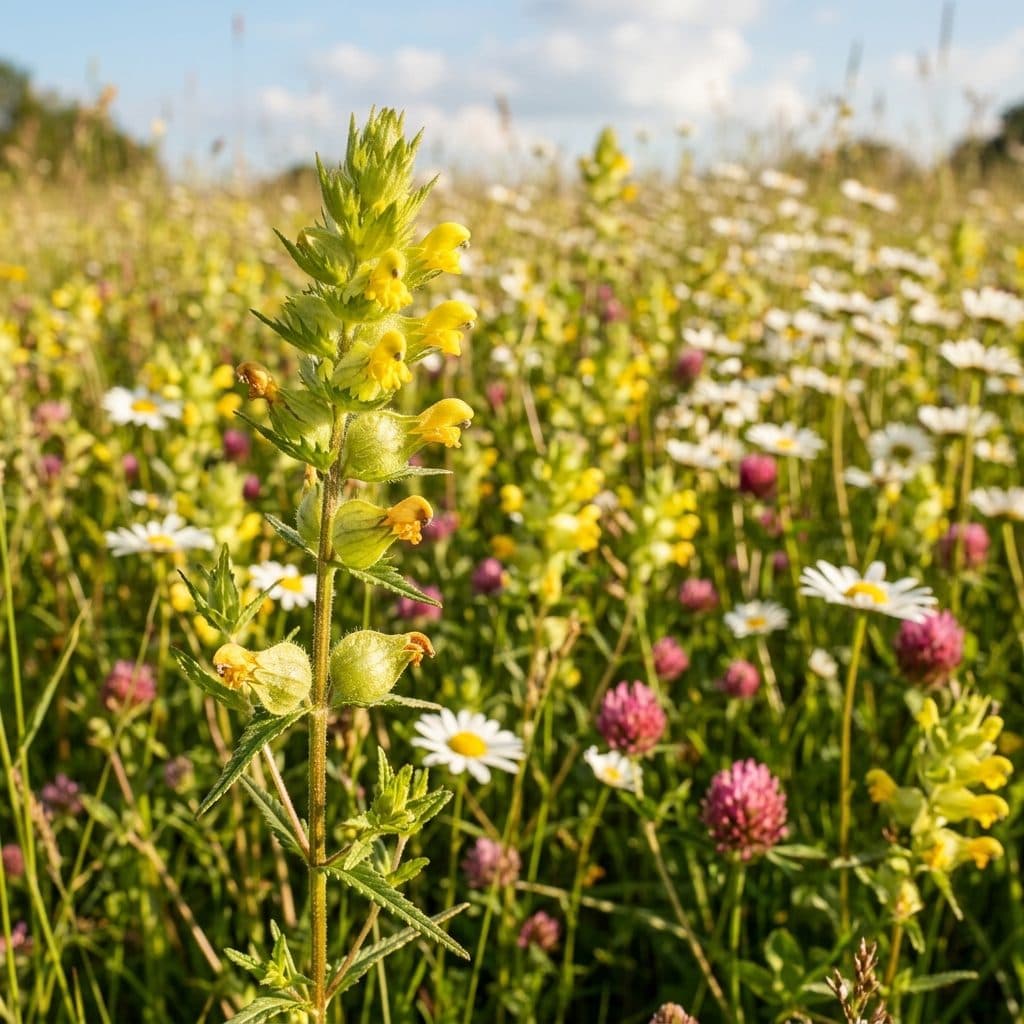
- Habit: Erect annual herb growing 20 to 50 cm (8 to 20 in) in height. Stems are stiff, four-angled, and marked with dark purple or black longitudinal spots.
- Leaves: Opposite, sessile, lanceolate to linear-oblong, 2 to 5 cm (0.8 to 2 in) long and 0.5 to 1.5 cm (0.2 to 0.6 in) wide, with coarsely saw-toothed margins.
- Inflorescence: Dense terminal spike bearing prominent, pale green, bladder-like inflated bracts below each flower.
- Flowers: Two-lipped tubular flowers measuring 12 to 15 mm (0.5 to 0.6 in) long. The upper lip forms a yellow hood tipped with two small violet-blue teeth, while the lower lip is three-lobed and yellow.
- Seed capsules: Flattened, papery, inflated calyx capsules measuring 1 to 1.5 cm (0.4 to 0.6 in) across. When mature, the capsule encloses loose, flat, winged brown seeds that rattle freely when shaken.
It is distinguished from greater yellow rattle (Rhinanthus angustifolius), which grows taller (up to 80 cm / 32 in) with longer flowers and slender bract teeth. It is separated from eyebrights (Euphrasia species) by its larger, tubular yellow flowers rather than small white or lilac blossoms.
Cautions
Growers utilising yellow rattle should understand its ecological behaviour and chemical liabilities:
- Livestock toxicity (aucubin): Rhinanthus minor contains the iridoid glycoside aucubin. While mature plants dried in summer hay are eaten safely by livestock in moderate amounts, fresh pasture containing high proportions of yellow rattle can cause digestive irritation in grazing livestock, particularly horses and calves. Avoid using yellow rattle in high-density equine grazing paddocks.
- Obligate hemiparasitic requirement: Yellow rattle cannot survive without root hosts. Sowing yellow rattle on bare, weeded soil or sterile compost leads to seedling starvation. Seedlings must encounter living grass or legume roots to survive past early leaf stages.
- Seed viability and cold dormancy: Yellow rattle seeds lose viability rapidly if stored dry. Sowing older seed or sowing in spring without winter chilling results in total failure. Always purchase fresh, current-year seed and sow in autumn.
- Vulnerability to early mowing: Because yellow rattle is a strict annual, populations rely on seeds shed between late July and August. Mowing or heavy grazing between April and mid-July will eliminate plants before seed set, eradicating the species in a single season.
- Meadow balance: In poor soils, yellow rattle can suppress grass so severely that bare ground is exposed to thistle or dock invasion. If rattle becomes excessively dense, cut the meadow in early June before seed sets to reduce the population.
Sources
- Royal Botanic Gardens, Kew. Rhinanthus minor L. Plants of the World Online.
- Royal Horticultural Society. Rhinanthus minor (yellow rattle)
- Plants For A Future. Rhinanthus minor - L.