Key takeaways
- Test your soil pH with an accurate laboratory assay before applying lime; most garden vegetables thrive best between pH 6.2 and 6.8.
- Choose calcitic limestone (calcium carbonate) for soils already high in magnesium, or dolomitic limestone (calcium magnesium carbonate) if magnesium is deficient.
- Account for soil texture buffering capacity; heavy clay and organic soils require twice as much lime as light sandy loams to achieve the same pH shift.
- Apply lime in late fall so freeze-thaw cycles and soil moisture have two to three months to neutralize soil acidity before spring planting.
- Never apply lime simultaneously with high-nitrogen animal manure or ammonium fertilizers, as chemical reactions cause nitrogen to volatilize into ammonia gas.
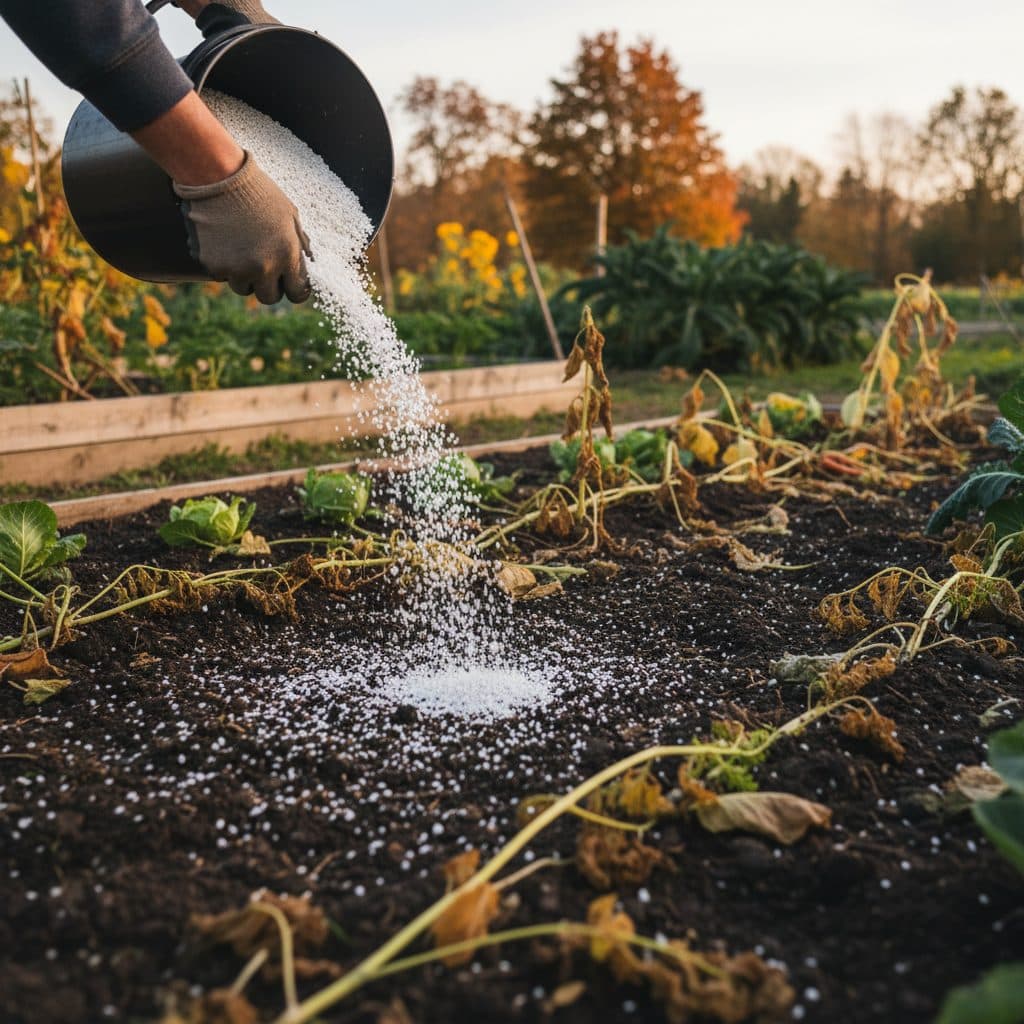
Quick answer: Adding lime to soil raises the pH of acidic ground (below 6.0) to an optimal target of 6.2 to 6.8, making phosphorus available to plant roots and reducing aluminum and manganese toxicity. Apply 3 to 4.5 pounds of pelletized calcitic or dolomitic limestone per 100 square feet on sandy soils, or 8 to 10 pounds on heavy clay loams, based strictly on a soil test. Apply in late fall and rake into the top 4 to 6 inches of soil.
Soil acidity is a common limiting factor for vegetable gardeners across high-rainfall regions of North America, including the Pacific Northwest, the Northeast, and the Southeast. High precipitation leaches basic alkaline cations (calcium, magnesium, and potassium) from the topsoil, leaving behind acidic hydrogen and aluminum ions.
When soil pH drops below 6.0, phosphorus becomes chemically bound to iron and aluminum, making it unavailable to plant roots regardless of how much fertilizer you apply. Beneficial soil bacteria and earthworms also slow their activity in acidic environments.
Adding agricultural lime neutralizes excess acidity, supplies essential calcium and magnesium, and improves soil structure. However, calculating the correct dosage and choosing between calcitic and dolomitic formulations is essential to prevent over-liming and nutrient lock-out.
Understanding soil pH and nutrient availability
The pH scale measures hydrogen ion concentration logarithmically; a soil with a pH of 5.0 is ten times more acidic than a soil with a pH of 6.0.
+-------------------------------------------------------------------+
|               SOIL pH AND NUTRIENT AVAILABILITY SPECTRUM          |
|                                                                   |
|   pH 4.5 - 5.5 (Strongly Acidic)                                  |
|   [-] Aluminum and manganese toxicity; phosphorus locked to iron  |
|                                                                   |
|   pH 6.2 - 6.8 (OPTIMAL VEGETABLE RANGE)                          |
|   [*] Maximum phosphorus availability; reduced Al/Mn toxicity     |
|                                                                   |
|   pH 7.5 - 8.5 (Alkaline / Calcareous)                            |
|   [-] Iron, zinc, manganese, and phosphorus unavailable           |
+-------------------------------------------------------------------+
+------------------------+-------------------+-----------------------------------------+
| Crop Group | Ideal pH Range | Acid Sensitivity |
+------------------------+-------------------+-----------------------------------------+
| Brassicas (Broccoli) | 6.5 to 7.2 | Highly sensitive (acid encourages clubroot)|
| Solanaceous (Tomatoes) | 6.2 to 6.8 | Moderate; demands available calcium |
| Legumes (Beans, Peas) | 6.0 to 6.8 | Moderate; rhizobia bacteria need calcium|
| Acid Lovers (Blueberry)| 4.5 to 5.2 | Stunted and chlorotic if limed |
| Root Crops (Potatoes) | 5.0 to 5.5 | High pH (>6.0) promotes potato scab |
+------------------------+-------------------+-----------------------------------------+Because potatoes develop bacterial scab in limed soils with a pH above 6.0 and blueberries require acidic conditions (pH 4.5 to 5.2), never lime your entire garden uniformly. Always treat individual garden beds according to crop needs.
Types of garden lime: calcitic vs dolomitic
Not all garden lime products are identical. The two primary forms of agricultural limestone supply different mineral balances.
+------------------------+-----------------------+-----------------------------------+-------------------------------------------------------------+
| Lime Type              | Chemical Composition  | Calcium / Magnesium Ratio         | Best Application                                            |
+------------------------+-----------------------+-----------------------------------+-------------------------------------------------------------+
| Calcitic Limestone     | Calcium carbonate     | High Calcium (~35%), Low Mg (<2%) | Soils with high magnesium                                   |
| Dolomitic Limestone    | Ca/Mg carbonate       | Balanced (20% Ca, 10-12% Mg)      | Sandy, Mg-deficient soils                                   |
| Hydrated / Slaked Lime | Calcium hydroxide     | Caustic, fast-acting              | Avoid in home gardens                                       |
| Wood Ash               | Potassium/Ca carbonate| Variable Ca + high Potassium      | Fast-acting and easy to over-apply; use sparingly and re-test|
+------------------------+-----------------------+-----------------------------------+-------------------------------------------------------------+
+-------------------------------------------------------------------+
| HOW TO CHOOSE BETWEEN CALCITIC AND DOLOMITIC |
| |
| Check Soil Test Magnesium Levels: |
| - If Magnesium is LOW (<10% base saturation) --> Use DOLOMITIC |
| - If Magnesium is OPTIMAL or HIGH (>15%) --> Use CALCITIC |
+-------------------------------------------------------------------+Using dolomitic lime on soils that already possess high magnesium levels tightens heavy clay soils and causes potassium deficiencies. Conversely, sandy soils prone to magnesium deficiency benefit greatly from dolomitic limestone.
Compare soil amendments and mineral balances in gypsum lime sulfur soil test and explore fast-acting alkaline options in wood ash garden use guide.
Application rates by soil texture
The amount of lime required to shift soil pH depends heavily on soil texture and cation exchange capacity (CEC). Heavy clay soils and soils rich in organic matter resist pH changes far more than light, sandy ground.
+-------------------------------------------------------------------+
|     POUNDS OF AGRICULTURAL LIME PER 100 SQ FT TO RAISE pH BY 1.0  |
+-------------------------------------------------------------------+
| - Sandy / Light Sandy Loam:    3.0 to 4.5 lbs per 100 sq ft       |
| - Medium Loam / Silt Loam:     6.0 to 7.5 lbs per 100 sq ft       |
| - Heavy Clay / Clay Loam:      8.0 to 10.0 lbs per 100 sq ft      |
|- High Organic / Peat Soil:    10.0 to 12.0 lbs per 100 sq ft (split application) |
+-------------------------------------------------------------------+
+------------------------+-------------------+-------------------+---------------------------------------------------------------------------+
| Starting Soil pH | Sandy Soil Rate | Loam Soil Rate | Clay Soil Rate |
+------------------------+-------------------+-------------------+---------------------------------------------------------------------------+
| 5.0 (Shift to 6.5) | 5.0 lbs / 100 sq ft| 9.0 lbs / 100 sq ft| 12.0 lbs / 100 sq ft (split into two 6 lb applications six months apart) |
| 5.5 (Shift to 6.5) | 3.5 lbs / 100 sq ft| 6.0 lbs / 100 sq ft| 8.0 lbs / 100 sq ft |
| 6.0 (Shift to 6.5) | 2.0 lbs / 100 sq ft| 3.0 lbs / 100 sq ft| 4.5 lbs / 100 sq ft |
+------------------------+-------------------+-------------------+---------------------------------------------------------------------------+Never apply more than 10 pounds of lime per 100 square feet in a single application. If your soil is extremely acidic (pH below 5.0) and requires larger amounts, split the application into two doses applied six months apart.
For managing dense, mineral-rich ground, see plants for clay soil.
Timing and application method
Limestone is relatively insoluble in water; it requires contact with soil moisture and acidic soil particles to undergo the chemical reaction that neutralizes hydrogen ions.
+-------------------------------------------------------------------+
|               STEP-BY-STEP LIME APPLICATION PROCEDURE             |
|                                                                   |
| 1. Test Soil:     Conduct a reliable lab soil test in early fall  |
| 2. Weigh Product: Measure exact pounds of pelletized limestone    |
| 3. Broadcast:     Spread evenly across bare bed using a spreader  |
| 4. Incorporate:   Rake or broadfork into top 4 to 6 inches        |
| 5. Water In:      Moisten thoroughly to activate breakdown        |
+-------------------------------------------------------------------+
Why fall is the best time to lime
Fall is the ideal season for adding lime to soil. Winter rainfall, freeze-thaw cycles, and soil moisture allow the limestone particles to dissolve and react over several months. By the time spring planting arrives, the root zone has stabilized at the desired pH.
Pelletized vs pulverized limestone
Choose pelletized lime for home gardens. Pelletized limestone consists of finely pulverized stone bound into uniform, dust-free granules with a water-soluble binding agent. The pellet breaks apart quickly on contact with rain or irrigation, releasing the fine limestone to begin reacting with the soil over the following months.
Avoiding dangerous chemical interactions and over-liming
Improper liming practices can damage soil ecology and waste expensive nutrients.
+------------------------+-------------------+-----------------------------------------+
| Liming Mistake         | Chemical Reaction | Consequence                             |
+------------------------+-------------------+-----------------------------------------+
| Lime + Fresh Manure    | Alkaline reaction | Volatilizes nitrogen into ammonia gas   |
| Lime + Soluble P       | Insoluble complex | Locks phosphorus into calcium phosphate |
| Over-Liming (pH > 7.5) | Cation imbalance  | Induces iron, boron, and zinc chlorosis |
| Hydrated Lime Overuse  | Fast caustic burn | Kills beneficial soil fungi and worms   |
+------------------------+-------------------+-----------------------------------------+
Always maintain a separation of at least three to four weeks between applying agricultural lime and spreading animal manure or high-nitrogen fertilizers.
Proper calcium levels from lime also help prevent physiological disorders such as blossom end rot in solanaceous crops, as detailed in tomato blossom end rot calcium water and deficiency diagnosis in magnesium calcium deficiencies tomato cucurbit.
Re-test your garden soil every two to three years to monitor pH drift and maintain fertile, biologically active growing conditions.