Key takeaways
- Hugelkultur beds significantly increase water retention, reducing irrigation needs by up to 50% in dry climates.
- The slow decomposition of wood within hugelkultur mounds generates consistent soil warmth, extending growing seasons by several weeks.
- Integrating hugelkultur with permaculture principles like swales and plant guilds maximizes water harvesting and nutrient cycling.
- Ideal for USDA zones 6-10, hugelkultur improves soil structure, aeration, and nutrient availability over many years.
- Careful site assessment and material selection are necessary for successful hugelkultur construction in dry regions.
Quick answer: Hugelkultur beds build water resilience by burying woody debris that acts like a giant sponge, capturing and slowly releasing thousands of gallons of water to plants, reducing irrigation needs by 30-50% in dry climates. This method also improves soil structure and extends growing seasons.
Growers across the US Southwest and High Plains face significant challenges, with average annual rainfall often below 15 inches. Regions like Arizona, New Mexico, and parts of Colorado contend with persistent water scarcity, where some areas have experienced multi-year droughts, including a 20-year megadrought [3]. This scarcity makes traditional gardening difficult and often unsustainable without extensive irrigation systems that draw heavily on limited water resources.
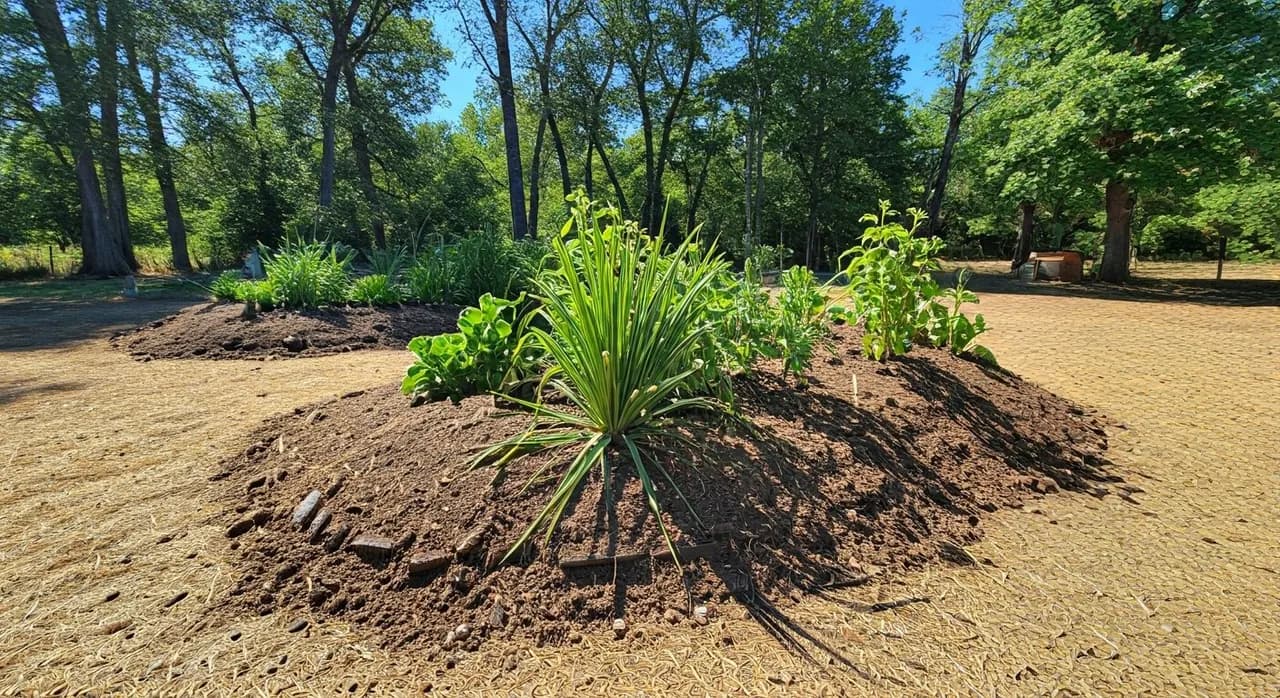
Hugelkultur, a German term meaning ‘hill culture’ or ‘mound culture,’ offers a practical, long-term solution for these dry conditions. It involves burying large pieces of wood and organic matter beneath a layer of soil, creating raised beds that act as giant sponges. These beds capture and store rainfall, slowly releasing it to plants over weeks or even months, which cuts how much supplemental irrigation you need.
Understanding the arid challenge and hugelkultur’s role
The arid and semi-arid regions of the United States (the Southwest, the Great Basin, and the western High Plains) have low precipitation and high evaporation rates. States like Nevada, Utah, and western Texas frequently see less than 12 inches of rain per year, making water conservation essential for any growing operation. Drought conditions recur regularly, with long-term data showing consistent periods of severe water stress across these regions [3]. This environment demands strategies that build resilience into the soil and plant systems.
Hugelkultur directly addresses these challenges by creating a self-watering, nutrient-rich growing environment. The core principle involves burying woody debris, which slowly decomposes, acting like a giant sponge that holds substantial amounts of water. A well-constructed hugelkultur bed can hold thousands of gallons of water per acre, releasing it gradually to plant roots over an entire growing season, even during extended dry spells of 60 days or more. This method also improves soil structure, aeration, and provides a slow-release source of nutrients for plants for over ten years.
Why hugelkultur works in dry climates
The benefits of hugelkultur extend beyond simple water storage. As the wood breaks down, it releases nutrients, creating a fertile soil environment that often requires less external fertilization. A raised mound warms faster in spring than flat ground, which can bring planting forward somewhat in cooler regions like the High Plains. This internal warmth allows for earlier planting in spring and later harvests in fall, maximizing productivity from a single bed for up to 15 years.
- Improved water retention, reducing irrigation by 30-50%.
- Enhanced soil fertility through slow decomposition.
- Extended growing season due to internal heat generation.
- Reduced need for external inputs like fertilizers and compost.
- Increased microbial activity for healthier plant growth.
Constructing your water-wise hugelkultur mound
The success of a hugelkultur bed in arid regions hinges on careful construction and material selection. Begin by identifying a suitable location that receives at least six to eight hours of direct sunlight daily. While hugelkultur can be built directly on the ground, digging a shallow trench, about one to two feet deep, for the base logs can enhance water absorption from surrounding areas and improve stability for mounds taller than three feet. The ideal bed width is typically three to six feet, allowing easy access from both sides without stepping on the mound.
The foundation of your hugelkultur bed consists of large, decomposing logs. Hardwoods like oak, maple, or mesquite are preferred because they break down slowly, providing benefits for 10-20 years or more [5]. Avoid fresh wood, especially softwoods like pine, as they can temporarily deplete soil nitrogen as they decompose. After the largest logs, layer progressively smaller woody debris (branches, twigs, and wood chips) to fill voids and create a porous structure that maximizes water and air pockets. This woody core is the sponge that holds water and releases it slowly to roots.
Layering for maximum water retention
Above the woody layers, add nitrogen-rich organic materials. Inverted sod, with the grass side facing down, is an excellent choice as it provides a dense layer that retains moisture and offers a slow release of nutrients. Follow this with a six-inch layer of well-rotted compost or aged manure, which introduces beneficial microbes and provides immediate nutrients for young plants. Finally, cap the mound with six to twelve inches of good quality topsoil, shaping it into a gentle, rounded hill. This final soil layer provides a stable medium for planting and prevents rapid evaporation from the underlying organic matter. Initial watering should be thorough: soak the mound in stages over a day or two, letting each soaking sink in, until water reaches the woody core instead of running off the sides.
- Select decomposing hardwood logs for the base.
- Layer progressively smaller woody debris.
- Add nitrogen-rich materials like inverted sod or compost.
- Cap with 6-12 inches of fertile topsoil.
- Thoroughly water the new mound to activate decomposition.
Permaculture principles for enhanced hugelkultur systems
Integrating hugelkultur into a broader permaculture design amplifies its benefits, especially in arid landscapes. Permaculture design, which involves careful observation and planning, helps growers read a site before planting it, ensuring every element serves multiple functions. For example, placing hugelkultur beds along contour lines (lines of equal elevation) can turn them into effective water harvesting structures, similar to swales. These contour beds slow surface runoff so more water infiltrates instead of running off the property. This strategy is particularly effective in regions with infrequent but intense rain events, common in the US Southwest.
Food forests, a core permaculture concept, can be built directly on or around hugelkultur mounds. These multi-layered plant communities mimic natural forest ecosystems, creating a resilient and productive system. A hugelkultur mound acts as a canopy layer for smaller plants, providing shade and wind protection while its internal moisture supports multiple species. Consider planting taller fruit trees like jujube or native mesquite on the west side of the mound, where they shade understory plants through the hottest part of the afternoon without shading the whole bed; leave the south face for sun-lovers.
Designing with zones and plant guilds
Permaculture zones define areas based on the frequency of human interaction, from Zone 1 (most frequently visited, near the home) to Zone 5 (wild, unmanaged areas). Hugelkultur beds are often placed in Zone 2 or 3, where they can be regularly observed and harvested but do not require daily attention. This placement ensures they receive adequate care while still contributing to the overall site’s productivity. For a comprehensive approach, consider exploring a permaculture garden plan that integrates these elements.
Plant guilds are another powerful permaculture tool that pairs well with hugelkultur. A guild is a group of plants that support each other through various functions, such as nitrogen fixation, pest deterrence, or nutrient accumulation. For example, planting nitrogen-fixing legumes like native lupines or clovers alongside fruit trees on a hugelkultur mound can enrich the soil, reducing the need for external fertilizers by 20-30% and supporting healthier tree growth. This pairing supports a resilient, self-sustaining planting that uses the water and nutrients stored within the mound.
- Place hugelkultur beds on contour lines for water harvesting.
- Integrate hugelkultur into multi-layered food forest designs.
- Position beds in permaculture Zone 2 or 3 for optimal management.
- Create plant guilds for nutrient cycling and pest management.
- Utilize mounds to create microclimates for sensitive plants.
Plant selection and guild design for arid hugelkultur
Choosing suitable plants determines the success of a hugelkultur system in arid and drought-prone regions. Focus on species that are inherently drought-tolerant, suited to your specific USDA zone (typically 6-10), and can thrive with reduced irrigation. Native plants are often an excellent choice as they are already adapted to local conditions, requiring up to 70% less water than non-native species once established. Examples include Nopal cactus (Opuntia spp.), agave, desert willow (Chilopsis linearis), and various native sages.
Beyond individual plant selection, designing plant guilds (communities of plants that mutually benefit each other) maximizes the efficiency of your hugelkultur bed. For instance, a guild might include a central fruit or nut tree suited to low water, such as jujube, mesquite, or a drought-tolerant peach for USDA zone 7-9. Avoid pecan, which is among the thirstiest nut trees and needs deep, frequent irrigation through summer. Note too that jujube suckers freely from the roots and can travel well beyond the planting site. Surround the central tree with legumes that genuinely fix nitrogen and suit the region, such as native mesquite, prairie clover (Dalea spp.), or a native lupine. Honey locust is often listed as a nitrogen fixer but it does not nodulate and fixes none, so a fertility plan built on it delivers nothing; check any acacia against your state's noxious-weed list first, since several are aggressive escapees in the arid West. Underneath, plant sterile Bocking 14 comfrey instead of common comfrey (which self-sows and regrows from every root fragment), or yarrow, cutting the leaves for mulch. Comfrey is mulch only: its pyrrolizidine alkaloids are hepatotoxic, so it is not food or fodder. This layered approach makes fuller use of the water and nutrients stored in the mound.
Optimizing plant placement and benefits
Consider the microclimates created by the hugelkultur mound itself. The north side of the mound will be cooler and shadier, ideal for plants that prefer some protection from intense afternoon sun, such as some leafy greens or herbs in USDA zone 8. The south side, receiving more sun, is perfect for heat-loving plants like peppers, tomatoes, or melons. Placing taller plants strategically can also provide shade for more sensitive species, reducing water evaporation from the soil surface by 10-20% during peak summer months. Monitoring soil moisture with a soil moisture meter can help fine-tune irrigation needs for different plants on the mound.
For growers interested in resilient food sources, consider crops like quinoa (Chenopodium quinoa), which is low-water and nutritious but needs cool nights and sets poorly in extreme heat. Successful US production sits at high elevation, such as Colorado's San Luis Valley, instead of in hot low deserts. In a hot arid garden, sow it for a cool-season window or grow amaranth or tepary beans instead. Incorporating such resilient crops into your hugelkultur guilds can further enhance food security and reduce reliance on water-intensive staples. Supplementing with fermented soybean meal organic fertilizer can provide a slow-release nitrogen boost, especially for hungry fruit trees.
- Prioritize native and drought-tolerant plant species.
- Design guilds with nitrogen-fixers and dynamic accumulators.
- Utilize microclimates on the mound for optimal plant placement.
- Incorporate resilient crops like quinoa for food security.
- Consider companion planting principles for pest deterrence and growth.
Long-term benefits and maintenance in dry climates
The true value of hugelkultur in arid regions becomes most apparent over the long term, often spanning decades. As the woody material within the mound slowly decomposes, it continuously enriches the soil, raising organic matter content over the first several years. This improved soil structure translates directly into enhanced water retention, aeration, and nutrient availability, creating a highly fertile and resilient growing medium. Over time, the need for external fertilizers and extensive irrigation diminishes significantly, making the system increasingly self-sustaining and reducing operational costs by up to 40%.
One of the less obvious but powerful benefits is the creation of a stable, consistent soil temperature. A raised mound warms faster in spring than the flat ground around it. This subtle warmth can extend the growing season by several weeks in cooler arid regions, such as parts of the High Plains (USDA zone 5-6), allowing for earlier spring planting and later fall harvests. This extended season means more productive plants and higher yields from the same footprint, maximizing the return on your initial investment.
Minimal maintenance for lasting productivity
While hugelkultur beds require significant initial effort, their long-term maintenance is surprisingly minimal. Once established, they rarely need tilling, and their built-in fertility reduces the need for frequent fertilization. The primary maintenance tasks involve occasional top-dressing with a few inches of compost every two to three years to replenish surface nutrients and support the microbial community. Monitoring plant health and addressing any specific nutrient deficiencies, perhaps through foliar feeds, is also important. For additional guidance on resilient layouts, see permaculture design principles.
Watering, while significantly reduced, is still necessary during prolonged dry spells, especially for newly planted annuals. However, the deep moisture reservoir means irrigation can be less frequent but more thorough, saturating the mound completely. Over time, the mound becomes a thriving ecosystem, supporting a diverse array of beneficial insects and microorganisms, which contribute to natural pest control and disease resistance. This biodiversity helps maintain the health and productivity of the bed for 20 years or more in dry climates.
- Continuous soil enrichment and organic matter increase.
- Stable soil temperatures extend the growing season.
- Reduced need for external fertilizers and irrigation over time.
- Minimal ongoing maintenance, primarily top-dressing with compost.
- Enhanced biodiversity and natural pest control.
Hugelkultur vs. Traditional Raised Beds for Arid Regions
Feature | Hugelkultur | Traditional Raised Bed |
|---|---|---|
Water Retention | Excellent; wood acts as a sponge, reducing irrigation by 30-50% for 10+ years. | Good, but relies on soil mix; typically requires more frequent watering. |
Soil Building | Builds deep, rich soil over decades as wood decomposes, increasing organic matter by 15-20%. | Relies on added compost and amendments; soil health depends on consistent external input. |
Initial Effort | High; involves sourcing and layering significant woody material and soil. | Moderate; involves building walls and filling with soil mix. |
Longevity | Very long; benefits last 10-20+ years with minimal intervention. | Moderate; structure may last 5-15 years, but soil fertility needs annual replenishment. |
Cost | Low to moderate; often uses free or inexpensive woody debris, reducing long-term input costs. | Moderate to high; lumber for walls and purchasing quality soil/compost can be significant. |
Water Savings: Hugelkultur beds can reduce irrigation needs by 30-50% in arid environments by improving water retention [6].
Soil Temperature Boost: A raised mound warms sooner in spring than flat ground, which can bring planting forward.
Long-Term Fertility: Hardwood logs in hugelkultur provide a slow-release source of nutrients and improve soil structure for 10-20 years or more [5].
Frequently asked questions
How much water can a hugelkultur bed save?
A well-established hugelkultur bed can reduce irrigation needs by 30% to 50% in arid environments. The woody core acts as a sponge, storing water and releasing it slowly to plants over weeks, which helps carry plantings through extended dry spells.
What kind of wood is best for hugelkultur in dry regions?
Decomposing hardwood logs like oak, maple or mesquite are best for arid regions, breaking down slowly and holding water for 10-20 years or more. Cottonwood works as filler but rots far faster, in roughly five to ten years, so do not rely on it for the structural core. Avoid fresh softwoods like pine, which can temporarily tie up soil nitrogen for 1-2 years [5].
Can hugelkultur extend the growing season?
A mound warms faster in spring than flat ground, which can bring planting forward in cooler arid regions and stretch the season at the other end.
How long does a hugelkultur bed last?
A properly constructed hugelkultur bed, especially one using dense hardwoods, can remain productive and provide significant benefits for 10 to 20 years, or even longer. The slow breakdown of wood continuously enriches the soil and maintains its water-holding capacity.
What permaculture elements pair well with hugelkultur?
Hugelkultur integrates effectively with several permaculture elements. Building beds along contour lines can create swale-like structures that hold rainfall on site instead of letting it run off. They also serve as excellent foundations for multi-layered food forests and plant guilds, enhancing biodiversity and nutrient cycling.
References
- Clustering Drought-Prone Regions in Southeast Türkiye: An Analysis Using Multiple Drought Indices (2025). Clustering Drought-Prone Regions in Southeast Türkiye: An Analysis Using Multiple Drought Indices.
- Water management in Mediterranean regions prone to drought: The Júcar Basin experience (2005). Water management in Mediterranean regions prone to drought: The Júcar Basin experience.
- Multivariate standardized indices – application beyond drought detection for operational drought management in semi-arid regions in the Americas (2023). Multivariate standardized indices – application beyond drought detection for operational drought management in semi-arid regions in the Americas.
- Inclusion of quinoa in cropping systems for ensuring food and nutrition security in drought prone semi-arid regions: An energy-water-carbon-food nexus approach (2025). Inclusion of quinoa in cropping systems for ensuring food and nutrition security in drought prone semi-arid regions: An energy-water-carbon-food nexus approach.
- USDA Natural Resources Conservation Service (2024). USDA Natural Resources Conservation Service.
- EPA — Soak Up the Rain (2024). EPA — Soak Up the Rain.