Key takeaways
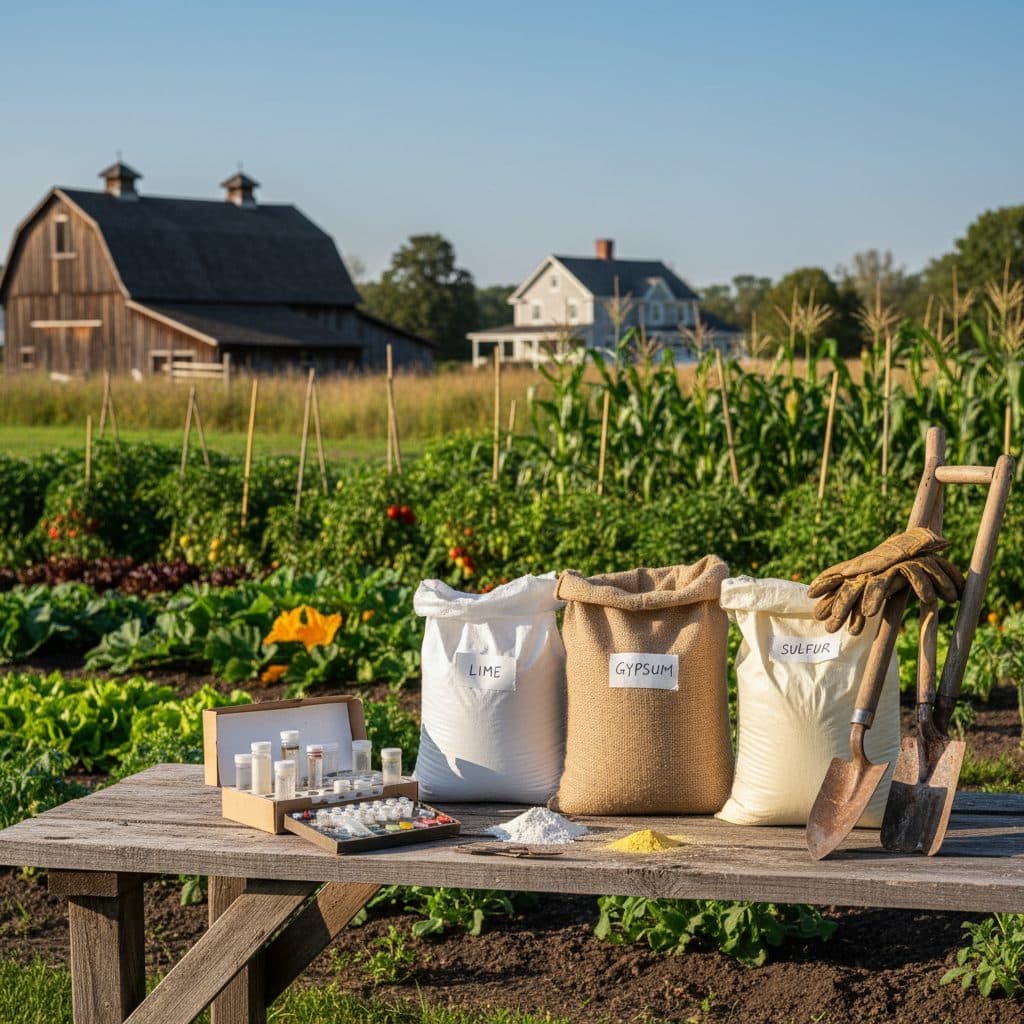
- A comprehensive soil test is the essential first step before applying any amendments like gypsum, lime, or sulfur.
- Gypsum (calcium sulfate) is primarily used to improve soil structure in heavy clay soils, particularly in regions like the Pacific Northwest, without significantly altering pH.
- Lime (calcium carbonate or calcium magnesium carbonate) raises soil pH in acidic conditions, common in the Eastern US, aiming for a target pH range of 6.0 to 7.0 for most crops.
- Elemental sulfur lowers soil pH in alkaline soils, often found in the arid Southwest, with a typical target pH of 6.0 to 6.5 for acid-loving plants.
- Proper application rates, based on soil test recommendations, and consistent timing prevent over-amendment and maintain long-term soil health.
- Integrating compost and biochar with mineral amendments improves microbial activity and nutrient cycling, improving overall soil fertility over time.
Quick answer: To adjust soil pH and structure for better yields, first conduct a soil test. Then, use gypsum to improve clay soil structure, lime to raise pH in acidic soils, or elemental sulfur to lower pH in alkaline soils, following recommended application rates.
In my 30 years of growing vegetables and berries in central Pennsylvania, I’ve seen firsthand how much a soil test can tell you about what your plants truly need. A soil test provides a direct guide to better yields and healthier plants. Without that initial soil analysis, you’re just throwing amendments around, hoping something sticks, which can lead to wasted effort and money, sometimes even causing more problems than you solve. For instance, applying lime to already alkaline soil, common in parts of the Great Plains, can lock up essential micronutrients like iron and zinc, crippling plant growth.
Understanding when and how to use amendments like gypsum, lime, and sulfur is fundamental for any serious grower. These aren’t one-size-fits-all solutions; each has a specific job, and applying the wrong one, or the right one in the wrong amount, can set your garden back by a season or more. For example, a soil test might reveal a pH of 5.2 in your USDA zone 6 garden, indicating a need for lime, whereas a pH of 7.8 in a California desert garden would call for sulfur. This article will walk you through how to interpret your soil test and use these materials effectively, ensuring your efforts lead to tangible improvements in your soil and harvests.
Understanding your soil test results
Before you even think about buying a bag of gypsum, lime, or sulfur, you need a current soil test. This isn’t an optional step; it’s the foundation of informed soil management. Most state extension offices, like those associated with land-grant universities, offer affordable soil testing services, often for under $20. A good test provides specific data on your soil’s pH, organic matter content, and levels of essential nutrients like nitrogen, phosphorus, and potassium, along with micronutrients. The USDA Natural Resources Conservation Service emphasizes soil testing as a key practice for sustainable agriculture, recommending it every three to five years for established gardens and annually for new plots [6].
Deciphering the numbers: pH and nutrient levels
The pH reading is perhaps the most critical number for deciding on lime or sulfur. It measures your soil’s acidity or alkalinity on a scale from 0 to 14, with 7 being neutral. Most vegetables and fruits thrive in a slightly acidic to neutral range, typically between 6.0 and 7.0. If your test shows a pH of 5.5, as is common in many areas of the Southeastern US, your soil is too acidic, and nutrient availability for plants like tomatoes or beans will be reduced by as much as 30%. Conversely, a pH of 7.5, frequently seen in arid regions, can lead to iron deficiency in plants, causing yellowing leaves. Pay close attention to the cation exchange capacity (CEC), which indicates your soil’s ability to hold onto nutrients, and the percentage of organic matter, which ideally should be above 3% for healthy soil structure and microbial life. You can also use a 3-in-1 soil pH, moisture, and light meter for quick, on-site checks, but it won’t replace a laboratory analysis for nutrient levels.
- pH: Determines nutrient availability.
- Organic Matter: Influences soil structure and water retention.
- Cation Exchange Capacity (CEC): Measures nutrient holding capacity.
- Macronutrients (N-P-K): Essential for plant growth in large amounts.
- Micronutrients: Needed in smaller quantities but equally vital.
Gypsum: improving soil structure without changing pH
Gypsum, chemically known as calcium sulfate (CaSO₄·2H₂O), is a valuable soil amendment, but it’s often misunderstood. Its primary role isn’t to change soil pH significantly, unlike lime or sulfur. Instead, gypsum excels at improving the physical structure of heavy clay soils, particularly those with high sodium content, which are common in arid and semi-arid regions like parts of Arizona and California. When sodium builds up, clay particles disperse, leading to compacted soil that drains poorly and makes root growth difficult. Gypsum’s calcium replaces the sodium on clay particles, allowing them to clump together into larger aggregates, a process called flocculation. This creates larger pore spaces, improving water infiltration and aeration by up to 25%.
Applying gypsum for better drainage and root growth
A typical application rate for gypsum on problematic clay soils is between 25 to 50 pounds per 1,000 square feet, worked into the top 4 to 6 inches of soil. For example, a 100 square foot raised bed might need 2.5 to 5 pounds. It’s particularly useful in areas with heavy rainfall and clay soils, such as the Pacific Northwest, where it can help prevent waterlogging. Gypsum also provides calcium, an essential plant nutrient, without raising the pH, making it suitable for acid-loving plants like blueberries that might suffer from calcium deficiency. While it doesn’t dramatically alter pH, early research from 1980 indicated that sulfur can infiltrate gypsum mortars, suggesting a complex interaction of these elements in various matrices [1]. For gardeners dealing with compacted, waterlogged conditions, especially if a soil test confirms high sodium or poor drainage, gypsum can be a real asset.
- Improves drainage: Reduces compaction in clay soils.
- Enhances aeration: Allows roots to breathe better.
- Adds calcium: Provides a vital nutrient without pH change.
- Leaches sodium: Beneficial in saline or sodic soils.
- Reduces crusting: Prevents hard surface layers after rain.
Lime: raising pH in acidic soils
Lime, typically ground agricultural limestone (calcium carbonate, CaCO₃), or dolomitic lime (calcium magnesium carbonate, CaMg(CO₃)₂), is used to increase soil pH. This is a common practice in many parts of the Eastern United States, where rainfall tends to leach basic cations, leading to naturally acidic soils. For instance, soils in states like Maine or Georgia often have a pH below 6.0. When soil pH is too low, essential nutrients like phosphorus, potassium, and nitrogen become less available to plants, even if they are present in the soil. A pH below 5.5 can reduce phosphorus availability by as much as 50% for many common garden vegetables, impacting root development and fruit production.
Choosing and applying lime effectively
The amount of lime needed depends on your current soil pH, target pH, soil type (clay soils require more lime than sandy soils to achieve the same pH change), and the buffering capacity of your soil. Your soil test report will provide a specific recommendation, often in pounds per 1,000 square feet. For a sandy loam soil with a pH of 5.5 in USDA zone 7, you might need 25 to 50 pounds of agricultural lime per 1,000 square feet to raise the pH to 6.5. For a heavier clay soil, that amount could easily double. It’s best to apply lime in the fall or early spring, giving it several months to react with the soil. Incorporate it into the top 6 to 8 inches of soil for faster results. Dolomitic lime is preferred if your soil test also indicates a magnesium deficiency, which is common in some coastal plain soils. Historically, the use of lime in agriculture has been well-documented, with early circulars from 1925 discussing its benefits [4].
- Raises pH: Makes acidic soils more alkaline.
- Increases nutrient availability: Especially phosphorus and nitrogen.
- Adds calcium: Essential for cell wall development.
- Adds magnesium: If using dolomitic lime.
- Boosts microbial activity: Favors beneficial bacteria.
Sulfur: lowering pH in alkaline soils
Elemental sulfur (S) is the primary amendment used to lower soil pH, making it more acidic. This is particularly important in regions with naturally alkaline soils, such as the arid Western and Southwestern United States, where soils often have a pH above 7.0, sometimes reaching 8.0 or higher. In these conditions, essential micronutrients like iron, manganese, and zinc can become insoluble and unavailable to plants, leading to chlorosis (yellowing of leaves) and stunted growth. Sulfur works by converting into sulfuric acid through microbial action in the soil, a process that requires warmth, moisture, and active soil microbes. This conversion can take several weeks to months, depending on soil conditions and temperature, with optimal activity occurring above 55°F.
Effective use of sulfur for acid-loving plants
The amount of sulfur needed to lower pH depends on the soil’s current pH, desired pH, and buffering capacity. For example, to lower the pH of a loam soil from 7.5 to 6.5, you might need 10 to 20 pounds of elemental sulfur per 1,000 square feet. For acid-loving plants like blueberries, rhododendrons, or azaleas, which prefer a pH between 4.5 and 5.5, the application rate could be significantly higher, perhaps 30 to 50 pounds per 1,000 square feet. Apply sulfur in stages, especially for large adjustments, and retest the soil after 6-12 months to avoid over-acidification. Sulfur can be broadcast and lightly incorporated into the top few inches of soil. For a detailed analysis of sulfur content in various solutions, official methods exist, such as AOAC Official Method 920.33 for sulfur in lime sulfur solutions [3]. This ensures the quality of the product you’re using. If you’re growing plants like okra or zucchini, which prefer slightly acidic to neutral soils, monitoring pH is critical for optimal yields.
- Lowers pH: Makes alkaline soils more acidic.
- Increases micronutrient availability: Especially iron, manganese, and zinc.
- Provides sulfur: An essential plant nutrient.
- Requires microbial activity: For conversion to sulfuric acid.
- Slow-acting: pH changes occur gradually over weeks or months.
Integrating mineral amendments with organic practices
While gypsum, lime, and sulfur address specific mineral deficiencies or pH imbalances, their effectiveness improves when integrated with sound organic practices. Adding compost and biochar improves soil health on multiple fronts, creating a more resilient and productive growing environment. Compost, rich in organic matter, buffers pH changes, improves soil structure, and provides a slow-release source of nutrients. For instance, incorporating 1 to 2 inches of mature compost annually can improve soil organic matter by 0.5% to 1% per year, significantly boosting overall fertility. Biochar, a stable form of carbon, can increase water retention by 10% to 20% in sandy soils and enhance nutrient availability by providing habitat for beneficial microbes.
Enhancing soil fertility with compost and biochar
When you apply lime or sulfur, active soil microbes fed by organic matter drive the chemical conversion. Microbes convert elemental sulfur into sulfuric acid, making it effective for lowering pH. Similarly, organic acids released during decomposition can help make nutrients more available, even in less-than-ideal pH ranges. For example, a 30:1 carbon-to-nitrogen ratio in compost ensures efficient decomposition and nutrient release. After amending soil with lime or sulfur, incorporating a 1-inch layer of compost into the top 6 inches of soil can help stabilize pH and provide a continuous food source for soil organisms. Biochar, applied at a rate of 5% to 10% by volume in the topsoil, can provide long-term benefits, lasting for hundreds of years. Combining targeted mineral amendments with a steady supply of organic matter builds soil fertility year after year, reducing the need for constant intervention. You can further boost your soil’s health with fermented soybean meal organic fertilizer for added nitrogen and other nutrients.
- Compost: Buffers pH, adds organic matter, slow-release nutrients.
- Biochar: Improves water retention, enhances nutrient availability, supports microbes.
- Microbial activity: Essential for sulfur conversion and nutrient cycling.
- Long-term fertility: Reduces reliance on synthetic inputs.
- Soil resilience: Helps soil adapt to environmental stresses.
Comparison of Gypsum, Lime, and Sulfur for Soil Amendment
Amendment | Primary Function | Typical Application Rate (per 1,000 sq ft) | Effect on pH | Key Benefits |
|---|---|---|---|---|
Gypsum (Calcium Sulfate) | Improves soil structure, especially in clay soils | 25-50 lbs | Minimal to none | Enhances water infiltration, aeration, provides calcium, leaches sodium |
Lime (Calcium Carbonate) | Raises soil pH in acidic soils | 25-100 lbs (depending on soil type) | Increases (makes more alkaline) | Increases nutrient availability (P, N), provides calcium and/or magnesium |
Sulfur (Elemental Sulfur) | Lowers soil pH in alkaline soils | 10-50 lbs (depending on pH drop) | Decreases (makes more acidic) | Increases micronutrient availability (Fe, Mn, Zn), provides sulfur |
Soil pH Sweet Spot: Most garden vegetables thrive in a soil pH range of 6.0 to 7.0, where nutrient availability is optimized by over 90%.
Gypsum for Clay: Applying 25 pounds of gypsum per 1,000 square feet can improve water infiltration in heavy clay soils by up to 25%.
Sulfur’s Slow Action: Elemental sulfur typically takes 6 to 12 months to significantly lower soil pH, with microbial activity optimal above 55°F.
Frequently asked questions
How often should I test my soil?
For established gardens, testing your soil every three to five years is generally sufficient to monitor long-term trends and nutrient levels. However, if you’re establishing a new garden or have made significant amendments, it’s wise to retest after one year to ensure desired changes have occurred and to adjust future plans accordingly.
Can I apply gypsum, lime, and sulfur at the same time?
Generally, it’s not recommended to apply all three at once. Gypsum primarily affects soil structure and has minimal pH impact, so it can often be applied independently. However, lime raises pH while sulfur lowers it, making their simultaneous application counterproductive. Address the most pressing issue first based on your soil test, retest, and then consider other amendments if needed after 6 to 12 months.
How long does it take for these amendments to work?
The time frame varies significantly. Gypsum can begin to improve soil structure within a few weeks to months, with full effects seen over one to two seasons. Lime typically takes 3 to 6 months to significantly alter soil pH, depending on particle size and soil moisture. Elemental sulfur is the slowest, often requiring 6 to 12 months for substantial pH reduction, as it relies on microbial activity.
What happens if I apply too much lime or sulfur?
Applying too much lime can raise soil pH excessively, locking up micronutrients like iron, manganese, and zinc, leading to deficiencies and stunted growth. Over-applying sulfur can drastically lower pH, potentially making aluminum toxic to plants and creating an overly acidic environment where many nutrients are less available. Always follow soil test recommendations and apply in measured amounts, retesting after 6-12 months.
Are there organic alternatives to these mineral amendments?
While there aren’t direct organic replacements that provide the same rapid or specific pH/structural changes, organic matter like compost, well-rotted manure, and biochar can significantly improve soil health over time. Compost buffers pH, making soils more resilient to extreme changes, and improves structure. Pine needles or peat moss can slowly acidify soil, but generally require larger quantities and longer periods than elemental sulfur to achieve significant pH drops, often requiring 10-20 pounds per 100 square feet for noticeable change.
References
- THERMAL PROPERTIES OF SULFUR INFILTRATED LIME AND GYPSUM MORTARS (1980). THERMAL PROPERTIES OF SULFUR INFILTRATED LIME AND GYPSUM MORTARS.
- 96/05995 Recovery of lime, sulfur, and iron from gypsum and pyrite wastes (1996). [96/05995 Recovery of lime, sulfur, and iron from gypsum and pyrite wastes](https://doi.org/10.1016/s0140-6701(97)83402-9).
- AOAC Official Method 920.33Sulfur (Sulfide) in Lime Sulfur Solutions and Dry Lime Sulfur (2023). AOAC Official Method 920.33Sulfur (Sulfide) in Lime Sulfur Solutions and Dry Lime Sulfur.
- Letter Circular 169: (1925). Letter Circular 169:.
- Clays. Lime and magnesite. Gypsum and plasters. Glass sand etc. (1908). Clays. Lime and magnesite. Gypsum and plasters. Glass sand etc..
- USDA Natural Resources Conservation Service (2024). USDA Natural Resources Conservation Service.