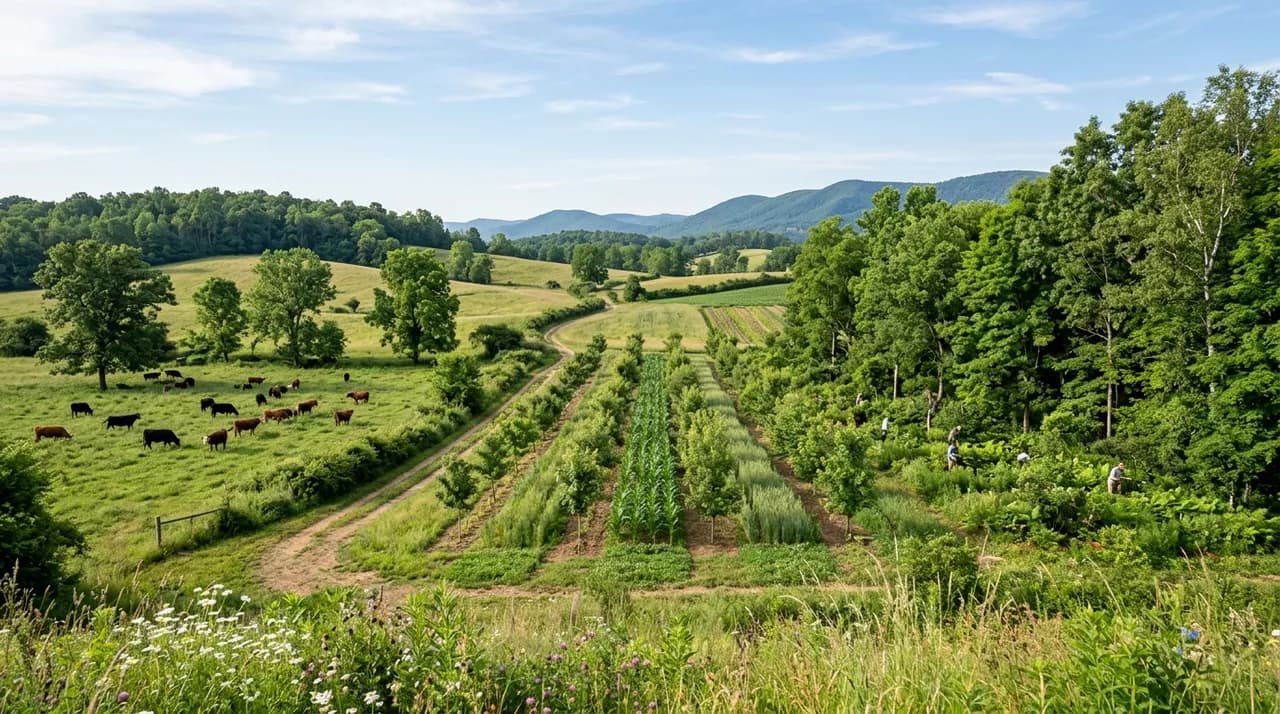
Agroforestry encompasses any land-use system where woody perennials deliberately interact on the same management unit with agricultural crops, animals, or both. Scientific literature classifies agroforestry across three standardized dimensions: structural composition, primary system function, and ecological or socioeconomic context. This structural-functional taxonomy provides researchers and students with an objective diagnostic framework to evaluate biological interactions, resource competition, and management intensity in any integrated landscape.
Understanding these classification criteria allows students to analyze systems from first principles. When examining a complex landscape, formal taxonomy strips away localized vernacular and reveals how species arrangements manipulate light, water, and nutrient fluxes.
Why academic taxonomy matters in agroforestry
In popular literature, agroforestry practices are frequently conflated with related disciplines or described using interchangeable, imprecise terminology. Land designs such as permaculture gardens, regenerative pastures, and conservation woodlots frequently overlap in appearance. However, as explored in discussions of permaculture vs agroforestry, agroforestry as an academic discipline requires standardized descriptors to measure and compare experimental trials across disparate geographic regions.
The standard classification architecture adopted by international agroforestry research institutions evaluates systems across four foundational criteria:
- Structural Basis: The spatial arrangement and vertical stratification of woody and non-woody components, as well as their temporal sequencing.
- Functional Basis: The primary output of the woody component, categorizing whether trees are cultivated for productive yields or protective services.
- Socioeconomic Basis: The level of input intensity, capital investment, labor allocation, and market orientation governing system operations.
- Ecological Basis: The environmental and bioclimatic zone in which the system operates, determining physiological limits such as moisture availability, cold tolerance, and growing-season length.
By evaluating any integrated system through these distinct lenses, researchers can isolate variables, predict resource competition, and replicate successful designs.
Structural classification: component composition and arrangement
The structural axis represents the most common entry point into agroforestry literature. It classifies systems first by the biological nature of their components, and second by how those components are arranged across physical space and operational time.
Component composition
At the highest structural level, systems are grouped according to the specific biological kingdoms and life-forms managed together:
- Agrisilvicultural Systems: Combinations of woody perennials (trees or shrubs) and agricultural crops. This category includes widespread practices such as alley cropping, shaded perennial tree-crop plantations (such as coffee or cacao under native forest canopies), boundary hedgerows, and multi-tier homegardens.
- Silvopastoral Systems: Intentional combinations of woody perennials, forage species, and domesticated grazing animals. As documented in silvopasture research, these systems manage livestock distribution, pasture productivity, and tree growth simultaneously. Examples include managed wood pasture, fodder-bank plantations, and orchards grazed during dormant periods.
- Agrosilvopastoral Systems: Complex combinations integrating crops, livestock, and trees within a unified rotation or spatial footprint. Common examples include multi-tiered tropical homegardens housing small livestock or poultry, as well as crop fields interplanted with browse trees that are grazed after seasonal crop harvest.
- Specialized Structural Variants: Specific literature branches also recognize apisilviculture (trees integrated with beekeeping infrastructure), entomosilviculture (woody plants supporting sericulture or beneficial insects), and silvofisheries or aquasilviculture (mangrove or riparian trees integrated with aquaculture ponds).
Spatial arrangement
Component distribution across the landscape determines how light and root zones are partitioned. In general types of agroforestry, spatial designs fall into three broad geometries:
- Zonal or Linear: Components are segregated into distinct parallel or geometric strips. Alley cropping, contour hedgerows, windbreaks, and riparian buffers use linear bands to facilitate mechanical cultivation or targeted erosion control while reducing competitive interference.
- Mixed Dense: Multiple species and growth forms are mingled across horizontal space, creating complex horizontal intermixing and dense multi-layered vertical canopies. Tropical homegardens and syntropic planting lines illustrate this arrangement.
- Mixed Sparse: Woody perennials are distributed at low densities across pastures or croplands, such as the open dehesa oak parklands of the Mediterranean or scattered Faidherbia trees across dryland millet fields.
Temporal sequencing
The temporal axis categorizes whether components occupy the ground simultaneously or in sequence:
- Coincident or Concurrent: Woody and non-woody components grow together across the same ground throughout the year, requiring continuous management of light and water competition.
- Concomitant: Components occupy the landscape during distinct phases of an annual or seasonal cycle, such as growing winter annuals under deciduous trees before spring leaf-out.
- Sequential or Rotational: Crops and woody plants alternate over multiple years. In improved woody fallow systems, fast-growing leguminous trees are established on depleted fields to restore soil fertility, then harvested or cleared before annual cropping resumes.
Functional classification: productive and protective roles
The functional classification asks what the woody component is intended to achieve within the farm enterprise. While nearly all trees provide multiple benefits, agroforestry models generally distinguish between primary outputs:
``` +-------------------------------------------------------------------------------+
| AGROFORESTRY FUNCTIONAL MATRIX | +---------------------------------------+---------------------------------------+
| PRODUCTIVE FUNCTIONS | PROTECTIVE FUNCTIONS | +---------------------------------------+---------------------------------------+
|
|
|
|
|
|
|
|
|
|
| - Pharmaceutical and chemical inputs | - Biological pest and pollinator hosts| +---------------------------------------+---------------------------------------+ ```
When evaluating a system from a functional perspective, students should identify whether tree management is driven by harvestable yields or environmental service delivery. In commercial alley cropping, for instance, tree rows may be planted for high-value timber (productive). In contrast, windbreaks and riparian buffers exist primarily to reduce soil erosion, manage runoff, and moderate wind speeds (protective). Many mature systems operate as dual-purpose enterprises, where protective windbreaks yield firewood and fenceposts during periodic thinning.
Socioeconomic and ecological stratification
A structural or functional description alone cannot predict whether an agroforestry system will succeed under real-world conditions. Researchers must also account for operational intensity and bioclimatic limits.
Socioeconomic classification
Agroforestry systems are stratified across three operational scales based on capital input, labor structure, and market integration:
- Commercial Systems: Characterized by high capital investment, machinery use, low species diversity, and commercial orientation. Examples include industrial pecan-pasture silvopasture, timber alley cropping with commercial cereals, and rubber plantations with intercropped cash crops.
- Intermediate Systems: Medium-scale family farms balancing cash generation with household food production. These systems often utilize family labor and modest off-farm inputs, relying on perennials to buffer market price volatility.
- Subsistence Systems: Systems where land and labor are organized primarily to meet household nutritional, fuel, and shelter requirements with minimal cash outlays. Biological diversity is typically very high, distributing yield risks across multiple species with staggered harvest windows.
Ecological and bioclimatic stratification
Ecological classification situates systems within global biomes, as climate governs the biological pace of interactions:
Bioclimatic Zone | Key Environmental Constraints | Dominant Agroforestry Archetypes |
|---|---|---|
Humid Tropics | High rainfall, rapid nutrient leaching, heavy disease pressure | Multistrata homegardens, shaded agroforests, alley cropping |
Arid / Semi-Arid | Severe water deficit, erratic precipitation, prolonged dry season | Silvopastoral parklands, windbreaks, fodder banks, living fences |
Temperate | Cold winters, distinct frost windows, short growing season | Mechanized alley cropping, timber silvopasture, forest farming |
Highland / Montane | Steep topography, severe erosion risk, cold night temperatures | Contour hedgerows, bench-terrace agroforestry, shelterbelts |
Diagnostic matrix for field evaluation
When conducting field evaluations or reading academic literature, students can synthesize these axes into a unified diagnostic sequence. By identifying the component composition, spatial arrangement, primary function, and operational scale, any system can be categorized within global agroforestry frameworks.
Diagnostic Question | Observational Indicator | Resulting Classification |
|---|---|---|
What components are present? | Crops + trees vs. Animals + trees vs. All three | Agrisilvicultural / Silvopastoral / Agrosilvopastoral |
How are trees spaced? | Alternating rows vs. dense clusters vs. sparse canopy | Zonal / Mixed Dense / Mixed Sparse |
When do components interact? | Same season vs. staggered seasons vs. rotational fallow | Concurrent / Concomitant / Sequential |
What drives tree management? | Harvestable timber/fruit vs. wind/water/soil protection | Productive vs. Protective |
What is the economic goal? | Single cash commodity vs. diversified household survival | Commercial vs. Subsistence |
Analytical limitations and succession dynamics
While taxonomic frameworks bring clarity to academic literature, students must recognize their real-world limitations. Real farm systems change over time. A system established as an agrisilvicultural alley cropping layout (planting wheat between rows of young walnut saplings) functions under concurrent, zonal management for the first decade. As tree canopies expand and shade out cereal crops, the land manager may sow perennial grasses and introduce sheep, shifting the system into a silvopastoral model.
At agripure, ecological assessments treat classification systems as analytical lenses. Understanding where a field system sits within structural, functional, and socioeconomic frameworks enables researchers to diagnose management bottlenecks, evaluate biological trade-offs, and advance practical agroforestry science.