Key takeaways
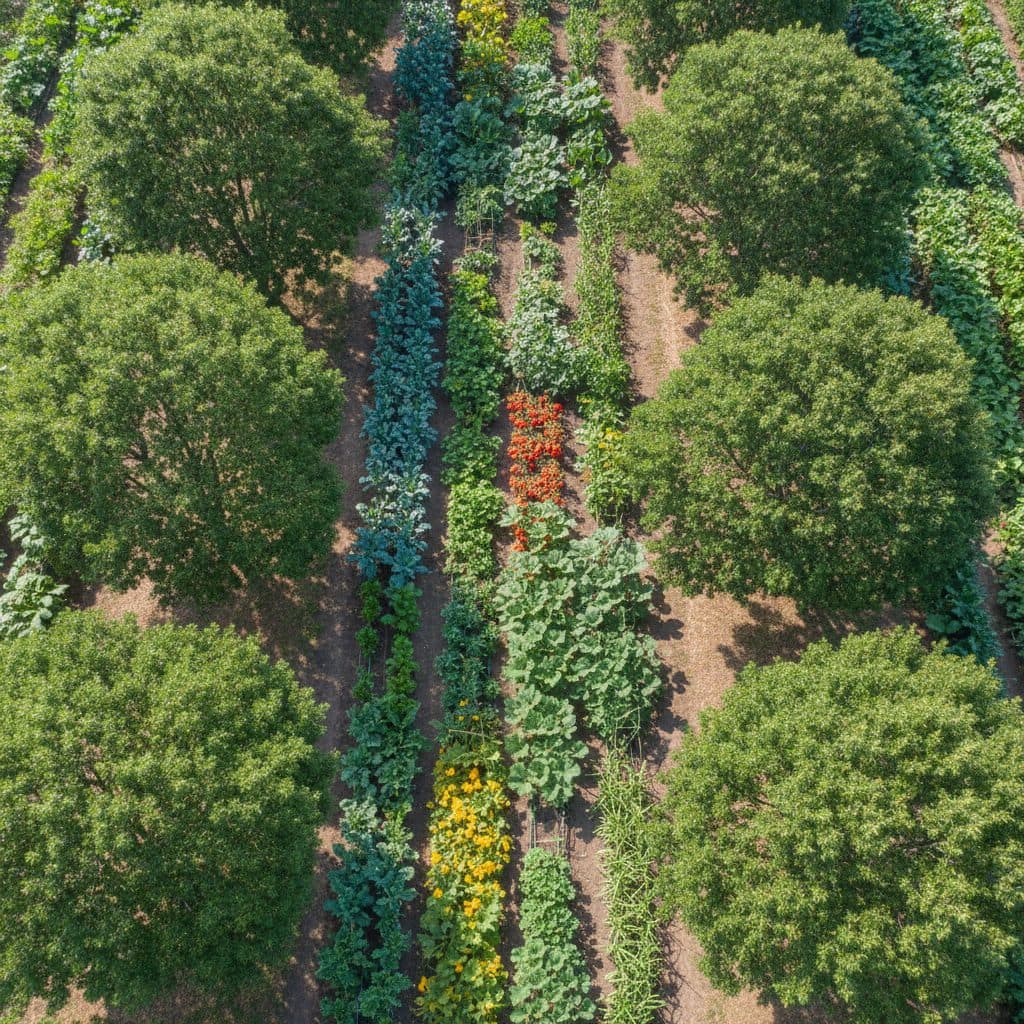
- Alley cropping is an agroforestry practice where annual or perennial crops are cultivated in wide alleys between parallel rows of trees and shrubs.
- Combine high-value timber, nut, or fruit trees with annual grains, vegetables, forages, or medicinal herbs.
- Design alley widths based on mature tree canopy spread and farm machinery dimensions (typically 10 m to 30 m / 33 ft to 100 ft wide).
- Manage root competition by periodic deep root pruning along tree row margins to encourage tree roots to grow downward.
- Prune, pollard, or coppice tree canopies to allow sufficient sunlight to reach alley crops during peak summer growing phases.
- Tree rows act as permanent windbreaks, reducing evapotranspiration, filtering surface runoff, and cycling deep subsoil nutrients.
Quick answer: Alley cropping is an agroforestry system where agricultural crops are grown in wide alleys between parallel rows of trees or woody shrubs. This integrated design diversifies income, improves soil fertility through leaf biomass and root exudates, reduces wind erosion, and moderates microclimates.
As agricultural producers and homesteaders worldwide seek methods to build soil organic matter, improve drought resilience, and diversify farm income, alley cropping has emerged as a premier agroforestry practice. By integrating perennial woody trees with annual crop production on the same land base, alley cropping combines the biological stability of a forest ecosystem with the short-term productivity of field agriculture.
Successfully executing an alley cropping system requires balancing the ecological interactions between trees and understorey crops. Understanding how to calculate alley dimensions, select adapted tree species, manage light and root competition, and cycle biomass ensures that trees and companion crops benefit each other over decades.
What is alley cropping? Core principles and systems
Alley cropping (also known as hedgerow intercropping) involves planting single or multi-species rows of trees at wide, regular intervals, creating broad avenues (alleys) where annual or perennial crops are cultivated.
+-------------------------------------------------------------+
|                ALLEY CROPPING SYSTEM PROFILE                |
|                                                             |
|   [ Tree Row ] <------ Cultivated Alley Width ------> [ Tree Row ]|
|   (Timber/Nut)         (10 m to 30 m / 33-100 ft)     (Timber/Nut)|
|                                                             |
|        |||        - * * * * * * * * * * * * * *          |||    |
|       ( o )        ( Grains / Vegetables / Herbs )        ( o )   |
|        /|\          =============================          /|\    |
|       / | \        | | | | | | | | | | | | | | | |        / | \   |
|   (Deep Roots)      (Shallow Annual Crop Roots)       (Deep Roots)|
+-------------------------------------------------------------+
The multi-tier economic timeline:
- Short-term returns (Years 1–5): Annual vegetables, grains, berries, or forages grown in the open alleys generate immediate cash flow while young trees establish.
- Medium-term returns (Years 5–15): Nut crops (hazelnuts, chestnuts), fruit harvests, or coppice biomass provide secondary revenue streams.
- Long-term returns (Years 20–50+): High-value hardwood sawtimber or veneer logs (black walnut, oak, cherry) represent significant capital appreciation.
For species comparisons, see our guide on honey locust vs black locust.
Selecting tree species: timber, nuts, and biomass
Tree selection determines system longevity, management intensity, and economic yield.
+-------------------------------------------------------------+
|                 TREE FUNCTIONAL CATEGORIES                  |
|                                                             |
|   1. HIGH-VALUE HARDWOOD TIMBER:                            |
|   - Black Walnut (Juglans nigra), Oaks, Wild Cherry         |
|   - Deep taproot with coarse laterals; sawlogs              |
|                                                             |
|   2. NUT & FRUIT CROPS:                                     |
|   - Hybrid/Blight-Resistant Chestnut, Hazelnut, Pecan, Apple|
|   - Provides commercial harvests starting in years 5-8      |
|                                                             |
|   3. BIOMASS & NITROGEN-FIXING SPECIES:                     |
|   - Alder (Alnus), Black Locust (Robinia), Gliricidia       |
|   - Fast coppice growth; heavy leaf mulch contribution      |
+-------------------------------------------------------------+
Region & Climate | Recommended Tree Rows | Complementary Alley Crops | Key Functional Benefit |
|---|---|---|---|
Cool & Temperate | Black Walnut, Blight-Resistant Chestnut, Hybrid Hazelnut, Oak | Small grains (wheat, rye), garlic, squash, brassicas | Nut crops, high-value timber, wind protection |
Mediterranean & Arid | Olive, Almond, Carob, Fig | Legumes, barley, aromatic herbs (lavender, rosemary) | Drought resilience, low-flammability tree buffers (olive, carob) |
Subtropical & Tropical | Gliricidia sepium, Inga edulis, Leucaena, Moringa | Maize, cassava, ginger, turmeric, sweet potatoes | Nitrogen-fixing mulch; Moringa as leaf/fodder crop |
In cool temperate climates: Deciduous nut and timber species allow full sunlight to penetrate alley crops during early spring before tree leaf-out occurs. Note that black walnut roots exude juglone, which is toxic to sensitive crops such as tomato, potato, pepper, and aubergine (eggplant), with reduced performance for many brassicas and cucurbits close to the tree line. When planting chestnuts, chestnut blight rules out American chestnut in eastern North America and is present in Europe — plant resistant selections only (such as Chinese, Japanese, or blight-resistant hybrid stock).
In Mediterranean, subtropical, and tropical climates: Fast-growing nitrogen-fixing hedgerows are regularly pruned throughout the rainy season to deliver green mulch directly to adjacent crop rows. Note regional weed caveats before selecting species: Robinia pseudoacacia (black locust) is native to the eastern United States and is regarded as invasive across much of Europe and outside its native range elsewhere: check its local status before planting. *Leucaena leucocephala* is invasive across much of the tropics and is a declared weed in parts of Australia, the Pacific and Africa: check your national weed list before planting.
For nitrogen-fixing tree options, explore our overview of cold hardy nitrogen fixers.
Alley width calculations and machinery integration
Alley dimensions must be designed around equipment width, mature tree crown spread, and solar orientation.
+-------------------------------------------------------------+
|                ALLEY WIDTH CALCULATION FORMULA              |
|                                                             |
|   Alley Width = (Machinery Width x Multiple Passes)         |
|                 - Mature Tree Canopy Overhang               |
|                 - 1.5 m (5 ft) Operator Safety Buffer       |
+-------------------------------------------------------------+- Solar orientation: Orient tree rows on a North-to-South axis wherever terrain permits. This ensures both sides of the tree row receive equal east-west solar exposure throughout the day, minimizing dense, one-sided shading on alley crops.
- Machinery width: If using a tractor with a 3-metre (10 ft) mower or grain drill, design the open alley to accommodate exact multiples of that width (e.g., 9 m, 12 m, or 15 m / 30, 40, or 50 ft) plus a 1.5-metre (5 ft) buffer on each side to prevent tractor wheels from damaging tree trunks.
- Contour planting on slopes: On rolling hills, plant tree rows along keyline contours to intercept overland water flow, prevent soil erosion, and harvest rainfall into the landscape.
For contour water management systems, consult our guide on swale berm planting with nitrogen fixers and fruit trees.
Managing competition: light, roots, and water
The primary challenge in alley cropping is preventing mature trees from outcompeting adjacent annual crops for light and soil moisture.
+-------------------------------------------------------------+
|                 COMPETITION MANAGEMENT TACTICS              |
|                                                             |
|   ABOVE GROUND (Light Management):                          |
|   - Prune lower tree branches to 2.5-3 m (8-10 ft) height   |
|   - Pollard or coppice biomass hedgerows in early spring    |
|                                                             |
|   BELOW GROUND (Root Management):                           |
|   - Subsoil root ripping / vibratory plowing to 45 cm depth |
|   - Forces tree roots downward below crop root zone         |
+-------------------------------------------------------------+
1. Canopy pruning (Light management)
Prune lower side branches on timber trees up to a height of 2.5 to 3 metres (8 to 10 ft) as trees mature. This "clear-boling" creates valuable knot-free timber while allowing morning and evening low-angle sunlight to reach alley crops. For fast biomass species, regular coppicing yields continuous organic mulch for adjacent rows.
2. Root pruning (Moisture management)
Tree roots naturally spread horizontally into fertile alley soil. Running a tractor-mounted subsoil ripper, single-shank subsoiler, or vibratory plow 45 cm (18 in) deep along the tree row margin once every two to three years severs shallow lateral roots. This trains the tree root system to grow downward into subsoil moisture layers, preventing competition with shallow-rooted annual crops.
For shade canopy comparisons, explore fast growing shade trees.
Environmental microclimate benefits and soil building
Alley cropping alters local environmental physics in ways that directly benefit crop yields and regional biodiversity:
- Windbreak reduction: Tree rows cut wind speed in the sheltered zone downwind of the row, with the effect strongest close to the trees and diminishing with distance, substantially reducing crop water loss through transpiration during hot summer spells.
- Temperature buffering: The canopy moderates temperature extremes, keeping alley crops slightly cooler during heatwaves and buffering against early autumn frosts.
- Nutrient pumping: Deep tree roots intercept leaching nitrates and minerals from the subsoil, returning them to the surface as leaf fall decomposes onto the soil.
- Wildlife and pollinator corridors: Linear woody hedgerows provide continuous habitat, nesting sites, and nectar corridors for native birds, predatory beetles, and wild bees across agricultural landscapes.
By combining long-term timber and nut investments with short-term annual crop returns, alley cropping establishes a resilient, biologically diverse agricultural system that builds soil health and stabilizes farm income over generations.