Key takeaways
- Tilapia are warm-water fish, thriving between 70°F and 85°F, with good growth rates and a feed conversion ratio (FCR) around 1.5:1.
- Channel catfish tolerate a wider temperature range, from 65°F to 85°F, and can reach harvestable size in 6 to 12 months.
- Bluegill are a cooler-water option, suitable for systems where temperatures range from 60°F to 75°F, but grow slower than tilapia or catfish.
- Goldfish are primarily ornamental but can serve as a biomass source in smaller systems, tolerating temperatures from 50°F to 80°F.
- Optimal fish selection depends on your climate, desired harvest, and the specific plants you intend to grow in your aquaponics setup.
- Maintaining stable water parameters like pH (6.0-7.0) and ammonia/nitrite levels below 0.5 ppm is crucial for fish health and plant growth.
Quick answer: Choosing aquaponics fish for a 300-gallon system depends on climate, desired harvest, and plant types. Key factors include water temperature tolerance, pH compatibility, growth rate, and feed conversion ratio for species like tilapia, catfish, bluegill, or goldfish.
Setting up an aquaponics system in a climate like USDA zone 7, where temperatures fluctuate seasonally, requires careful thought about fish selection. A 300-gallon system, for instance, offers enough volume to support a decent number of fish, but the choice of species will dictate much of your system’s design and operational routine. The right fish can make your aquaponics venture productive and rewarding, while a poor choice can lead to significant challenges.
Growers observe how different fish species perform under various conditions across the US. Understanding their specific needs for water temperature, pH, and stocking density is critical for success. This guide will compare four common aquaponics fish – tilapia, catfish, bluegill, and goldfish – to help you make an informed decision for your own setup, whether it’s a small backyard system or a larger commercial operation.
Understanding the basics of aquaponics fish selection
Before diving into specific species, it’s important to grasp the fundamental criteria for choosing fish in an aquaponics system. The goal is to find fish that thrive in conditions suitable for your chosen plants and provide sufficient nutrients without overwhelming the system. For many growers in the Midwest, maintaining water temperatures between 68°F and 78°F is a common challenge, requiring either indoor setups or seasonal adjustments. A well-run aquaponics system, as explained in our article on aquaponics systems explained: fish, plants, and the nitrogen loop, relies on a balanced ecosystem.
Key factors for fish health and system productivity
When selecting fish, consider several factors: water temperature tolerance, pH range compatibility, growth rate, and feed conversion ratio (FCR). Tilapia, for example, are known for having an efficient feed conversion ratio (FCR). This efficiency matters for economic viability. You also need to consider the fish’s disease resistance and its ability to handle stocking densities common in aquaponics, which requires careful management of stocking density. For a 300-gallon tank, this could mean supporting 150 to 300 pounds of fish.
- Water temperature: Critical for fish metabolism and plant nutrient uptake.
- pH compatibility: Most aquaponics systems aim for a pH between 6.0 and 7.0 for optimal plant and fish health.
- Growth rate: How quickly fish reach harvestable size, impacting system turnover.
- Feed conversion ratio (FCR): The amount of feed needed to produce one unit of fish weight.
- Disease resistance: Important for maintaining a healthy, productive system.
Tilapia: the warm-water workhorse
Tilapia are often considered the most popular fish for aquaponics, especially in warmer climates or heated indoor systems. They are hardy, grow quickly, and tolerate a wide range of water conditions, making them a reliable choice for many growers. In Florida, for example, outdoor tilapia systems can operate year-round without significant heating costs. They thrive in water temperatures between 70°F and 85°F, with an optimal range around 78°F [1]. This warm-water preference means that growers in USDA zones 6 and below will likely need to heat their tanks for consistent production, potentially using a setup like a reflective indoor grow tent to conserve heat.
Nile and Mozambique tilapia for production
Two common species are Nile tilapia (Oreochromis niloticus) and Mozambique tilapia (Oreochromis mossambicus). Nile tilapia are generally preferred for their faster growth rate, reaching a harvestable size in under a year under optimal conditions. Their FCR is typically around 1.5:1 to 1.8:1, making them efficient at converting feed into biomass. Tilapia are also omnivorous, consuming a variety of plant and animal matter, which simplifies their diet requirements. For a 300-gallon system, you might realistically stock 30 to 45 adult tilapia, aiming for a density of 0.5 to 0.75 pounds per gallon.
- Fast growth rate: Reach harvestable size in 6-9 months.
- High stocking density tolerance: Can be stocked at 0.5-1.0 lb/gallon.
- Good feed conversion ratio: Typically 1.5:1 to 1.8:1.
- Warm water preference: Optimal at 78°F, range 70°F-85°F.
- Omnivorous diet: Adaptable to various commercial feeds.
Catfish: hardy and adaptable
Channel catfish (Ictalurus punctatus) are another excellent choice for aquaponics, particularly for growers seeking a fish that can tolerate a broader range of temperatures than tilapia. They are native to many US waterways and are widely farmed across the South and Midwest. Catfish can thrive in water temperatures from 65°F to 85°F, making them a more forgiving option for outdoor systems in USDA zones 7 and 8 where summer temperatures are high but winters can be cool. While they prefer warmer water for optimal growth, they can survive cooler periods down to about 50°F, though their growth will slow significantly [1].
Channel catfish characteristics for aquaponics
Channel catfish are known for their hardiness and ability to handle relatively high stocking densities. They are omnivores, but their diet tends to be more protein-heavy than tilapia, often requiring a feed with 32% to 38% protein content. Their growth rate is respectable, typically reaching a harvestable size of 1 to 2 pounds in 6 to 12 months, depending on water temperature and feed quality [2]. The FCR for channel catfish is slightly higher than tilapia but still efficient. For a 300-gallon system, you could comfortably stock 25 to 40 adult channel catfish, aiming for a density of 0.4 to 0.6 pounds per gallon.
- Wide temperature tolerance: 65°F-85°F, good for varied climates.
- Hardy and disease resistant: Tolerant of less-than-ideal conditions.
- Good growth rate: Harvestable in 6-12 months.
- Higher protein diet: Requires feed with 32%-38% protein.
- Omnivorous scavenger: Helps keep tanks clean.
Bluegill and goldfish: alternative considerations
This builds directly on catfish.
While tilapia and catfish dominate commercial aquaponics, bluegill and goldfish offer interesting alternatives for hobbyists or specific niche systems. Bluegill (Lepomis macrochirus) are a native US panfish, widely found in ponds and lakes across nearly every state. They are a cooler-water species, thriving in temperatures between 60°F and 75°F, making them suitable for unheated outdoor systems in USDA zones 5 and 6, or for growers who prefer to avoid heating costs [1]. However, their growth rate is significantly slower than tilapia or catfish, often taking 12 to 18 months to reach a harvestable size of 0.5 to 1 pound.
Goldfish for biomass and ornamental appeal
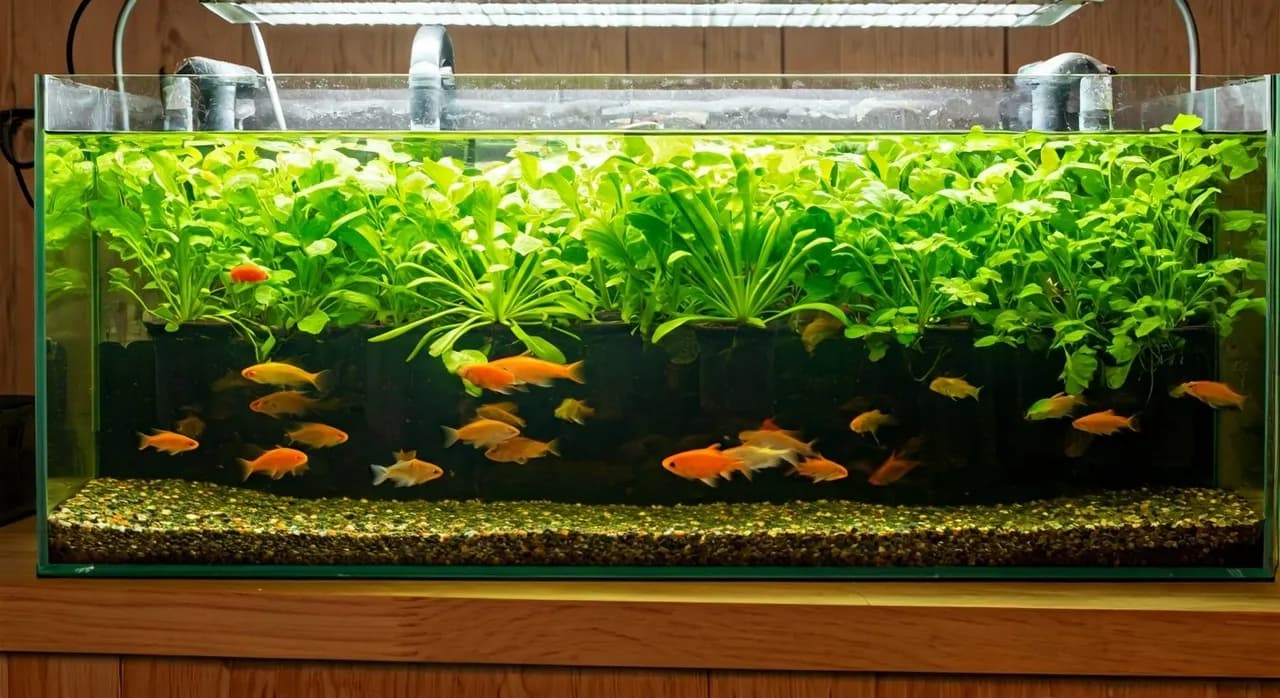
Goldfish (Carassius auratus) are primarily ornamental, but their hardiness and tolerance for a wide range of conditions make them viable for aquaponics, particularly for systems focused on plant production where fish are a nutrient source rather than a food crop. They can tolerate water temperatures from 50°F to 80°F and are very forgiving of fluctuating water quality [1]. While they don’t grow large or quickly for food, a 100-gallon aquaponics fish tank with goldfish can still provide ample nutrients for leafy greens. Their FCR is generally higher than food fish, often 3:1 or more, reflecting their slower growth and lower feed efficiency for biomass production. For a 300-gallon system, you might stock 50-70 goldfish, focusing on their waste production for plants.
- Bluegill: Cooler water (60°F-75°F), slower growth (12-18 months to harvest).
- Goldfish: Very hardy, wide temperature tolerance (50°F-80°F).
- Both: Lower stocking densities typically, 0.25-0.5 lb/gallon.
- Bluegill: Can be a food fish, but smaller harvest size.
- Goldfish: Primarily ornamental or nutrient producers, not typically eaten.
Stocking density and system management
Regardless of the fish species you choose, proper stocking density and diligent system management are paramount for success. Overstocking a tank, even with hardy fish, can quickly lead to poor water quality, stressed fish, and ultimately, system failure. A general rule of thumb for mature aquaponics systems is to aim for 0.5 to 1.0 pound of fish per gallon of water [4]. For a 300-gallon system, this means you’re looking at supporting 150 to 300 pounds of fish biomass. However, new systems should start with a much lower density, perhaps 0.25 pounds per gallon, to allow the beneficial bacteria to establish themselves in the biofilter over several weeks.
Maintaining water quality for fish and plants
Consistent monitoring of water parameters is non-negotiable. You should regularly check pH levels, ammonia, nitrite, and nitrate. Ammonia and nitrite should always be near zero, while nitrates should be present to feed your plants. A pH range of 6.0 to 7.0 is generally considered ideal for most aquaponics setups, balancing the needs of both fish and plants. Adequate aeration, provided by air pumps and air stones, is also critical to maintain dissolved oxygen levels above 5 mg/L, especially in densely stocked tanks. Regular water testing, at least two to three times per week in a new system, can prevent many common issues.
- Start with low stocking density: Begin with 0.25 pounds of fish per gallon in new systems.
- Monitor pH: Maintain between 6.0 and 7.0 for optimal health.
- Check ammonia/nitrite: Keep levels below 0.5 ppm to prevent toxicity.
- Ensure adequate aeration: Maintain dissolved oxygen above 5 mg/L.
- Regular testing: Test water parameters 2-3 times weekly in early stages.
Aquaponics fish comparison: Tilapia, Catfish, Bluegill, and Goldfish
Feature | Tilapia | Channel Catfish | Bluegill | Goldfish |
|---|---|---|---|---|
Optimal Temp (°F) | 70-85 | 65-85 | 60-75 | 50-80 |
pH Range | 6.0-7.5 | 6.0-7.5 | 6.5-8.0 | 6.0-8.0 |
Growth Rate | Fast (6-9 months) | Medium (6-12 months) | Slow (12-18 months) | Very Slow (12+ months) |
Harvest Size (lb) | 1.5-2.0 | 1.0-2.0 | 0.5-1.0 | 0.1-0.5 (ornamental) |
FCR (approx.) | 1.5:1-1.8:1 | 1.8:1-2.5:1 | 2.5:1-3.5:1 | 3.0:1+ |
Hardiness | High | Very High | Medium | Very High |
Primary Use | Food fish | Food fish | Food/Ornamental | Ornamental/Nutrient |
Tilapia FCR: Tilapia have an efficient feed conversion ratio (FCR) of 1.5:1 to 1.8:1, converting feed into biomass well: about 1 pound of fish from 1.5 to 1.8 pounds of feed [1].
Aquaponics pH: Maintaining a stable pH between 6.0 and 7.0 is crucial for aquaponics, as this range optimizes nutrient availability for plants and minimizes stress for most fish species [5].
Frequently asked questions
What is the best temperature for aquaponics fish?
The best temperature depends on the fish species; tilapia prefer 70°F-85°F, while bluegill thrive in cooler water, 60°F-75°F. Maintaining a consistent temperature is more important than hitting a single ‘best’ number [1].
How many fish can I put in a 300-gallon aquaponics tank?
For a mature 300-gallon aquaponics tank, the number of fish it can support depends on the species, filtration, and management. This could translate to a population of several dozen adult tilapia or catfish.
What pH level is ideal for aquaponics fish and plants?
An ideal pH range for most aquaponics systems is between 6.0 and 7.0. This range balances the needs of the fish, which prefer slightly acidic to neutral water, and the plants, which absorb nutrients best in this range [5].
Are goldfish good for aquaponics?
Goldfish are a hardy option for aquaponics, especially for beginners or systems prioritizing plant growth over fish harvest. They tolerate a wide temperature range (50°F-80°F) and produce waste that fertilizes plants, though their growth for food is minimal [1].
How long does it take for tilapia to grow to harvestable size?
Nile tilapia typically reach a harvestable size of 1.5 to 2 pounds in about six to nine months when grown under optimal conditions, including consistent water temperatures around 78°F and high-quality feed [2].
What is a good feed conversion ratio (FCR) for aquaponics fish?
A good feed conversion ratio (FCR) for aquaponics fish is generally below 2.0:1. Tilapia, for example, often achieve an FCR of 1.5:1 to 1.8:1, meaning they convert 1.5 to 1.8 pounds of feed into 1 pound of fish mass [1].
References
- Fish in Aquaponics Systems (2026). Fish in Aquaponics Systems.
- Introduction to Aquaponics (2026). Introduction to Aquaponics.
- Building an Aquaponics Business (2026). Building an Aquaponics Business.
- Anatomy of an Aquaponics System (2026). Anatomy of an Aquaponics System.
- Plants in Aquaponics Systems (2026). Plants in Aquaponics Systems.
- USDA Natural Resources Conservation Service (2024). USDA Natural Resources Conservation Service.