Key takeaways
- A portable solar generator provides flexible, silent power for homesteads, especially useful in areas like the Pacific Northwest during outages.
- Main components include a solar panel, charge controller, battery, and inverter, each sized to meet specific power demands.
- Accurate power consumption calculations matter; a 100-watt device running for 12 hours needs 1200 watt-hours of battery capacity.
- Lithium iron phosphate (LiFePO4) batteries offer superior cycle life (3,000-5,000 cycles) and depth of discharge compared to lead-acid options.
- Proper wiring, including appropriate gauge wire and fusing, is essential for safety and system efficiency, preventing issues like voltage drop over long runs.
- Regular maintenance, such as cleaning solar panels and checking battery terminals, ensures system longevity and optimal performance for over 10 years.
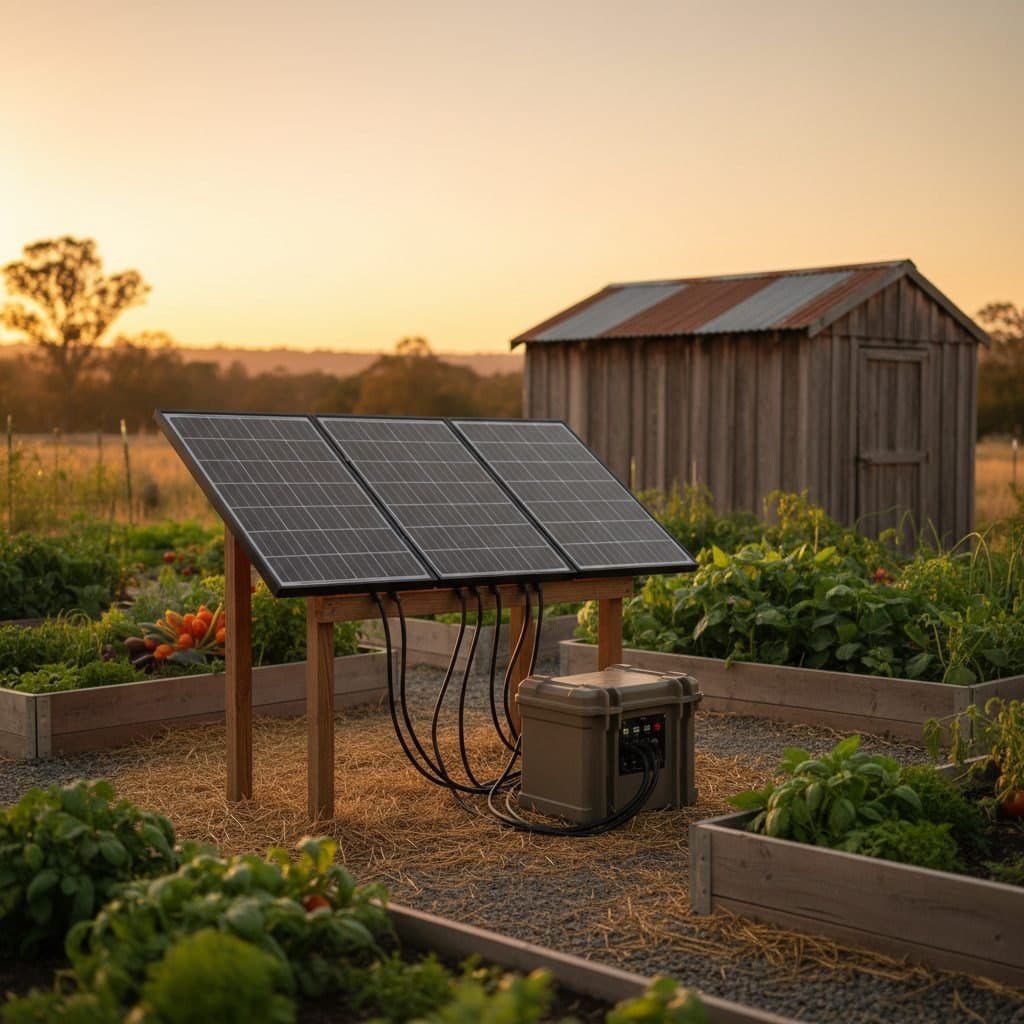
Quick answer: A portable solar generator is built by combining a solar panel, charge controller, battery, and inverter, all sized to meet specific power demands. This system converts sunlight into usable electricity, providing silent, flexible off-grid power for homesteads.
For many homesteaders in regions like the Midwest or the Appalachian mountains, reliable off-grid power is a necessity. A portable solar generator, built from individual components, gives a flexible and scalable solution for powering essential tools, lights, or even a small refrigerator during outages or at remote job sites. Unlike noisy gasoline generators that require fuel, a solar setup operates silently and needs only sunlight, making it ideal for quiet rural settings.
This guide will walk you through the process of assembling your own portable solar power station, focusing on practical considerations for a US audience. We will cover selecting components, sizing your system to meet specific power needs, and safely wiring everything together. With careful planning, you can build a system capable of delivering 500 to 1500 watts of continuous power.
Understanding the core components
A portable solar generator is essentially a self-contained system that converts sunlight into usable electricity. The four primary components work together to achieve this: the solar panel, the charge controller, the battery, and the inverter. Each plays a distinct role in the energy conversion and storage process. For example, a typical 100-watt solar panel might measure 40 by 20 inches and weigh around 15 pounds, making it manageable for portable use.
The solar panel: capturing sunlight
Solar panels convert sunlight into direct current (DC) electricity. Monocrystalline panels are efficient and widely used in portable setups because they pack high output into a small footprint and still produce in partial shade. In USDA zone 6, a 100-watt panel can produce an average of 400-500 watt-hours per day during peak sun hours. For more on how these devices work, consider reading how a solar panel actually works: from photon to power outlet.
- Monocrystalline panels offer high efficiency, often above 20%.
- Flexible panels are lighter, weighing 2-4 pounds for a 100-watt unit.
- Panel wattage directly impacts daily energy harvest.
- Consider a panel with a 12-volt nominal output for smaller systems.
Sizing your system: calculating power needs
Before selecting any components, you must accurately determine your power requirements. This involves listing all the devices you plan to power, their wattage, and how many hours per day each will run. For instance, a 60-watt LED light bulb running for 5 hours consumes 300 watt-hours (Wh) of energy. Overestimating your needs slightly is better than underestimating, especially for critical applications like powering a well pump in a remote cabin in Montana.
Calculating daily energy consumption
Start by identifying the wattage of each appliance, usually found on a label. Multiply the wattage by the hours of daily use to get daily watt-hours. Sum these values for your total daily energy consumption. If your total daily consumption is 1200 Wh, you’ll need a battery system that can store at least that much, accounting for inverter efficiency losses, which can be 10-15%. For more detailed guidance on sizing, see solar panels for off-grid living: sizing the array and the battery.
- List all devices and their wattage ratings.
- Estimate daily run time for each appliance in hours.
- Calculate daily watt-hours (Wattage × Hours) for each device.
- Sum individual watt-hours for total daily consumption.
- Add a buffer for inverter losses and cloudy days.
Component selection and wiring
Once you have your daily energy consumption, you can select appropriately sized components. For a system needing 1200 Wh per day, a 100 Ah (amp-hour) 12-volt lithium iron phosphate (LiFePO4) battery provides 1200 Wh of usable energy, assuming an 80-100% depth of discharge. LiFePO4 batteries are preferred over lead-acid for their longer long lifespan and lighter weight, often 25-30 pounds for a 100 Ah unit.
Choosing the right parts
A charge controller protects your battery from overcharging. MPPT (Maximum Power Point Tracking) controllers are more efficient, and are more efficient than PWM (Pulse Width Modulation) controllers, especially in cooler climates like upstate New York. For an inverter, a pure sine wave inverter is recommended for sensitive electronics, providing clean power similar to grid electricity. A 1000-watt pure sine wave inverter can handle most small appliances. Wire gauge is also critical; for a 100-watt panel, appropriately sized wire is typically sufficient for reasonable cable runs to minimize voltage drop.
- Select a LiFePO4 battery for superior cycle life and discharge depth.
- Choose an MPPT charge controller for 15-30% better efficiency.
- Opt for a pure sine wave inverter for sensitive electronics.
- Size wiring (e.g., 10 AWG) to match current and cable length.
- Include appropriate fuses (e.g., 30 amp for a 1000W inverter at 12V) for safety.
Assembly and testing for safe operation
Assembling your portable solar generator requires careful attention to detail and safety. Always connect components in the correct order: charge controller to battery first, then solar panel to charge controller, and finally the inverter to the battery. This sequence prevents damage to the charge controller from unregulated panel voltage. Use appropriate connectors, such as MC4 connectors for solar panels, which ensure a watertight and secure connection for outdoor use in climates like Florida, where humidity is high.
Wiring and initial checks
Ensure all connections are tight and secure. Use a multimeter to verify voltage at each stage: 12-14 volts from the battery, and 120 volts AC from the inverter when a load is applied. For safety, install fuses on both the battery-to-charge controller line and the battery-to-inverter line. Use a fuse sized for a 1000-watt inverter wired to a 12-volt battery. Test the system with a small load, like a 60-watt light bulb, to confirm proper function. This systematic approach helps prevent electrical shorts and component failure so your system delivers its rated 500-1500 watts safely.
- Connect the charge controller to the battery first.
- Connect the solar panel to the charge controller second.
- Connect the inverter to the battery last.
- Use properly sized fuses on all major lines.
- Verify all connections are secure and watertight.
Maintenance and expansion
Even a well-built portable solar generator requires periodic maintenance to ensure its longevity and optimal performance. For systems operating in dusty environments, like a farm in Kansas, solar panels should be cleaned every one to three months to remove dirt and debris that can reduce output. Regularly inspect all wiring for fraying or corrosion, especially at terminals, which can lead to increased resistance and power loss. A well-maintained system can reliably provide power for 10-15 years.
Extending system life and capacity
Check battery terminals annually for corrosion and ensure they are tight. For LiFePO4 batteries, monitor cell voltage balance, typically using a battery management system (BMS) that maintains cells within a narrow voltage range of each other. If your power needs grow, you can often expand a modular system by adding more solar panels in parallel or series, or by adding another battery in parallel, provided your charge controller and inverter can handle the increased capacity. For example, doubling a 100 Ah battery to 200 Ah could extend your run time by 100%, allowing a small refrigerator to run for 24 hours instead of 12. You can also explore off-grid and hybrid solar systems for larger, more permanent setups.
- Clean solar panels quarterly to maintain efficiency.
- Inspect wiring and connections annually for wear or corrosion.
- Monitor battery health, especially cell balance for LiFePO4 units.
- Consider adding more panels or batteries for increased capacity.
- Store the system in a cool, dry place when not in use to extend component life.
Comparison of common battery types for portable solar generators
Feature | Lithium Iron Phosphate (LiFePO4) | Sealed Lead-Acid (AGM/Gel) |
|---|---|---|
Cycle Life | 3,000-5,000 cycles | 300-1,000 cycles |
Depth of Discharge | 80-100% | 50% |
Efficiency | 95-99% | 80-85% |
Weight (100Ah 12V) | 25-30 pounds | 60-70 pounds |
Cost (100Ah 12V) | $300-$600 | $150-$250 |
Maintenance | Low (BMS managed) | Low (sealed) |
Power calculation tip: A 12-volt, 100 amp-hour (Ah) LiFePO4 battery provides 1200 watt-hours of usable energy, enough to power a 100-watt device for 12 hours.
Efficiency matters: MPPT charge controllers are 15-30% more efficient than PWM controllers, especially beneficial in regions with varying sunlight like the Pacific Northwest.
References
- Energy Crisis Way-Forward: Diesel Generator-Micro Hydro-Solar Hybrid Power System of Off-Grid Power Station for Rural Development.
- ERDA 10 MWe solar pilot plant subsystem research experiments, steam generator tests at Northern States Power Riverside Station. Volume III. Test No. 18 (1977).
- ERDA 10 MWe solar pilot plant subsystem research experiments, steam generator tests at Northern States Power Riverside Station. Volume IV. Test No. 19 (1977).
- ERDA 10 MWe solar pilot plant subsystem research experiments, steam generator tests at Northern States Power Riverside Station. Volume VIII. Test No. 23 (1977).
- ERDA 10 MWe solar pilot plant subsystem research experiments, steam generator tests at Northern States Power Riverside Station. Volume II. Test No. 17 (1977).
- USDA Natural Resources Conservation Service (2024).