Key takeaways
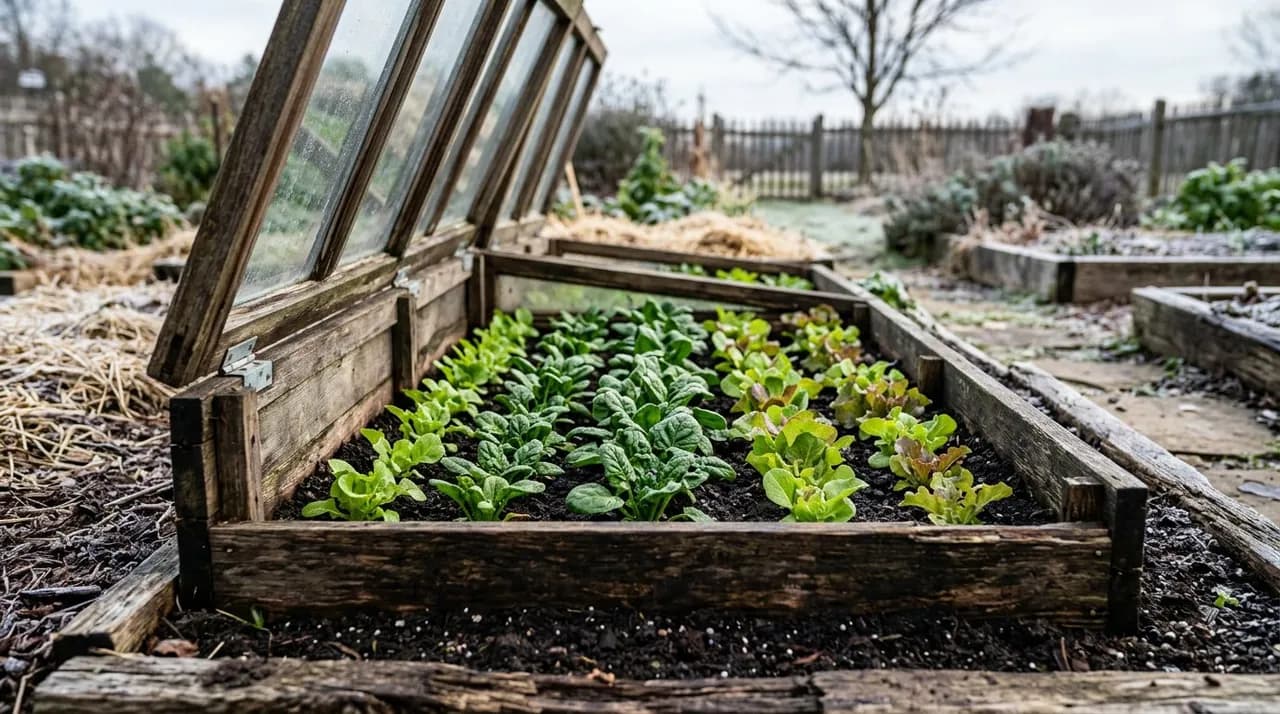
- A cold frame is an unheated bottomless box with a transparent lid that captures solar heat to protect crops from frost and wind.
- Building a DIY cold frame using salvaged storm windows and rot-resistant timber offers affordable season extension.
- Sloping the glazed lid toward the equator maximizes winter sun capture and sheds rainwater and snow.
- Daily ventilation management prevents extreme temperature spikes from cooking tender seedlings on sunny days.
- Cold frames allow winter harvesting of cold-hardy salad greens and accelerate early spring seed starting by four to six weeks.
Quick answer: Cold frame gardening uses a simple, unheated low structure with a transparent glass or polycarbonate lid to create a protected microclimate for vegetables. It extends the growing season by four to six weeks in early spring and late autumn, and protects cold-hardy greens and root crops for continuous harvesting throughout winter without artificial heating.
For home food growers, the shoulder seasons of early spring and late autumn often present the greatest growing challenges. Sudden frosts, biting winds, and cold, saturated soils slow seed germination and damage tender transplants.
Practicing cold frame gardening bridges this seasonal gap. By trapping passive solar radiation and creating an insulated thermal buffer around soil and foliage, a cold frame lets you start seeds weeks before outdoor soils warm, harden off nursery starts safely, and harvest fresh salads even when snow covers the garden.
Whether you build a diy cold frame from salvaged timber or construct a permanent masonry bed, mastering season extension fundamentals expands your garden's productive calendar.
What is a cold frame and how does it compare to a greenhouse?
A cold frame is a simple, ground-level enclosure with solid insulated walls and a transparent glazed lid that admits sunlight while trapping radiant heat. Unlike heated greenhouses, cold frames rely entirely on passive solar gain and the thermal mass of the underlying soil.
Comparing a cold frame vs greenhouse helps clarify their distinct functional roles:
- Footprint and scale: Greenhouses are walk-in structures requiring significant yard space, structural framing, and level foundations. Cold frames occupy a minimal footprint, making them ideal for small backyards, raised beds, or patio corners.
- Cost and construction: Greenhouses require substantial financial investment in framing materials, ventilation fans, and poly coverings. A functional cold frame can be constructed in an afternoon using inexpensive lumber or salvaged materials.
- Thermal efficiency: Because of its low profile and close proximity to the ground, a cold frame captures ground warmth more efficiently per unit volume than an unheated full-sized greenhouse.
To learn how to condition garden beds before installing cold frames, explore our guide on sheet mulching for soil moisture.
How do you build a DIY cold frame from old windows or new timber?
Building your own cold frame is a straightforward DIY carpentry project. Follow these foundational cold frame plans to construct a durable unit:
1. Dimension and orientation guidelines
- Ideal footprint: A box measuring 90 to 120 cm (3 to 4 ft) deep and 120 to 180 cm (4 to 6 ft) wide allows easy arm access from the outside without stepping on garden soil.
- Sloped lid angle: Build the back wall 38 to 45 cm (15 to 18 in) high and the front wall 20 to 25 cm (8 to 10 in) high. This creates a gentle slope of 10 to 15 degrees.
- Orientation: Position the low front edge facing directly toward the equator (south-facing in the Northern Hemisphere, north-facing in the Southern Hemisphere) to capture low-angled winter sun.
2. Sourcing frame materials
- Wood options: Rot-resistant hardwoods, cedar, redwood, or untreated exterior-grade pine offer solid insulation. Avoid creosote-treated railroad ties, which leach harmful chemical compounds into garden soil.
- Straw bale walls: For a temporary, zero-carpentry solution, arrange straw bales in a rectangle to form 40 cm (16 in) thick insulated walls, laying glazed sashes directly across the bales.
- Cinder blocks or brick: Masonry walls absorb solar heat during sunny days and slowly release warmth back to the root zone at night, creating exceptional thermal mass.
3. Selecting glazing materials
- Salvaged storm windows: A cold frame from old windows is traditional and cost-effective. Ensure glass is firmly puttied into wooden or aluminum frames.
- Twin-wall polycarbonate: Modern 6 mm to 8 mm twin-wall polycarbonate sheets are lightweight, shatterproof, and provide superior thermal insulation compared to single-pane glass.
What vegetables should you grow in a cold frame across seasons?
Knowing what to grow in a cold frame depends on the time of year and temperature dynamics:
Early spring
- Early direct sowing: Direct-sow fast-growing cool crops: radishes, baby spinach, arugula, scallions, and early carrots.
- Seed starting and hardening off: Use the frame as a protected staging area to transition indoor-started brassica, onion, and lettuce seedlings before transplanting into open garden beds.
Autumn and winter
- Overwintering salad greens: Sow winter-hardy greens in late summer or early autumn so plants reach mature size before day lengths drop below 10 hours. Cold-hardy crops that thrive in winter frames include spinach, mache (corn salad), claytonia (miner's lettuce), tatsoi, winter lettuce, and kale.
- Root protection: Carrots, beets, and turnips grown in the frame remain crisp and unfrozen, ready for harvest throughout winter.
How do climate conditions affect cold frame management globally?
While the physical structure remains identical, management rhythms vary across climate zones:
In cool temperate climates (UK/US north/Northern Europe): Focus on thermal retention during freezing winter months. Add thermal mass inside the frame by placing dark water-filled jugs along the back wall to absorb heat. Cover the glass with an insulating burlap blanket or old quilt during severe sub-zero cold snaps.
In subtropical and mild Mediterranean climates (AU/IN/US south/Southern Europe): Excessive solar heat accumulation is the primary danger rather than extreme freezing. Frame walls need less insulation, but daily venting is essential to prevent daytime temperatures from exceeding 30°C (86°F), which causes leafy greens to bolt and wilt.
How do you manage temperature, ventilation, and watering?
Proper environmental management inside a cold frame prevents common growing failures:
Preventing overheating with proper ventilation
On clear, sunny days (even when outside temperatures are near freezing), air temperatures inside a sealed cold frame can quickly climb above 35°C (95°F), cooking tender seedlings.
- Manual venting: Prop the lid open 5 to 15 cm (2 to 6 in) with a wooden notched block during the morning on sunny days, closing the sash before dusk to trap evening warmth.
- Automatic solar vent openers: Install a non-electric, wax-cylinder automatic solar vent arm that automatically expands and pushes the lid open when temperatures exceed 18°C (65°F), closing automatically as the frame cools.
Managing moisture and humidity
High humidity in sealed, cool environments creates ideal conditions for fungal damping-off disease and grey mold (Botrytis).
- Water in the morning on sunny days so foliage dries before evening.
- Water the soil directly at ground level rather than using overhead sprinklers.
- Prop the lid open slightly on overcast days to maintain gentle air circulation.
To integrate season extension into permanent edible landscapes, explore our guides on how to start a food forest and building healthy garden soils with cover crops for the home garden.