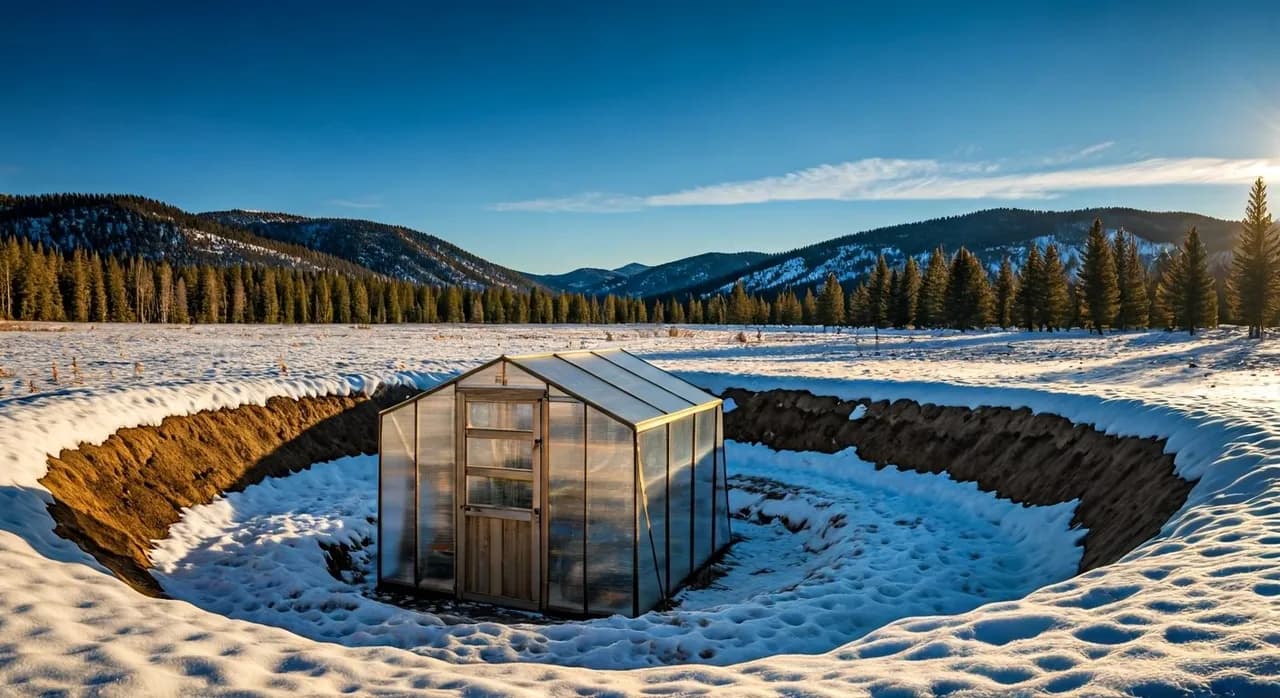
Key takeaways
- Walipinis utilize subterranean depth to tap into stable geothermal temperatures, often maintaining 50-60°F soil temperatures.
- Optimal glazing angles, typically 30-45 degrees for 40°N latitude, maximize winter solar gain and minimize summer overheating.
- Effective drainage systems, including French drains and sump pumps, are critical to prevent water accumulation and structural damage.
- Proper ventilation, both passive and active, is essential for temperature regulation and humidity control within the pit-greenhouse.
- Structural integrity requires sturdy retaining walls and roof supports designed for local snow and soil loads, often exceeding 40 pounds per square foot.
- Careful site selection, considering sun exposure, soil type, and water table, is the first step to a successful walipini project.
Quick answer: Walipini greenhouses extend growing seasons by utilizing subterranean depth to tap into stable geothermal temperatures, maintaining warmer soil and air temperatures than outside. This allows for year-round production of cool-season crops even in cold USDA zones.
In regions like the upper Midwest or the Mountain West, where winter temperatures can regularly drop below 0°F and the growing season is often limited to 120-150 days, extending cultivation into colder months presents a significant challenge. Traditional greenhouses demand substantial heating, often relying on propane or natural gas, which can be costly and less resilient for off-grid homesteads. The walipini, a subterranean pit-greenhouse, gives a compelling alternative by harnessing the earth’s stable temperatures to provide a more consistent growing environment.
A well-designed walipini can maintain interior temperatures 20-30°F warmer than outside air during winter, allowing for year-round production of cool-season crops even in USDA zones 4 and 5. This article explores the critical design elements of depth, glazing angle, and drainage, providing practical insights for growers looking to build a resilient, low-energy food production system on their homestead.
Optimal depth and thermal mass for temperature stability
The core principle of a walipini relies on the earth’s thermal mass. Below a certain depth, ground temperatures remain relatively constant, typically around 50-60°F in many US regions, regardless of surface air fluctuations. Digging a pit 6 to 8 feet deep allows the greenhouse to tap into this stable geothermal heat, significantly reducing the need for supplemental heating. In USDA zone 5, for instance, a walipini dug to 7 feet can maintain soil temperatures around 55°F, even when outside air drops to 10°F, providing a critical buffer for plants.
The excavated soil itself, when used as berms around the structure, further increases insulation and thermal mass. This design strategy is a fundamental component of passive solar design. For structural integrity, retaining walls are essential, often constructed from treated lumber, concrete blocks, or even stacked tires. These walls must be strong enough to withstand the lateral pressure of several tons of soil, and must be designed to handle significant soil pressure at the base. Proper compaction of backfill around the walls is also critical to prevent settling over time.
- Excavate to a minimum of 6 feet for consistent temperatures.
- Aim for 7-8 feet deep in colder USDA zones like 4 or 5.
- Utilize excavated soil to create insulating berms around the structure.
- Construct sturdy retaining walls capable of supporting significant soil pressure.
- Ensure proper backfill compaction to prevent future structural issues.
Glazing angle and material for maximum solar gain
The glazing — the transparent roof material — is the primary means of capturing solar energy for a walipini. The angle of this glazing is critical for maximizing winter sun exposure and minimizing summer overheating. For locations around 40°N latitude, such as Denver, Colorado, or Columbus, Ohio, an optimal glazing angle typically ranges from 30 to 45 degrees from horizontal. This angle allows low-angle winter sun to penetrate deeply into the pit, while the higher summer sun is reflected, preventing excessive heat buildup. A 35-degree angle can capture a significant amount of available winter solar radiation.
Material choice also plays a significant role. Double-wall polycarbonate panels are a popular choice due to their superior insulation properties, light transmission, and durability compared to single-pane glass or polyethylene film. They offer an R-value of 1.7 to 2.0, significantly higher than single-pane glass at 0.9. Polycarbonate sheets typically come in 8 mm or 16 mm thicknesses, with the thicker option providing better insulation. Proper sealing of all glazing joints is essential to prevent heat loss, which can account for a significant portion of total heat loss in a poorly sealed structure.
- Angle glazing at 30-45 degrees for 40°N latitude to optimize winter solar gain.
- Consider a 35-degree angle for efficient solar capture.
- Use double-wall polycarbonate for better insulation and durability.
- Choose 8 mm or 16 mm polycarbonate, with 16 mm offering superior R-value.
- Ensure all glazing joints are well sealed to prevent heat escape.
Critical drainage systems and moisture control
Because a walipini is a pit in the ground, managing water — both from rainfall and groundwater — is paramount. Poor drainage can lead to waterlogging, root rot, structural damage to retaining walls, and increased humidity, which encourages disease. Before digging, assess your site’s water table and soil percolation rates. The USDA Natural Resources Conservation Service (NRCS) provides detailed soil surveys that can indicate drainage characteristics for specific areas [6]. In areas with high water tables or heavy clay soils, a sturdy drainage system is non-negotiable.
A common solution is a French drain system installed around the perimeter of the pit at the base of the retaining walls. This involves a trench filled with gravel and a perforated pipe, sloped at a minimum of 1/8 inch per foot, directing water away from the structure to a lower elevation or a sump pump. Where annual rainfall tops 30 inches or soils drain slowly, a sump pump feeding a buried drain line is often needed to move standing water out. Installing a 6-inch layer of gravel beneath the growing beds also helps prevent standing water and improves aeration for plant roots.
- Assess your site’s water table and soil percolation rates before construction.
- Install a French drain system around the perimeter of the pit.
- Slope drain pipes at least 1/8 inch per foot to ensure proper flow.
- Consider a sump pump for high rainfall areas or slow-draining soils.
- Lay a 6-inch gravel layer beneath growing beds for improved drainage.
Ventilation and air circulation for healthy growth
While capturing solar heat is essential, preventing overheating and managing humidity are equally important for plant health. Without adequate ventilation, temperatures inside a walipini can quickly soar above 90°F on a sunny day, even in winter, and humidity can reach 100%, encouraging fungal diseases. Passive ventilation is the simplest approach, utilizing strategically placed vents. High vents near the glazing allow hot air to escape, while low vents on the opposite side draw in cooler, fresh air. These vents should be sized to provide ample area for effective air exchange.
For more precise control, especially in larger walipinis or those in warmer climates, automated ventilation systems are beneficial. These systems typically involve thermostatically controlled exhaust fans and motorized intake vents. A 1,000 square foot walipini might require an exhaust fan capable of moving 10,000 cubic feet per minute (CFM) to achieve a one-minute air exchange rate, preventing temperature spikes. Integrating these systems with off-grid and hybrid solar systems can ensure reliable operation without grid dependence. Maintaining air circulation with small internal fans also helps prevent stagnant air pockets and reduces humidity around plants, which is critical for preventing issues like powdery mildew.
- Install high and low vents for passive air exchange, totaling 20% of glazing area.
- Consider automated exhaust fans and motorized intake vents for precise temperature control.
- Size exhaust fans to achieve a one-minute air exchange rate for your walipini’s volume.
- Integrate ventilation systems with solar power for off-grid reliability.
- Use small internal circulation fans to prevent stagnant air and reduce humidity.
Walipini vs. Traditional Above-Ground Greenhouse
Feature | Walipini Pit-Greenhouse | Traditional Above-Ground Greenhouse |
|---|---|---|
Primary Heat Source | Geothermal mass, passive solar gain | Active heating (gas, electric), passive solar gain |
Temperature Stability | High (50-60°F soil temp buffer) | Moderate, highly dependent on active heating and insulation |
Energy Consumption | Very low for heating, moderate for ventilation (if automated) | High for heating, moderate for ventilation |
Construction Cost | Moderate to high (excavation, retaining walls) | Low to moderate (frame, glazing) |
Winter Growing Season Extension | Significant (e.g., 60+ days in USDA zone 5) | Moderate, costly to extend in cold climates |
Vulnerability to Wind/Snow | Low (partially subterranean, strong roof) | Moderate to high (exposed structure, snow load critical) |
Geothermal Stability: The earth’s thermal mass below 6 feet maintains soil temperatures around 55°F, even when outside air drops to 10°F.
Solar Capture Efficiency: A 35-degree glazing angle can capture a significant amount of available winter solar radiation for locations at 40°N latitude.
Ventilation Requirement: Effective passive ventilation requires ample vent openings.