Key takeaways
- Sandy soils, common in regions like Florida and the Northeast, drain quickly and lose nutrients rapidly, posing a challenge for gardeners.
- Compost significantly increases a sandy soil’s organic matter, improving its capacity to hold water and essential nutrients.
- Biochar, a charcoal-like substance, enhances water retention and reduces nutrient leaching, especially when blended with organic amendments.
- Cover crops add organic matter, suppress weeds, and can fix nitrogen, building long-term soil health and resilience.
- A combined approach using compost, biochar, and cover crops offers the most robust solution for transforming poor sandy soils.
- Regular soil testing helps monitor progress and guides amendment strategies, ensuring efficient resource use.
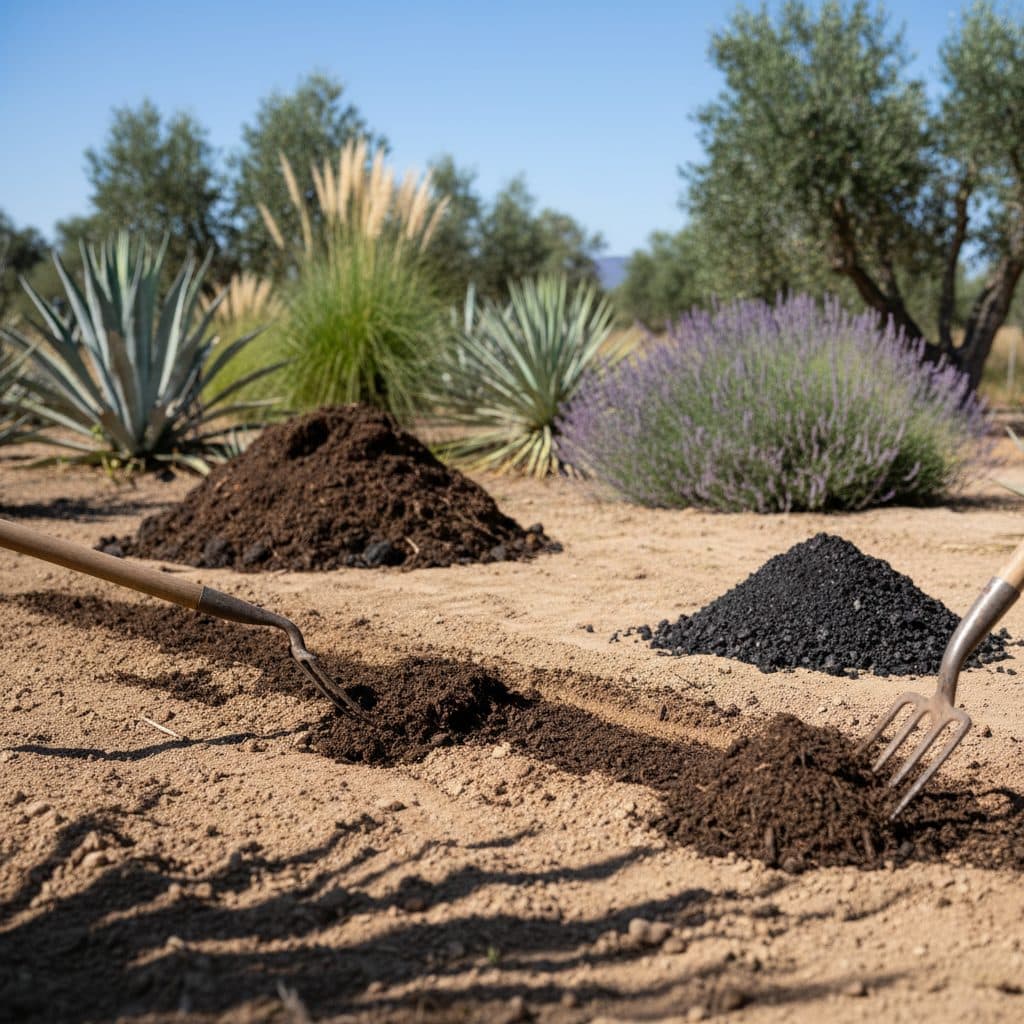
Quick answer: To improve sandy soil’s water and nutrient retention, incorporate organic amendments like compost and biochar, and utilize cover crops. These methods enhance the soil’s capacity to hold moisture and essential nutrients, building resilience against drought.
Gardeners across the United States, from the coastal plains of Florida to the sandy outwash plains of New England, often contend with sandy soil. This soil type, characterized by its large particle size, allows water to drain rapidly, taking valuable nutrients with it. In a typical sandy garden bed in USDA zone 8, water might percolate through the top 6 inches in less than 30 minutes after a heavy rain, leaving plants thirsty and undernourished.
Improving sandy soil’s ability to retain water and nutrients builds resilience against heatwaves and drought. This article outlines practical, research-backed strategies using compost, biochar, and cover crops to transform your sandy plot into a more productive and sustainable growing space, capable of supporting a thriving garden through challenging climates.
Understanding sandy soil and its challenges
Sandy soils are defined by their high percentage of sand particles, which are relatively large compared to silt and clay. This structure creates large pore spaces, leading to excellent aeration but poor water and nutrient retention. For instance, a sandy loam soil might hold only 0.5 to 1.5 inches of plant-available water per foot of soil depth, significantly less than a clay loam which can hold 2 to 3 inches. The USDA Natural Resources Conservation Service emphasizes that increasing soil organic matter is a fundamental strategy for improving water holding capacity and nutrient cycling [6].
The problem with fast drainage
Rapid drainage means that irrigation water and rainfall quickly pass beyond the root zone, making it unavailable to plants. This is particularly problematic in arid regions like parts of Arizona or during dry spells in the Midwest. Furthermore, sandy soils typically have rapid drainage, which contributes to significant nutrient loss and reduced water availability for plants. Essential nutrients like nitrogen and potassium, which are highly mobile, are easily leached out of the root zone before plants can absorb them, requiring more frequent fertilization or leading to nutrient deficiencies in crops like tomatoes or corn.
- Poor water retention: Water drains quickly, leaving plants thirsty.
- Nutrient leaching: Essential plant nutrients wash away easily.
- Low organic matter: Often naturally deficient in humus.
- Weak soil structure: Lacks aggregation, leading to compaction over time.
- Increased irrigation needs: Requires more frequent watering, increasing water bills.
Compost: the foundation of sandy soil improvement
Compost is an effective and accessible amendment for sandy soils. It is rich in decomposed organic matter, which acts like a sponge, dramatically increasing the soil’s water-holding capacity. For example, adding 2 inches of compost to the top 6 inches of a sandy garden bed can increase its water retention by 10% to 20%. Combined compost and clay amendments have been shown to improve water and nutrient retention in sandy soil [1]. This is particularly beneficial in drought-prone regions like California or the Texas panhandle, where every drop of water counts.
How compost works its magic
Beyond water retention, compost provides a slow-release source of a wide array of nutrients, reducing the need for synthetic fertilizers. It also supports a healthy soil microbiome, providing conditions for beneficial bacteria and fungi that improve nutrient cycling and disease suppression. For best results, aim to incorporate 1 to 3 inches of finished compost into the top 6 to 8 inches of your sandy soil annually. This practice can increase soil organic matter content by several percentage points over time. Consider using a product like Fermented Soybean Meal Organic Fertilizer to supplement nutrient needs while building soil health.
- Increases water holding capacity: Holds up to 20 times its weight in water.
- Slow-release nutrients: Provides a steady supply of essential elements.
- Improves soil structure: Creates stable aggregates, reducing compaction.
- Boosts microbial activity: Supports a diverse and healthy soil food web.
- Buffers soil pH: Helps stabilize pH levels for optimal plant growth.
Biochar: a long-term soil amendment
Biochar is a charcoal-like material produced by heating organic matter in a low-oxygen environment. Its highly porous structure makes it an excellent amendment for sandy soils, significantly increasing both water and nutrient retention. Manure-biochar blends can effectively reduce nutrient leaching and increase water retention in sandy agricultural soils, as observed in field experiments [2]. This is particularly useful in regions with high rainfall or frequent irrigation, such as the Pacific Northwest, where nutrient runoff can be a concern.
Applying biochar effectively
While biochar offers long-term benefits, proper application is key. High doses of fine biochar in sandy subsoils can increase water retention, but some studies indicate they may cause first-year yield depressions for drought-stressed barley [4]. For home gardens, a typical application rate is 5% to 10% by volume mixed into the top 6 inches of soil. Biochar derived from materials like rice husk can influence sandy soil properties, nutrient uptake, and plant growth [5]. It is often most effective when ‘charged’ with nutrients by mixing it with compost or liquid fertilizers before incorporation, as its porous structure can initially absorb nutrients, making them temporarily unavailable to plants. This charging process helps it immediately contribute to nutrient availability rather than temporarily reducing it.
- Enhanced water retention: Porous structure holds water for longer periods.
- Reduced nutrient leaching: Binds nutrients, preventing them from washing away.
- Improved microbial habitat: Provides shelter for beneficial soil microorganisms.
- Long-lasting stability: Persists in the soil for hundreds to thousands of years.
- Carbon sequestration: Locks carbon in the soil, contributing to soil health.
Cover crops: living soil builders
Cover crops are plants grown primarily to protect and enrich the soil instead of for harvest. They are particularly valuable for sandy soils, providing a continuous source of organic matter when tilled in or left as mulch. For example, planting a mix of cereal rye and hairy vetch in the fall can add significant biomass to a garden bed in USDA zone 6 by spring, improving soil structure and nutrient availability. You can learn more about specific species and timing in our article on cover crops for the home garden.
Choosing and managing cover crops
Leguminous cover crops, such as clover or vetch, have the added benefit of fixing atmospheric nitrogen, making it available to subsequent crops. This can reduce the need for nitrogen fertilizers by 20% to 40% in the following growing season. Non-legumes like cereal rye or oats are excellent for adding bulk organic matter and scavenging leftover nutrients. Terminate cover crops before they go to seed, typically 2 to 4 weeks before planting your main crops, to prevent them from becoming weeds. Incorporate the green matter into the top few inches of soil or chop and drop it as a thick mulch layer. This practice contributes to building soil organic matter over time, enhancing the soil’s resilience to drought, a common issue in states like Oklahoma and Kansas.
- Adds organic matter: Increases humus content, improving water retention.
- Suppresses weeds: Outcompetes unwanted plants, reducing weeding effort.
- Prevents erosion: Roots hold soil in place, especially during heavy rains.
- Fixes nitrogen: Legumes provide natural nitrogen for subsequent crops.
- Improves soil structure: Root systems create channels for air and water.
Integrating strategies for maximum impact
While each of these strategies (compost, biochar, and cover crops) offers benefits individually, their combined application accelerates soil improvement. Start by incorporating a substantial amount of compost, perhaps 2 to 3 inches, into your sandy beds. This immediately boosts water retention and nutrient availability. Then, integrate biochar at a rate of 5% to 10% volume, ensuring it is charged with nutrients to prevent initial nutrient tie-up. This provides a long-term structural improvement to the soil matrix.
Long-term soil health management
Establish a rotation of cover crops in beds that are not actively growing cash crops. This ensures a continuous supply of fresh organic matter, further enhancing the work done by compost and biochar. For instance, in a garden in USDA zone 7, you might plant a summer cover crop of buckwheat, followed by a winter cover crop of crimson clover. Over three to five years, this integrated approach can transform a barren sandy patch into a rich, dark, and highly productive soil, capable of supporting a wide range of plants, including those that are drought tolerant. Regular soil testing every 2 to 3 years will help you monitor your progress and fine-tune your amendment strategy, ensuring your efforts are targeted and efficient.
- Initial compost application: Provides immediate organic matter and nutrients.
- Biochar incorporation: Offers long-term structural and retention benefits.
- Cover crop rotation: Continuously adds fresh organic matter and fixes nitrogen.
- Mulching: Reduces evaporation and adds organic matter over time.
- Regular soil testing: Monitors progress and guides future amendments.
Comparing sandy soil amendments
Amendment | Primary benefit | Application frequency | Cost (per cubic yard) |
|---|---|---|---|
Compost | Water & nutrient retention, microbial life | Annually | $30 – $70 |
Biochar | Long-term water & nutrient retention, structure | Once every 5-10 years | $100 – $300 |
Cover crops | Organic matter, nutrient cycling, erosion control | Seasonally (2-3 times/year) | $10 – $50 (seed cost) |
Organic Matter Goal: Aim for at least 3% to 5% organic matter content in sandy soil for significantly improved water and nutrient retention.
Water Savings: Improving sandy soil can reduce irrigation water needs by up to 25% to 50% in arid climates.
Frequently asked questions
How much compost should I add to sandy soil?
For initial improvement, incorporate 2 to 3 inches of finished compost into the top 6 to 8 inches of your sandy garden soil. For ongoing maintenance, a 1-inch layer applied annually will continue to build organic matter and improve soil health over several years.
Can biochar be used alone to improve sandy soil?
While biochar does improve water and nutrient retention, it is most effective when combined with other organic amendments like compost. Biochar can initially absorb nutrients, so ‘charging’ it with compost or liquid fertilizer for 2 to 3 weeks before application helps ensure immediate benefits to plants.
What are the best cover crops for sandy soil?
Good choices for sandy soil include cereal rye, oats, buckwheat, crimson clover, and hairy vetch. A mix of a grass (like rye) and a legume (like clover) often provides the best balance of organic matter addition and nitrogen fixation, benefiting subsequent crops by up to 40%.
How long does it take to see improvements in sandy soil?
You can see noticeable improvements in water retention and plant vigor within the first growing season after applying compost and biochar. Significant long-term changes in soil structure and organic matter content, especially with cover crops, typically take 3 to 5 years of consistent effort.
Is it possible to over-amend sandy soil with organic matter?
It is difficult to over-amend sandy soil with organic matter, as it continuously breaks down. However, extremely high applications (over 6 inches annually) might temporarily tie up nitrogen. Aim for a consistent 1 to 3 inches of compost per year to build soil health effectively without issues.
Do I still need to fertilize after adding compost and biochar?
Compost provides a slow-release source of many nutrients, reducing the need for synthetic fertilizers by 20% to 50%. Biochar helps retain these nutrients. However, a soil test every 2 to 3 years will indicate if specific nutrient deficiencies exist, especially for heavy feeders like corn or squash.
References
- Combined compost and clay amendments improve water and nutrient retention in sandy soil (2025). Combined compost and clay amendments improve water and nutrient retention in sandy soil.
- Manure‐biochar blends effectively reduce nutrient leaching and increase water retention in a sandy, agricultural soil: Insights from a field experiment (2024). Manure‐biochar blends effectively reduce nutrient leaching and increase water retention in a sandy, agricultural soil: Insights from a field experiment.
- Ecotoxicological Outcomes of Co-Amending Water and Wastewater Sludges in Sandy Soil Systems (2025). Ecotoxicological Outcomes of Co-Amending Water and Wastewater Sludges in Sandy Soil Systems.
- High doses of fine biochar in sandy subsoils increase water retention, but also cause first-year yield depressions for drought-stressed barley (2025). High doses of fine biochar in sandy subsoils increase water retention, but also cause first-year yield depressions for drought-stressed barley.
- Effect of Biochar Rate Derived from Rice Husk, Durian Peel and Oil Palm Petiole on Sandy Soil Properties, Nutrient Uptake and Plant Growth (2026). Effect of Biochar Rate Derived from Rice Husk, Durian Peel and Oil Palm Petiole on Sandy Soil Properties, Nutrient Uptake and Plant Growth.
- USDA Natural Resources Conservation Service (2024). USDA Natural Resources Conservation Service.