Key takeaways
- Organic weed management is labor-intensive, often costing 10 to 30 hours per acre and reducing yields by 20% to 80%.
- Cover crops suppress weed growth by 70% and contribute 50 to 150 pounds of nitrogen per acre.
- Occultation (tarping) reduces the viable weed seedbank by 60% to 80% within 4 to 6 weeks.
- The combined strategy can reduce weed biomass by 90% in subsequent organic cash crops, as shown in New York trials.
- Proper timing is crucial: plant winter cover crops in fall, then tarp for 3 to 6 weeks in spring before planting.
- Beyond weed control, these methods increase soil organic matter by 15% and improve water retention by 20,000 gallons per acre.
Quick answer: Combining cover crops and occultation (tarping) can reduce weed biomass by 90% in organic cash crops. This integrated strategy suppresses weed growth, depletes the weed seedbank, and improves soil health.
In the Mid-Atlantic region, organic growers often dedicate up to 40% of their total labor hours to weed management alone, a significant challenge for both profitability and sustainability. This intensive labor can translate to thousands of dollars per acre in regions like California’s Central Valley, making efficient weed control a top priority for farms from USDA zone 4 to zone 8.
Managing weeds without synthetic herbicides requires a thoughtful, integrated approach. Two powerful tools in the organic grower’s arsenal are cover cropping and occultation, also known as tarping. When used together, these methods can dramatically reduce weed pressure, improve soil health, and cut down on manual labor, offering a practical, research-backed solution for fields across the United States.
The persistent challenge of weeds in organic systems
Weeds are more than just an aesthetic issue; they directly compete with cash crops for water, nutrients, and sunlight, potentially reducing yields by 20% to 80% in various crops across the US. For organic operations, this competition is particularly acute, as synthetic herbicides are not an option. Manual weeding is labor-intensive and costly, often requiring 10 to 30 hours per acre for crops like carrots or onions, making it a major expense for growers.
Certain weeds, such as common purslane or broadleaf plantain, can quickly establish dense mats, outcompeting young seedlings and harboring pests. Research from the University of California, Davis, indicates that a high density of weeds can reduce crop nutrient uptake by up to 35% [4]. This nutrient drain weakens cash crops, making them less resilient and more susceptible to other stressors, ultimately impacting the farm’s bottom line by hundreds of dollars per acre.
the hidden costs of weed pressure
Beyond direct competition, weeds can also host diseases and insect pests, creating additional management challenges. For example, some common weeds can act as alternative hosts for diseases like early blight, which can then spread to susceptible crops like tomatoes or potatoes. This necessitates increased scouting and potentially organic pest control measures, adding further complexity and cost to farm operations, especially in humid regions like the Southeast where disease pressure is naturally higher.
- Reduced crop yields by 20% to 80% due to competition.
- Increased labor costs, often 10 to 30 hours per acre for manual weeding.
- Up to 35% reduction in crop nutrient uptake [4].
- Harboring of pests and diseases, increasing management complexity.
- Increased irrigation needs due to weed water consumption.
Cover crops: building soil and suppressing weeds
These persistent challenge of points carry into this section, too.
Cover crops are plants grown primarily to benefit the soil and subsequent cash crops, rather than for direct harvest. They are a cornerstone of organic farming, offering a multitude of benefits, including erosion control, nutrient cycling, and, critically, weed suppression. For instance, a dense stand of cereal rye planted in the fall in USDA zone 6 can produce up to 8,000 pounds of biomass per acre by spring, effectively smothering winter annual weeds and reducing their emergence by 70% or more [3].
Leguminous cover crops like crimson clover or hairy vetch, often grown in the Southeast, can fix 50 to 150 pounds of nitrogen per acre, reducing the need for purchased fertilizers by hundreds of dollars per acre [5]. This nitrogen becomes available to the following cash crop, improving its vigor and competitiveness against weeds. Selecting the right species for your region and goals is key; you can find more specific recommendations in our guide on best living-mulch and cover-crop legumes by USDA zone.
diverse benefits of cover cropping
Beyond direct weed suppression, cover crops improve soil structure, increasing water infiltration by up to 20% and reducing runoff. Their root systems help prevent soil erosion, especially on sloped fields in regions with heavy rainfall, protecting valuable topsoil. Over several seasons, consistent cover cropping can increase soil organic matter by 0.1% to 0.3% annually, leading to healthier, more productive soil.
- Suppresses weed growth by 70% or more [3].
- Fixes 50 to 150 pounds of nitrogen per acre [5].
- Prevents soil erosion and reduces runoff.
- Increases soil organic matter by 0.1% to 0.3% annually.
- Improves soil structure and water infiltration by up to 20%.
Occultation (tarping): smothering weeds with darkness
That work on cover crops sets up what follows here.
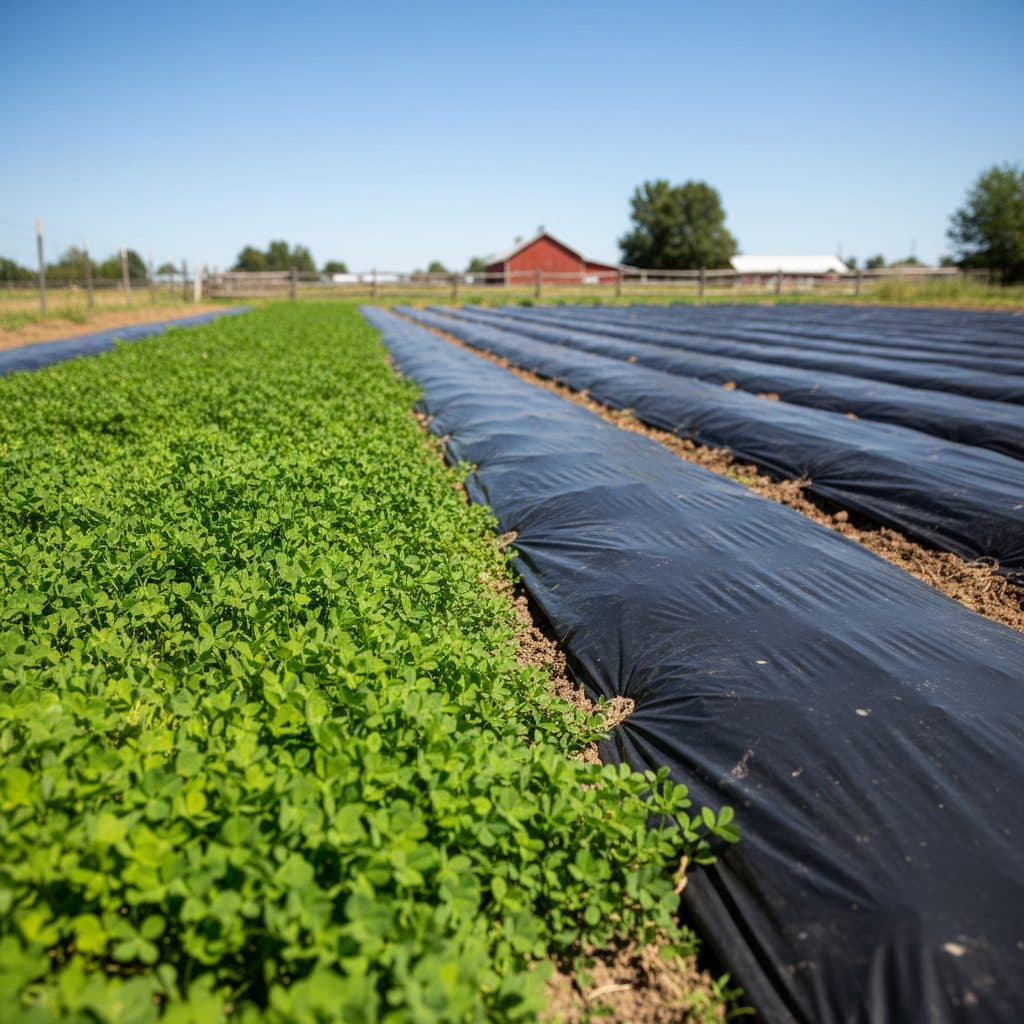
Occultation, or tarping, involves covering a section of ground with an opaque material, typically a black or dark-colored tarp, for a period of several weeks. This method works by depriving weeds of sunlight, preventing photosynthesis, and effectively ‘cooking’ dormant seeds in the top 2 inches of soil. In trials conducted in Vermont, black tarps elevated soil temperatures by 5 to 10°F compared to uncovered soil, accelerating weed seed germination and then killing the sprouted seedlings [1].
This process can reduce the viable weed seedbank in the upper soil layers by 60% to 80% within 4 to 6 weeks, significantly depleting the future weed pressure [3]. Tarps are typically made of durable woven polypropylene or silage plastic, designed to withstand several seasons of use. A 100-foot by 20-foot tarp can cover 2,000 square feet, making it suitable for both small market gardens and larger field sections in regions like the Pacific Northwest.
advantages of using tarps for weed control
Beyond weed suppression, tarping offers additional benefits. It conserves soil moisture by reducing evaporation, which can be particularly helpful in drier climates or during periods of low rainfall. It also creates a warm, moist environment that encourages the decomposition of organic matter, making nutrients more available for subsequent crops. This method is a non-chemical alternative to harsh herbicides; for more options, explore natural weed killers that actually work.
- Deprives weeds of sunlight, preventing growth.
- Elevates soil temperature by 5 to 10°F, killing sprouted seeds [1].
- Reduces viable weed seedbank by 60% to 80% in 4 to 6 weeks [3].
- Conserves soil moisture by reducing evaporation.
- Encourages organic matter decomposition and nutrient cycling.
The powerful synergy: cover crops and occultation combined
While cover crops and tarping are effective on their own, their combined use creates a powerful synergy for organic weed management. The cover crop first builds soil organic matter and suppresses initial weed growth, then the tarp is applied to terminate the cover crop and further deplete the weed seedbank. A study in New York demonstrated that tarping terminated cover crops (like cereal rye and hairy vetch) effectively, leading to a 90% reduction in weed biomass in subsequent organic cabbage production compared to untarped plots [1].
This allowed for successful no-till planting, preserving soil structure and moisture, and reducing manual weeding by 75% or more. The cover crop residue left under the tarp decomposes, adding organic matter and nutrients to the soil. This creates a fertile, weed-free seedbed, reducing the need for tillage and manual weeding by 75% or more. This method is particularly beneficial in systems aiming for reduced tillage or no-till practices, which are becoming more common in USDA zones 5 through 7, where soil health is a growing concern.
maximizing benefits for organic production
The combined approach not only controls weeds but also significantly enhances soil health. The cover crop’s roots improve soil aggregation, while the tarp’s warmth and moisture accelerate the breakdown of organic matter, feeding beneficial soil microbes. This integrated strategy can lead to an increase in soil organic carbon by 0.2% to 0.5% over a few seasons, improving the long-term productivity and resilience of the farm by reducing dependence on external inputs by 10% to 20%.
- Achieves 90% reduction in weed biomass for subsequent crops [1].
- Enables successful no-till or reduced-till organic production.
- Reduces manual weeding labor by 75% or more.
- Accelerates decomposition of cover crop residue under the tarp.
- Significantly improves soil organic matter and nutrient availability.
Practical application and timing for growers
This builds directly on powerful synergy.
Successful implementation of cover crops and occultation depends heavily on timing and local conditions. For a spring-planted cash crop, a common strategy involves planting a winter cover crop, such as a mix of cereal rye and crimson clover, in late fall (e.g., October in USDA zone 6). This cover crop grows through the winter and into early spring, establishing a robust biomass.
When the cover crop reaches maturity, typically in late April or early May, it is flattened or mowed, and then immediately covered with an opaque tarp. The tarp should remain in place for 3 to 6 weeks, depending on the target weeds and desired planting date. For example, in a trial in Pennsylvania, a 4-week tarping period after mowing a rye-vetch cover crop was sufficient to kill 95% of emerging broadleaf weeds before transplanting tomatoes. After tarp removal, the residual cover crop mulch provides continued weed suppression, often reducing subsequent weed flushes by 50% for the first 6 weeks of the cash crop’s growth.
adapting to your farm’s schedule
For fall-planted crops or succession plantings, the timing will shift. A summer cover crop like buckwheat or sudangrass can be planted in June or July, grown for 6 to 8 weeks, then mowed and tarped for 3 to 4 weeks before a fall crop like garlic or spinach is planted. This flexibility allows growers in diverse climates, from Florida to Washington, to integrate these practices into their specific rotations. For more detailed timing advice for smaller plots, consult resources like cover crops for the home garden.
- Plant winter cover crops in late fall (e.g., October in USDA zone 6).
- Mow or flatten cover crop in late spring (April/May).
- Apply tarps immediately after mowing for 3 to 6 weeks.
- Adjust tarping duration based on weed pressure and climate.
- Consider summer cover crops for fall cash crop rotations.
Beyond weed control: enhancing soil health and resilience
While weed suppression is a primary driver for using cover crops and occultation, the benefits extend significantly to overall soil health and farm resilience. Cover crops contribute organic matter, which improves soil structure, water infiltration, and nutrient retention. For example, a long-term study in Maryland showed that fields with regular cover cropping had 15% higher soil organic matter content after 5 years compared to conventionally tilled fields without cover crops [6].
This increased organic matter can hold an additional 20,000 gallons of water per acre, crucial for drought resilience in drier regions like the semi-arid West [6]. The tarping process, by creating a warm, moist environment, also encourages the activity of beneficial soil microorganisms. This can lead to a more active soil food web, which helps decompose organic matter and cycle nutrients, making them available for the subsequent crop. This method also reduces the need for heavy tillage, which can degrade soil structure and release carbon into the atmosphere, aligning with practices promoted by the USDA Natural Resources Conservation Service [6].
long-term benefits for farm sustainability
Implementing these practices over multiple seasons can lead to a cumulative improvement in soil fertility, reducing the need for external inputs by 10% to 20% over a decade. Healthier soils are more resilient to extreme weather events, such as heavy rains or prolonged droughts, which are becoming more frequent in many parts of the US. This translates to more stable yields and a more sustainable farming operation, providing economic benefits that extend far beyond a single growing season.
- Increases soil organic matter content by 15% over 5 years [6].
- Improves soil water holding capacity by 20,000 gallons per acre [6].
- Enhances beneficial soil microbial activity.
- Reduces reliance on tillage, preserving soil structure.
- Contributes to long-term farm sustainability and resilience.
Comparing Organic Weed Control Methods
Method | Primary Benefit | Weed Reduction Potential | Soil Health Impact | Labor Intensity |
|---|---|---|---|---|
Manual Weeding | Precise removal of specific weeds | High (if done consistently) | Minimal direct impact | Very High (10-30 hrs/acre) |
Cover Cropping | Weed suppression, soil building, N fixation | Moderate to High (70% reduction) | Very High (OM, structure, water) | Low to Moderate (planting, termination) |
Occultation (Tarping) | Weed seedbank depletion, bed preparation | High (60-80% seedbank reduction) | Moderate (moisture, warmth, OM decomp) | Low (laying, securing, removing tarps) |
Cover Crops + Occultation | Comprehensive weed control, maximum soil building | Very High (90% biomass reduction) | Very High (synergistic OM, water, nutrients) | Low to Moderate (integrated process) |
Weed Biomass Reduction: Combining cover crops and tarping can achieve a 90% reduction in weed biomass for subsequent organic cabbage crops in New York [1].
Soil Water Capacity: Increased soil organic matter from cover cropping can help soils hold an additional 20,000 gallons of water per acre, boosting drought resilience [6].
Frequently asked questions
How long should I leave the tarp on the ground?
The tarp should typically remain in place for 3 to 6 weeks. This duration is usually sufficient to kill most weeds and deplete the viable weed seedbank by 60% to 80% in the top soil layers, depending on your climate and target weeds.
Can I use this method in a small home garden?
Yes, absolutely. Occultation and cover cropping are highly adaptable for home gardens. Even a 10-foot by 10-foot area can benefit significantly, reducing manual weeding time by 75% for subsequent plantings.
What cover crops work best with tarping?
Winter annuals like cereal rye, hairy vetch, or crimson clover are excellent choices, especially in USDA zones 4 through 8. They produce substantial biomass that breaks down well under a tarp, contributing 50 to 150 pounds of nitrogen per acre.
Will tarping harm my soil or beneficial organisms?
No, tarping generally benefits soil health. It creates a warm, moist environment that encourages beneficial microbial activity, accelerating organic matter decomposition. Studies show soil organic matter can increase by 15% over 5 years with these practices [6].
How much does it cost to implement tarping?
Initial costs for durable tarps can range from $0.10 to $0.50 per square foot, but these tarps can last for 5 to 10 seasons, making the long-term investment quite cost-effective. Cover crop seeds typically cost $20 to $50 per acre.
Can I use this method for no-till planting?
Yes, combining cover crops and tarping is an excellent strategy for organic no-till systems. The terminated cover crop and clean seedbed allow for direct planting, preserving soil structure and reducing labor by up to 75%.
References
- Tarping Cover Crops Facilitates Organic No-till Cabbage Production and Suppresses Weeds (2022). Tarping Cover Crops Facilitates Organic No-till Cabbage Production and Suppresses Weeds.
- Effects of dryland summer cover crops and a weedy fallow on soil water, disease levels, wheat growth and grain yield in a Mediterranean-type environment (2022). Effects of dryland summer cover crops and a weedy fallow on soil water, disease levels, wheat growth and grain yield in a Mediterranean-type environment.
- Unveiling the impact of winter cover crops and weedy fallow on the soil seedbank (2024). Unveiling the impact of winter cover crops and weedy fallow on the soil seedbank.
- Weedy Conversation: What Weeds Are Saying to Your Crops May Make Them ‘Scream’ on the Inside (2020). Weedy Conversation: What Weeds Are Saying to Your Crops May Make Them ‘Scream’ on the Inside.
- Thoughts About Cover Crops (2020). Thoughts About Cover Crops.
- USDA Natural Resources Conservation Service (2024). USDA Natural Resources Conservation Service.