Key takeaways
- Creeping thyme (Thymus serpyllum and Thymus praecox) forms a dense, 2 to 3 inch tall aromatic carpet that requires zero routine mowing.
- Thrives in full sunlight (at least 6 hours daily) and demands lean, well-draining, sandy or gravelly soil; heavy wet clay causes root and crown rot.
- Planting nursery plugs spaced 6 to 12 inches apart establishes a complete cover in one growing season; sowing from seed requires diligent first-year weeding.
- Tolerates light to moderate foot traffic and releases a warm herbal scent when crushed underfoot, but cannot support heavy sports games.
- Once established, creeping thyme requires minimal irrigation compared to traditional turfgrass and thrives without synthetic fertilizers.
Quick answer: A creeping thyme lawn is an aromatic, drought-hardy ground cover that replaces turfgrass in sunny, well-drained yards. Plant nursery plugs 6 to 12 inches apart in spring or early autumn, provide light initial moisture until rooted, and enjoy a fragrant, weed-suppressing carpet that needs no mowing.
Replacing thirsty, high-maintenance turfgrass with a creeping thyme lawn has emerged as one of the most rewarding landscaping choices for sunny, water-conscious properties. Traditional grass lawns demand weekly mowing, frequent irrigation, and regular fertilization to maintain vigor.
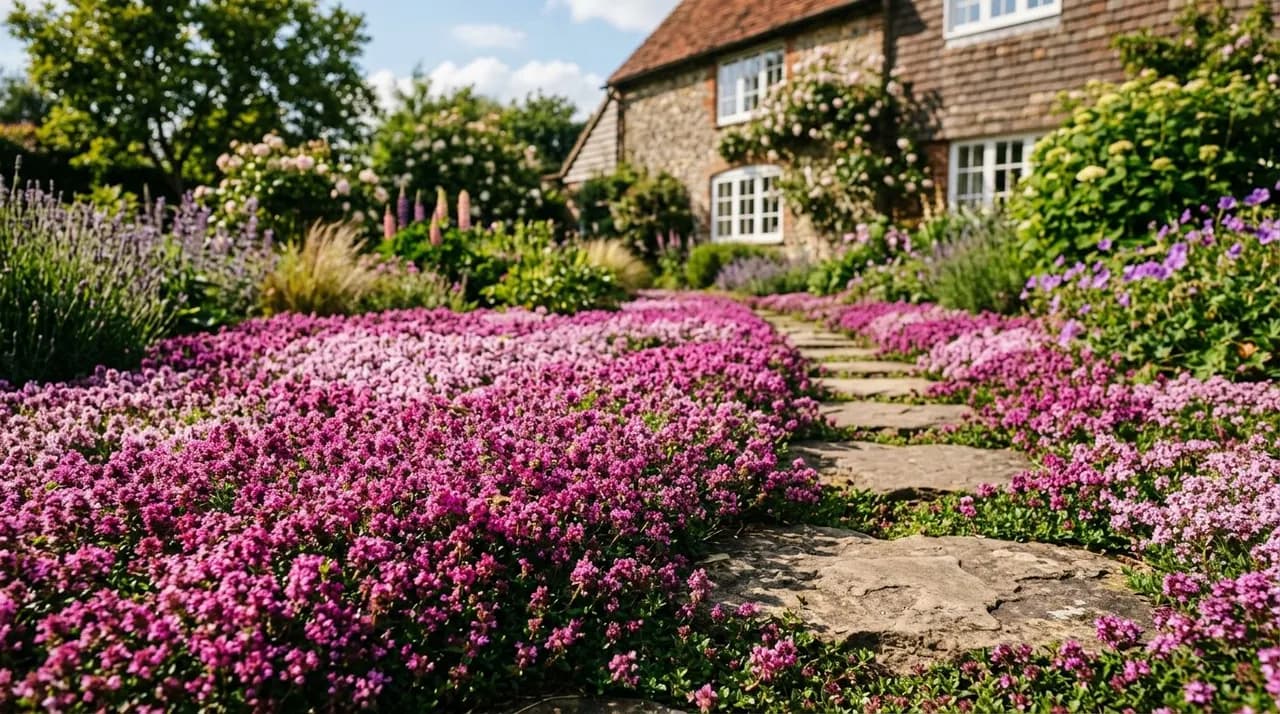
In contrast, creeping thyme forms a dense, woody-stemmed perennial mat that hugs the earth, topping out at just two to three inches in height. During late spring and early summer, the foliage fills with pink, purple, or magenta flowers that attract native pollinators.
Whether you wish to replace a small urban lawn, create walkable living paths between stone pavers, or stabilize a sunny dry slope, understanding creeping thyme varieties, soil requirements, and establishment techniques ensures long-term success.
Selecting creeping thyme varieties: red, woolly, and elfin
Different species and cultivars within the genus Thymus offer distinct foliage textures, bloom colors, and growth habits:
Red creeping thyme (Thymus serpyllum 'Coccineus')
Red creeping thyme is the most popular cultivar for full lawn replacements. It produces tiny, dark green leaves on prostrate, creeping stems and flowers in crimson-magenta clusters in early summer. It reaches 2 to 3 inches (5 to 8 cm) in height, spreads rapidly, and handles moderate foot traffic with ease.
Woolly Thyme (Thymus pseudolanuginosus)
Woolly thyme features soft, silvery-grey, pubescent foliage covered in fine hairs that trap moisture and reflect intense solar radiation. It forms an exceptionally flat, dense mat (under 1 inch tall) that excels in rock gardens, between flagstones, and on arid slopes. It produces pale pink blossoms, though less profusely than red creeping thyme. To understand related thyme species, explore our botanical profile on Thymus vulgaris.
Elfin Thyme (Thymus praecox 'Elfin')
Elfin thyme is a miniature, slow-growing selection forming tight, moss-like green cushions barely 1 to 2 inches (2.5 to 5 cm) tall. It produces delicate lavender flowers and is best suited for small courtyards, narrow path joints, and intimate patio borders where a compact form is needed.
Cultivar | Scientific Name | Height | Flower Color | Best Application |
|---|---|---|---|---|
Red Creeping | Thymus serpyllum 'Coccineus' | 2 to 3 in | Crimson / Magenta | Full lawn replacement, slopes |
Woolly Thyme | Thymus pseudolanuginosus | 0.5 to 1 in | Soft Pale Pink | Rock gardens, flagstone gaps |
Elfin Thyme | Thymus praecox 'Elfin' | 1 to 2 in | Soft Lavender | Small courtyards, stepping stones |
White Creeping | Thymus serpyllum 'Albus' | 2 to 3 in | Pure White | Cottage borders, moon gardens |
Creeping thyme lawn pros and cons
Weighing the practical creeping thyme lawn pros and cons helps you decide if this aromatic ground cover matches your site conditions:
+-----------------------------------------------------------------------+
|                    CREEPING THYME TRADE-OFFS                          |
+-----------------------------------+-----------------------------------+
|            ADVANTAGES             |            LIMITATIONS            |
+-----------------------------------+-----------------------------------+
| - Zero routine mowing needed      | - High upfront plug cost          |
| - Excellent drought tolerance     | - Requires excellent drainage     |
| - Aromatic fragrance when walked  | - Cannot handle heavy athletics   |
| - Dense floral display in summer  | - Slow seed establishment         |
| - Deer, rabbit, and pest resistant| - Needs weeding during year one   |
+-----------------------------------+-----------------------------------+
The primary advantages
- Elimination of mowing: Creeping thyme naturally stops growing upward at 2 to 3 inches, eliminating weekly mowing; the only pass is an optional post-bloom trim to remove spent seed heads.
- Exceptional water conservation: Once root systems establish, creeping thyme requires watering only during extended droughts, cutting outdoor water consumption dramatically compared to turfgrass. For companion drought-hardy ideas, consult our guide to drought tolerant ground cover.
- Herbal fragrance: Stepping on the foliage releases natural essential oils (thymol and carvacrol among them, varying by species and cultivar), creating a pleasant herbal aroma throughout the landscape.
- Wildlife resistance: The pungent essential oils that make thyme pleasant to humans act as a natural feeding deterrent against deer, rabbits, and voles.
- Pollinator sanctuary: The nectar-rich flowers support honeybees, solitary bees, and butterflies throughout the early summer months.
Practical limitations
- Upfront investment: Planting a large lawn from potted plugs requires purchasing hundreds of individual starts, resulting in higher initial costs than broadcasting grass seed.
- Drainage vulnerability: Creeping thyme cannot tolerate wet feet or poorly drained, waterlogged clay soils. Standing winter moisture will rot the root crowns. Learn how to evaluate your ground with our guide on soil drainage percolation testing.
- Traffic limitations: While it withstands casual foot traffic and pet activity, it cannot handle soccer matches, intense sports drills, or repeated heavy wheel traffic.
- Weed pressure during establishment: Until plugs knit together into a solid, impenetrable mat (typically 6 to 12 months), manual weeding between plants is required.
Soil requirements and planting from plugs vs seed
Creeping thyme thrives in lean, well-draining soil under full sun. Proper soil prep and planting method determine your establishment speed:
[ Method A: Plugs ] ----> Fast cover (6-12 months), reliable rooting, higher initial cost
[ Method B: Seed ]  ----> Economical, slow emergence, requires rigorous 1st-year weeding
Soil preparation and drainage amendments
Creeping thyme prefers a soil pH between 6.5 and 7.5. It thrives in gritty, sandy loam or rocky soils with low to moderate organic matter. Avoid heavy applications of rich compost or high-nitrogen fertilizers, which cause the stems to grow weak, leggy, and prone to fungal rot.
- Clay Soil Modification: If your yard consists of heavy clay, amend the top 4 to 6 inches (10 to 15 cm) with coarse horticultural grit, pumice, or sharp builder's sand, or plant on raised mounds and gentle slopes to guarantee rapid drainage. For soil amendment guidelines, see soil amendments demystified.
- Weed Eradication: Remove all existing turfgrass, perennial weeds, and roots thoroughly before planting. Solarize or clear the ground several weeks in advance to reduce the weed seed bank.
Option 1: planting from nursery plugs (recommended)
Planting rooted plugs or dividing 4-inch nursery pots is the most dependable method for establishing a creeping thyme lawn:
- Timing: Plant in mid-spring after the last hard frost, or in early autumn (at least six weeks before the ground freezes) so roots anchor before winter dormancy.
- Spacing: Space plugs 6 to 9 inches (15 to 23 cm) apart for rapid coverage within 4 to 6 months, or 12 inches (30 cm) apart for larger areas on a budget.
- Planting Depth: Dig small holes matching the depth of the plug root ball. Set each plug level with the surrounding soil surface, backfill with native gritty soil, and firm gently.
- Initial Watering: Water thoroughly immediately after planting. Keep soil lightly moist for the first three to four weeks until new green runners emerge.
Option 2: sowing creeping thyme from seed
Growing creeping thyme from seed is economical for large expanses but requires significant patience:
- Creeping thyme seeds are dust-fine (over 2 million seeds per pound). Mix seed with dry sand and broadcast at a rate of 1 to 2 ounces per 1,000 square feet onto a finely raked, weed-free seedbed in spring.
- Press seed firmly into the soil surface; do not bury it, as light is required for germination.
- Keep the top layer of soil damp with a fine mist for 14 to 21 days until germination occurs.
- Be prepared to hand-weed regularly during the first growing season to prevent faster-growing weeds from smothering the seedlings.
Watering schedule, feeding, and weed control
Once established, maintaining a creeping thyme lawn requires remarkably few inputs:
Irrigation regimen
- Weeks 1 to 4 (Establishment): Water every two to three days in the absence of rain to maintain modest subsoil moisture without waterlogging the crowns.
- Year 1 Maintenance: Water once a week during hot, dry summer periods when top growth shows slight dulling.
- Established Stand (Year 2 onward): Thyme requires supplemental irrigation only during prolonged droughts exceeding three to four weeks without rain. A single deep soaking of 0.5 inches every few weeks is sufficient.
Nutritional guidelines
Creeping thyme produces the best compact foliage in lean soil. Never apply synthetic high-nitrogen lawn fertilizers, which promote soft vegetative growth that compromises drought tolerance and reduces flower production. An optional light spring top-dressing of finely screened compost or a low-analysis organic rock mineral amendment once every two to three years provides ample trace nutrients.
Weed management strategy
Preventing weed competition during the first year is important:
- Apply a 0.5-inch layer of fine gravel, coarse sand, or pine bark grit between newly planted plugs to suppress weed seed germination and keep foliage dry.
- Hand-pull opportunistic weeds when soil is damp, taking care not to dislodge expanding thyme runners.
- Once the thyme carpet knits together fully, its dense canopy and shallow fibrous root network suppress nearly all weed encroachment naturally. Explore broader non-chemical lawn strategies in our guide to clover lawn.
Long-term maintenance, mowing, and winter care
Maintain a creeping thyme lawn with straightforward seasonal care:
- Post-Bloom Trimming: Once the vivid summer flower flush fades in midsummer, you can run a lawn mower set at its highest setting (3 inches) or use a line trimmer across the stand. This removes dry brown blossom heads, neatens the canopy, and stimulates a fresh flush of aromatic green foliage.
- Fall Clean-Up: In late autumn, gently rake away fallen tree leaves using a flexible plastic leaf rake. Allowing thick wet leaves to mat over thyme during winter traps moisture and induces crown rot.
- Winter Hardiness: Creeping thyme is reliably hardy in roughly USDA zones 4 to 9; woolly thyme is the least tolerant of cold, wet winters. In cold zones with little snow cover, the foliage may take on bronze or purplish winter tones, which quickly turn bright green when spring warmth returns.
- Spring Renovation: In early spring, inspect the lawn for any small patches affected by winter wetness. Simply snip out dead brown twigs and pin living runners across the gap; they will root quickly at the nodes and fill the opening within weeks.