Key takeaways
- White Dutch clover and microclover naturally fix atmospheric nitrogen into the soil, eliminating the need for synthetic nitrogen fertilizers.
- Clover holds its color into midsummer without fertilizer, but it is shallow-rooted: in a real drought it goes semi-dormant and regrows from its stolons.
- Overseed existing turfgrass lawns at a rate of 2 to 4 ounces per 1,000 square feet, or sow pure stands at 6 to 8 ounces.
- Clover tolerates moderate foot traffic but cannot handle heavy athletic sports, and broadleaf herbicides will kill it immediately.
- Mowing is optional; mowing two to three times per year at 3 to 4 inches keeps stands tidy and prevents unwanted seed heads.
Quick answer: A clover lawn is a low-input alternative to turfgrass that needs little mowing, minimal watering once established, and no nitrogen fertilizer. Sow seed in early spring or early fall onto moist, aerated soil for rapid germination.
Transforming a high-maintenance turf yard into a clover lawn has become one of the most practical strategies for home landscaping with lower inputs. Traditional turfgrass lawns consume substantial amounts of municipal water, require constant mowing through the growing season, and demand regular fertilizer inputs to maintain their green color.
In contrast, clover species have been used as trusted forage and living ground covers for centuries. Before selective broadleaf herbicides were introduced in the mid-twentieth century, white clover was an intentional component of commercial lawn seed mixes due to its soil-building qualities.
Whether you choose to overseed an existing grass lawn or establish a pure perennial stand, understanding clover biology, establishment mechanics, and seasonal management will help you build a resilient, drought-tolerant yard that stays green with minimal inputs.
Understanding clover species: white Dutch clover vs microclover
Selecting the right clover species determines the overall height, foliage texture, and long-term maintenance requirements of your living ground cover:
White Dutch Clover (Trifolium repens)
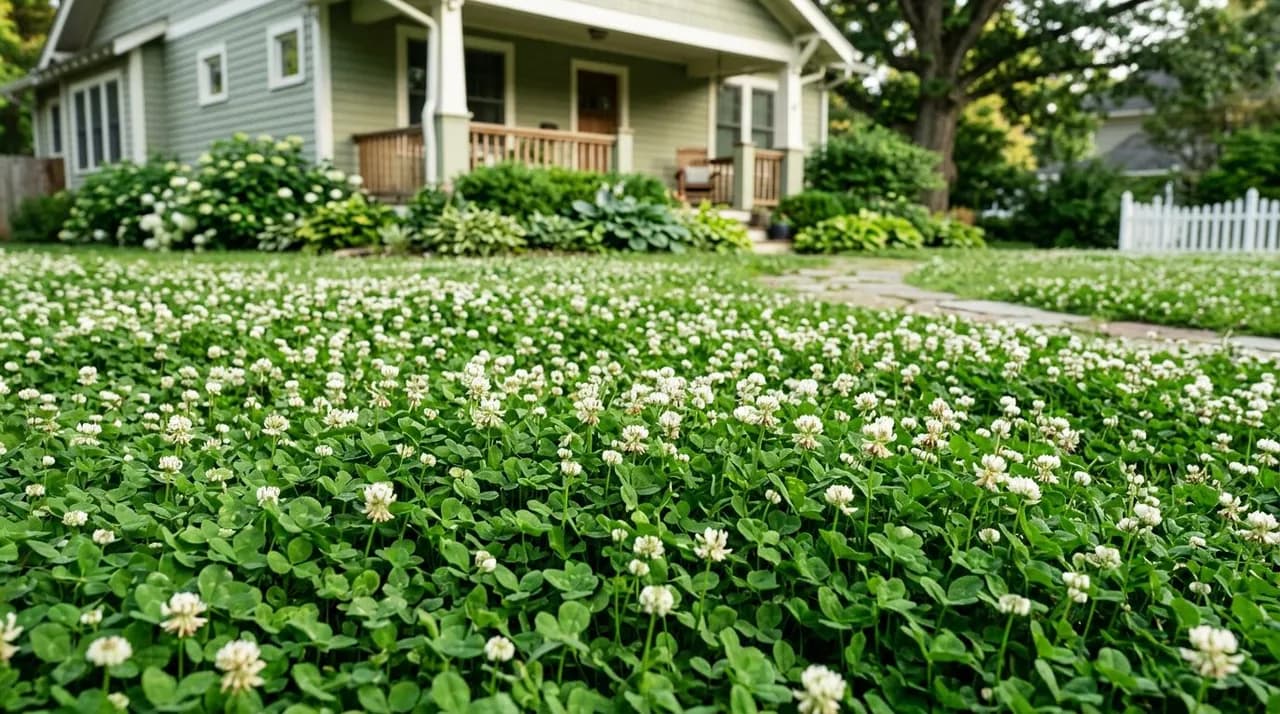
White Dutch clover is the traditional, robust variety widely utilized across residential yards, orchards, and pasture systems. It typically reaches a mature height of 4 to 8 inches (10 to 20 cm) and spreads through creeping aboveground stems known as stolons. As the stolons creep across the soil surface, they establish secondary root nodes that anchor the plant and knit the stand into a dense mat.
White Dutch clover produces rounded flower heads consisting of small white or pale pink florets from late spring through midsummer. These blossoms are rich in nectar and provide an essential food source for honeybees and native pollinators. It is exceptionally winter-hardy and handles poor ground far better than standard lawn grasses. To explore the botanical profile and growth requirements of this species, consult our guide on Trifolium repens.
Microclover (small-leaved Trifolium repens cultivars)
Microclover is white clover bred for smaller leaf size rather than a separate species, sold under cultivar names such as 'Pipolina' and 'Microclover'. It has significantly smaller leaves, shorter petioles, and a compact growth habit that tops out at roughly 3 to 5 inches (7 to 13 cm). Because it produces fewer and smaller flower heads, it maintains a uniform green appearance that blends seamlessly with fine-textured lawn grasses.
Microclover possesses higher stolon density than standard white Dutch clover, allowing it to knit tightly with turfgrasses such as Kentucky bluegrass, perennial ryegrass, and tall fescue without forming patchy clumps. While microclover seed carries a higher upfront cost, its compact form makes it the premier choice for formal front lawns where a manicured aesthetic is desired.
Characteristic | White Dutch Clover | Microclover |
|---|---|---|
Mature Canopy Height | 4 to 8 inches (10 to 20 cm) | 3 to 5 inches (7 to 13 cm) |
Leaf Dimensions | Medium (0.5 to 0.75 in) | Small (0.25 to 0.5 in) |
Flowering Density | Abundant, profuse blooms | Sparse, occasional blooms |
Growth Habit | Open clumping with stolons | Tight, dense mat forming |
Best Landscape Use | Pure stands, orchards, eco-lawns | Mixed turfgrass lawns, front yards |
Relative Seed Cost | Economical | Moderate to premium |
Honest clover lawn pros and cons
Evaluating the practical clover lawn pros and cons allows homeowners to weigh ecological benefits against functional limitations before converting their property:
+-----------------------------------------------------------------------+
|                       CLOVER LAWN TRADE-OFFS                          |
+-----------------------------------+-----------------------------------+
|            ADVANTAGES             |            LIMITATIONS            |
+-----------------------------------+-----------------------------------+
| - Fixes nitrogen naturally        | - Low tolerance for hard sports   |
| - Stays green in summer heat      | - Stains clothing green easily    |
| - Low mowing (2-4 times a year)   | - Killed by broadleaf weedkillers |
| - Thrives in poor, compacted soil | - Attracts bees (barefoot risk)   |
| - Suppresses common garden weeds  | - Dies back briefly in winter     |
+-----------------------------------+-----------------------------------+
The primary advantages
- Natural nitrogen fixation: Clover roots develop symbiotic nodules housing Rhizobium bacteria. These beneficial microorganisms capture atmospheric nitrogen gas and convert it into plant-available nutrients, eliminating the need for synthetic feeding.
- Summer color without fertilizer: Clover holds its color into midsummer better than unfertilized cool-season turf because it makes its own nitrogen, not because it roots more deeply. White clover's seedling taproot is short-lived and mature plants root shallowly from stolon nodes; in a sustained drought clover wilts and goes semi-dormant like grass, then regrows from the stolons once rain returns.
- Substantially reduced mowing: Because clover reaches a natural height ceiling, it requires only two or three mowings per season to tidy spent flower heads, compared to weekly mowing for conventional grass.
- Broad soil tolerance: Clover thrives in soils with low organic matter, tolerates moderate compaction, and grows well across pH levels ranging from 6.0 to 7.3.
- Living weed barrier: The dense canopy formed by trifoliate clover leaves shades the soil surface, preventing weed seeds from receiving the sunlight needed for germination. Learn more about biological ground covers in our overview of living mulch for soil cooling.
Practical limitations to consider
- Foot traffic durability: Clover withstands moderate foot traffic, children at play, and domestic pets. However, it cannot endure repeated, high-impact athletic activities or repetitive sports drills that tear the tender stems.
- Chlorophyll staining: The soft, moisture-rich foliage crushes easily, releasing green sap that stains light-colored clothing and shoes more readily than dry turfgrass blades.
- Herbicide vulnerability: Broadleaf selective weedkillers (such as 2,4-D or dicamba) cannot distinguish clover from dandelions or plantain. Applying standard weed-and-feed products will completely kill a clover lawn.
- Seasonal winter dieback: In colder northern zones, top foliage dies back to the ground during hard winter freezes, leaving exposed soil until spring regrowth begins.
Step-by-step soil preparation and planting guide
Proper seedbed preparation and seeding technique ensure uniform establishment whether you are starting fresh or renovating an existing lawn:
1. Optimal seeding windows
Plant clover during early spring as soon as soil temperatures reach 50°F to 55°F (10°C to 13°C) and spring rains provide natural moisture. Alternatively, seed in late summer to early autumn, roughly six to eight weeks before your region's first average frost date. Late summer sowings face far less competition from annual summer weeds.
2. Soil preparation and drainage
Clover performs best in well-aerated ground with reliable drainage. Assess your yard's drainage characteristics using our guide to soil drainage percolation testing.
- For pure clover lawns: Remove existing vegetation using a sod cutter or solarization. Lightly rake the top 1 inch (2.5 cm) of soil to create a loose seedbed, then roll the ground flat to remove large air pockets.
- For overseeding existing turf: Mow the existing grass as short as possible (scalp to 1 to 1.5 inches) and collect clippings. Thoroughly rake with a thatch rake to expose bare soil between grass clumps.
3. Inoculating and calculating seeding rates
Clover seed requires Rhizobium leguminosarum biovar trifolii bacteria to initiate root nodulation. Most retail clover seed is pre-inoculated. If using raw seed, coat with fresh agricultural inoculant before planting.
- Pure Clover Stand: 6 to 8 ounces (170 to 225 grams) per 1,000 square feet.
- Overseeding into Existing Grass: 2 to 4 ounces (55 to 115 grams) per 1,000 square feet.
4. Broadcasting and irrigation
Mix the fine seed with four to five times its volume of dry sand or fine compost to ensure even distribution. Spread half walking north-south and half east-west, then press lightly into the soil. Clover seed requires light; do not bury deeper than 1/8 to 1/4 inch (3 to 6 mm). Keep the seedbed damp with a light daily mist for 10 to 14 days until sprouts reach 2 inches.
Blending clover with turfgrass: management and ratios
Combining clover with traditional turfgrass species creates an exceptionally resilient, self-nourishing polyculture lawn:
- Tall Fescue: Pairs well with microclover; fescue provides tensile strength while clover supplies nitrogen.
- Kentucky Bluegrass: Spreads via underground rhizomes while clover creeps aboveground, forming an interlocking weed barrier.
- Fine Fescues: Ideal for low-input, shade-dappled lawns where minimal watering and mowing are primary goals.
When managing a blended stand, set your mower deck to 3 to 3.5 inches (7.5 to 9 cm) to preserve leaf area and shield soil from evaporation. If you are exploring other drought-resilient ground covers, explore our guides on drought tolerant ground cover and creeping thyme lawn.
Seasonal care, mowing regimens, and troubleshooting
Maintaining a clover lawn requires a low-intervention approach that works with natural ecological cycles:
- Spring care: Rake lightly to remove winter debris without disturbing shallow stolons. If thin patches appear, scatter a pinch of inoculated seed over bare spots. Avoid synthetic nitrogen fertilizers, which suppress bacterial nodulation.
- Summer care: Clover remains green during hot spells; provide 0.5 to 1 inch of water every two to three weeks only during prolonged droughts. Mow at 3 inches when white blossoms fade if you wish to tidy spent heads.
- Weed management: Hand-pull taprooted weeds while young. Regular high mowing at 3 to 3.5 inches prevents tall annual weeds from setting seed, allowing the dense clover canopy to dominate.