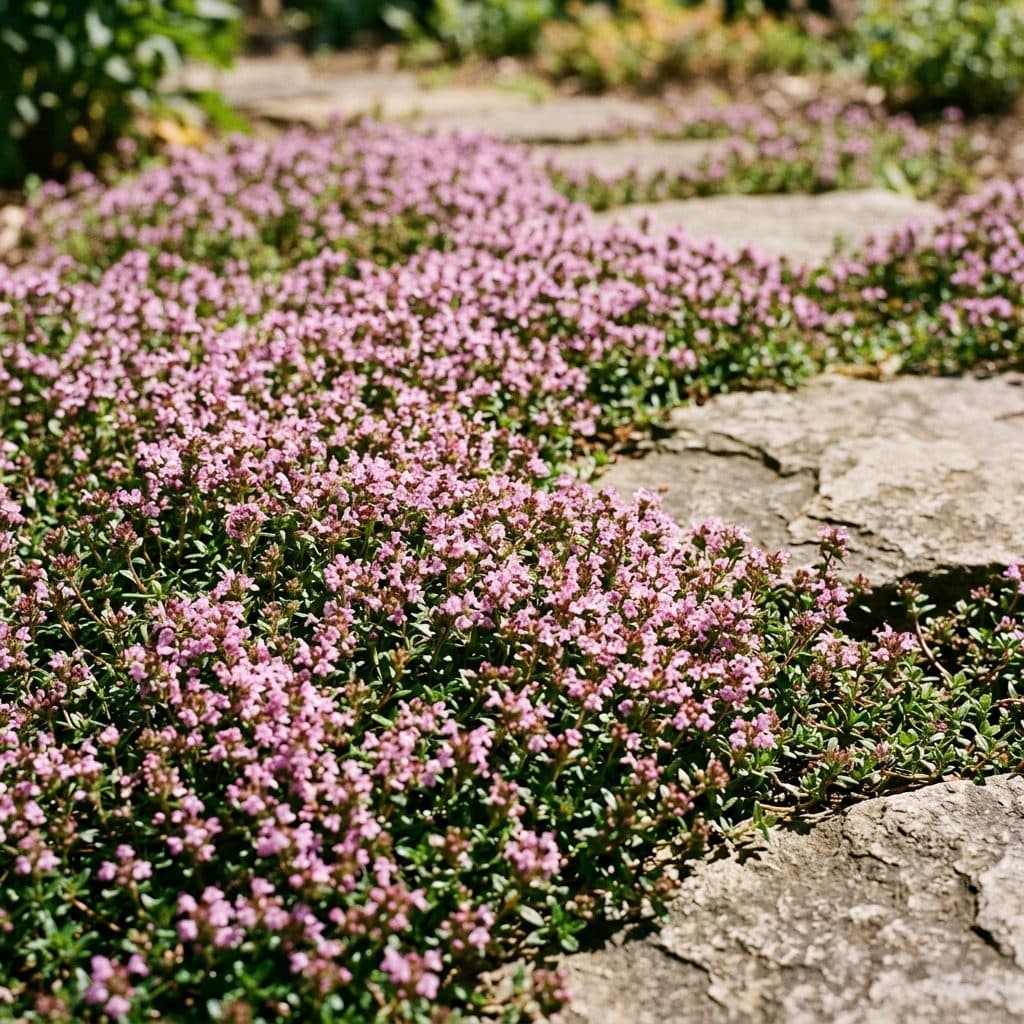
support
Creeping thyme
Thymus serpyllum
International hardiness
- USDA 4-9
- RHS H7
- AU: Cool temperate, Warm temperate
Where it grows — regional guide
| Zones / rating | Regional notes |
|---|---|
USDA 4-9 | Performs well in USDA Zones 4 to 9; plant in sandy, lean soils in full sun and trim borders annually to keep rooting runners from overtaking delicate rockeries. |
| Zones / rating | Regional notes |
|---|---|
H7 (below -20C) | Fully hardy across Britain; site in raised beds, gravel gardens, or path margins with sharp drainage to avoid winter wet and crown rot. |
| Zones / rating | Regional notes |
|---|---|
Cool temperate, Warm temperate | Thrives in cool-temperate areas of Victoria, Tasmania, and the southern tablelands; provide light afternoon shade during intense summer heatwaves. |
| Zones / rating | Regional notes |
|---|---|
USDA 4-9 (USDA scale) Canada uses its own zone system; Canadian zones run roughly one lower than USDA. | Exceptionally hardy through southern and maritime Canada down to Zone 4; ensure snow cover or gravel mulch to protect woody crowns from dry winter freeze. |
| Zones / rating | Regional notes |
|---|---|
No region-specific data yet | No region-specific data yet |
Creeping thyme (Thymus serpyllum), also known as wild thyme or mother-of-thyme, is a prostrate, woody-based perennial subshrub in the mint family (Lamiaceae). Cultivated widely as an ornamental and aromatic ground cover, the plant forms dense, evergreen carpets that hug the soil surface. When crushed underfoot, the foliage releases an herbal aroma similar to culinary thyme, though milder and more earthy.
The species is native to northern and central Europe, where it inhabits dry heathlands, sandy banks, and rocky outcrops. In homestead landscapes, creeping thyme is a low-water lawn substitute for light-traffic zones, a living mulch in perennial borders, and an erosion-control cover on slopes. Unlike erect Mediterranean subshrubs such as lavender or rosemary, Thymus serpyllum roots along its prostrate stems, knitting together a continuous mat that suppresses weeds and moderates soil temperatures. Its abundant blossoms attract honeybees and native pollinators from June through August.
Growing creeping thyme
Creeping thyme requires lean, sharply drained soils to thrive. Heavy clay retains excess moisture during cool seasons, quickly inducing root and crown rot. The optimal soil texture ranges from sandy loams to gravelly substrates with a neutral to slightly alkaline soil pH between 6.5 and 7.5. In rich garden soils, creeping thyme produces loose, leggy growth with sparse flowering and diluted aroma. Adding coarse grit or crushed pumice to the planting bed improves aeration and drainage.
Full sunlight is essential for maintaining dense mats and profuse blossoms. Plant creeping thyme in full sun where it receives at least six hours of direct sunlight daily. While plants tolerate light afternoon shade in hot climates, continuous shade causes stems to stretch, drop lower leaves, and succumb to fungal damping.
Moisture management is critical during establishment. Water newly installed plugs regularly for the first six to eight weeks until roots anchor. Once established, creeping thyme displays strong drought tolerance, thriving on modest rainfall. In arid regions, deep irrigation every two to three weeks during peak summer heat preserves leaf turgor and prevents center dieback. Overhead watering should be minimized; drip irrigation or morning watering allows foliage to dry quickly.
Propagation is achieved through stem cuttings, root division, or seed. Stem cuttings taken in late spring root in sand and perlite within three to four weeks. Division of established clumps is best carried out in early spring as new growth starts; separate rooted stolons with a sharp knife and transplant directly. When starting from seed, sow indoors eight to ten weeks before the last spring frost, pressing the fine seeds into the surface without burying them, as light aids germination. Germination takes 14 to 21 days at 18 to 21 °C (65 to 70 °F).
Space individual plants 20 to 30 cm (8 to 12 in) apart. Mats typically knit together within one to two seasons. Cultivars like 'Elfin' and 'Coccineus' offer variations in vigor and flower color, with 'Elfin' forming miniature cushions barely 2.5 to 5 cm (1 to 2 in) tall. Minimal fertilizer is required; a light dressing of compost in spring supplies adequate nutrition. Excess nitrogen promotes soft growth easily damaged by foot traffic.
Harvest and uses
Creeping thyme yields fragrant foliage and flowers throughout the growing season. For fresh culinary use, snip tender green stem tips with shears in the morning after dew evaporates. Strip the small leaves from the wiry stems to flavor marinades, roasted vegetables, and herbal infusions. While edible, Thymus serpyllum is milder than *Thymus vulgaris*, making it frequent as an herbal tea rather than a primary kitchen spice.
For drying, harvest stems just as flower buds open, when essential oil concentration peaks. Bundle stems loosely and hang them in a warm, dry, shaded room, or lay them across drying screens. Once crisp, strip the leaves and store them in airtight glass jars away from direct light. Dried foliage retains aroma for up to 12 months.
In folk medicine, creeping thyme infusions have been used as a gargle for throat irritation and a mild digestive tea. Its essential oil contains thymol and carvacrol, which provide antimicrobial and antioxidant qualities. The creeping stems also form an aromatic living walkway between stepping stones, tolerating moderate foot traffic while perfuming the air when stepped upon.
Identifying creeping thyme
Creeping thyme is recognized by several key botanical characteristics:
- Habit and stems: Prostrate, mat-forming subshrub growing 5 to 10 cm (2 to 4 in) tall and spreading 30 to 60 cm (12 to 24 in) wide. Non-flowering stems creep along the surface and root at the nodes; flowering stems are square and lightly pubescent.
- Leaves: Opposite, simple, linear-elliptic to oblong-ovate blades measuring 5 to 10 mm (0.2 to 0.4 in) long and 2 to 4 mm (0.08 to 0.16 in) wide. Margins are entire with tiny basal cilia; surfaces are dotted with aromatic oil glands.
- Flowers: Dense, rounded terminal clusters 1 to 2 cm (0.4 to 0.8 in) across, blooming from June to August.
- Blossoms: Two-lipped flowers measuring 4 to 6 mm (0.16 to 0.24 in) long, ranging in color from pale pink to deep purple, with protruding stamens.
It is distinguished from common culinary thyme (Thymus vulgaris) by its low, creeping habit and rooting stems, whereas common thyme forms an upright shrub 20 to 40 cm (8 to 16 in) high. It differs from broad-leaved thyme (Thymus pulegioides) in having stems pubescent on all sides rather than restricted to four stem angles.
Cautions
Creeping thyme requires deliberate site selection and boundary management:
- Invasiveness and garden spread: Creeping thyme spreads steadily through rooting stems. While not listed as a noxious weed in North America, vigorous carpets can overgrow small rock-garden alpines and seedlings. In defined beds, edge the perimeter annually with shears to prevent encroachment into neighboring plantings.
- Drainage and fungal rot: Plants cannot tolerate standing water. In poorly drained soils, Thymus serpyllum quickly succumbs to root rot caused by Rhizoctonia and Pythium. Humid weather can also induce gray mold (Botrytis) in crowded plantings with poor airflow.
- Center dieback: Mats develop woody, hollow centers after three to four seasons. Shearing foliage lightly after flowering maintains vigor, and aging clumps should be divided and reset in early spring.
- Essential oil sensitivity: Concentrated thyme oil contains thymol, which can cause skin irritation and contact dermatitis in sensitive people. Never apply undiluted oil directly to skin or ingest essential oil concentrates.
- Pet safety: Whole Thymus serpyllum foliage is non-toxic to dogs and cats under standard veterinary guidelines, but concentrated oil extracts should remain inaccessible to household pets.
- Sourcing: Commercial seeds labeled creeping thyme frequently contain related taxa such as Thymus praecox. Source certified vegetative cultivars when uniform mat height is needed.
Sources
- Royal Botanic Gardens, Kew. Thymus serpyllum L. Plants of the World Online.
- NC State Extension Plant Toolbox. Thymus serpyllum
- Plants For A Future. Thymus serpyllum - L.
- Royal Horticultural Society. Thymus serpyllum (wild thyme)