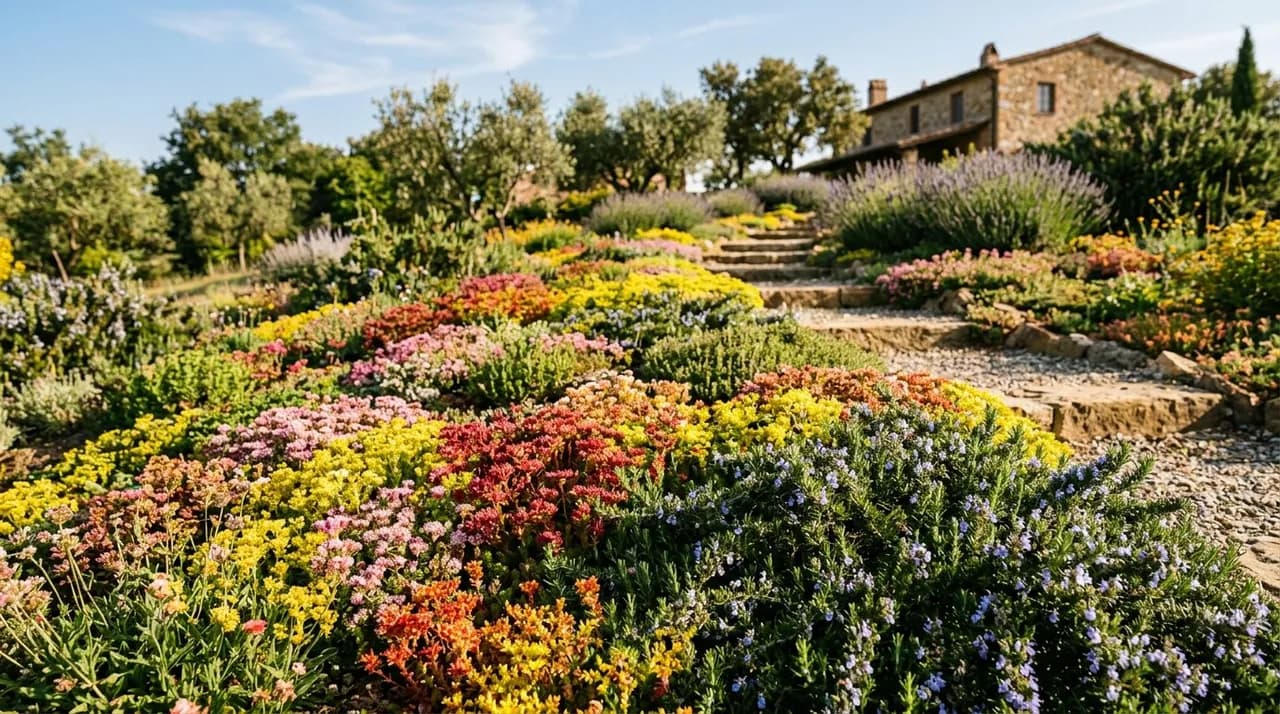
Key takeaways
- Drought-tolerant ground covers replace thirsty turfgrass and cut landscape irrigation substantially once established.
- Top selections for full sun include stonecrops (Sedum spp.), creeping thyme, trailing rosemary, ice plant (Delosperma), and silver carpet (Dymondia).
- Sharp soil drainage is essential; drought-hardy perennials withstand extreme heat but will rot quickly in heavy, waterlogged winter soil.
- Establish plants with deep, infrequent watering during their first growing season before tapering down to minimal supplemental irrigation.
- Mulch newly planted areas with coarse gravel, crushed granite, or bark grit to suppress weeds and reduce soil surface evaporation.
Quick answer: Drought-tolerant ground covers are low-growing, resilient perennial plants that thrive in hot, dry conditions with minimal supplemental irrigation. Top varieties like sedums, creeping thyme, ice plant, and prostrate rosemary form dense living carpets that suppress weeds, prevent erosion, and conserve water.
Managing a conventional turfgrass lawn in regions subject to summer heatwaves, dry spells, or municipal water restrictions has become increasingly impractical. Turfgrass requires constant moisture to maintain its green appearance, consuming a substantial share of residential water use.
Transitioning to drought-tolerant ground cover reduces irrigation needs. By covering exposed soil with resilient perennials, you can cover bare ground under intense sun, suppress weeds, stabilize slopes, and lower water bills.
Selecting the right species and preparing the soil properly helps establish ground cover across xeriscape yards, lawn strips, and rocky slopes.
Top drought-tolerant ground covers for full sun
These resilient species thrive under direct, blazing sunlight and lean soil conditions:
+-----------------------------------------------------------------------+
|                 Full-sun drought-tolerant ground covers               |
+-------------------+-----------------------+---------------------------+
| Plant species     | Height & habit        | Key characteristic        |
+-------------------+-----------------------+---------------------------+
| Sedum / Stonecrop | 2 to 6 in, succulent  | Extreme heat & rock hardy |
| Creeping thyme    | 2 to 3 in, carpet     | Fragrant, walkable flowers|
| Trailing rosemary | 6 to 12 in, cascading | Evergreen culinary herb   |
| Ice plant         | 2 to 4 in, spreading  | Neon jewel-toned flowers  |
| Silver carpet     | 1 to 2 in, flat mat   | Dense silver/green turf   |
+-------------------+-----------------------+---------------------------+
1. Stonecrops and sedums (Sedum and Phedimus species)
Sedums are hardy succulent ground covers for harsh, sun-baked environments. Their fleshy, water-storing leaves and CAM photosynthesis allow them to thrive where other plants wither:
- Dragon's Blood Sedum (Phedimus spurius 'Schorbuser Blut', sold as 'Dragon's Blood'): Forms a 3 to 5 inch dense mat of scalloped leaves that turn deep burgundy-bronze in autumn, topped with ruby-red flowers in midsummer.
- Goldmoss Stonecrop (Sedum acre): A bright yellow-flowering, 2-inch carpet that spreads rapidly across gravel, rocky cracks, and sandy slopes.
- Kamchatka Stonecrop (Phedimus kamtschaticus): Hardy, dark green toothed foliage with bright golden-orange blossoms that tolerate light foot traffic.
2. Creeping thyme (Thymus serpyllum)
Creeping thyme is an aromatic ground cover that grows 2 to 3 inches (5 to 8 cm) tall. It produces crimson, pink, or white flowers in early summer, resists deer browsing, and handles light to moderate walking. For establishment steps, see our creeping thyme lawn guide.
3. Trailing / prostrate rosemary (Salvia rosmarinus 'Prostratus')
An evergreen woody perennial that reaches 6 to 12 inches (15 to 30 cm) in height while spreading 3 to 6 feet wide. Hardy in roughly USDA zones 7 to 8 and warmer (its late winter through spring bloom is typical of mild-winter areas), it grows over retaining walls and rocky embankments, yielding fragrant culinary leaves year-round.
4. Purple ice plant (Delosperma cooperi)
Native to South Africa, Delosperma forms a fast-spreading, 3-inch succulent mat covered in bright magenta daisy-like blossoms from late spring through autumn. It thrives in poor, sandy soil and tolerates radiant heat from paved sidewalks.
5. Silver carpet (Dymondia margaretae)
An ultra-flat, drought-tolerant ground cover barely 1 to 2 inches tall. Hardy only in roughly USDA zones 9 to 11 (treat it as an annual or container plant elsewhere). It has slender green leaves with silver-white undersides that handle foot traffic between stepping stones and tolerate coastal salt air. For broader ground covers, see our guide on ground cover plants.
Low-water ground covers for dry shade
Dry shade beneath mature trees or under building overhangs is notoriously challenging. These species handle low light and limited soil moisture:
- Barrenwort / Bishop's Hat (Epimedium spp.): Tough, leathery heart-shaped leaves that turn bronze in fall, producing delicate winged flowers in spring. Once established, Epimediums tolerate root competition beneath large shade trees.
- Creeping Mahonia / Oregon Grape (Mahonia repens): Native evergreen ground cover with holly-like leaves, fragrant yellow spring blossoms, edible blue berries, and exceptional drought tolerance.
- Sweet Woodruff (Galium odoratum): Produces whorled emerald leaves and starry white flowers in spring, creating ground cover under deciduous canopies. It needs a first season of regular water, browns off in prolonged summer drought, and spreads by runners, so give it room.
- Bigroot Geranium (Geranium macrorrhizum): Forms a dense, 8 to 12 inch mound of aromatic, weed-suppressing foliage with magenta or soft pink flowers, thriving in dry shade where grass fails.
Soil preparation, drainage, and xeriscape planting steps
Drought-tolerant perennials require specific soil conditions to develop deep root systems and survive cold, wet winters:
[ Step 1: Clear ]       --> [ Step 2: Amend Grit ] --> [ Step 3: Plant & Water ] --> [ Step 4: Gravel Mulch ]
Remove grass & weeds         Add sand/pumice to clay     Water deeply year 1           2 in inorganic mulch
1. Soil drainage
While drought-hardy plants tolerate prolonged dry spells, they are highly sensitive to standing water and saturated soil, especially during cold winter dormancy. Heavy clay holds water, suffocating roots and inviting fungal crown rot.
- Clay Soil Modification: Incorporate 2 to 3 inches of coarse mineral grit, crushed granite, or volcanic pumice into the top 6 inches of soil. Alternatively, plant on raised berms or sloping beds so excess rain drains away from plant crowns. Test your soil using our guide to soil drainage percolation testing.
- Fertility Caution: Avoid heavy applications of manure or high-nitrogen fertilizers. High fertility causes loose, floppy growth and shortens plant lifespan. For balanced soil care, see soil amendments demystified.
2. Planting technique
- Dig planting holes slightly wider than the container root ball and matching its exact depth.
- Ensure the crown of the plant sits slightly above the surrounding grade to prevent soil from washing over the stem base.
- Backfill with native gritty soil and firm gently with your hands to eliminate air pockets.
- Water each plant thoroughly immediately after planting.
3. Mulching for moisture conservation
Cover the bare ground between new plants with a 1.5 to 2 inch (4 to 5 cm) layer of inorganic mulch, such as crushed pea gravel, decomposed granite, or lava rock. Inorganic gravel mulch keeps plant crowns dry, reflects excess heat, suppresses weeds, and prevents soil erosion without trapping excessive moisture against succulent stems.
Watering schedules: establishment vs long-term maintenance
The transition from early rooting to long-term drought tolerance follows a regular schedule:
[ Months 1-3 ]: Water 1-2x weekly to anchor root balls
[ Months 4-12 ]: Water every 10-14 days to force roots deep
[ Year 2+ ]: Supplemental water only during extreme 3-4+ week dry spells
First-year establishment protocol
Drought-tolerant plants are not drought-hardy on the day they are planted. They require consistent moisture while expanding their root systems beyond the nursery container mix into the surrounding native soil:
- Weeks 1 to 4: Water deeply every three to four days in the absence of rain.
- Weeks 5 to 12: Reduce watering to once every 7 to 10 days, applying enough water to soak the top 6 to 8 inches of soil.
- Late First Season: Water once every two weeks during dry summer heat.
Long-term low-water management (year two onward)
Once root systems are established, these ground covers thrive on natural rainfall alone in many temperate zones. In arid regions, provide a single deep irrigation every three to four weeks during peak summer heat to maintain foliage density.
If you are renovating larger lawn areas, compare these options with our guides on clover lawn and living mulch for soil cooling.
Seasonal maintenance, pruning, and weed management
Maintain an attractive, low-water ground cover with minimal seasonal tasks:
- Spring Cleanup: In early spring, shear back winter-damaged stems and remove any accumulated leaves that blew into the planting. Lightly shear sprawling sedums or thyme to encourage dense, compact branching.
- Post-Bloom Shearing: Once summer flowering finishes on creeping thyme or ice plants, use hedge shears or a string trimmer set high to remove spent flower heads and tidy the mat.
- Weed Suppression: Maintain your gravel mulch layer and hand-pull occasional weeds while they are small. As ground covers mature and knit together, their dense root systems and shaded soil canopy prevent virtually all weed seed germination.