Key takeaways
- Shaded garden zones require specialized ground covers adapted to low light, dry soil, and root competition.
- Epimedium (barrenwort) and Pennsylvania sedge are the top performers for dry, challenging shade under mature trees.
- Native wild ginger and foamflower create dense, weed-suppressing carpets in moist, dappled woodland settings.
- Wintergreen holds glossy evergreen foliage through hard winters; Allegheny pachysandra is semi-evergreen and thins out in the coldest zones.
- Practice pocket planting between major tree roots rather than tilling, which damages mature tree root systems.
Quick answer: The best ground cover for shade includes epimedium, wild ginger, Pennsylvania sedge, foamflower, and Allegheny pachysandra. These resilient species thrive in low-light environments beneath tree canopies, suppressing weeds and conserving soil moisture without demanding frequent irrigation.
Finding the ideal ground cover for shade is one of the most common landscaping dilemmas for homeowners. Shaded areas (whether beneath the dense canopy of mature oak trees, along the north-facing wall of a house, or under overhanging pine boughs) are notoriously inhospitable to traditional turfgrass.
When gardeners attempt to grow standard grass seed in deep shade, the lawn inevitably thins out, turns yellow, and gives way to bare mud and opportunistic moss. Furthermore, gardening beneath mature shade trees involves fierce underground competition: large tree roots greedily absorb available soil moisture and nutrients, creating the dreaded condition known as dry shade.
Many woodland ground covers have adapted to flourish on the forest floor. By matching the right plant species to your shade conditions (such as dry shade under trees, moist woodland soil, or acidic ground beneath conifers), you can establish ground cover even in neglected garden corners.
Understanding shade microclimates
Before selecting ground cover species, evaluate the moisture levels, soil chemistry, and lighting quality of your planting zone:
- Dry Shade: The most challenging garden environment, commonly found beneath mature maples, oaks, and beeches. The overhead canopy intercepts rainfall, while expansive tree root networks rapidly deplete soil water. Plants must possess drought tolerance and fibrous, competitive root systems.
- Moist or Dappled Shade: Found along woodland edges, near downspouts, or beneath high, open-branched deciduous trees. Soil remains cool and consistently damp, providing ideal conditions for lush, broad-leaved foliage.
- Deep North-Facing Shade: Areas along the north side of tall buildings or boundary fences that receive zero direct sunlight throughout the year.
- Acidic Pine Shade: Ground beneath evergreen conifers and pine trees where acidic needle drop and year-round dense canopy shade create lean, low-pH soils.
To explore how these species function as living mulches within multi-layered agroforestry layouts, explore what is a food forest. For wider landscaping comparisons across sun and slope environments, see our overview of ground cover plants.
Top 8 ground covers for shade and low-light zones
The following eight perennial species provide dependable, low-maintenance coverage across diverse shade conditions.
1. Barrenwort / fairy wings (Epimedium species)
Epimedium is the most reliable plant most gardeners will find for dry shade.
- Growth Habit & Foliage: Forms dense, spreading mounds 8 to 12 inches (20 to 30 cm) tall. The heart-shaped leaves emerge with bronze-red mottling in spring, mature to leathery green in summer, and turn rich burgundy in autumn. Many cultivars are semi-evergreen to fully evergreen.
- Spring Blooms: Produces airy clusters of delicate, spider-like flowers in shades of yellow, pink, white, or purple in mid-spring.
- Hardiness & Tolerance: USDA Zones 4 to 9. Exceptionally deer-resistant and rabbit-resistant, with tough, woody rhizomes that thrive directly between massive tree roots where other plants wither.
2. Native wild ginger (Asarum canadense)
A classic North American native woodland perennial that forms an elegant, weed-suppressing carpet.
- Appearance: Features velvety, heart-shaped or kidney-shaped leaves measuring 4 to 6 inches (10 to 15 cm) across, reaching a uniform height of 6 to 8 inches (15 to 20 cm).
- Growing Conditions: Thrives in partial to full shade in rich, moist-to-average soil (Zones 3 to 8). Spreads steadily via shallow rhizomes without becoming invasive.
- Evergreen Alternative: European wild ginger (Asarum europaeum) offers thick, glossy, leathery evergreen leaves hardy in Zones 4 to 8.
3. Pennsylvania Sedge (Carex pensylvanica)
A fine-textured native sedge that provides a soft, grass-like alternative for shady lawns and woodland paths.
- Appearance: Features slender, arching, pale green blades forming a natural 6 to 8-inch (15 to 20 cm) weeping carpet.
- Performance: Native to dry eastern deciduous forests, it handles severe dry shade, poor soils, and light foot traffic (Zones 3 to 8). It spreads via underground runners to create a low-maintenance, no-mow ground cover. Discover broader lawn substitutes in our guide to lawn alternatives.
4. Foamflower (Tiarella cordifolia)
A charming eastern North American native that illuminates dark woodland beds with prolific spring blooms.
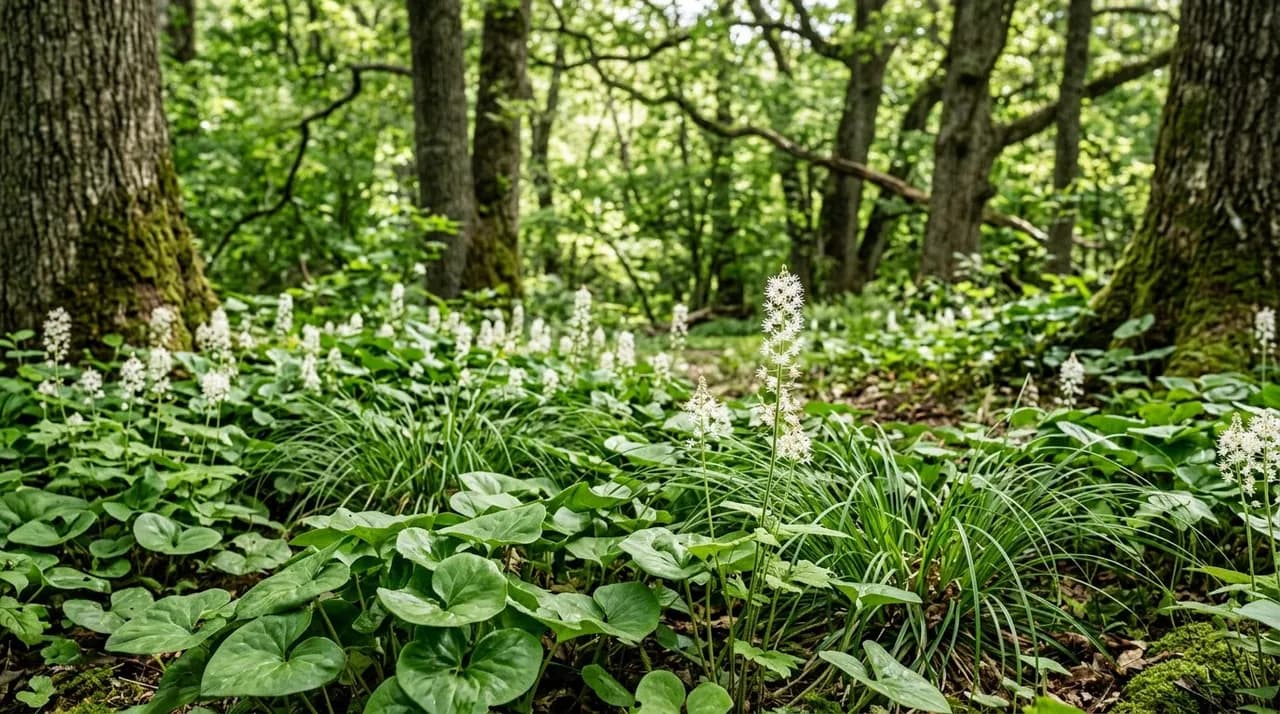
- Appearance: Forms compact clumps of lobed, maple-like green leaves with prominent dark burgundy central veining. In spring, it sends up dozens of frothy, bottle-brush spikes of starry white or blush-pink flowers lasting 4 to 6 weeks.
- Hardiness & Culture: Zones 3 to 9. Thrives in moist, humus-rich soil and spreads via above-ground stolons to knit together into a dense, weed-suppressing mat.
5. Sweet woodruff (Galium odoratum)
A vigorous, fast-spreading ground cover that brings bright green texture and fragrant white blooms to shady spots.
- Appearance: Features whorled, lance-shaped leaves arranged in starry collars along slender 6 to 8-inch (15 to 20 cm) stems. Covered in tiny, sweet-scented white blossoms in late spring.
- Scent & Texture: The foliage releases a sweet vanilla and freshly mown hay fragrance when crushed or stepped on. Hardy in Zones 4 to 8 in moist-to-average shade. It spreads fast enough to swamp small beds and neighbouring perennials — site it where it can be edged or contained, and check your state's invasive plant list before planting.
6. Allegheny Pachysandra (Pachysandra procumbens)
The superior native North American alternative to common Japanese pachysandra.
- Appearance: Forms a non-aggressive, semi-evergreen ground cover 6 to 10 inches (15 to 25 cm) tall. The matte green leaves feature attractive silver-white mottling and scalloped edges.
- Blooms: Produces fragrant, creamy-white bottle-brush flower spikes in early spring before new deciduous leaves emerge.
- Hardiness: Zones 5 to 9. Highly resistant to the fungal blights that frequently attack Japanese spurge. Review year-round foliage options in our dedicated guide on evergreen ground covers.
7. Creeping wintergreen (Gaultheria procumbens)
An outstanding acid-loving native ground cover ideally suited for planting beneath pine trees and conifers.
- Appearance: Forms a low creeping mat only 3 to 6 inches (7.5 to 15 cm) tall, featuring glossy, leathery oval leaves that turn reddish-purple in winter.
- Berries & Scent: Produces small white bell flowers in summer, followed by bright red, edible winter berries that persist through spring. Foliage smells strongly of wintergreen when crushed. Hardy in Zones 3 to 8 in acidic soils (pH 4.5 to 6.0).
8. Japanese forest grass (Hakonechloa macra)
A graceful, slow-spreading ornamental grass that brings architectural movement and luminous color to dappled shade.
- Appearance: Features arching, ribbon-like foliage (popular variegated forms like 'Aureola' feature bright golden-yellow stripes) growing 12 to 18 inches (30 to 45 cm) tall.
- Garden use: Cascades over boulders, timber edgings, and along shaded flagstone walkways in Zones 5 to 9.
Shade ground cover selection matrix
Species | Light Requirement | Moisture Needs | Height | USDA Hardiness |
|---|---|---|---|---|
Epimedium | Part to Full Shade | Dry to Moist | 8–12 in (20–30 cm) | Zones 4–9 |
Wild Ginger | Partial to Deep Shade | Moist to Average | 6–8 in (15–20 cm) | Zones 3–8 |
Penn Sedge | Part to Full Shade | Dry to Moist | 6–8 in (15–20 cm) | Zones 3–8 |
Foamflower | Partial to Full Shade | Consistently Moist | 8–12 in (20–30 cm) | Zones 3–9 |
Sweet Woodruff | Part to Full Shade | Moist to Average | 6–8 in (15–20 cm) | Zones 4–8 |
Allegheny Pachysandra | Part to Deep Shade | Dry to Moist | 6–10 in (15–25 cm) | Zones 5–9 |
Wintergreen | Dappled to Full Shade | Acidic / Moist | 3–6 in (7.5–15 cm) | Zones 3–8 |
Hakone Grass | Dappled to Part Shade | Moist / Rich | 12–18 in (30–45 cm) | Zones 5–9 |
How to plant ground covers beneath mature trees
Planting under mature trees requires gentle techniques to protect tree health while ensuring new ground covers establish successfully:
- Never Add Thick Topsoil Over Tree Roots: Piling 4 to 6 inches of heavy topsoil over an established tree's root zone smothers delicate feeder roots and can kill mature oaks and maples over several years.
- The Pocket Planting Technique: Use a narrow hand trowel to dig small planting holes in natural pockets between major structural roots. Do not use rotary tillers or axes to sever large tree roots.
- Enrich the Planting Hole: Backfill each pocket with a blend of excavated soil and a handful of rich organic compost.
- Water Thoroughly During Establishment: Even drought-tolerant species like epimedium require consistent supplemental moisture during their first growing season to develop deep root networks before they can compete independently with tree roots.
- Mulch Lightly: Spread a 2-inch (5 cm) layer of shredded leaf mould or fine arborist pine bark around newly planted plugs, keeping mulch 4 inches clear of the tree's trunk flare.
For additional low-light species and shade gardening design strategies, consult our comprehensive guide on plants for full shade.
Selecting ground covers suited to your shade and moisture conditions helps replace sparse turf with woodland plants that establish reliably year after year.