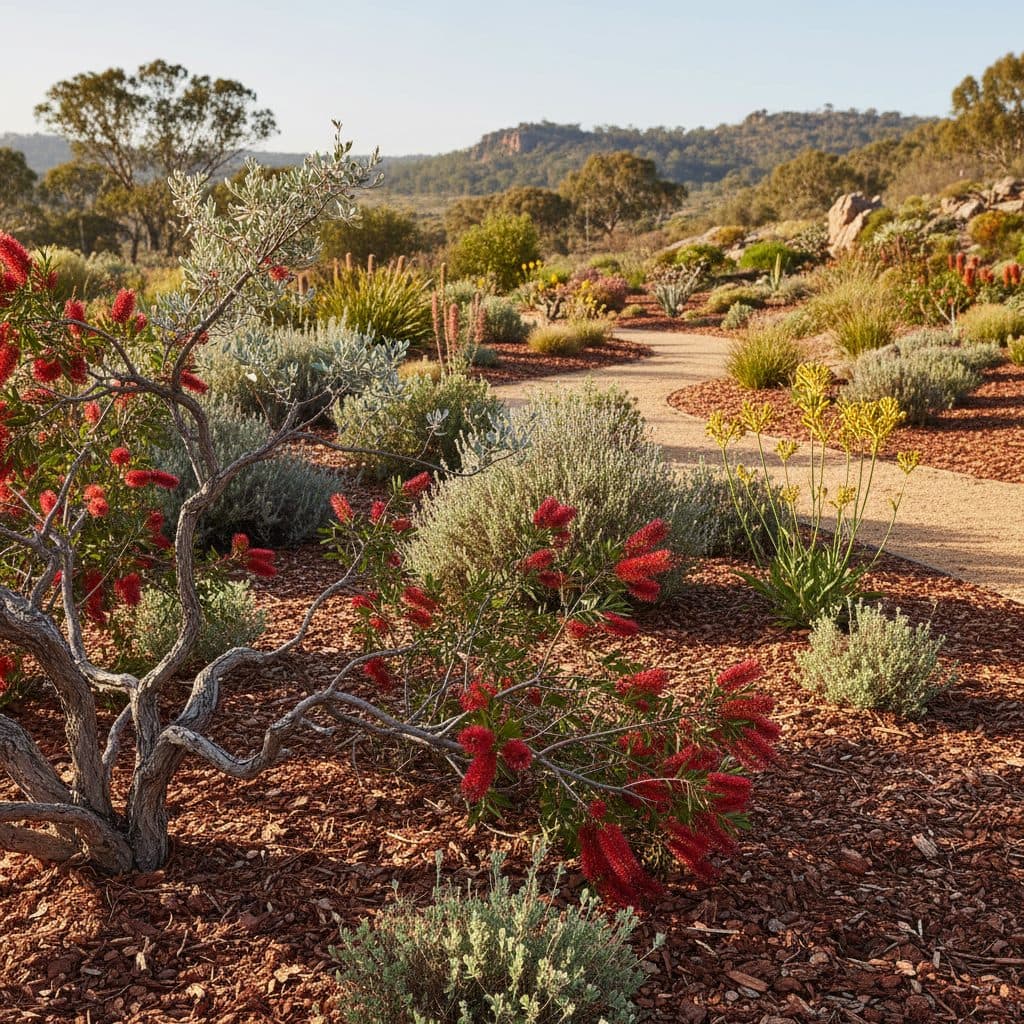
Key takeaways
- Select native and climate-adapted plants evolved to endure prolonged dry spells, heatwaves, and seasonal water restrictions.
- Incorporate drought-hardy structural shrubs like coastal rosemary (Westringia), emu bush (Eremophila), and hybrid grevilleas.
- Use strappy architectural species such as kangaroo paw (Anigozanthos) and spiny-head mat-rush (Lomandra longifolia) for reliable border texture.
- Overcome soil hydrophobicity (water-repellent sand) in Perth, Adelaide, and coastal regions by applying organic compost and bio-wetters.
- Apply a 7.5 cm to 10 cm layer of coarse, chunky woodchip mulch to insulate the soil and sharply cut surface evaporation.
- Practice deep, infrequent watering early in the morning rather than daily light surface sprinkling to encourage deep root systems.
Quick answer: The best drought tolerant plants for Australia include coastal rosemary (Westringia fruticosa), hybrid grevilleas, emu bush (Eremophila), and kangaroo paw (Anigozanthos). These waterwise native species thrive on natural rainfall once established, tolerate hot summer winds, and provide year-round nectar for native birds.
Australia is the driest inhabited continent on Earth, where periodic droughts, extreme summer heatwaves, and municipal water restrictions are regular realities of gardening. From the sandy coastal plains of Perth and the Mediterranean climate of Adelaide to inland Victoria and regional New South Wales, designing a waterwise garden is essential for long-term landscaping success.
Selecting resilient Australian native plants and adapted Mediterranean flora, structuring beds around moisture-retaining organic matter, and applying thick organic mulches produces a lush, colourful, bird-filled garden that thrives through the hottest summers with minimal supplemental water.
Principles of waterwise garden design in Australia
Designing for drought resilience requires grouping plants with similar water requirements (hydrozoning) and enhancing the soil's natural capacity to absorb and retain rainfall.
+-------------------------------------------------------------+
|                WATERWISE HYDROZONING SCHEME                 |
|                                                             |
|   HYDROZONE A: OASIS BEDS (Near House & Patio)              |
|   - Veggie patch, potted citrus, herbs, soft-leaf plants    |
|   - Receives greywater, rainwater tank overflow             |
|                                                             |
|   HYDROZONE B: TRANSITION BEDS (Mid-Garden Borders)         |
|   - Grevilleas, Bottlebrush, Kangaroo Paws, Midyim Berry    |
|   - Needs water only during prolonged multi-week heatwaves  |
|                                                             |
|   HYDROZONE C: ARID SURVIVAL BEDS (Perimeter & Verges)      |
|   - Westringia, Eremophila, Acacia, Lomandra, Saltbush      |
|   - Relies 100% on natural rainfall once established        |
+-------------------------------------------------------------+
Hydrozoning ensures that water from rainwater tanks or greywater systems is concentrated where it is needed most, rather than wasting resources across entire properties.
For broader landscape design concepts, explore our guide on edible drought-tolerant landscaping.
Top drought-tolerant native plants for Australian gardens
Australian natives offer remarkable diversity in foliage texture, form, and flower colour, while providing critical nectar and habitat for native honeyeaters, blue-banded bees, and pollinating insects.
+-------------------------------------------------------------+
|              DROUGHT-TOLERANT NATIVE CATEGORIES             |
|                                                             |
|   1. HARDY SHRUBS (Structural Bones):                       |
|   - Westringia fruticosa (Coastal Rosemary): Grey foliage   |
|   - Grevillea 'Moonlight' & 'Robyn Gordon': Constant nectar |
|   - Correa alba (White Correa): Velvety round leaves        |
|   - Eremophila nivea (Silky Eremophila): Silver & lilac     |
|                                                             |
|   2. STRAPPY & ARCHITECTURAL (Border Structure):            |
|   - Anigozanthos (Kangaroo Paw): Velvet flower claws        |
|   - Lomandra longifolia 'Tanika': Indestructible green turf |
|   - Doryanthes excelsa (Gymea Lily): Massive focal rosettes |
|                                                             |
|   3. FEATURE TREES & SHADE:                                 |
|   - Corymbia ficifolia (Flowering Gum): Summer firecracker  |
|   - Acacia pendula (Weeping Myall): Drooping silver canopy  |
+-------------------------------------------------------------+
Plant Species | Common Name | Type & Height | Foliage & Flower | Drought Hardiness | Best Regional Fit |
|---|---|---|---|---|---|
Westringia fruticosa | Coastal Rosemary | Shrub (1.5–2 m) | Fine grey-green, white flowers | Extreme | Coastal, Temperate, Mediterranean |
Grevillea (Cultivars) | Native Grevillea | Shrub (1–3 m) | Divided leaves, red/pink spider blooms | High | Best in temperate, Mediterranean and semi-arid gardens with free drainage; in humid summer-rainfall areas choose humidity-tolerant or grafted cultivars |
Lomandra longifolia | Spiny-Head Mat-Rush | Strappy Perennial (0.8 m) | Fine green blades, fragrant yellow spikes | Extreme (full sun to part shade) | All regions |
Anigozanthos flavidus | Tall Kangaroo Paw | Strappy Perennial (1–1.5 m) | Upright fans, yellow/red velvet flowers | High | Perth, Adelaide, Sydney, Melbourne |
Correa alba | White Correa | Shrub (1.2 m) | Round grey felted leaves, white star flowers | High | Coastal, Mediterranean, Cool |
Eremophila (Species) | Emu Bush | Shrub (1–2 m) | Silver/grey leaves, tubular pink/purple blooms | Extreme | Arid, Inland, Mediterranean |
Westringia fruticosa can be clipped into formal architectural spheres or left unpruned as a soft, billowy coastal screen. Lomandra longifolia 'Tanika' provides clean, evergreen structure along driveways, handling baking sun, part shade, and periods of water immersion equally well. For Corymbia ficifolia (flowering gum), outside south-west WA, buy grafted named cultivars rather than seedlings.
For shrub selection, consult our companion piece on drought-tolerant shrubs.
Overcoming hydrophobic soil in sandy Australian regions
In many parts of Australia—most notably the sandy coastal plains of Perth and Adelaide—soils become severely hydrophobic (water-repellent) after hot summer dry spells. Decomposing plant waxy residues coat sand particles, causing water to bead up and run off without penetrating the root zone.
+-------------------------------------------------------------+
|              HYDROPHOBIC WATER BEADING VS FIX               |
|                                                             |
|       HYDROPHOBIC SAND                TREATED WATERWISE SOIL|
|    Water beads & runs off         Water soaks deeply to root|
|                                                             |
|          (Water Drops)                   (Rain / Water)     |
|           o   o   o                            | | |        |
|      =================== Soil Surface    ==============     |
|       / / / / / / / /                    | | | | | | | |    |
|      (Bone-dry sand beneath)             (Moist root zone)  |
+-------------------------------------------------------------+
Remedying water-repellent soils:
- Apply bio-wetting agents: Apply a quality organic soil wetting agent across garden beds in early spring (September) and again in mid-summer (January). Wetting agents break the surface tension of water, allowing moisture to coat sand particles evenly.
- Incorporate organic matter: Dig in well-rotted compost and mature manure. Organic matter holds far more water than sand alone and builds a moisture reservoir through the profile.
- Add clay to sandy soil: Incorporate kaolin or bentonite clay (at 5 to 10 kg per square metre) into the top 15 cm of pure sand. Start at the lower rate for swelling clays such as bentonite, and mix the clay thoroughly through the top 10 cm to 15 cm rather than leaving it as a layer. Clay permanently alters soil structure, binding with sand to store water and nutrients.
Mulching strategies for Australian summers
Mulch is the first line of defense against the drying Australian sun. Bare soil in an Australian summer dries out in the top few centimetres within a day or two of watering.
- Coarse woodchip mulch: Use chunky, irregular tree loppings or arborists' woodchips applied at a depth of 7.5 cm to 10 cm. Coarse chips allow heavy rain to pass through quickly to the soil beneath while creating an open air layer that resists capillary water loss.
- Avoid fine mulches: Fine bark dust or sawdust mats together, forming an impenetrable crust that absorbs light rain before it ever reaches the soil.
- Keep trunks clear: Always leave a 10 cm gap between the mulch layer and plant stems to prevent fungal collar rot.
For deeper insights into mulching physics, explore our guide on mulching strategies to conserve soil moisture.
Water-wise irrigation techniques
How and when you apply water determines how well your plants withstand intense heatwaves:
- Deep, infrequent watering: Apply 20 to 30 litres of water to mature shrubs once every two weeks during dry periods rather than 5 minutes of daily surface spraying. Deep soakings encourage roots to grow deep into cool subsoil layers.
- Early morning timing: Irrigate before 8:00 AM. Watering in the heat of the day wastes water through evaporation, while evening watering can promote fungal foliar diseases during humid summer spells.
- Drip irrigation and sub-surface pipes: Install pressure-compensating drip lines beneath the woodchip mulch layer to deliver water directly to the root zone with almost no evaporation loss.
- Rainwater storage: Install rain tanks connected to roof downpipes to collect winter rainfall for targeted summer oasis zone watering.
By pairing rugged Australian native species with soil-wetting practices, thick woodchip mulches, and deep hydrozoning, you can maintain a resilient, flowering, waterwise garden throughout the driest seasons.