Key takeaways
- Replacing 1,000 square feet of traditional lawn can save 30,000 gallons of water annually in regions like California [1].
- Many US states offer rebates for lawn removal, with some programs covering up to $3 per square foot of converted area [1].
- Selecting plants native to your USDA zone or specific arid regions ensures better survival rates and lower water needs.
- Amending soil with 2-4 inches of organic matter and using 3-4 inches of mulch significantly reduces water evaporation.
- Drip irrigation systems can reduce water usage by 30-50% compared to traditional sprinklers, delivering water directly to plant roots.
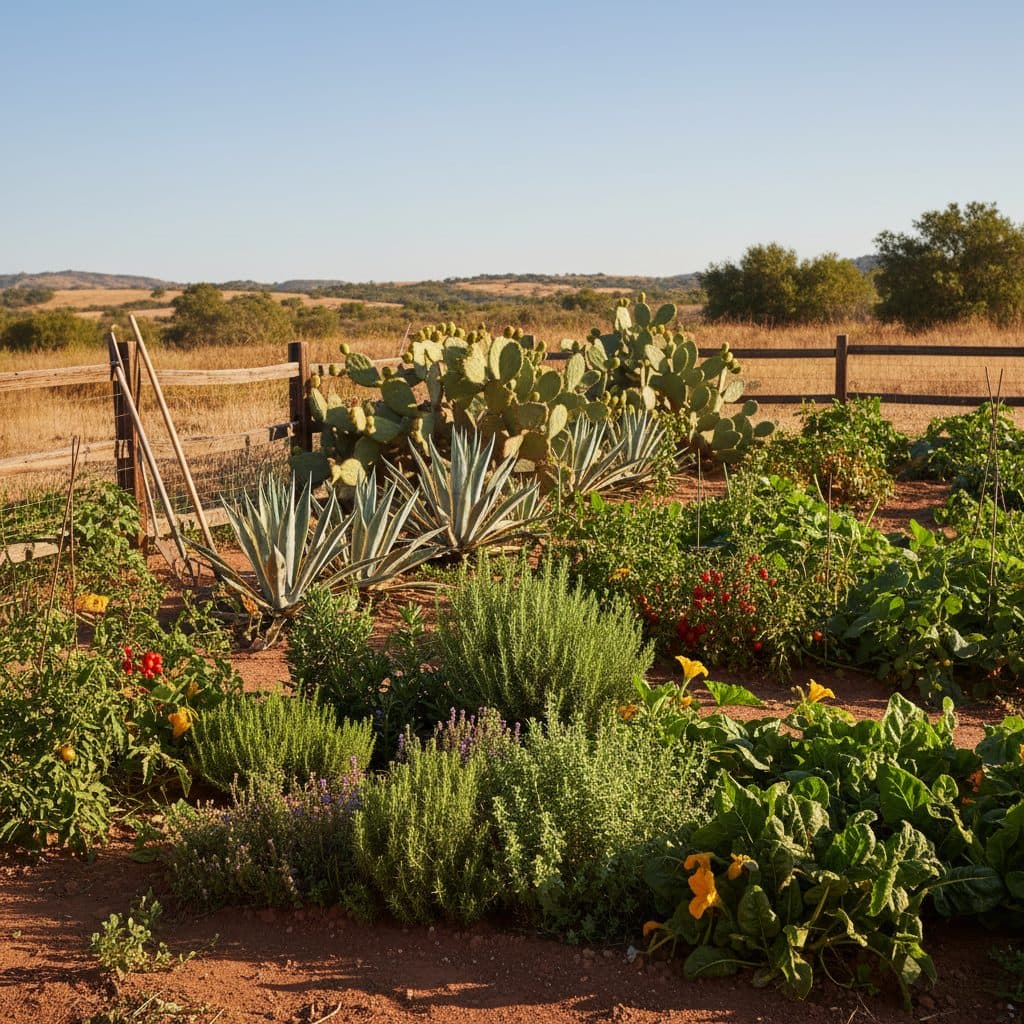
- Consider edible plants like prickly pear, agave, and certain varieties of herbs that thrive in USDA zones 7-10 with minimal irrigation.
Quick answer: Converting a 1,000 square foot lawn to drought-tolerant edible plants can save 30,000 gallons of water annually in regions like California. This transition involves selecting native plants, amending soil, using mulch, and implementing drip irrigation.
Across the American West, from the parched plains of Arizona to the sun-baked valleys of California, water scarcity is a growing concern. Since 1980, droughts in the US have cost over $250 billion, impacting everything from agriculture to urban water supplies [3]. Traditional lawns, often composed of non-native turf grasses, are significant water consumers, demanding up to 50% of residential water in some areas. For instance, replacing just 1,000 square feet of lawn with drought-tolerant landscaping in California can save an average of 30,000 gallons of water per year [1]. Replacing turf with drought-tolerant plantings conserves water and builds resilience into home gardens.
Edible, drought-tolerant plants replace thirsty turfgrass with crops that produce food and withstand dry spells. In 1926, ‘Lippia’ was promoted as a drought-resisting lawn substitute, showing the long history of water-wise plantings [2]. Planning plant selection and irrigation makes the transition straightforward.
Understanding the need for change: water, cost, and food
These takeaways points carry into this section, too.
The traditional American lawn, while aesthetically pleasing to some, comes with a substantial environmental and financial price tag. In many US regions, especially those experiencing prolonged drought conditions like the Southwest, turfgrass can account for 30-70% of residential water use. A typical 1,000 square foot lawn can require 20,000 to 40,000 gallons of water annually, depending on the climate and grass type. Beyond water, maintenance (mowing, fertilizing, and pest control) costs homeowners hundreds of dollars each year and contributes to carbon emissions from gasoline-powered equipment.
The hidden costs of conventional lawns
Consider the cumulative impact: if 100 homes in a community each have a 1,000 square foot lawn, that’s 2-4 million gallons of water annually just for turf. This water could instead be used for food production or retained in natural systems. Many US states and cities now offer financial incentives to convert lawns. California, for example, has offered rebates of up to $3 per square foot for turf replacement, making the initial investment more manageable for homeowners [1]. These programs recognize the long-term savings in municipal water treatment and supply. Shifting to edible, drought-tolerant plants reduces water bills by 30-50% while providing fresh produce for the household.
- Traditional lawns consume 30-70% of residential water in arid regions.
- A 1,000 square foot lawn can use 20,000-40,000 gallons of water per year.
- Lawn maintenance costs can exceed $500 annually for an average US home.
- Rebate programs in states like California can provide up to $3 per square foot for turf removal [1].
- Converting to drought-tolerant landscaping can reduce water bills by 30-50%.
Planning your edible, water-wise landscape
That work on understanding need sets up what follows here.
Successful lawn conversion starts with thoughtful planning. Begin by observing your existing space: how much sun does it get? What are the soil conditions? A 3-in-1 soil meter can help you understand your soil’s pH, moisture, and light levels, which are critical for plant selection. Most edible plants prefer full sun, meaning at least six hours of direct sunlight daily. For soil, a basic soil test can reveal nutrient deficiencies and texture, guiding your amendments. In many arid regions, soils are often sandy or heavy clay, both of which benefit from significant organic matter.
Designing for resilience and yield
Consider your USDA hardiness zone when selecting plants. For instance, a gardener in USDA zone 9b in Arizona will choose different plants than someone in zone 6a in Colorado. Focus on plants native to arid or semi-arid regions, as they are naturally adapted to dry conditions. Group plants with similar water needs together (hydrozoning) to maximize irrigation efficiency. Think about the mature size of plants to avoid overcrowding, which can reduce air circulation and increase disease risk. A well-designed plan can reduce water usage by 70% compared to a traditional lawn, especially when incorporating rainwater harvesting techniques encouraged by programs like EPA’s Soak Up the Rain [6].
- Assess sun exposure, aiming for 6+ hours of direct sun for most edibles.
- Test soil pH and texture to inform amendments.
- Select plants appropriate for your USDA hardiness zone, like zone 8 in Texas.
- Group plants by water needs (hydrozoning) to save 70% water.
- Plan for mature plant sizes to ensure adequate spacing, typically 1-3 feet apart for smaller edibles.
Selecting drought-tolerant edible plants for your region
This builds directly on planning edible water-wise.
Success with an edible, drought-tolerant garden depends on choosing plants suited to your specific USDA zone and microclimate. Many plants offer both culinary value and water-wise characteristics. For instance, in warmer zones like USDA zones 8-10, prickly pear cactus (Opuntia ficus-indica) thrives with minimal water once established, producing edible pads (nopales) and fruit (tunas). Agave (Agave americana), also suitable for zones 8-10, provides a sweet syrup from its core, though it’s a long-term investment, taking 7-15 years to mature.
Diverse options for various climates
Even in cooler zones, options exist. Many Mediterranean herbs like rosemary (USDA zones 7-10), thyme (USDA zones 5-9), and oregano (USDA zones 4-9) are highly drought-tolerant once established and add flavor to your kitchen. For a more substantial crop, consider certain varieties of edible canna (Canna edulis), which can produce starchy rhizomes and tolerate drier conditions than many other root crops, especially in zones 7-10. You can explore more options in our drought tolerant plants guide and drought tolerant shrubs guide. Always verify a plant’s specific water needs and hardiness for your area; a plant labeled ‘drought-tolerant’ in Florida (zone 9) might still need supplemental water in a drier zone 9 climate like Arizona.
- Prickly pear (Opuntia ficus-indica) thrives in USDA zones 8-10, providing edible pads and fruit.
- Agave (Agave americana) is a low-water option for zones 8-10, yielding syrup after 7-15 years.
- Rosemary, thyme, and oregano are drought-tolerant herbs for zones 4-10.
- Edible canna (Canna edulis) can produce starchy rhizomes in zones 7-10.
- Consider native plant varieties for maximum resilience; for example, native currants in USDA zone 4.
Soil preparation and efficient watering strategies
Good soil is the foundation of any productive garden, especially one designed for drought resilience. Before planting, remove all turf grass, ensuring at least 6 inches of soil depth for most edible roots. Amend your soil generously with 2-4 inches of organic matter, such as compost or well-rotted manure, and incorporate it into the top 6-12 inches of existing soil. Organic matter improves soil structure, increases water retention in sandy soils, and enhances drainage in clay soils. This can boost water holding capacity by 20-30%.
Smart irrigation and mulching
Once plants are in the ground, apply a 3-4 inch layer of organic mulch (such as wood chips, straw, or shredded leaves). Mulch suppresses weeds, moderates soil temperature, and reduces water evaporation from the soil surface by 25-50%. For watering, drip irrigation or soaker hoses are far more efficient than overhead sprinklers, delivering water directly to the plant roots and minimizing waste. These systems can reduce water usage by 30-50%. For new plantings, a soil moisture meter can help you determine exactly when to water, preventing both under- and overwatering. The USDA Natural Resources Conservation Service provides excellent resources on water conservation practices for home gardens [5].
- Remove all turf, ensuring 6 inches of clear soil depth.
- Incorporate 2-4 inches of organic matter into the top 6-12 inches of soil.
- Apply a 3-4 inch layer of organic mulch to reduce evaporation by 25-50%.
- Install drip irrigation or soaker hoses to save 30-50% water compared to sprinklers.
- Monitor soil moisture with a meter to optimize watering schedules.
Comparison of Traditional Lawn vs. Edible Drought-Tolerant Landscape (per 1,000 sq ft)
Feature | Traditional Lawn | Edible Drought-Tolerant Landscape |
|---|---|---|
Annual Water Use (gallons) | 20,000 – 40,000 | 6,000 – 12,000 (70% reduction) |
Maintenance Time (hours/year) | 20 – 40 (mowing, fertilizing) | 5 – 15 (harvesting, occasional pruning) |
Annual Cost (estimated) | $300 – $800 | $50 – $200 (excluding initial plant cost) |
Food Production | None | Significant (fresh produce, herbs) |
Rebate Eligibility | None | Up to $3 per square foot in some regions [1] |
Water Savings: Converting 1,000 square feet of lawn can save 30,000 gallons of water annually in California [1].
Rebate Opportunities: Many US cities offer rebates up to $3 per square foot for turf removal, significantly offsetting conversion costs [1].
Frequently asked questions
How much water can I really save by converting my lawn?
You can save a substantial amount of water. In California, replacing 1,000 square feet of lawn with drought-tolerant landscaping can save an average of 30,000 gallons of water per year [1]. This can translate to a 30-50% reduction in your overall outdoor water use.
Are there financial incentives for removing my lawn?
Yes, many US states and municipalities offer rebates for turf removal. Some programs, particularly in California, have historically offered up to $3 per square foot for converted areas [1]. Check with your local water district or city for available programs in your region.
What are some easy-to-grow edible drought-tolerant plants for beginners?
For beginners, consider plants like rosemary (USDA zones 7-10), thyme (USDA zones 5-9), and sage (USDA zones 4-9), which are hardy and require minimal water once established. Prickly pear cactus (USDA zones 8-10) is also very forgiving and provides edible pads and fruit.
How do I prepare my soil for a drought-tolerant garden?
Start by removing all existing turf, ensuring a depth of at least 6 inches. Then, amend your soil with 2-4 inches of organic matter, such as compost, mixed into the top 6-12 inches. This improves drainage and water retention, critical for plants that need less frequent watering.
What’s the best way to water an edible drought-tolerant landscape?
Drip irrigation or soaker hoses are highly recommended as they deliver water directly to the plant roots, reducing water waste by 30-50% compared to overhead sprinklers. Additionally, applying a 3-4 inch layer of organic mulch helps retain soil moisture and reduces evaporation.
Can I grow edible plants in poor soil conditions?
While most edibles prefer good soil, many drought-tolerant varieties are more forgiving. Amending poor soil with 2-4 inches of organic matter before planting improves soil structure and water retention. Some plants, like certain herbs or native edibles, are naturally adapted to leaner soils in their native USDA zones.
References
- The Analysis of Lawn Rebate Programs and Drought Tolerant Lawn Recommendations in California (2024). The Analysis of Lawn Rebate Programs and Drought Tolerant Lawn Recommendations in California.
- Lippia price list ; Lippia the drought-resisting lawn plant, a new and remarkable substitute for lawn grass / (1926). Lippia price list ; Lippia the drought-resisting lawn plant, a new and remarkable substitute for lawn grass /.
- Thirsty for Projects and Funds to Mitigate Drought? (2022). Thirsty for Projects and Funds to Mitigate Drought?.
- The thirsty impact: How droughts threaten global water quality and human health (2026). The thirsty impact: How droughts threaten global water quality and human health.
- USDA Natural Resources Conservation Service (2024). USDA Natural Resources Conservation Service.
- EPA — Soak Up the Rain (2024). EPA — Soak Up the Rain.