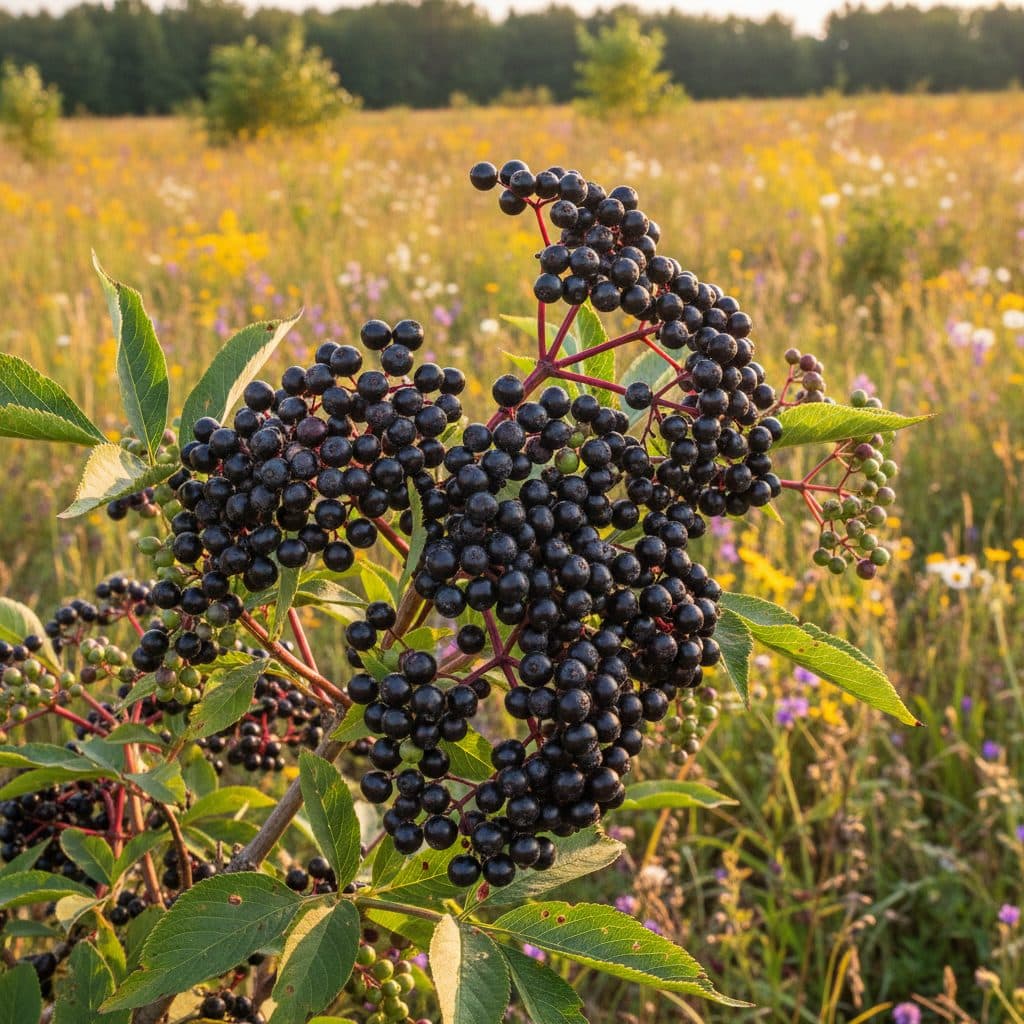
Key takeaways
- Elderberries (Sambucus species) are found across most of the US, thriving in USDA zones 3 through 9.
- Always cook elderberries and elderflowers thoroughly; raw berries and other plant parts contain cyanogenic glycosides.
- Correct identification is critical to avoid toxic lookalikes like water hemlock or pokeweed, which can be deadly.
- Harvest elderflowers in late spring to early summer, and berries in late summer to early fall so full ripeness.
- Forage responsibly by taking no more than 25% of the plant’s yield and avoiding areas near roads or industrial sites.
- Store dried elderflowers for up to 12 months and processed elderberry products for 6-9 months in a cool, dark place.
Quick answer: To safely forage elderberries and elderflowers, correctly identify Sambucus species, avoid toxic lookalikes like water hemlock, and always cook berries and flowers thoroughly before consumption. Harvest responsibly, taking no more than 25% of a plant’s yield.
Across the United States, from the humid lowlands of Florida to the cooler climates of the Pacific Northwest, elderberry plants offer a seasonal bounty for those who know how to identify and process them safely. Sambucus canadensis, the American elderberry, is a common sight in many states, flourishing in USDA zones 3 to 9, while its European cousin, Sambucus nigra, is also cultivated and sometimes naturalized. Both species provide edible flowers and fruits, but their safe use hinges on careful identification and proper preparation. In 2018, research noted the diverse metabolites in these plants, which offer potential benefits but still require caution [1].
Wild elderberries and elderflowers are easy to misidentify or mishandle if you skip basic checks, and poisoning incidents happen every year. Below are the field markers, harvest rules, and preparation steps needed to gather and use both parts of the plant safely across US regions.
Understanding elderberry species and their US distribution
The genus Sambucus encompasses around 30 species worldwide, with several prominent varieties found across North America. The most common native species in the US is Sambucus canadensis, often called American elderberry, which grows abundantly from the East Coast to the Great Plains and into the Southwest, thriving in USDA zones 3 through 9 [5]. You’ll find it in sunny clearings, along stream banks, and at the edges of woodlands, often reaching heights of 5 to 12 feet. Its adaptability means it can be found in nearly every state except for arid regions of the far West. For example, in states like Missouri and Ohio, it’s a ubiquitous shrub, producing flowers in June and berries by August.
Regional variations and growth habits
While Sambucus canadensis is widespread, its European counterpart, Sambucus nigra, is also grown commercially and in home gardens, and occasionally escapes cultivation, particularly in the Pacific Northwest and parts of the Northeast. Both species prefer moist, well-drained soils with a pH between 5.5 and 6.5. In California, a distinct species, Sambucus cerulea (blue elderberry), is common, producing berries that ripen to a dark blue color with a whitish bloom. Regardless of the specific species, all elderberry plants require similar safety precautions. Understanding the local species in your area, such as the Sambucus canadensis found across most of the Midwest, is the first step in safe foraging. For more general guidance on starting your foraging journey, consider reviewing resources like Foraging for beginners: identifying common wild edibles safely.
- Sambucus canadensis: Native to eastern and central North America, growing up to 12 feet tall.
- Sambucus nigra: European native, often cultivated, found in USDA zones 5-7.
- Sambucus cerulea: Western US native, known for its blue-dusted berries.
- Preferred habitat: Moist soils, full sun to partial shade, often near water.
- Average height: 5 to 12 feet for most mature plants.
Identifying elderflowers and elderberries safely
Accurate identification is the most critical step in safe foraging. Elderflowers are typically creamy white, flat-topped clusters (cymes) that can be 6 to 10 inches across, appearing in late spring to early summer, usually May through June in most US regions. Each individual flower is small, about 0.125 inches in diameter, with five petals. The leaves are compound, meaning they consist of multiple leaflets, typically 5 to 9 per leaf, arranged oppositely on the stem. Each leaflet is oval-shaped with serrated edges, usually 2 to 6 inches long. The stems are woody, but young stems and branches have a characteristic spongy white pith.
Avoiding toxic lookalikes
Several plants can be mistaken for elderberry, some of which are highly toxic. Water hemlock (Cicuta maculata) is perhaps the most dangerous lookalike, especially its white flower clusters, which can resemble elderflowers. However, water hemlock has single stems arising from a cluster of fleshy roots, and its leaves are typically triple-compound, unlike elderberry’s opposite, pinnately compound leaves. Another common impostor is pokeweed (Phytolacca americana), which has dark purple berries that are toxic if consumed raw. Pokeweed berries grow in elongated clusters, not the umbrella-like cymes of elderberries, and its stems are often reddish-purple. When in doubt, always err on the side of caution; a single misidentification can have severe consequences. Always confirm at least three distinct identification features before harvesting. For general safety when harvesting wild edibles, consult guides like Foraging for beginners: identifying common wild edibles safely.
- Elderflower size: Flat-topped clusters (cymes) 6-10 inches wide.
- Leaf arrangement: Opposite, compound leaves with 5-9 serrated leaflets.
- Stem pith: White, spongy pith in young stems.
- Berry color: Dark purple to black, 0.125-0.25 inches in diameter.
- Toxic lookalikes: Water hemlock (Cicuta maculata) and pokeweed (Phytolacca americana).
Safe harvesting practices and ethical considerations
When harvesting elderflowers, aim for late spring to early summer, typically May to June in USDA zones 5-7, when the flowers are fully open and fragrant, but before they start to brown. For elderberries, the season runs from late summer to early fall, usually August to September, when the berries are deep purple or black and soft to the touch. All berries in a cluster should be ripe; green or red berries are immature and should not be consumed. Use sharp shears or scissors to cleanly snip flower clusters or berry umbels, leaving a small stem attached to the cluster. This helps preserve the integrity of the plant and makes processing easier.
Foraging location and quantity
Choose your foraging locations carefully. Avoid areas near busy roads, industrial sites, or agricultural fields where plants may be exposed to vehicle exhaust, pesticides, or other pollutants [3]. A good rule of thumb is to forage at least 50 feet away from roadsides. Always seek permission before harvesting on private land. When harvesting, practice sustainable foraging: take no more than 10% to 25% of the available flowers or berries from a single plant or patch [2]. This ensures enough remains for wildlife, for the plant to reproduce, and for other foragers. For instance, if you find a patch with 20 clusters of berries, limit your harvest to 2-5 clusters. Leaving a significant portion, perhaps 75% or more, ensures the plant’s long-term health and productivity.
- Harvesting tools: Sharp shears or scissors for clean cuts.
- Flower season: Late spring to early summer (May-June), when fully open.
- Berry season: Late summer to early fall (August-September), when fully ripe and dark.
- Location: At least 50 feet from roads, away from pollutants.
- Quantity: Take no more than 10-25% of flowers or berries from a single plant.
Safe preparation and consumption of elderberries and elderflowers
Raw elderberries, leaves, stems, bark, and roots contain cyanogenic glycosides, which can release hydrogen cyanide when ingested [1]. This is why you must cook elderberries thoroughly before consumption. Cooking, especially thorough boiling, effectively neutralizes these compounds, rendering the fruit safe. Symptoms of raw elderberry poisoning can include nausea, vomiting, and diarrhea, which can appear shortly after ingestion. For elderflowers, the risk is much lower, but it is still recommended to cook or infuse them, for example, by making a syrup or tea, to ensure safety and improve digestibility.
Processing and storage
After harvesting, remove all stems and leaves from elderberry clusters, as these parts are toxic. A fork can be useful for quickly stripping berries from their stems. Rinse the berries thoroughly under cool water. To prepare a simple elderberry syrup, berries are typically simmered in water, strained, and then combined with a sweetener like honey or sugar. This syrup can be stored in the refrigerator for a short time or canned for longer preservation. Dried elderflowers, stored in an airtight container, can retain their potency for an extended period. Always ensure any prepared products are clearly labeled with the date of processing. For other wild edibles that require specific preparation, like Lamb’s quarters: how to identify, harvest, and cook wild spinach safely, similar attention to detail is key.
- Cooking requirement: All elderberries must be cooked thoroughly, typically boiled for 20 minutes.
- Toxic parts: Raw berries, leaves, stems, bark, and roots.
- Syrup ratio: Approximately 4 cups berries to 3 cups water, plus sweetener.
- Storage: Refrigerate syrup for 2-3 weeks, dried flowers for up to 12 months.
- Symptoms of raw consumption: Nausea, vomiting, diarrhea.
Comparison of common elderberry species in the US
Feature | Sambucus canadensis (American Elderberry) | Sambucus nigra (European Elderberry) | Sambucus cerulea (Blue Elderberry) |
|---|---|---|---|
Native Range | Eastern & Central North America | Europe, North Africa, Asia | Western North America |
USDA Zones | 3-9 | 5-7 | 5-10 |
Berry Color | Dark purple-black | Dark purple-black | Dark blue with white bloom |
Typical Height | 5-12 feet | 10-20 feet | 10-30 feet |
Flower Bloom | May-June | May-July | June-August |
Toxicity warning: Raw elderberries contain cyanogenic glycosides, which can cause illness; thorough cooking is essential to neutralize these compounds [1].
Foraging distance: To avoid pollutants, always harvest wild edibles at least 50 feet away from busy roadsides and agricultural fields [3].
References
- Comprehensive Insight into the Elderflowers and Elderberries (Sambucus nigra L.) Mono and Sesquiterpenic Metabolites: Factors that Modulate Their Composition (2018).
- Harvesting and Consuming Wild Foods Safely (2024).
- Rosemary (2021).
- HARVESTING AND CONSUMING WILD FOODS SAFELY (2024).
- USDA Natural Resources Conservation Service (2024).