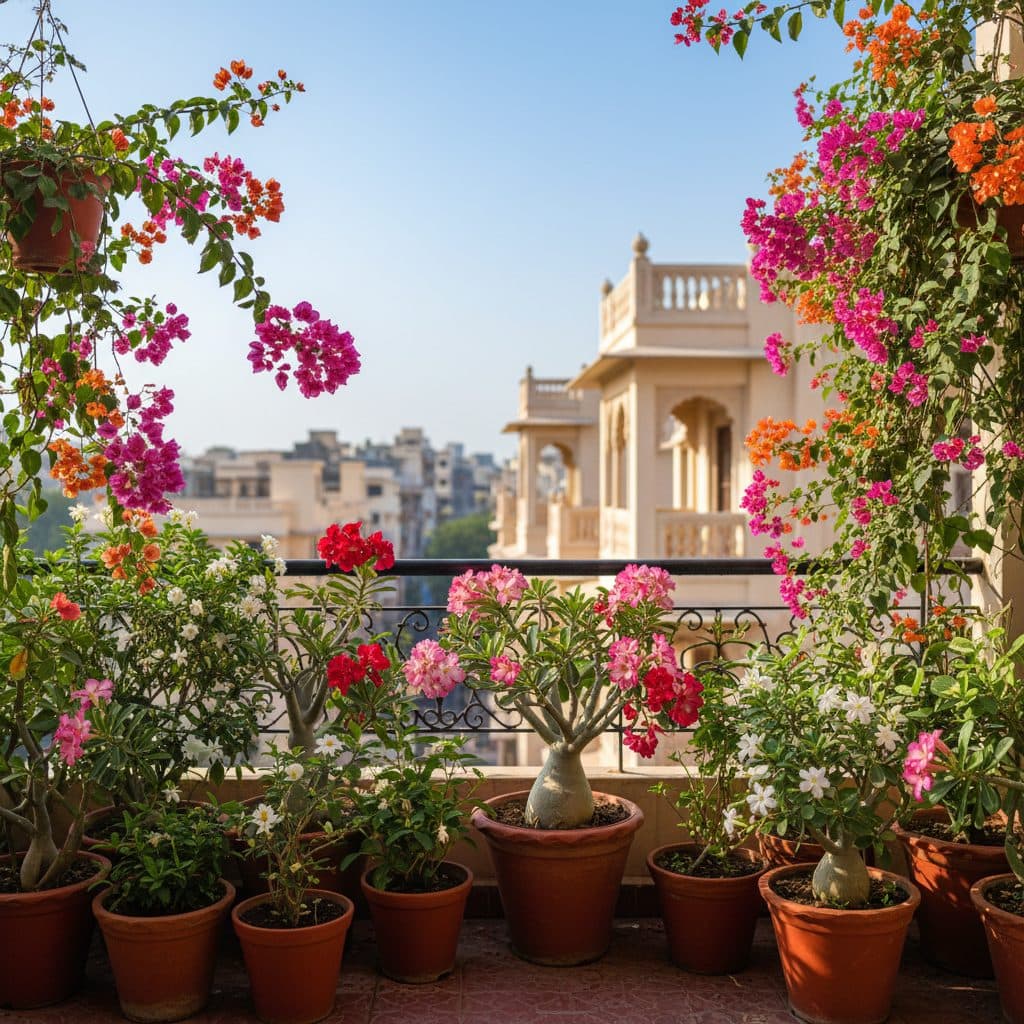
Key takeaways
- Choose hardy, all-season flowering perennials like Bougainvillea, Mogra (Arabian Jasmine), Hibiscus (Gudhal), Adenium (Desert Rose), and Sadabahar (Vinca).
- Select container sizes according to root volume, using 25 cm to 35 cm pots for shrubby perennials and hanging planters for trailing species.
- Formulate a lightweight potting substrate using 40 percent washed cocopeat, 35 percent aged vermicompost or cow manure, 15 percent coarse river sand or perlite and 10 percent native garden soil.
- Elevate all balcony pots on drainage stands or rubber saucers to prevent water stagnation and avoid staining balcony floor tiles during the monsoon.
- Feed every 15 days with fermented mustard cake (sarson ki khali) liquid extract and monthly with steamed bone meal to stimulate continuous flower bud development.
Quick answer: Selecting flowering plants for balcony India requires matching plant sun requirements with your balcony orientation (east, west, north, or south). Top year-round performers include Bougainvillea, Mogra, Hibiscus, Adenium, and Sadabahar (Vinca). Use well-draining lightweight soil rich in vermicompost and cocopeat, ensure pots are elevated for monsoon drainage, and feed with organic phosphorus and potassium sources (bone meal, wood ash) alongside nitrogen-rich mustard cake liquid.
Apartment balcony gardening across Indian cities brings color, fragrance, and a bit of urban biodiversity into high-rise living spaces.
However, balcony microclimates in India present distinct challenges. High-rise balconies face intense summer sun (40°C to 45°C), drying thermal winds from concrete walls, seasonal monsoon deluges (kharif), and limited space constraints.
By selecting heat-hardy, perennial flowering species suited to container culture and mastering lightweight potting mixes, you can maintain a lush, fragrant balcony garden in bloom through every season.
Top all-season flowering plants for Indian balconies
Selecting resilient perennial species gives you the best chance of continuous floral displays without the constant expense of replanting seasonal annuals.
+------------------------+---------------------------------------+-------------------+-----------------------------+
| Plant Name (Common/Hindi)| Botanical Name                      | Sun Requirement   | Flower Fragrance & Color    |
+------------------------+---------------------------------------+-------------------+-----------------------------+
| Mogra (Arabian Jasmine)| *Jasminum sambac*                     | 4 to 6 Hours Full | Intensely fragrant white    |
| Bougainvillea          | *Bougainvillea* spp.                  | 6+ Hours Direct   | Vibrant magenta, red, orange|
| Hibiscus (Gudhal)      | *Hibiscus rosa-sinensis*              | 5+ Hours Direct   | Red, yellow, pink, peach    |
| Adenium (Desert Rose)  | *Adenium obesum*                      | 6+ Hours Direct   | Pink, red, white (succulent)|
| Sadabahar (Vinca)      | *Catharanthus roseus*                 | 4+ Hours Direct   | Purple, pink, pure white    |
| Aparajita (Clitoria)   | *Clitoria ternatea*                   | 4 to 5 Hours      | Deep royal blue, white      |
| Champa (Frangipani)    | *Plumeria* spp. (P. rubra, P. obtusa) | 5+ Hours Direct   | Sweetly fragrant white/gold |
| Rugmini (Ixora)        | *Ixora coccinea*                      | 4 to 5 Hours      | Dense clusters of scarlet   |
+------------------------+---------------------------------------+-------------------+-----------------------------+
Plumeria spp. (frangipani) is not to be confused with Magnolia champaca, also called champa or son champa. Note that Adenium obesum sap (cardiac glycosides), Plumeria latex, and Catharanthus roseus (Sadabahar) are toxic if ingested; place them safely away from pets and small children.
+-------------------------------------------------------------------+
|               BALCONY ORIENTATION AND PLANT MATCHING              |
|                                                                   |
| [South / West Balcony]              [East / North Balcony]        |
| Intense afternoon sun (6+ hrs)      Gentle morning sun (3-4 hrs)  |
| Best: Bougainvillea, Adenium,       Best: Impatiens (Balsam),     |
|       Plumeria, Hibiscus, Mogra           Begonia, Anthurium, Ferns|
+-------------------------------------------------------------------+
Mogra (Arabian Jasmine)
Mogra is prized across India for its sweet, calming evening fragrance and pristine white double blossoms. It thrives in 30 cm pots with morning sunlight and blooms profusely from March through October. Prune shoot tips after each flowering flush to encourage new flower-bearing branches.
Bougainvillea
Bougainvillea is one of the most heat-tolerant, drought-resilient flowering plants for sunny south- and west-facing Indian balconies. Its colorful papery bracts smother the plant throughout summer and winter. It prefers being slightly root-bound and blooms best when watered only after the topsoil dries out completely.
Adenium (Desert Rose)
With its sculpted, water-storing caudex stem and striking trumpet flowers, Adenium is exceptionally low-maintenance. It thrives in full, baking rooftop and balcony sun, requiring minimal watering and thriving in gritty, porous potting mixes.
Container sizing, vertical railing planters and balcony load
Balcony floor load limits and root confinement dictate container selection and vertical arrangement.
+------------------------+-------------------+-------------------+-------------------------+
| Pot Material           | Weight Factor     | Durability        | Root Aeration           |
+------------------------+-------------------+-------------------+-------------------------+
| UV-Stabilised Plastic  | Lightweight       | 5 to 7 Years      | Moderate (needs holes)  |
| Traditional Terracotta | Heavy             | Fragile           | Excellent (porous walls)|
| Geotextile Fabric Bags | Ultra-lightweight | 3 to 5 Years      | Superior air-pruning    |
| Railing Saddle Planters| Very light        | 4 to 6 Years      | Straddles balcony rail  |
+------------------------+-------------------+-------------------+-------------------------+
+-------------------------------------------------------------------+
| MINIMUM POT SIZES BY SPECIES |
+-------------------------------------------------------------------+
| Small (20 cm / 8 in): Sadabahar (Vinca), Dwarf Portulaca, Kalanchoe|
| Medium (30 cm / 12 in): Mogra, Ixora, Aparajita vine, Dwarf Hibiscus|
| Large (40 cm / 16 in): Bougainvillea, Plumeria (Champa), Rose |
| Railing Troughs: Petunias, Verbena, Trailing Portulaca |
+-------------------------------------------------------------------+Always use lightweight UV-stabilized plastic or fabric containers on high-rise balconies to keep structural dead-weight low. Utilizing vertical railing planters and hanging macrame holders doubles your floral display without taking up precious balcony floor space. Ensure every container has three to four open drainage holes at the base.
For container layouts and floor planning, explore rooftop patio container gardening.
Formulating a lightweight, nutrient-rich potting mix
Standard garden soil is too heavy for balcony structures and turns into compacted, suffocating mud during heavy monsoon rainfall.
+-------------------------------------------------------------------+
|                 BALCONY FLOWER SUBSTRATE RECIPE                   |
+-------------------------------------------------------------------+
| - 40% Washed Cocopeat: Retains moisture without heavy weight      |
| - 35% Aged Vermicompost or Cow Manure: Sustained organic feeding  |
| - 15% Coarse River Sand or Perlite: Ensures fast water drainage   |
| - 10% Native Garden Soil: Supplies beneficial minerals and clays  |
| - Amendments: 2 tbsp Neem cake powder + 1 tbsp Bone meal          |
|   (measured per 25-30 cm pot)                                     |
+-------------------------------------------------------------------+
Neem cake powder (Azadirachta indica press cake) suppresses soil grubs and root-knot nematodes and releases nitrogen slowly; it will not prevent root rot, which is caused by poor drainage.
+-------------------------------------------------------------------+
|                   BALCONY DRAINAGE ELEVATION                      |
|                                                                   |
|   [================= Potting Substrate =================]         |
|   [------------ Geotextile Mesh Filter Layer -----------]         |
|   +-----------------------------------------------------+         |
|   |                  [Drainage Holes]                   |         |
|   +================= Rubber Pot Stand ==================+         |
|   ------------------ Balcony Tiled Floor ----------------         |
+-------------------------------------------------------------------+
Cover the drainage holes with mesh or a geotextile square — do not add a gravel or crock layer, which raises the waterlogged zone inside the pot. Elevating containers on 2 cm rubber pot stands ensures excess irrigation water drains away freely without creating muddy standing pools beneath pots.
Organic fertilization and natural pest management
Container plants deplete soil nutrients within six to eight weeks of active growth. A structured organic feeding and pest management schedule keeps plants blooming continuously.
+--------------------+-------------------------+--------------------+-----------------------------------------+
| Care Practice      | Application Method      | Frequency          | Primary Benefit                         |
+--------------------+-------------------------+--------------------+-----------------------------------------+
| Mustard Cake Liquid| Fermented liquid drench | Once every 15 days | High nitrogen; small amounts of P and K |
| Steamed Bone Meal  | 2 tbsp scratched in soil| Monthly            | Slow-release phosphorus                 |
| Wood Ash Solution  | 1 tbsp in 1 litre water | Monthly            | Natural potassium boost                 |
| Neem Oil Emulsion  | 5 ml neem oil + 2 ml soap| As needed for pests| Controls mealybugs                      |
| Vermicompost       | 2 handfuls top-dressed  | Monthly            | Soil microbial health                   |
+--------------------+-------------------------+--------------------+-----------------------------------------+
Use wood ash sparingly and skip it for Ixora and other acid-preferring plants; repeated wood ash raises container pH and causes yellowing between leaf veins.
Making mustard cake liquid fertilizer (sarson ki khali)
- Soak 100 grams of mustard oil cake in 1 litre of water in an open plastic bottle for four days, stirring daily.
- The mixture ferments into a potent, pungent liquid concentrate.
- Dilute 1 part concentrate with 10 parts fresh water until it resembles pale black tea.
- Drench soil around root zones of Mogra, Hibiscus, and Bougainvillea to stimulate explosive flower bud formation.
Organic mealybug control on Hibiscus
Hibiscus plants on urban balconies are prone to white cottony mealybugs (family Pseudococcidae). Spray infested stem nodes with a solution of 5 ml cold-pressed neem oil and 2 ml organic liquid dish soap shaken vigorously in 1 litre of warm water. The soap breaks down the waxy coating while neem blocks insect reproduction.
Seasonal balcony care: summer, monsoon and winter
Balcony plants experience extreme microclimate shifts across India's three primary seasons: zaid (summer), kharif (monsoon), and rabi (winter).
+----------------+--------------------------+---------------------------------------+
| Season         | Watering Frequency       | Special Management Action             |
+----------------+--------------------------+---------------------------------------+
| Summer (Zaid)  | Daily morning & evening  | Provide 50% shade net; mist foliage   |
| Monsoon (Kharif)| Only when topsoil dries  | Clear drainage holes; check root rot  |
| Winter (Rabi)  | Once every 2 to 3 days   | Maximise full sun; apply compost top  |
+----------------+--------------------------+---------------------------------------+
During May and June heatwaves, protect delicate flowering buds from scorching afternoon sun by installing shade systems detailed in shade net for terrace garden.
For automated watering while traveling, implement self watering balcony planters.
Pair your year-round perennials with wet-season blooms from monsoon flowering plants and compact fruiting varieties in fruit plants for terrace garden for a multi-layered urban sanctuary.