Key takeaways
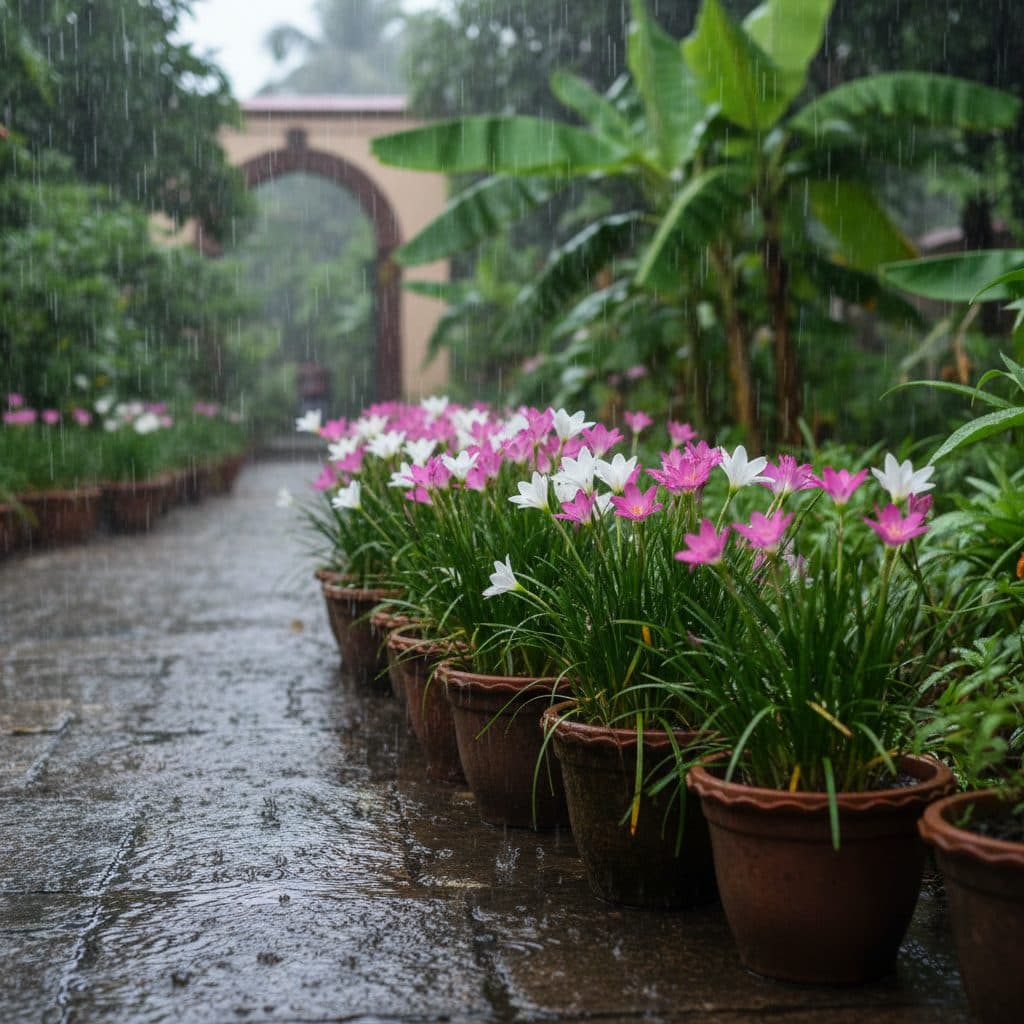
- Plant specialized rainy-season bloomers including Rain Lilies (Zephyranthes), Gulmehndi (Balsam), Madhumalti (Rangoon Creeper), Chandni (Crepe Jasmine), and Genda (Marigold).
- Plant rain lily bulbs in May before pre-monsoon showers so root systems establish ahead of July downpours.
- Ensure every container has open, unobstructed drainage holes and rests on pot stands to prevent waterlogging and anaerobic root suffocation.
- Incorporate Trichoderma viride biofungicide and neem cake into potting soils to prevent soil-borne damping off and collar rot during high humidity.
- Prune faded blossoms and deadhead spent flower clusters immediately after rainstorms to stop fungal botrytis mold from colonizing wet foliage.
Quick answer: The best monsoon flowering plants in India are species triggered into bloom by atmospheric humidity and fresh rainwater, notably Rain Lilies (Zephyranthes), Balsam (Gulmehndi), Crepe Jasmine (Chandni), Rangoon Creeper (Madhumalti), and Marigolds. Successful monsoon cultivation requires free-draining sandy loam soil enriched with neem cake, elevating containers on pot stands to prevent waterlogging, and maintaining airflow to deter fungal rot.
The arrival of the southwest monsoon (kharif season) brings welcome relief from scorching summer heat across the Indian subcontinent. After months of dry heat, the sudden deluge of nitrogen-rich rainwater sparks explosive vegetative growth and vibrant floral blooms.
However, the rainy season also introduces severe horticultural challenges. Relentless cloud cover reduces photosynthesis, high ambient humidity fosters fungal spores, and heavy downpours can drown root systems in waterlogged pots.
By selecting flowers that naturally thrive in torrential rain and establishing proper container drainage, you can create a spectacular, disease-resistant monsoon flower garden.
Top monsoon flowering plants for Indian gardens
Certain flowering perennials and seasonal annuals evolved specifically to synchronize their reproductive blooming with rainy seasons.
+------------------------+-------------------------------+-------------------+-----------------------------------------+
| Plant Name (Hindi)     | Botanical Name                | Flowering Period  | Key Floral Traits & Safety Notes        |
+------------------------+-------------------------------+-------------------+-----------------------------------------+
| Rain Lily (Zephyranthes)| *Zephyranthes* spp.          | July to September | Pink/white/yellow; toxic bulb to pets   |
| Gulmehndi (Balsam)     | *Impatiens balsamina*         | June to September | Vibrant rose-like blooms; safe          |
| Madhumalti (Rangoon)   | *Combretum indicum*           | June to October   | Fragrant night vine; seeds toxic in qty |
| Chandni (Crape Jasmine)| *Tabernaemontana divaricata*  | Year-round (peaks)| Pure white waxy stars; toxic latex sap  |
| Genda (Marigold)       | *Tagetes erecta*              | July to November  | Golden orange ruffled heads; safe       |
| Zinnia                 | *Zinnia elegans*              | July to October   | Bright multi-coloured petals; safe      |
| Champa (Plumeria)      | *Plumeria* spp.               | Monsoon peak      | Highly fragrant; toxic milky sap        |
| Kaner (Oleander)*      | *Nerium oleander*             | June to October   | EXTREMELY TOXIC cardiac glycosides      |
+------------------------+-------------------------------+-------------------+-----------------------------------------+
* Safety Warning: Kaner (Nerium oleander), Chandni (Tabernaemontana), and Champa (Plumeria) contain toxic alkaloids or cardiac glycosides in their milky sap and tissues. Keep these plants away from unsupervised pets and small children.
+-------------------------------------------------------------------+
|               MONSOON FLORAL CALENDAR (KHARIF SEASON)             |
+-------------------------------------------------------------------+
| [May - Jun]  Plant rain lily bulbs & sow balsam/marigold seeds    |
| [Jul - Aug]  Peak monsoon deluge; explosive floral bud flush      |
| [Aug - Sep]  Deadhead spent blooms; apply organic biofungicides   |
| [Oct - Nov]  Transition to winter rabi annuals (petunias, pansies)|
+-------------------------------------------------------------------+
Rain Lilies (Zephyranthes)
Rain lilies are the undisputed champions of the Indian monsoon. Dormant during dry summer months, their underground bulbs respond within 48 to 72 hours of the first heavy rain, sending up slender stalks topped with pink, white, or yellow star blossoms. Plant bulbs 5 cm deep in shallow wide troughs in May. (Note: Bulbs contain alkaloids toxic to dogs and cats if chewed.)
Gulmehndi (Garden Balsam)
Impatiens balsamina is an ancient cottage-garden annual across India. Its succulent, water-filled stems love high humidity and saturated air. Sown from seed in June, balsam produces dense spikes of frilled, camellia-like flowers in crimson, purple, and pastel pink throughout the rains.
Madhumalti (Rangoon Creeper)
Combretum indicum (syn. Quisqualis indica) produces hanging clusters of star-shaped flowers with an intoxicating night fragrance. The blossoms open white, turn pink by afternoon, and mature into deep crimson by the second day. It is ideal for covering balcony grilles and terrace pergolas during the monsoon.
Soil drainage and container elevation architecture
The single greatest killer of potted plants during the Indian rainy season is root rot caused by standing, stagnant water.
+-------------------------------------------------------------------+
|                 MONSOON CONTAINER DRAINAGE BLUEPRINT              |
|                                                                   |
|   [================= Porous Potting Substrate ===============]   |
|   [ 35% Cocopeat + 30% Compost + 20% Sand + 10% Charcoal + 5% Red ]|
|   [---------------- Synthetic Mesh Over Drain Holes -------------]|
|   +-------------------------------------------------------------+ |
|   |          [O]                   [O]                   [O]    | |
|   +====================== 3 cm Pot Feet Stand ==================+ |
|   ===================== Tiled Terrace Floor ===================== |
+-------------------------------------------------------------------+
+------------------------+-------------------+-----------------------------------------+
| Pot Setup Component | Minimum Standard | Monsoon Functional Benefit |
+------------------------+-------------------+-----------------------------------------+
| Base Drainage Holes | 4 to 6 holes | Prevents water pooling in root zone |
| Synthetic Drain Mesh | Mesh over holes | Keeps exit holes clear without clogging |
| Substrate Porosity | 20% sand/perlite | Rapid gravity percolation |
| Elevation Stand | 3 cm pot feet | Allows unhindered water flow beneath pot|
+------------------------+-------------------+-----------------------------------------+Never place containers directly flush onto flat concrete or tiled floors during the monsoon. Stagnant rainwater pools under the base, creating an airtight seal that blocks drainage holes and turns the bottom soil anaerobic. Always elevate pots on 3 cm pot feet or bricks.
Coordinate container positioning with our urban guide on flowering plants for balcony india and rooftop layouts in rooftop patio container gardening.
Formulating a water-resilient potting substrate
Monsoon potting soil must be extremely porous to allow heavy rainwater to drain through within seconds while retaining sufficient organic nutrition.
+-------------------------------------------------------------------+
|               MONSOON POROUS SUBSTRATE FORMULATION                |
+-------------------------------------------------------------------+
| - 35% Washed Coarse Cocopeat: Lightweight aeration matrix         |
| - 30% Well-Aged Vermicompost: Organic microbial nutrition         |
| - 20% Coarse Washed River Sand / Perlite: Instant gravity drainage|
| - 10% Crushed Horticultural Charcoal: Absorbs excess acidity      |
| - 5% Native Red Soil: Mineral structure and trace clays           |
| - Bio-Additives: 2 tbsp Neem cake + 5g *Trichoderma viride* / pot |
+-------------------------------------------------------------------+
Charcoal chips improve soil oxygenation during prolonged cloudy spells, while neem cake suppresses soil pests, and Trichoderma viride protects against water-molds (Phytophthora and Pythium).
Protect root systems against fungal blight by reviewing biological inoculation techniques in biofungicides soil roots disease suppression.
Monsoon plant propagation and stem cuttings
The high ambient atmospheric humidity of July and August makes the monsoon the most productive season for propagating perennial flowering shrubs from stem cuttings.
+------------------------+-----------------------------------+-------------------------+
| Plant for Cuttings     | Cutting Type & Length             | Rooting Time            |
+------------------------+-----------------------------------+-------------------------+
| Hibiscus (Gudhal)      | Semi-hardwood pencil-thick (15 cm)| 14 to 20 Days           |
| Bougainvillea          | Hardwood mature stem (20 cm)      | 25 to 35 Days           |
| Portulaca / Moss Rose  | Soft green tip cutting (8 cm)     | 5 to 7 Days             |
| Coleus                 | Soft vegetative tip (10 cm)       | 4 to 6 Days             |
| Chandni (Crape Jasmine)| Semi-hardwood stem (15 cm)        | 18 to 25 Days           |
+------------------------+-----------------------------------+-------------------------+
Take 15 cm stem cuttings with clean pruning shears, dip the cut base in pure organic aloe vera gel or honey, and insert into a 50/50 mix of river sand and cocopeat. Kept under sheltered eaves, cuttings develop dense white root clusters rapidly in monsoon humidity without wilting.
Preventing fungal disease, damping off and mold
Warm temperatures combined with 90%+ relative humidity create ideal conditions for fungal pathogens.
+------------------------+-------------------+-----------------------------------------+
| Monsoon Disease        | Visual Symptoms   | Cultural & Organic Control              |
+------------------------+-------------------+-----------------------------------------+
| Damping Off            | Seedling collapse | Drench with *Trichoderma*; sand topping |
| Leaf Spot (Cercospora) | Dark brown rings  | Space pots for airflow; remove leaves   |
| Powdery / Downy Mildew | White/grey powder | Spray baking soda solution (5g/L water) |
| Collar / Crown Rot     | Black soft stem   | Keep soil level 2 cm below stem crown   |
| Bud Blast (Botrytis)   | Rotted flower buds| Deadhead faded flowers immediately      |
+------------------------+-------------------+-----------------------------------------+
The cinnamon and turmeric fungicidal drench
For mild fungal infections on seedling trays, dust raw cinnamon powder across the soil surface or dissolve 5 grams of pure turmeric powder in 1 litre of warm water to drench the root zone. Both possess natural antifungal properties that suppress spore germination.
Pruning, deadheading and monsoon fertilization
Heavy rains physically batter delicate flower petals, leaving behind wet, decaying mush that quickly rots healthy adjoining stems.
+-------------------------------------------------------------------+
|               MONSOON FLOWER BED MAINTENANCE CHECKLIST            |
+-------------------------------------------------------------------+
| 1. Morning Deadheading: Snip off rain-damaged flower heads daily  |
| 2. Thinning Leaves:     Prune lower leaves within 10 cm of soil   |
| 3. NO Hard Pruning:     Avoid heavy cutting during continuous rain|
| 4. Organic Feeding:     Apply dry vermicompost rather than liquids|
| 5. Snail Hand-Picking:  Inspect pots at night for giant snails    |
+-------------------------------------------------------------------+
Avoid hard pruning or heavy cutting back of woody shrubs (such as Hibiscus, Bougainvillea, or Gardenia) during continuous heavy rains, as open cut wounds easily invite fungal and bacterial dieback in relentless damp. Restrict maintenance to deadheading spent flowers, light tip pinching, and clearing yellowing lower leaves to maintain bottom air circulation.
During continuous downpours, liquid fertilizers wash straight through the drainage holes. Instead, scratch dry organic amendments (bone meal, neem cake powder, and vermicompost) into the top 2 cm of soil where rainwater slowly dissolves nutrients into the root zone.
Buffer intense monsoon storms and summer heat transitions using overhead protection from shade net for terrace garden and pair with container orchard trees in fruit plants for terrace garden.