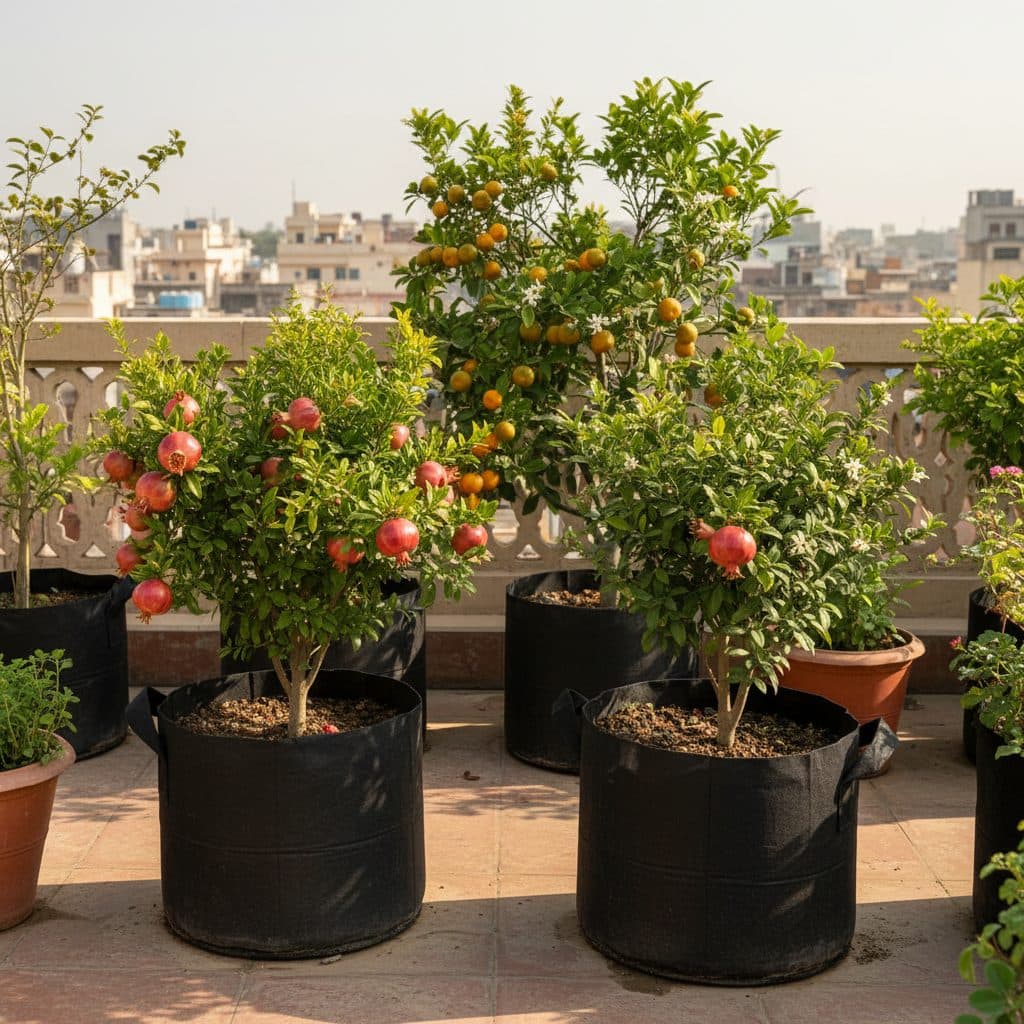
Key takeaways
- Choose grafted or air-layered cultivars such as Amrapali mango, Kagzi lime, compact guava (Arka Kiran, Lalit), and Bhagwa pomegranate for reliable container fruiting.
- Have a structural engineer verify roof slab load capacity before placing large containers (50 to 100+ litres), which exert 480 to 560 kg/m² when fully saturated.
- Mix a lightweight potting substrate using 40 percent cocopeat, 30 percent well-rotted vermicompost, and 30 percent garden soil with perlite or coarse sand.
- Elevate all fruit containers on pot stands over an intact waterproofing membrane to prevent pooling and heat conduction.
- Prune trees post-harvest (June–August for mango; October for guava) to maintain an open canopy under 2 metres.
Quick answer: Growing fruit plants for terrace garden setups in India succeeds by selecting compact, grafted varieties adapted to container root confinement, such as Kagzi lemon, Bhagwa pomegranate, compact guava (Arka Kiran, Lalit, or hard-pruned Lucknow 49), and Amrapali mango. Saturated 100-litre containers weigh 120 to 140 kg (concentrating ~480–560 kg/m²), so consult a structural engineer and elevate pots on stands over a sound waterproofing membrane. Consistent irrigation, organic feeding, and seasonal pruning keep trees productive.
Cultivating fruit trees on rooftop spaces allows urban growers across Indian cities to harvest fresh, chemical-free produce from limited domestic footprints. Rooftops receive unfiltered full sunlight, which is essential for sugar development and abundant flower blossom in subtropical and tropical fruit species.
However, containerised fruit plants on an exposed concrete terrace face unique environmental pressures. High surface temperatures during summer (zaid), intense monsoon downpours (kharif), and wind shear require deliberate plant selection, appropriate soil structure, and structural load awareness.
By matching compact rootstock cultivars to appropriately sized grow bags and establishing a structured feeding schedule, you can create a resilient, high-yielding rooftop orchard.
Top fruit varieties for Indian rooftop gardens
Selecting grafted or air-layered saplings is essential for terrace orchards. Seed-grown woody fruit trees (such as mango, sapota, and citrus) take seven to ten years to fruit and develop massive taproots unsuited to container confines (papaya is an exception, fruiting from seed within 8 to 10 months). Grafted or air-layered saplings come true to type and begin fruiting far sooner — one to two years for guava and citrus, three to four for mango and sapota. Compactness comes from root restriction and annual pruning, not from the graft itself.
+--------------------+---------------------------------------+-------------------+-------------------------+
| Fruit Crop         | Recommended Cultivar                  | Min. Pot Size     | Fruiting Season         |
+--------------------+---------------------------------------+-------------------+-------------------------+
| Lemon / Lime       | Kagzi Lime, Baramasi                  | 40 to 50 Litres   | Year-round / Multiple   |
| Pomegranate (Anar) | Bhagwa, Ganesh                        | 50 to 75 Litres   | July to September       |
| Guava (Amrood)     | Arka Kiran, Lalit, Lucknow 49*        | 60 to 80 Litres   | Winter & Rainy Season   |
| Mango (Aam)        | Amrapali, Mallika                     | 80 to 120 Litres  | Summer (May to July)    |
| Sapota (Chiku)**   | Cricket Ball, Kalipatti               | 75 to 100 Litres  | Winter to Spring        |
| Papaya (Papita)    | Red Lady 786 (Dwarf F1 seed-grown)    | 50 to 75 Litres   | 8-10 Months from Sowing |
+--------------------+---------------------------------------+-------------------+-------------------------+
* Lucknow-49 is a vigorous standard cultivar requiring hard annual pruning; nursery trade names like "Thai 7" / VNR Bihi also respond well to container pruning.
** Cricket Ball and Kalipatti sapota are full-sized trees on Manilkara seedling rootstocks; they are slow-growing enough to maintain in large containers for several years but will eventually outgrow them.
Citrus: Kagzi lime and Baramasi lemon
Citrus trees thrive in Indian terrace gardens because of their manageable root systems and high tolerance for warm temperatures. Kagzi lime and Baramasi lemon bloom multiple times a year, providing an ongoing kitchen harvest. They require full sun (minimum 6 hours daily) and free-draining soil to prevent root rot during the monsoon.
Pomegranate (Bhagwa and Ganesh)
Pomegranates are naturally shrubby and drought-tolerant, making them one of the most resilient fruit plants for rooftop conditions. The Bhagwa variety produces glossy red rinds with sweet, soft arils. Pomegranates thrive in hot climates and benefit from dry conditions during fruit maturation.
Guava in containers: cultivars and management
Lucknow-49 (Sardar) is a vigorous, standard commercial guava variety that can only be kept compact in containers through hard annual pruning; genuine compact choices include Arka Kiran, Lalit, or nursery-grafted semi-dwarf selections. Guava plants in containers often set their first fruit in the first year, with worthwhile crops from the second or third year. Regular tip pruning encourages lateral fruiting spurs while keeping the canopy accessible.
Grafted Mango (Amrapali)
Amrapali is a naturally dwarf, precocious hybrid mango developed specifically for high-density planting. When grown in an 80 to 100-litre container, it produces aromatic, deep orange-fleshed fruit while remaining under 2 metres in height.
+-------------------------------------------------------------------+
|               CONTAINER SIZING BY TREE DEVELOPMENT STAGE          |
+-------------------------------------------------------------------+
| Stage 1 (Year 1):      30 to 40 Litre Pot (root establishment)    |
| Stage 2 (Years 2-3):   60 to 75 Litre Pot (canopy expansion)      |
| Stage 3 (Mature):      100+ Litre Pot / Drum (long-term fruiting) |
+-------------------------------------------------------------------+
Container selection and structural load considerations
Rooftop structural safety and container longevity must guide your choice of growing vessels.
+------------------------+-------------------+-------------------+-------------------------+
| Container Type         | Weight Factor     | Durability        | Thermal Insulation      |
+------------------------+-------------------+-------------------+-------------------------+
| HDPE UV Grow Bags      | Ultra-lightweight | 4 to 6 Years      | Moderate (breathable)   |
| Terracotta / Clay Pots | Heavy             | Fragile           | Excellent (cool roots)  |
| HDPE Plastic Drums     | Moderate          | 8 to 10 Years     | Prone to heat buildup   |
| Fabric Geotextile Bags | Very light        | 3 to 5 Years      | Excellent air-pruning   |
+------------------------+-------------------+-------------------+-------------------------+
Weight distribution and structural load considerations
A mature fruit tree in a 100-litre container filled with damp soil and tree biomass weighs roughly 120 to 140 kg when saturated after monsoon rains. Concentrated on a 0.25 m² pot footprint, this exerts approximately 480 to 560 kg/m²—well above the standard 150 to 200 kg/m² design live load of many residential slabs.
To maintain building safety:
- Have a qualified structural engineer inspect and confirm your roof slab's live-load capacity before placing containers over 50 litres, especially on an older slab or a building you did not construct yourself.
- Never place heavy containers on cantilevered slab edges (such as chajjas, balcony projections, or parapet overhangs) or across unsupported spans without structural advice; site containers directly over load-bearing structural columns and beams.
- Distribute container weight across the slab and use lightweight potting substrates to minimize bulk density.
- Protect your waterproofing: standing water beneath pots will penetrate defects in the roof membrane. Elevate all containers on sturdy pot stands or drain tiles over an intact, freely draining surface.
For foundational container planning and layouts, refer to our guide on rooftop patio container gardening and planting guidelines in plant fruit tree correctly.
Formulating a lightweight potting substrate
Standard garden topsoil compacts into dense, impermeable mud inside large containers and adds excessive weight to the terrace slab. A porous, biologically active blend ensures strong root aeration and rapid monsoon drainage.
+-------------------------------------------------------------------+
|                 IDEAL SUBSTRATE FORMULATION FOR ROOFTOPS          |
+-------------------------------------------------------------------+
| - 40% Washed Cocopeat: Retains moisture while remaining light     |
| - 30% Aged Vermicompost or Cow Manure: Steady organic nutrients   |
| - 15% Coarse River Sand or Perlite: Prevents structural compaction|
| - 15% Native Garden Soil: Supplies beneficial minerals and clays  |
| - Mineral Additions: 200g Neem cake powder + 100g Bone meal / pot |
+-------------------------------------------------------------------+
Neem cake powder (Azadirachta indica press cake) suppresses soil-borne nematodes and fungal pathogens while slowly releasing organic nitrogen.
+-------------------------------------------------------------------+
|                   CONTAINER DRAINAGE LAYER ASSEMBLY               |
|                                                                   |
|   [================= Potting Substrate =================]         |
|   [---------------- Geotextile Filter Fabric -----------]         |
|   +-----------------------------------------------------+         |
|   | [Drainage Holes]   [Drainage Holes]   [Drainage Holes]        |
|   +====================== Pot Stand ====================+         |
|   ------------------ Drained Membrane -------------------         |
+-------------------------------------------------------------------+
Cover bottom drainage holes with mesh or geotextile fabric to prevent soil loss without adding dead weight. Do not add gravel or crock layers, which raise the perched water table and increase slab load. Always elevate pots on stands to protect the waterproofing membrane and allow unhindered drainage.
Irrigation and summer sun management
Containerised trees dry out rapidly on open terraces where wind velocity and ambient heat accelerate transpiration.
+----------------+--------------------------+---------------------------------------+
| Season         | Watering Frequency       | Protection Measure                    |
+----------------+--------------------------+---------------------------------------+
| Summer (Zaid)  | Twice daily (early/late) | 50% shade net or white canopy cloth   |
| Monsoon (Kharif)| As needed (check topsoil)| Clear drainage outlets; tilt pots     |
| Winter (Rabi)  | Once every 2 to 3 days   | Full open sunlight; root-zone mulch   |
+----------------+--------------------------+---------------------------------------+
Apply a 5 cm layer of organic mulch (dry leaves, sugarcane bagasse, or wood chips) over the soil surface in each grow bag. Mulching lowers root zone temperatures by several degrees during peak summer heatwaves.
When intense heat causes blossom drop, provide filtered overhead light using methods from shade net for terrace garden. For automated, continuous watering that prevents moisture swings, implement diy self watering drip containers.
Seasonal pruning and nutrient management
Regular pruning keeps rooftop trees compact and stimulates productive new lateral growth.
+-------------------------------------------------------------------+
|                 ANNUAL FRUIT TREE CARE TIMELINE                   |
+-------------------------------------------------------------------+
| Post-Harvest (Jun-Aug): Structural pruning for mango              |
| Post-Monsoon (Oct):     Pruning for guava to shift crop season    |
| Winter (Dec-Jan):       Top-dress with 5 kg vermicompost + bone meal|
| Flowering (Feb-Mar):    Reduce nitrogen; maintain steady moisture |
| Fruit Set (Apr-Jun):    Thin excess fruitlets; apply foliar seaweed|
+-------------------------------------------------------------------+
Avoid heavy nitrogen fertilisers once flower buds appear, as excessive nitrogen causes flower drop and stimulates vigorous vegetative leaves at the expense of fruit development.
Pair your rooftop orchard with vegetable containers using our balcony container vegetable garden guide for a productive, multi-layered urban kitchen garden.