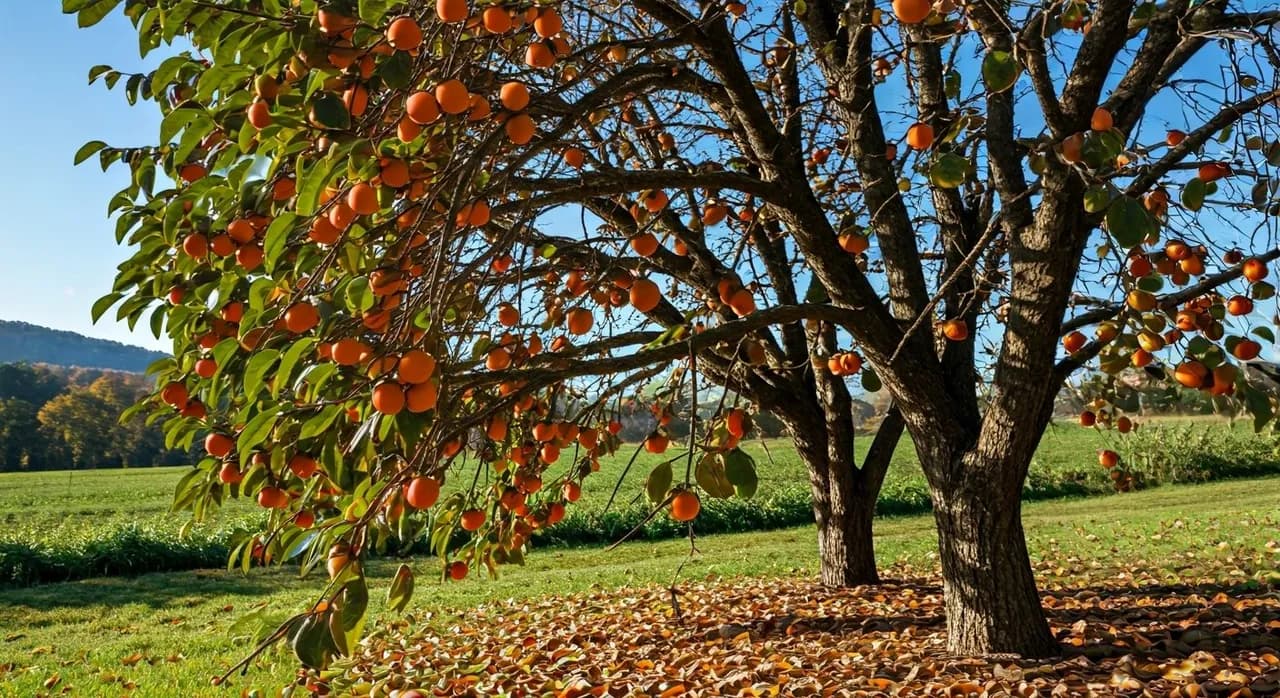
Key takeaways
- Wait for fruit to soften considerably, often after a hard frost, in regions like USDA zone 6.
- Color change from green to deep orange or reddish-orange is a key indicator, but not the only one.
- Astringency is caused by tannins, which break down as the fruit ripens, especially in varieties like ‘Meader’.
- Harvesting too early results in an unpalatable, mouth-puckering experience due to high tannin levels.
- Native to 28 states, American persimmons are a useful wild food source from Florida to Iowa.
Quick answer: American persimmons are typically ripe when they are very soft, have changed from green to a deep orange or reddish-orange color, and often after a hard frost, which helps break down astringent tannins.
Across the eastern and central United States, from the coastal plains of Florida up to the Great Lakes region and west into Kansas, the American persimmon (Diospyros virginiana) is a resilient native fruit tree. This hardy species thrives in USDA zones 4 through 9, often reaching heights of 30 to 60 feet. For centuries, its sweet, custardy fruit has been a cherished wild edible, providing sustenance for wildlife and people alike. However, tasting an unripe American persimmon, a sharply mouth-puckering event, is well known.
Understanding when an American persimmon is truly ripe helps you enjoy its rich flavor. Observing visual, tactile, and environmental cues signals peak ripeness, helping foragers and growers avoid astringency across the tree's native range of 28 states.
The native American persimmon: a resilient fruit
The American persimmon, Diospyros virginiana, is a deciduous tree native to a vast area of the United States, extending from southern Florida north to Connecticut, and west to Iowa and eastern Kansas. This species is remarkably adaptable, thriving in a wide range of conditions across USDA zones 4 to 9. Mature trees can reach impressive heights, often growing 30 to 60 feet tall, with some specimens exceeding 80 feet in ideal conditions. Historically, Native American tribes utilized the fruit, wood, and bark of the persimmon tree, and early European settlers quickly adopted it as a useful food source, especially in the southern states where it is most abundant.
Understanding its natural habitat
These trees prefer full sun exposure for at least 6 hours daily and well-drained soils, though they can tolerate a variety of soil types, including sandy and clay loams. In states like Missouri and Kentucky, persimmon trees are a common sight along fence rows, forest edges, and old fields, often forming dense thickets from root suckers. A single mature tree can produce a significant amount of fruit in a good year, providing a significant harvest for foraging or cultivation. The tree’s deep taproot makes it drought-tolerant once established while aiding its resilience in diverse climates.
- Hardiness: Thrives in USDA zones 4-9.
- Height: Typically 30-60 feet tall.
- Sunlight: Prefers 6+ hours of full sun daily.
- Soil: Adaptable, but prefers well-drained.
- Yield: 50-100 pounds of fruit per mature tree.
The science of astringency: why unripe fruit puckers
The infamous mouth-puckering sensation of an unripe American persimmon is due to high concentrations of tannins, specifically soluble proanthocyanidins. These compounds bind with proteins in your saliva and on your tongue, causing a dry, rough, and astringent feeling. Unripe American persimmons can contain high concentrations of tannins by dry weight, a significant amount that makes the fruit nearly inedible. As the fruit ripens, these soluble tannins become insoluble, either by polymerizing into larger, non-astringent compounds or by being sequestered within specialized cells, effectively removing their ability to bind with proteins. This transformation is a natural part of the fruit’s maturation process.
Tannins and fruit development
The breakdown of tannins is a complex biochemical process influenced by various factors, including temperature, ethylene production, and enzymatic activity. In regions like the Mid-Atlantic, this process often accelerates after the first hard frost, leading to a noticeable improvement in fruit palatability. This mechanism differentiates it from some Japanese persimmon (Diospyros kaki*) varieties, which may ripen without frost but often require specific post-harvest treatments to remove astringency. For example, the ‘Hachiya’ Japanese persimmon, a common astringent type, often needs to be fully soft or treated with alcohol or carbon dioxide to become edible, a practice dating back to at least 1886. Understanding this chemical change explains the ripe fruit's sweetness, which can reach a high sugar content.
- Soluble tannins: Cause astringency in unripe fruit.
- Protein binding: Leads to the puckering sensation.
- Insoluble transformation: Occurs during ripening.
- Environmental triggers: Cold temperatures can accelerate the process.
- Species differences: American persimmons often rely on natural ripening, unlike some Japanese varieties.
Visual cues: color and texture changes
The most obvious indicators of ripeness in American persimmons are changes in color and texture. Unripe fruit is typically firm and bright green, sometimes with a yellowish tint. As it matures, the skin transitions to a deep orange or reddish-orange, often developing a translucent appearance. This color shift is a good general guide, but it is not foolproof; some persimmon cultivars, like ‘Early Golden’, may show good color before they are truly soft and sweet. Always look for a deep, uniform color across the entire fruit, indicating a more advanced stage of ripening. In areas like the Ohio Valley, this color change typically occurs from late September through November.
Observing external indicators
Texture is perhaps the most reliable visual and tactile cue. A truly ripe American persimmon will be incredibly soft, feeling almost like a water balloon or a bag of jelly. It should yield easily to gentle pressure, often becoming quite wrinkly or even slightly bruised in appearance. If the fruit feels firm, even slightly, it is likely still astringent. Many growers in USDA zone 7 recommend waiting until the fruit is so soft it practically falls off the tree with a light touch. Some varieties, such as ‘Prok’, are known for their larger size, sometimes reaching 2 inches in diameter, and may take longer to soften completely than smaller wild varieties.
- Green to orange/red: Primary color transition.
- Translucent skin: Common sign of advanced ripeness.
- Softness: Must be very soft, yielding to gentle pressure.
- Wrinkled appearance: Often accompanies peak ripeness.
- Easy detachment: Ripe fruit falls or twists off easily.
The frost factor: a traditional ripening trigger
For generations, foragers and growers in the Midwest and Northeast have sworn by the adage that American persimmons are not truly ripe until after the first hard frost. While not strictly necessary for all varieties, a hard frost (typically temperatures falling below 28°F for several hours) significantly aids in the ripening process for many wild and cultivated American persimmons. The cold temperatures help to break down the soluble tannins more rapidly, accelerating the transformation into insoluble forms. This natural process can turn an otherwise astringent fruit into a sweet, delectable treat. In USDA zone 6, for instance, waiting until late October or early November, after a few cold nights, is a common practice.
Post-frost harvesting
The impact of frost is particularly noticeable in areas like southern Illinois or Indiana, where wild persimmons are abundant. Before a frost, many fruits might still exhibit some astringency, even if they appear orange. After a solid cold snap, however, the same fruits often become wonderfully soft and sweet. This doesn’t mean you can’t find ripe fruit before frost; some early-ripening cultivars, like ‘Meader’, are known to ripen reliably in September without needing a frost. However, for most wild trees, patience until after the first significant temperature drop below 32°F is often rewarded with a superior-tasting fruit. This waiting period ensures the fruit reaches its peak sugar content, often reaching very high levels.
- Accelerated tannin breakdown: Cold helps convert soluble to insoluble tannins.
- Improved sweetness: Frost often leads to a richer flavor.
- Improved texture: Fruit becomes softer and less firm.
- Regional practice: Common wisdom in colder persimmon-growing regions.
- Not always required: Some cultivars ripen pre-frost.
Taste test: the ultimate ripeness indicator
Despite all the visual and environmental cues, the ultimate test for American persimmon ripeness is a taste test. There’s no substitute for sampling a small piece of fruit to confirm its sweetness and lack of astringency. When tasting, start with a tiny bite, perhaps just a sliver from the softest part of the fruit. If it’s ripe, you’ll be greeted with a rich, sweet, custardy flavor, often described as a blend of apricot, honey, and spice. The texture will be smooth and jelly-like. If it’s unripe, even a small taste will immediately cause a strong, dry, puckering sensation that can last for several minutes. Do not spit it out; the astringency will pass.
Sampling for sweetness
Foraging for wild edibles, including persimmons, requires careful identification. When testing persimmons, remember that fruit on the same tree, or even on the same branch, can ripen at different rates. One fruit might be perfectly sweet, while another just a few inches away is still astringent. This variability means you should test individual fruits rather than assuming an entire batch is ripe based on one sample. A truly ripe persimmon can have a sugar content upwards of 20%, making it a naturally sweet treat perfect for baking or eating fresh.
- Small bite first: Always start with a tiny piece.
- Sweet, custardy flavor: Indicates ripeness.
- Smooth, jelly-like texture: Characteristic of ripe fruit.
- Astringent sensation: Signifies unripe fruit.
- Individual testing: Ripeness varies even on the same tree.
Harvesting and storage for peak flavor
Once you’ve identified truly ripe American persimmons, harvesting them correctly ensures their quality. Since ripe fruit is very soft, it’s best to handle them gently. Twist the fruit off the stem instead of pulling, or wait for them to fall naturally. Placing a tarp or old sheet under the tree can help catch falling fruit and prevent bruising, especially if you’re collecting a large quantity from a mature tree that might yield 50 to 100 pounds. In regions like USDA zone 8, where frosts are milder or later, you might be harvesting well into December.
Maximizing your harvest
Ripe American persimmons are perishable. They can be stored in the refrigerator for 2 to 3 weeks. For longer preservation, persimmons freeze exceptionally well. You can freeze whole, soft fruits, or process them into pulp first. Simply wash the fruit, remove the calyx, and place them in freezer-safe bags or containers. Frozen persimmon pulp can last for up to 12 months and is excellent for baking into breads, puddings, or making jams. The seeds, which are fairly large, can be saved for propagation; some nurseries, like Sherwood Persimmon and Walnut Nurseries, were selling persimmon trees as early as 1925.
- Gentle handling: Avoid bruising soft fruit.
- Twist or collect fallen fruit: Best harvesting methods.
- Refrigerate: Store for 2-3 weeks.
- Freeze: Whole or as pulp for up to 12 months.
- Seed saving: Collect seeds for future planting.
Beyond the fruit: other uses and propagation
While the fruit is the most celebrated part of the American persimmon, the tree itself offers several other useful uses. The wood of Diospyros virginiana is exceptionally hard, dense, and strong, making it highly prized for specialty applications. Historically, it was used to make golf club heads, specifically the ‘woods,’ and shuttles for textile looms due to its durability and smooth finish. Its density is comparable to ebony, a related species, and it has a fine grain that takes a polish well. In parts of the Southeast, this wood has also been used for tool handles and veneer, providing a tangible economic benefit beyond fruit production.
The persimmon tree’s versatility
Propagating American persimmons can be done from seed, though germination rates can be variable without stratification. Seeds require a period of cold stratification for 60 to 90 days to break dormancy. Grafting is another common method, especially for propagating specific named cultivars like ‘Prok’ or ‘Meader’ so genetic consistency. These trees are also important for wildlife, providing a late-season food source for deer, birds, and other animals across their native range of 28 states. The deep taproot system can extend deep into the soil, making it a useful tree for erosion control on slopes in areas like the Appalachian foothills.
- Hard, dense wood: Used for specialty items like golf clubs.
- Historical significance: Valued in textile manufacturing.
- Seed propagation: Requires cold stratification for 60-90 days.
- Grafting: Ensures cultivar consistency.
- Wildlife food source: Important for late-season sustenance.
American vs. Japanese persimmon characteristics
Feature | American Persimmon (D. virginiana) | Japanese Persimmon (D. kaki) |
|---|---|---|
Native Range | Eastern and Central US (28 states, USDA zones 4-9) | East Asia (introduced to US, USDA zones 7-10) |
Fruit Size | Small, 1-2 inches in diameter | Larger, 2-4 inches in diameter |
Astringency | Always astringent until very soft and ripe | Varieties are either astringent (e.g., Hachiya) or non-astringent (e.g., Fuyu) |
Cold Hardiness | Very hardy, down to -25°F | Less hardy, down to 0°F |
Ripening Trigger | Often benefits from frost, becomes very soft | Astringent types require full softening or treatment; non-astringent types can be eaten firm |
Native Range: The American persimmon is native to 28 US states, spanning from USDA zone 4 to 9, demonstrating its wide adaptability.
Tannin Content: Unripe American persimmons contain high concentrations of tannins, causing intense astringency that can last for several minutes.
References
- American Persimmon (2013).
- Persimmon (2013).
- DIOSPYROS VIRGINIANA, AMERICAN PERSIMMON (2014).
- The Japanese Persimmon (1886).
- Retail price list Sherwood Persimmon and Walnut Nurseries / (1925).
- USDA Natural Resources Conservation Service (2024).