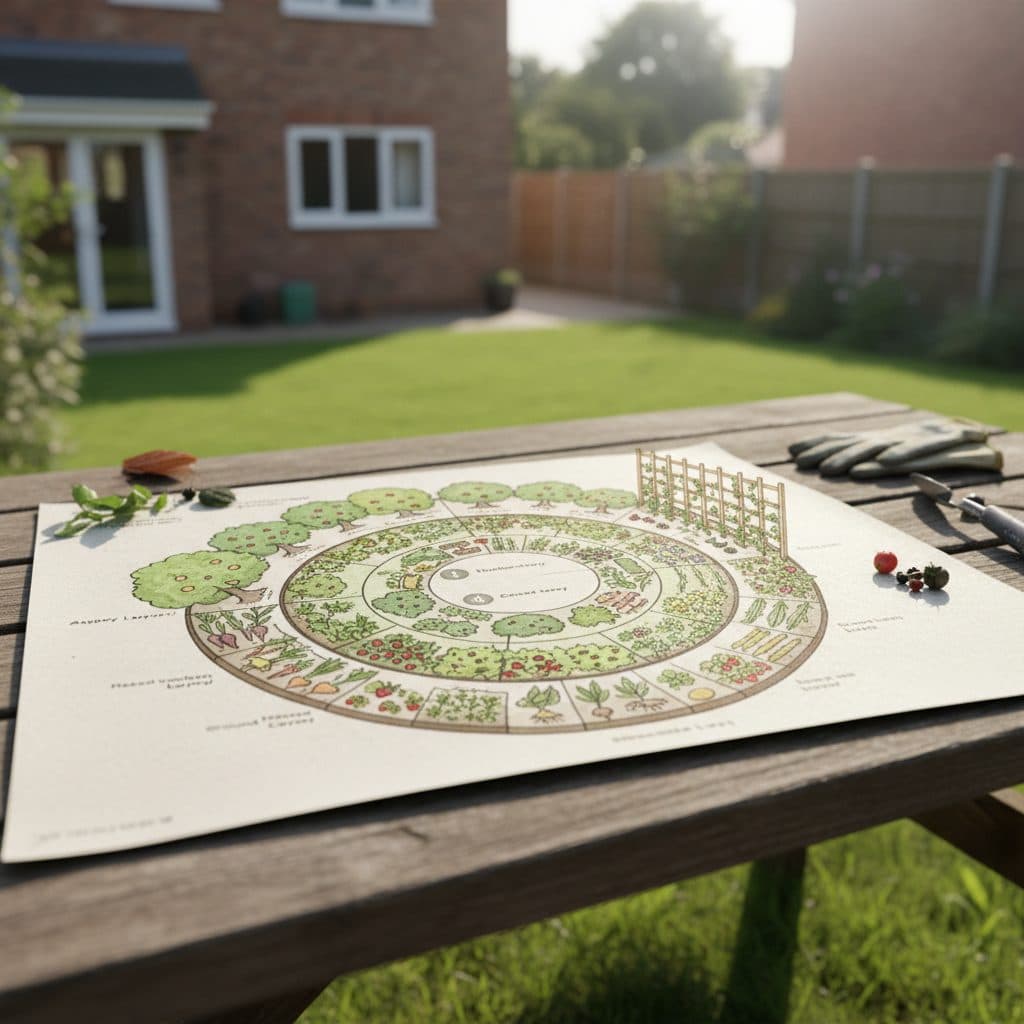
Key takeaways
- Utilize dwarfing (M9, M27) and semi-dwarfing (M26) rootstocks, with MM106 only where there is room for a semi-vigorous tree.
- Arrange plants in synergistic biological guilds that combine fruit production, nitrogen fixation, mineral cycling, and pollinator attraction.
- Design spatial layouts with a graduated profile: tallest trees on the northern boundary sloping down to low ground covers to the south.
- Incorporate shade-tolerant soft fruit (blackcurrants, gooseberries, raspberries) beneath dappled canopy shade.
- Maintain permanent mulched winding pathways to define access zones and prevent soil compaction over shallow feeder roots.
Quick answer: Forest garden design for UK back gardens involves arranging edible and multifunctional perennial plants into a self-sustaining, multi-tiered ecosystem scaled for small spaces. By selecting dwarfing rootstocks, creating multi-species plant guilds, grouping plants with complementary light needs, and layering root systems, gardeners can fit a wide range of edible species into a modest 50-square-metre backyard while minimizing maintenance and weeding.
Many UK gardeners assume that creating a forest garden requires acres of rural smallholding. However, the ecological principles of forest gardening—stacking canopy layers, building fungal soil networks, and utilizing perennial polycultures—can be successfully applied to typical suburban back gardens and allotment plots.
In small gardens, design precision is paramount. Without careful spatial planning and rootstock selection, vigorous standard fruit trees can quickly overshadow the entire garden, starving lower shrubs and perennial vegetables of necessary sunlight.
With the right rootstock, well-planned guilds, and attention to sun angles and harvest timing, you can turn an ordinary lawn into a productive edible garden.
Scaling the seven layers for small back gardens
Adapting natural woodland edge architecture to a suburban plot requires selecting compact, high-yielding perennial cultivars. (Note: Akebia quinata is vigorous, needs hard annual pruning in small gardens, and should be checked against local invasive species lists).
+------------------------+-----------------------------------+-----------------------------------+
| Forest Garden Layer    | Large Rural Acreage Specimen      | Small UK Back Garden Choice       |
+------------------------+-----------------------------------+-----------------------------------+
| 1. Canopy (Overstorey) | Standard Sweet Chestnut / Oak     | Dwarf Apple on M26 Rootstock      |
| 2. Sub-Canopy (Under)  | Standard Medlar / Perry Pear      | Quince on Quince C / Columnar Pear|
| 3. Shrub Layer         | Hazel thicket / Sea Buckthorn     | Blackcurrant, Jostaberry, Gooseberry|
| 4. Herbaceous Layer    | Wild Angelica / Giant Comfrey     | Bocking 14 Comfrey, Sweet Cicely  |
| 5. Ground Cover        | Wild Strawberry carpet            | Alpine Strawberries, Creeping Thyme|
| 6. Underground / Root  | Wild Yam, Horseradish thicket     | Babington Leeks, Chinese Artichoke|
| 7. Climber / Vine      | Full-size Grapevine / Wild Hop    | Cordon Grapevine, Akebia quinata  |
+------------------------+-----------------------------------+-----------------------------------+
+-------------------------------------------------------------------+
| SMALL BACK GARDEN VERTICAL PROFILE |
+-------------------------------------------------------------------+
| [North Boundary Wall / Fence] |
| || [Dwarf Apple on M26 / Pear on Quince C: 2.5 to 3.0 m] |
| || \ |
| || [Currants & Gooseberries: 1.2 to 1.5 m] |
| || \ |
| || [Comfrey & Perennial Greens: 0.5 to 0.8 m] |
| || \ |
| || [Alpine Strawberries & Thyme: 0.1 m] |
| ||======================================================== |
| [South Lawn / Sun Path] |
+-------------------------------------------------------------------+For practical ground preparation and step-by-step planting protocols, reference our companion installation guide on how to create a forest garden.
Designing functional plant guilds
A plant guild is an interconnected group of complementary species planted around a central food-producing tree. Each member performs a specific ecological function that benefits the group.
+-------------------------------------------------------------------+
|               THE CLASSIC UK APPLE GUILD ARCHITECTURE             |
+-------------------------------------------------------------------+
|1. Central Producer:   Apple (e.g. Discovery on M26 rootstock)     |
|2. Nitrogen Fixer:     Siberian Peashrub (Caragana arborescens)    |
|3. Dynamic Accumulator:Russian Comfrey (Bocking 14 cultivar)       |
|4. Pollinator Magnet:  Sweet Cicely (Myrrhis odorata) / Bergamot   |
|5. Pest Repellent:     Chives / Welsh Onions (Allium fistulosum)   |
|6. Living Ground Cover:Alpine Strawberry (Fragaria vesca)          |
+-------------------------------------------------------------------+
+------------------------+-------------------+---------------------------------------------------+
| Guild Member Role | Example Species | Primary Ecological Mechanism |
+------------------------+-------------------+---------------------------------------------------+
| Dynamic Accumulator | Russian Comfrey | Deep taproot mines subsoil potassium & calcium |
| Nitrogen Fixer | Goumi Berry | Fixes N in actinorhizal nodules; returns via litter |
| Pollinator Attractor | Fennel, Borage | Umbels provide nectar for beneficial hoverflies |
| Pest Confusion | Allium species | Strong sulphur aromas mask fruit tree scents |
| Weed-Suppressing Cover | Alpine Strawberry | Dense foliage carpets soil; yields edible berries |
+------------------------+-------------------+---------------------------------------------------+Guild design reduces reliance on synthetic sprays by integrating biological pest control and natural nutrient cycling into the planting layout.
Goumi (Elaeagnus multiflora) is bird-sown from seed; check local guidance before planting — Elaeagnus species are invasive in parts of North America and elsewhere.
Solar geometry and aspect planning in the UK
In Britain (latitudes 50°N to 58°N), winter and shoulder-season sun angles are low. Designing with solar geometry prevents unwanted shade from stunting understorey crops.
The stepped wedge layout
Position your tallest woody elements along the northern boundary (or eastern boundary if trading morning light for shelter from cold easterly winds). Arrange smaller shrubs and herbaceous plants along the southern margins. This stepped profile captures maximum solar radiation while sheltering sensitive understorey crops.
Managing dappled shade
Deciduous fruit trees leaf out in mid-to-late spring. Plant spring-flowering woodland ephemerals—such as wild garlic (ramsons, Allium ursinum), sweet violets, and Solomon's seal—underneath fruit trees. Ramsons spread freely by seed and bulb offsets and can carpet a small bed within a few years. These plants complete their annual growth and harvest cycle before the upper canopy fully casts dense shade in June.
Small-space training: cordons, espaliers and step-overs
Where horizontal ground space is restricted, train fruit trees against boundary fences and walls.
- Espalier Systems: Apples and pears trained into horizontal tiers against brick walls save space while maximizing reflected wall heat for fruit ripening.
- Single-Stem Cordons: Planted at a 45-degree angle spaced only 75 cm apart, cordons allow you to grow ten different fruit cultivars along a standard garden fence.
- Step-Over Edging: Dwarf apple trees pruned horizontally 30 cm above the ground form living, productive borders around vegetable beds and forest garden paths.
- Fan Training: Stone fruits like cherries and plums thrive when fan-trained against warm south-facing brick walls, protecting blossom from early spring frosts.
Ensure planting sites feature healthy soil biology, incorporating methods detailed in permaculture design and permaculture gardening.
Water management, wildlife habitats and access pathways
To protect soil structure and ensure easy harvesting across small backyard layouts:
- Permanent Pathways: Establish clear 60 cm wide bark-chip or clover pathways. Never walk on planted guild beds; keeping foot traffic on designated paths preserves spongy, aerated soil structure.
- Rainwater Redirection: Direct shed and house gutter downpipes into gravel-filled infiltration swales or rain gardens that hydrate tree root zones slowly during dry summer spells.
- Pond Integration: Even a miniature half-barrel wildlife pond attracts frogs, newts, and predatory ground beetles that consume slugs and snails naturally.
- Log Piles and Habitat Piles: Stack small bundles of hardwood prunings in shaded corners to shelter overwintering solitary bees, slow worms, and beneficial predatory insects.
- Soil Infiltration: Loosen heavy ground during setup without disturbing horizons, creating free-draining conditions for delicate understorey roots.
Long-term succession and canopy management
Over five to ten years, your forest garden canopy will expand. Formative winter pruning keeps dwarf fruit trees at their intended dimensions, preventing overcrowding. If a particular perennial vegetable becomes overly shaded as shrubs mature, divide root clumps in autumn and relocate them to sunnier southern margins.
With structured design, a small UK back garden can become a high-yielding, perennial food ecosystem that needs little weeding and offers beauty and biodiversity all year round.