Key takeaways
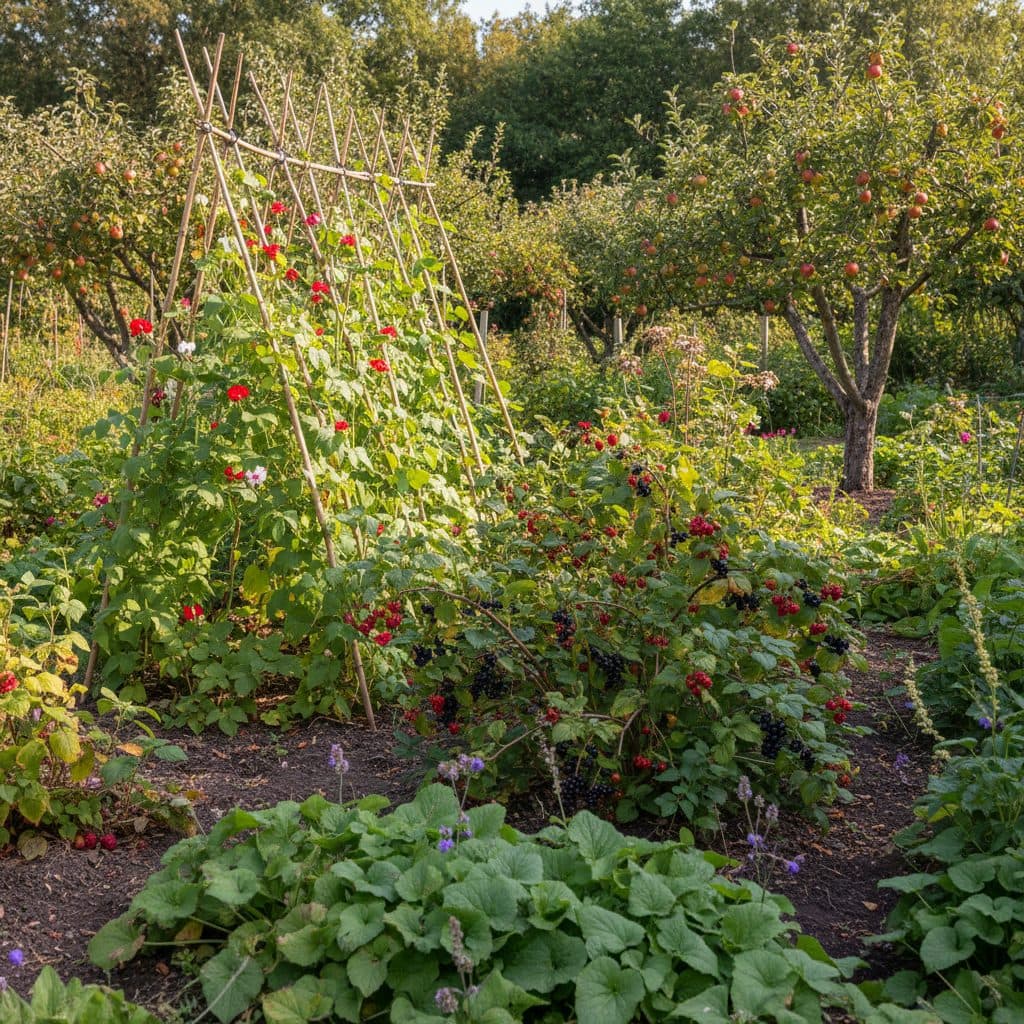
- Forest gardening mimics the multi-tiered structure and ecology of natural temperate woodland edges using predominantly edible and useful perennial plants.
- Clear aggressive perennial grasses using cardboard sheet mulching and heavy woodchip layers before planting long-term woody trees and shrubs.
- Plant nitrogen-fixing pioneer nurse trees (such as Italian alder, or sea buckthorn where root suckering is manageable) to shelter top fruit.
- Establish Bocking 14 Russian comfrey beneath fruit tree canopies for potassium-rich chop-and-drop mulch (note it is permanent once planted).
- Design planting densities and mature crown spreads to ensure adequate light reaches the shrub, herbaceous, and ground-cover layers.
Quick answer: Creating a forest garden in the United Kingdom involves designing and planting a self-sustaining, multi-layered perennial food ecosystem modelled on a natural woodland edge. By stacking seven functional vegetation layers—from canopy fruit and nut trees down to berry shrubs, perennial vegetables, root crops, and ground covers—UK growers create high-yielding gardens that build topsoil, eliminate annual digging, and resist pests naturally without synthetic chemical sprays.
Developed from the 1960s onward by Robert Hart at Wenlock Edge in Shropshire, and popularised by his 1991 book Forest Gardening, temperate forest gardening adapts the ancient multi-tiered agroforestry systems of the tropics to cool, maritime British climates. Unlike conventional vegetable plots that require continuous digging, annual replanting, and heavy chemical inputs, a forest garden relies on long-lived perennial plants that establish deep root networks and natural biological resilience.
Once established, a forest garden functions like a self-mulching, self-fertilising woodland ecosystem. Leaf litter feeds soil fungi, beneficial predatory insects shelter in diverse understorey foliage, and deep taproots cycle minerals from the subsoil into edible leaves, berries, fruits, and nuts.
Whether converting an overgrown allotment corner, an unused paddock, or a suburban back garden, following a systematic design and installation process ensures your forest garden establishes vigorously and remains productive for decades.
Assessing site, aspect and microclimates in the UK
Before purchasing a single tree, analyse your site's physical characteristics, drainage patterns, and solar exposure.
+------------------------+-----------------------------------+-----------------------------------+
| Site Factor            | UK Design Consideration           | Practical Management Action       |
+------------------------+-----------------------------------+-----------------------------------+
| Solar Aspect           | South/South-West receives most sun| Place tallest canopy trees north  |
| Wind Exposure          | Cold northerly and easterly gales | Plant windbreak hedge on perimeter|
| Soil Hydrology         | Heavy clay vs free-draining loam  | Install swales or mound wet zones |
| Frost Drainage         | Cold air pools in valley bottoms  | Avoid early-flowering fruit basins|
+------------------------+-----------------------------------+-----------------------------------+
In the UK, maximising sunlight capture is critical. Orient your planting rows or tree groupings along an east-to-west arc with the tallest canopy trees situated on the northern perimeter. This graduated height profile prevents tall trees from casting heavy shade over smaller berry bushes and herbaceous crops to the south.
Observe how water moves across the ground during winter downpours. If water stands on the surface for days, create shallow drainage swales or construct raised planting mounds to lift fruit tree root collars above saturated subsoils.
The seven layers of a temperate forest garden
A functional forest garden organises plants into distinct vertical layers, optimising three-dimensional space and sunlight capture.
+-------------------------------------------------------------------+
|               SEVEN LAYERS OF A UK FOREST GARDEN                  |
+-------------------------------------------------------------------+
| 1. Canopy Layer:       Apples, Pears, Sweet Chestnuts (UK stock)  |
| 2. Sub-Canopy / Under: Semi-Dwarf Fruit, Medlars, Quinces (groups)|
| 3. Shrub Layer:        Blackcurrants, Gooseberries, Jostaberries  |
| 4. Herbaceous Layer:   Russian Comfrey, Sweet Cicely, Horseradish |
| 5. Ground Cover Layer: Wild Strawberries, Creeping Thyme, Ajuga   |
| 6. Underground / Root: Jerusalem Artichokes, Babington Leeks      |
| 7. Climber / Vine:     Hops, Runner Beans, Kiwi (Dioecious/Issai) |
+-------------------------------------------------------------------+
(Note: Buy sweet chestnut only as UK-grown, traceable stock and check plant-health notices for blight. Match top fruit to compatible pollination groups. Confine vigorous spreaders: horseradish, Jerusalem artichokes, hops, ajuga, and mints regrow from root fragments and need deliberate containment or root barriers. Hardy kiwi requires 1 male per 5-6 females, or a self-fertile cultivar like 'Issai').
For detailed spacing measurements, companion guild groupings, and small-garden layouts, explore our companion architectural guide on forest garden design and broad ecological frameworks in what is a food forest.
Ground clearance and soil preparation
Attempting to plant delicate perennial ground covers directly into thick couch grass, creeping buttercup, or nettles invariably leads to weed competition.
+-------------------------------------------------------------------+
|               NO-DIG SHEET MULCH ESTABLISHMENT                    |
+-------------------------------------------------------------------+
| Step 1: Strim surface vegetation flush with the soil surface.     |
| Step 2: Lay thick unprinted corrugated cardboard (20 cm overlap). |
| Step 3: Apply 5 cm well-rotted compost over planting zones.       |
| Step 4: Cover entire site with 10 cm coarse woodchip mulch.       |
| Step 5: Cut through cardboard to plant trees and shrubs directly. |
+-------------------------------------------------------------------+
Avoid rotavating overgrown ground; mechanical tilling chops perennial weed roots into hundreds of viable fragments, multiplying bindweed and couch grass across the plot. Sheet mulching smothers weed foliage while feeding earthworms and native mycorrhizal fungi.
Leave the cardboard and woodchip mulch in place for two to three months before major planting to ensure underlying grass crowns die back completely.
Step-by-step planting strategy
Staging your plantings over two to three years ensures canopy shelter and soil fertility develop before planting delicate understorey herbs.
+------------------------+-------------------+---------------------------------------------------+
| Planting Phase         | Timing            | Focus Species & Activities                        |
+------------------------+-------------------+---------------------------------------------------+
| Phase 1: Infrastructure| Year 1 (Autumn)   | Windbreak hedges, swales, access paths, cardboard |
| Phase 2: Canopy & Nurse| Year 1 (Winter)   | Fruit trees, Italian alder, hazel, sea buckthorn* |
| Phase 3: Shrub Layer   | Year 2 (Winter)   | Currants, gooseberries, jostaberries (avoid olive)|
| Phase 4: Herbaceous    | Year 2-3 (Spring) | Comfrey, Turkish rocket, perennial onions, mints  |
+------------------------+-------------------+---------------------------------------------------+
1. Planting canopy and nurse trees
Plant bare-root fruit trees during deep winter dormancy (November to March). Ensure proper root alignment and staking as detailed in plant fruit tree correctly.
Interplant nitrogen-fixing nurse trees (such as Italian Alder, Alnus cordata) between young fruit trees. These pioneer species fix atmospheric nitrogen, shelter young fruit trees from wind, and can be coppiced annually to produce nutrient-rich mulch in line with principles from syntropic farming. Sea buckthorn (Hippophae rhamnoides) is a vigorous root-suckerer — keep it out of small plots and well away from coastal dune habitats, and plant one male to every six to eight females if you want berries.
2. Establishing the shrub and herbaceous layers
Once the upper canopy structure is established, plant productive berry bushes. Ribes species (blackcurrants, redcurrants, gooseberries) crop reliably in partial shade, though yields fall as the canopy closes over them.
Plant sterile Bocking 14 Russian comfrey around the drip line of every fruit tree. Comfrey foliage is rich in potassium and makes an excellent chop-and-drop mulch; Bocking 14 is seed-sterile but regrows from any root fragment and is effectively permanent once planted.
3. Integrating perennial vegetables
Introduce hardy perennial greens that produce year after year without annual replanting:
- Good King Henry (Blitum bonus-henricus): Traditional woodland spinach substitute producing nutritious spring shoots.
- Turkish Rocket (Bunias orientalis): Deep-rooted brassica providing edible florets and pungent spring leaves (cut flower stems before seed sets; once its taproot is down it cannot practically be dug out, so site it deliberately).
- Babington Leek (Allium ampeloprasum var. babingtonii): Native perennial leek that multiplies by underground bulbs and aerial bulbils.
Long-term forest garden maintenance
While a forest garden requires far less labour than an annual vegetable plot, routine stewardship maintains light penetration and productivity.
Formative pruning and light management
Conduct late-winter structural pruning on top fruit to maintain an open, spreading vase shape that allows dappled sunlight to penetrate down to the shrub layer. Follow established branch-training techniques from how to prune fruit trees.
Chop-and-drop mulching
In late spring and mid-summer, cut comfrey, sweet cicely, and alder coppice shoots, dropping the green matter directly around the base of berry shrubs. This natural mulch suppresses weed seedlings, conserves summer moisture, and supplies steady organic nutrients without synthetic fertilizers.
A well-planned UK forest garden becomes increasingly productive and self-regulating with each passing season, yielding fruit, nuts, perennial greens, and medicinal herbs for generations.