Key takeaways
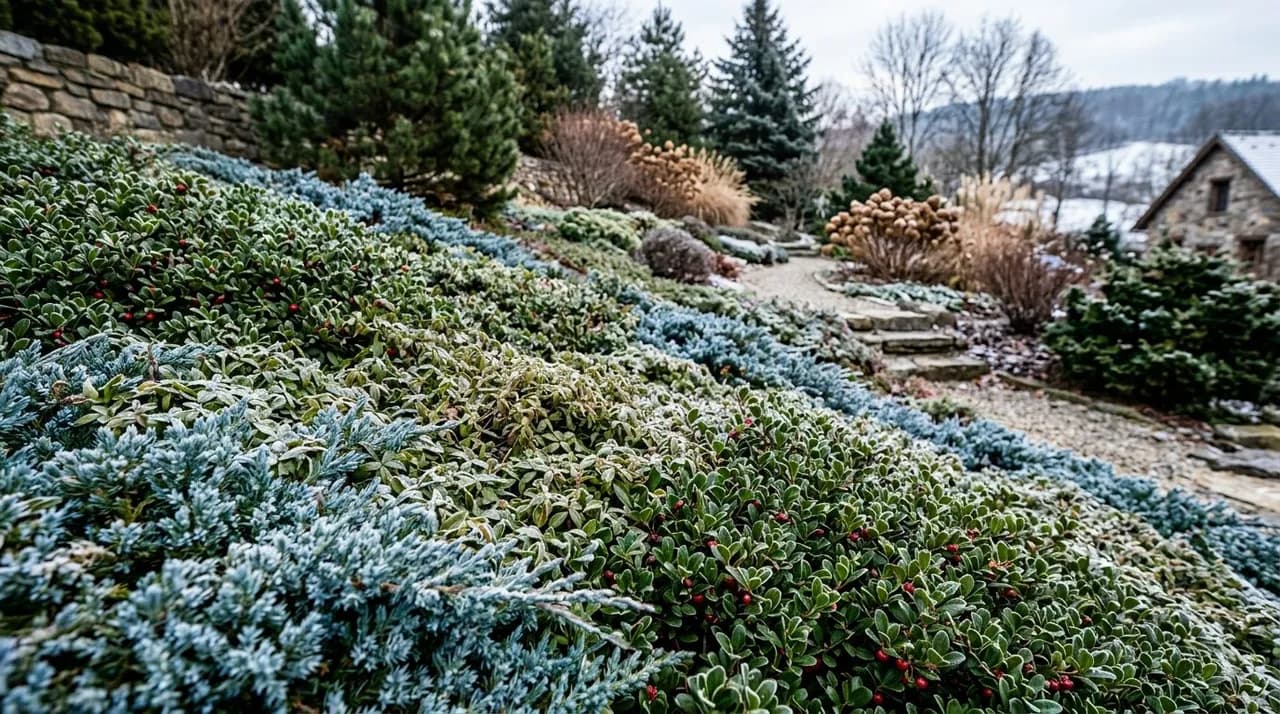
- Evergreen ground covers provide year-round foliage, suppress winter weeds, and prevent topsoil erosion on slopes.
- Creeping juniper and bearberry deliver unmatched cold hardiness down to USDA Zone 2 and 3 in full sun.
- European wild ginger holds glossy evergreen leaves in deep shade all winter; Allegheny pachysandra is semi-evergreen and may drop foliage in the coldest zones.
- Creeping phlox and creeping thyme combine evergreen needle-like mats with dense spring and summer blooms.
- Space small plugs 6 to 8 inches apart on a staggered grid, woody creepers such as juniper 12 to 18 inches, and mulch between plants through the first year.
Quick answer: The best evergreen ground cover plants include creeping juniper, creeping phlox, bearberry, European wild ginger, creeping thyme, and Allegheny pachysandra. These hardy perennials maintain dense green foliage throughout freezing winters, stabilizing slopes and suppressing weeds with minimal maintenance.
Choosing the right evergreen ground cover solves one of the most frustrating aesthetic challenges in home landscaping: the bleak, barren appearance of garden beds once deciduous perennials die back in late autumn. While summer gardens burst with seasonal color, conventional beds often spend four to five months of the year looking like bare dirt or decomposing mulch.
Evergreen ground covers eliminate this seasonal lull. By maintaining lush, living foliage through freezing winter winds, heavy snowfall, and summer droughts, these resilient prostrate plants act as permanent living carpets. Beneath their dense evergreen canopies, soil temperatures remain moderated, winter rain and snowmelt cannot wash away valuable topsoil, and opportunistic cool-season weed seeds are starved of the sunlight needed to germinate.
Whether you need to stabilize a steep, rocky slope in baking sun, cover bare ground beneath towering shade trees, or replace high-maintenance turf along pathways, selecting the proper evergreen species guarantees continuous year-round beauty with minimal seasonal upkeep.
Why plant evergreen ground covers?
Integrating permanent evergreen foliage into your landscape delivers substantial functional benefits:
- Year-Round Visual Structure: Keeps foundation plantings, curbside borders, and slope gardens looking green and structured even in the depths of January.
- Superior Erosion Control: The permanent fibrous and woody root systems of evergreen plants anchor fragile topsoil on slopes and embankments, preventing runoff during torrential winter rains and spring snowmelt.
- Natural Weed Suppression: Unlike deciduous ground covers that lose their leaves and expose bare soil for months, evergreen foliage forms an unbroken light barrier that halts weed seed germination year-round.
- Less Spring Clean-Up: There is no dead top-growth to rake off, though you will still lift fallen leaves and trim any winter-burnt patches.
To compare how these species function alongside broader walkable lawn substitutes, review our guide to lawn alternatives and general ground cover plants.
Top 9 evergreen ground covers by landscape niche
Explore the finest evergreen species categorized by sun exposure, moisture needs, and hardiness:
1. Creeping juniper (Juniperus horizontalis 'Wiltonii', sold as Blue Rug)
The toughest, most drought-tolerant evergreen for sunny slopes and rocky banks.
- Appearance: Forms a flat, trailing carpet only 4 to 6 inches (10 to 15 cm) tall, spreading 6 to 8 feet (1.8 to 2.4 m) wide. The needle-like foliage is brilliant silvery-blue in summer, taking on a subtle purplish tint in winter.
- Hardiness & Tolerance: USDA Zones 3 to 9. Thrives in full, blazing sun, poor sandy soil, urban pollution, and seaside salt spray. Once established, it requires zero supplemental watering.
2. Creeping phlox / moss phlox (Phlox subulata)
A dual-purpose ground cover that combines a needle-like evergreen mat with dense spring color.
- Appearance: Grows 3 to 6 inches (7.5 to 15 cm) tall. In mid-to-late spring, the dense green foliage is completely smothered in masses of fragrant flowers in shades of magenta, lavender, pink, or white.
- Culture: Zones 3 to 9. Requires full sun and well-drained, sandy-to-rocky soil. Outstanding for cascading over retaining walls and lining garden borders.
3. Bearberry / kinnikinnick (Arctostaphylos uva-ursi)
A native North American woody evergreen shrub adapted to extreme cold and lean soils.
- Appearance: Forms a prostrate, woody mat 6 to 12 inches (15 to 30 cm) tall. Features small, glossy, leathery green leaves that turn rich bronze-red in winter, accompanied by pale pink urn-shaped spring blossoms and bright red winter berries.
- Hardiness & Culture: Zones 2 to 8. Thrives in acidic, sandy, gravelly soils in full sun to partial shade. Highly drought-tolerant once established.
4. Creeping thyme (Thymus serpyllum and Thymus praecox)
A compact, aromatic evergreen ground cover that tolerates light foot traffic.
- Appearance: Forms a dense, woody mat only 2 to 3 inches (5 to 7.5 cm) tall, covered in tiny oval leaves and smothered in purple-pink blossoms from June to August.
- Culture: Zones 4 to 9. Requires full sun and lean, sharply draining soil. Releases a pleasant herbal scent when brushed or walked upon.
5. European wild ginger (Asarum europaeum)
A reliable evergreen choice for deep shade.
- Appearance: Features thick, leathery, heart-shaped leaves with a mirror-like glossy shine, growing 4 to 6 inches (10 to 15 cm) tall. The leaves remain pristine and deep forest green throughout freezing winters.
- Culture: Zones 4 to 8. Thrives in partial to full shade in rich, moist, humus-rich woodland soils. For detailed shade species, explore our guide to ground cover for shade.
6. Allegheny pachysandra (Pachysandra procumbens)
A non-invasive native North American alternative to common Japanese spurge.
- Appearance: Forms a mounding, semi-evergreen to evergreen carpet 6 to 10 inches (15 to 25 cm) tall. The matte green leaves feature attractive silver-white mottling and scalloped margins, topped by fragrant white bottle-brush flower spikes in early spring.
- Culture: Zones 5 to 9. Highly resistant to leaf blight diseases and flourishes in dry to moist shade beneath deciduous tree canopies.
7. Creeping wintergreen (Gaultheria procumbens)
A low-growing native evergreen tailored for acidic soils and conifer understories.
- Appearance: Forms a creeping carpet 3 to 6 inches (7.5 to 15 cm) tall. Features glossy, leathery oval leaves that turn purple-red in winter, accompanied by edible scarlet winter berries that smell strongly of wintergreen.
- Culture: Zones 3 to 8. Prefers acidic, organic soils (pH 4.5 to 6.0) in partial to full shade.
8. Dwarf mondo grass (Ophiopogon japonicus 'Nana')
An architectural, grass-like evergreen suited for modern borders and paver joints.
- Appearance: Features dense tufts of deep, dark green, strap-like blades growing only 2 to 4 inches (5 to 10 cm) tall.
- Culture: Zones 6 to 10. Thrives in partial shade to full sun, handling light foot traffic and forming a neat, formal edging along stone walkways.
9. Siberian cypress (Microbiota decussata)
An ultra-hardy coniferous evergreen ground cover that handles both severe cold and partial shade.
- Appearance: Features soft, feathery, arborvitae-like sprays growing 10 to 12 inches (25 to 30 cm) tall and spreading 6 to 8 feet (1.8 to 2.4 m) wide. The bright green summer foliage transforms into a coppery-bronze color during winter.
- Culture: Zones 2 to 7. Exceptionally cold-tolerant, thriving in cold northern climates where other evergreens suffer winterkill.
Evergreen ground cover selection matrix
Plant Species | Ideal Sun Exposure | Soil Moisture | Height | USDA Hardiness |
|---|---|---|---|---|
Creeping Juniper | Full Sun | Dry to Average | 4–6 in (10–15 cm) | Zones 3–9 |
Creeping Phlox | Full Sun | Well-Drained | 3–6 in (7.5–15 cm) | Zones 3–9 |
Bearberry | Full Sun to Part Shade | Dry / Acidic | 6–12 in (15–30 cm) | Zones 2–8 |
Creeping Thyme | Full Sun | Dry to Lean | 2–3 in (5–7.5 cm) | Zones 4–9 |
European Ginger | Part to Full Shade | Moist / Rich | 4–6 in (10–15 cm) | Zones 4–8 |
Allegheny Pachysandra | Part to Full Shade | Dry to Moist | 6–10 in (15–25 cm) | Zones 5–9 |
Wintergreen | Part to Full Shade | Moist / Acidic | 3–6 in (7.5–15 cm) | Zones 3–8 |
Dwarf Mondo Grass | Part Shade to Sun | Average | 2–4 in (5–10 cm) | Zones 6–10 |
Siberian Cypress | Full Sun to Part Shade | Well-Drained | 10–12 in (25–30 cm) | Zones 2–7 |
Planting, spacing, and establishment tips
Proper planting technique ensures fast canopy closure and prevents weed competition during year one:
1. Site preparation and weed clearance
Clear the planting area of all perennial grasses, dandelions, and bindweed. For large beds, use non-chemical smothering techniques detailed in our guide on sheet mulching for weed control.
2. Calculating plant spacing
- Rapid 1-Season Coverage: Space small plugs 6 to 8 inches (15 to 20 cm) apart on a diagonal staggered grid.
- Standard Spacing for Woody Creepers: Space vigorous spreaders (such as creeping juniper and bearberry) 12 to 18 inches (30 to 45 cm) apart.
- Planting Depth: Dig holes slightly wider than the root plug. Set plants at the exact same depth as they were growing in their nursery pots; burying the central crown too deeply causes fungal rot.
3. Mulching and first-year moisture
Spread a 2-inch (5 cm) layer of fine arborist woodchips or shredded bark around the newly planted plugs. Mulch conserves moisture, prevents soil crusting, and suppresses weeds while the ground covers expand. Water deeply once or twice a week during the first growing season until root systems establish.
To explore how living plant covers support wider soil fertility in edible landscapes, review our guide to living mulch cover crops by zone.
Matching evergreen species to your site's sun and soil conditions establishes low-maintenance ground cover that stays green through all four seasons.