Key takeaways
- Start seeds indoors in module trays from March to April, planting out into final positions in late May or June.
- Brussels sprouts require exceptionally firm, consolidated soil; tread the bed down thoroughly with your boots before planting to prevent loose, blown buttons.
- Space plants 60 cm apart in each direction to give large root systems sufficient soil volume and light penetration.
- Stake tall stems or draw up a 10 cm ridge of soil around the base to prevent winter wind rock from tearing fine feeder roots.
- Cover crops immediately with fine insect-proof mesh netting to exclude cabbage white butterflies and cabbage root flies without chemical sprays.
- Harvest buttons from the base of the stem upwards when they feel tight, solid, and walnut-sized (2.5 to 4 cm in diameter).
Quick answer: In the UK, sow Brussels sprout seeds in module trays between March and April, transplanting outdoors in late May or June into fertile, lime-rich soil that has been well firmed by foot. Space plants 60 cm apart, net them against brassica pests, stake them firmly against winter gales, and harvest solid buttons from the base upward from October through February.
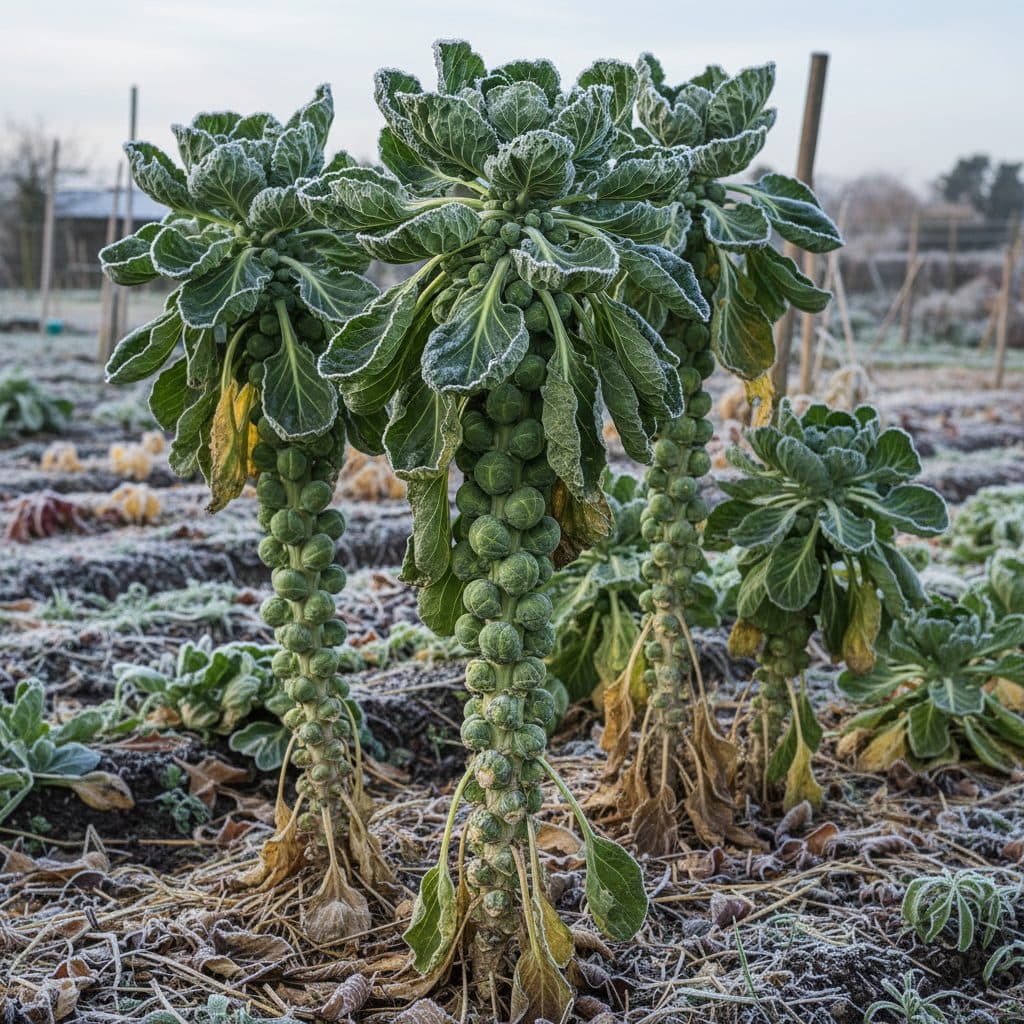
Brussels sprouts (Brassica oleracea var. gemmifera) are the heavyweight crop of the winter allotment. Standing tall through howling winds, sleet, and severe frost, they provide a reliable supply of fresh, nutrient-dense green buttons throughout the coldest months of the year when little else is cropping.
Successfully growing brussels sprouts in the UK demands planning and patience. Because the crop takes roughly 28 to 35 weeks from sowing to the first picking, and then holds the ground until late winter, plants need a rock-solid foundation in firm, nutrient-dense soil to develop tight, compact buttons rather than open, leafy rosettes known as "blown" sprouts.
Whether you aim for an early autumn harvest in October or traditional Christmas Day picking, this guide outlines the cultural practices required to protect plants from wind rock, manage brassica pests organically, and harvest top-quality buttons.
+-------------------------------------------------------------+
|              BRUSSELS SPROUTS SEASONAL TIMELINE             |
|                                                             |
|   MONTH             STAGE                                   |
|   -----             -----                                   |
|   March - April     Sow under cover in module trays         |
|   May - June        Firm soil thoroughly; transplant out    |
|   July - August     Cover with insect mesh; water in dry    |
|   Sept - October    Earth up stems / Stake tall plants      |
|   Oct - February    Harvest tight buttons from base upwards |
+-------------------------------------------------------------+
When and how should you sow Brussels sprout seeds?
Starting Brussels sprouts in module trays or a dedicated outdoor nursery seedbed ensures strong, stocky root systems capable of handling transplanting.
+-------------------------------------------------------------+
|                  SOWING TIMETABLE FOR UK                    |
|                                                             |
|   VARIETY TIMING    SOWING WINDOW     PLANTING OUT WINDOW   |
|   --------------    -------------     -------------------   |
|   Early Season      Early March       Late May              |
|   Maincrop          Late March-April  Early to mid-June     |
|   Late Season       Mid-April         Late June             |
+-------------------------------------------------------------+
Module tray sowing
Sow seeds under cover from March to mid-April. Fill modular seed trays with good peat-free seed compost. Sow two seeds per cell at a depth of 1 cm. Place in an unheated greenhouse, polytunnel, or cool, bright windowsill at 12°C to 16°C.
Once seeds germinate, thin to one strong seedling per cell. As seedlings grow, keep them well ventilated to avoid damping off. Harden off plants outside for 7 to 10 days before planting out in late May or early June when they have developed four to six true leaves and stand roughly 10 to 15 cm tall.
For advice on matching sowing dates to soil warmth, refer to soil temperature for planting.
Why is firm soil necessary for tight, solid buttons?
The single most common mistake allotment holders make when growing Brussels sprouts is planting in loose, freshly tilled, fluffy earth.
+-------------------------------------------------------------+
|                 SOIL FIRMNESS VS BUTTON QUALITY             |
|                                                             |
|   FIRM, CONSOLIDATED SOIL           LOOSE, ROTAVATED EARTH  |
|                                                             |
|   - Deep root anchorage             - Roots rock in wind    |
|   - Steady nutrient uptake          - Uneven water intake   |
|   - Tight, solid, dense buttons     - Open, leafy, blown    |
|   - Plants resist winter gales      - Stems tilt & flop     |
+-------------------------------------------------------------+
Bed preparation and the "treading" technique
- Soil pH: Brassicas thrive in neutral to slightly alkaline soil, pH 6.5 to 7.5, and lime towards the upper end where clubroot is known. In acidic soils, apply ground agricultural lime in the autumn prior to spring planting to deter clubroot (Plasmodiophora brassicae).
- Fertility: Prepare the ground the preceding winter by incorporating well-rotted garden compost or aged manure. Avoid applying fresh, high-nitrogen manure immediately before planting, which encourages soft, leafy top growth at the expense of tight button formation.
- Treading down: A week before planting out, walk over the entire bed with your boots on, shuffling your weight from heel to toe to consolidate the soil particles. The bed should feel solid and dense beneath your feet.
For low-disturbance bed management methods, read our guide on the no-dig allotment.
How do you transplant, space, and stake Brussels sprouts?
Brussels sprouts grow into massive architectural plants reaching 75 to 100 cm in height and spreading broad leaves.
+-------------------------------------------------------------+
|                 PLANT SPACING GRID (METRIC)                 |
|                                                             |
|   <- 60 cm ->                                               |
|   [Sprout] <-------- 60 cm --------> [Sprout]               |
|      |                                  |                   |
|   60 cm                              60 cm                  |
|      |                                  |                   |
|   [Sprout] <-------- 60 cm --------> [Sprout]               |
+-------------------------------------------------------------+
Planting out
- Dig holes spaced 60 cm apart in rows 60 cm apart.
- Plant each module deeply, burying the stem down to the level of the lowest set of true leaves.
- Heel each plant in firmly with your boot soles around the base of the stem.
- Water each plant thoroughly to settle soil particles around the root ball.
Preventing wind rock
As plants reach their full height in late summer, autumn gales exert substantial leverage on the tall leafy stems. Wind rocking loosens the root ball, breaking tender hair roots and resulting in distorted growth and blown buttons.
- Draw up a 10 to 15 cm mound of soil around the base of each stem (earthing up) in September to provide physical support.
- Drive a sturdy wooden stake or bamboo cane next to each plant on exposed or windy allotment sites and secure the main stem with soft garden twine.
Pair your brassica plantings alongside growing parsnips and growing courgettes to balance seasonal kitchen garden production.
Which Brussels sprout varieties perform best in the UK?
Modern F1 hybrid varieties produce uniform buttons that hold well on the stem in severe weather without opening prematurely.
+-------------------------------------------------------------+
|              POPULAR UK BRUSSELS SPROUT VARIETIES           |
|                                                             |
|   VARIETY          HARVEST SEASON   KEY CHARACTERISTICS     |
|   -------          --------------   -------------------     |
|   Brigitte F1      Mid to late      Tight, smooth buttons   |
|   Crispus F1       Late winter      Clubroot disease res.   |
|   Trafalgar F1     Christmas-late   Sweet, tender flavour   |
|   Red Bull         Mid season       Striking purple colour  |
|   Groninger        Heritage/late    Traditional allotment   |
+-------------------------------------------------------------+- 'Brigitte F1': A high-yielding standard producing solid, medium-sized buttons that resist rotting during wet UK winters.
- 'Crispus F1': An essential choice for allotments with known clubroot issues, offering high genetic resistance combined with firm button structure.
- 'Trafalgar F1': Known for its sweet flavour and ability to stand in the ground through January and February without deteriorating.
- 'Red Bull': An ornamental variety producing deep crimson-purple sprouts that retain their colour when lightly steamed and offer a nutty flavour.
To learn more about brassica development milestones, see vegetable growth stages explained.
How do you control brassica pests organically?
UK pesticide approvals for amateur use change frequently, so this guide sticks to cultural, physical and biological controls.
+-------------------------------------------------------------+
|              ORGANIC BRASSICA PEST DEFENCE                  |
|                                                             |
|   PEST              DAMAGE              ORGANIC REMEDY      |
|   ----              ------              --------------      |
|   Cabbage White     Caterpillars chew   Fine insect mesh    |
|   Cabbage Root Fly  Larvae eat roots    Felt cabbage collars|
|   Cabbage Aphid     Grey mealy clusters Jet of water/soaps  |
|   Pigeons           Foliage stripped    Sturdy cage netting |
+-------------------------------------------------------------+
Physical insect barrier netting
Erect a timber or hoop frame over the bed and drape fine insect mesh of about 1.3 mm or finer (standard Enviromesh is 1.35 mm). Coarser 7 mm butterfly netting stops cabbage whites and pigeons but will not exclude cabbage root fly or aphids:
- Ensure the netting is held clear of the leaves so butterflies cannot lay eggs through the holes.
- Secure the base with heavy stones, bricks, or buried soil edges to stop butterflies, moths, and root flies from crawling underneath.
- Netting also keeps wood pigeons off, provided it is held clear of the leaves on hoops, which can strip an entire mature brassica crop to bare skeletons in mid-winter.
Cabbage root fly collars
Fit 10 cm square or round collars made from roofing felt, recycled carpet underlay, or thick cardboard around the base of each transplant stem at ground level. These prevent the adult female root fly from depositing eggs in the soil adjacent to the crown.
How and when should you harvest Brussels sprouts?
Harvesting begins from the lower section of the main stem and proceeds upward over several months.
- Button harvesting: When the lowest buttons reach 2.5 to 4 cm in diameter and feel solid to the pinch, snap them off cleanly with a downward twist, or slice them off with a sharp harvesting knife.
- Upward progression: Pick buttons regularly as they swell. Removing the lower sprouts directs energy to the developing buttons higher up the stalk.
- Sprout tops: The leafy rosette at the very top of the stalk is a delicious culinary green with a flavour resembling spring greens. Harvest sprout tops only towards the end of the plant's life in late winter, as removing the top crown early halts button development lower down.
- Frost enhancement: Cold autumn frosts improve the sweetness of the buttons by triggering the conversion of starches into sugars, softening any bitter astringency.