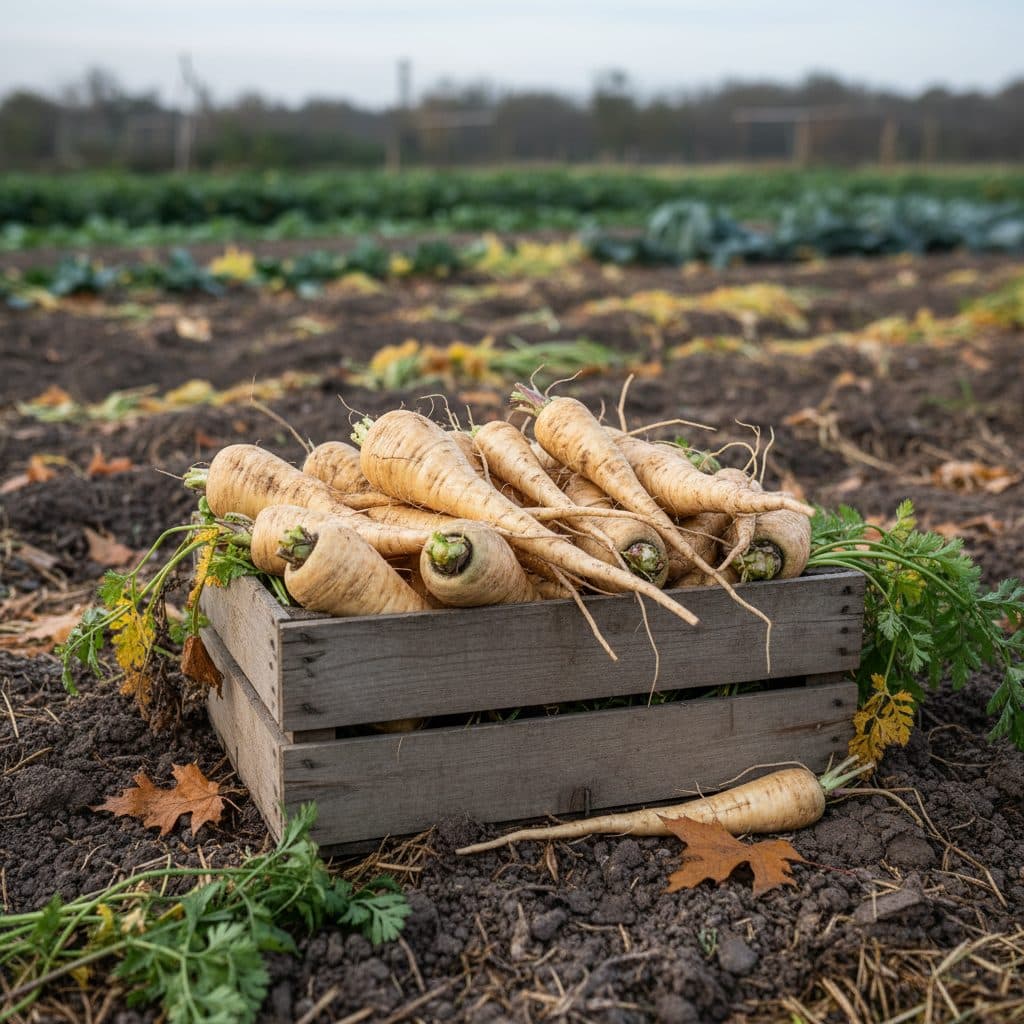
Key takeaways
- Always buy fresh seed every season, as parsnip seed viability drops dramatically after twelve months of storage.
- Direct sow seeds outdoors from March to May once soil temperatures reach at least 8°C to 10°C.
- Avoid planting in freshly manured soil to prevent roots from splitting, branching, or fanging into multiple distorted prongs.
- Parsnip seeds germinate slowly, taking 14 to 28 days; intersow fast-growing radishes along the drill to mark the rows for early weeding.
- Choose canker-tolerant varieties such as 'Gladiator' or 'Javelin' to reduce shoulder canker (Itersonilia perplexans, Phoma complanata) in wet winter soils.
- Leave parsnips in the ground through autumn frosts, as freezing temperatures convert root starches into simple sugars.
Quick answer: For successful crops in the UK, sow fresh parsnip seed directly outdoors from March to May in deep, stone-free soil that has not been freshly manured. Sow 1 cm deep in drills spaced 30 cm apart, thin emerging seedlings to 15 cm, keep rows weed-free during slow germination, and leave the long taproots in the ground until autumn frosts develop their natural sweetness.
Parsnips (Pastinaca sativa) are a cornerstone of the British winter kitchen garden and allotment. Long, sweet, and cold-hardy, they occupy the ground for up to nine months, standing untouched through severe frosts and snow to provide fresh harvests from October right through to February.
Successfully growing parsnips in the UK requires patience at the start of the season and careful bed preparation. Because parsnip seeds are slow to emerge and delicate during their initial growth stages, early weed competition and heavy, stony soils represent the main obstacles for plot holders.
Whether you manage an allotment plot or raised beds, reliable harvests depend on good seed germination, canker prevention, and proper lifting throughout the winter.
+-------------------------------------------------------------+
|                UK PARSNIP CROP CYCLE & TIMELINE             |
|                                                             |
|   MONTH             GROWTH STAGE                            |
|   -----             ------------                            |
|   March - May       Direct sow in stone-free drills         |
|   April - June      Slow germination (14-28 days) & thin    |
|   July - August     Foliage canopy fills; weed control      |
|   Sept - October    Roots bulk; first light frosts arrive   |
|   Nov - February    Winter harvesting as needed from ground |
+-------------------------------------------------------------+
When and how should you sow parsnip seeds?
Parsnips resent root disturbance and must be sown directly into their final growing positions; raising them in seed trays damages the taproot.
+-------------------------------------------------------------+
|                 PARSNIP SOWING WINDOWS (UK)                 |
|                                                             |
|   PERIOD            SOIL CONDITION        GERMINATION SPEED |
|   ------            --------------        ----------------- |
|   March             Cold (8-10°C)         Slow (21-28 days) |
|   April             Warming (10-14°C)     Steady (14-21 days|
|   May               Warm (14-18°C)        Rapid (10-14 days)|
+-------------------------------------------------------------+
The fresh seed rule
Parsnip seeds have the shortest shelf-life of almost any common vegetable. Seed stored for more than one year exhibits poor, patchy germination. Always purchase newly packed seeds stamped for the current growing season.
Sowing technique
- Rake the seedbed until it forms a fine, crumbly tilth free of large clumps.
- Draw shallow drills 1 cm deep, keeping 30 cm of space between parallel rows.
- Sow seeds thinly along the drill, or station-sow three seeds every 15 cm along the row.
- Cover lightly with fine soil and water gently with a fine rose.
- Intersow quick-germinating French breakfast radish seeds in the same drill. The radishes will pop up within 5 to 7 days, clearly marking the line of the row so you can hoe weeds between rows without disturbing unseen parsnip shoots.
To determine the ideal sowing time based on regional ground conditions, check our guide on soil temperature for planting.
+-------------------------------------------------------------+
|                 RADISH-MARKED SOWING DRILL                  |
|                                                             |
|   <- 15 cm ->                                               |
|   P...R...P...R...P...R...P   (P = Parsnip, R = Radish)     |
|                                                             |
|   <----------------- 30 cm Between Drills ----------------> |
+-------------------------------------------------------------+
Pre-germinating seed (chitting)
In cold, damp springs when soil warms slowly, you can speed up establishment by chitting seeds indoors. Place seeds between layers of damp kitchen paper in a sealed plastic tub kept at 18°C. Check daily; as soon as tiny white root tips emerge (usually 7 to 10 days), carefully transfer the germinated seeds into damp outdoor drills using tweezers.
What soil preparation prevents fanged and twisted roots?
Parsnip taproots can penetrate 30 to 45 cm deep into the earth. Any physical obstruction or concentrated layer of nutrients causes the growing tip to divide, creating forked or "fanged" roots.
- Avoid fresh manure: Never apply fresh farmyard manure or high-nitrogen organic fertilisers to a parsnip bed before sowing. The taproot forks when its growing tip hits an obstruction or a pocket of undecomposed manure, so sow into finely worked, evenly textured soil that was manured for the previous crop.
- Crop rotation: Sow parsnips on a plot that received generous compost for a previous hungry crop (such as potatoes, courgettes, or leeks) the prior year. This ensures adequate residual nutrition without excess fresh nitrogen.
- Removing stones: Fork through the top 30 cm of soil to remove stones, flint, and dense hardpan layers.
- Raised bed culture: If your allotment has heavy, poorly drained clay or stony subsoil, construct deep raised beds filled with a mixture of topsoil, well-rotted leaf mould, and coarse horticultural grit.
For long-term bed fertility strategies without disturbing the subsoil layers, explore our breakdown of a no-dig allotment.
+-------------------------------------------------------------+
|                 ROOT DEVELOPMENT IN SOILS                   |
|                                                             |
|   WELL-PREPARED TILTH               OBSTRUCTED / MANURED    |
|                                                             |
|          \|/ (Foliage)                     \|/ (Foliage)    |
|           |                                 |               |
|          / \ (Shoulder)                    / \              |
|         |   |                             /   \             |
|         |   |                            /  |  \ (Forked)   |
|         |   |                           /   |   \           |
|          \ / (Straight root)           |    |    |          |
|           V                            V    V    V          |
+-------------------------------------------------------------+
Which parsnip varieties offer the best canker resistance?
Parsnip canker is a fungal disease that causes orange-brown or black rot on the shoulders and crowns of maturing roots during wet autumn months. Choose canker-tolerant varieties such as 'Gladiator' or 'Javelin' to reduce shoulder canker (Itersonilia perplexans, Phoma complanata) in wet winter soils.
+-------------------------------------------------------------+
|              POPULAR UK PARSNIP VARIETIES                   |
|                                                             |
|   VARIETY          ROOT TYPE        KEY ATTRIBUTES          |
|   -------          ---------        --------------          |
|   Gladiator F1     Tapered, smooth  Outstanding canker tol. |
|   Javelin F1       Slender, uniform Stores well in ground   |
|   Tender and True  Heritage, long   Exceptional sweetness   |
|   White Gem        Short, broad     Ideal for shallow soil  |
|   Countess F1      Vigorous crown   High yield, early bulk  |
+-------------------------------------------------------------+- 'Gladiator F1': The benchmark hybrid for allotment growers. Produces smooth, cream-coloured roots with strong vigour and high tolerance to both black and orange canker.
- 'Javelin F1': A reliable commercial and garden standard that produces uniform, slender roots capable of standing in wet ground through mid-winter without rotting.
- 'Tender and True': A heritage variety prized for its fine culinary texture and deep flavour, best grown in light, stone-free soils.
- 'White Gem': A shorter, wedge-shaped variety well-suited to heavier allotment clays where long-rooted cultivars struggle.
When planning rotations, follow your brassica and legume beds with parsnips; see growing courgettes and growing brussels sprouts for the neighbouring plots.
How do you maintain and thin parsnip beds?
Because parsnips occupy the plot for many months, basic ongoing maintenance prevents weed smothering:
- Early thinning: When seedlings reach 3 to 5 cm tall, thin each station to leave the single healthiest shoot. Aim for a final spacing of 15 cm between plants. Wider spacing produces massive, chunky roots ideal for roasting; closer spacing (10 cm) yields slender, tender gourmet parsnips.
- Weed management: Hand-weed immediately around the crowns. Hoeing close to the roots risks slicing the emerging shoulders, inviting fungal canker spores into the wound.
- Carrot fly and canker: Carrot fly (Chamaepsila rosae) also attacks parsnips, and its tunnels are a main entry point for canker. Grow under insect mesh or a 60 cm barrier, and avoid thinning on still, warm evenings when the smell of bruised foliage carries.
- Watering: Parsnips are drought-tolerant once their deep taproots establish. However, in prolonged dry summer spells, water deeply once a week to prevent the roots from splitting when heavy autumn rain returns.
- Handling safety: Parsnip leaves contain photosensitising compounds called furanocoumarins. Contact with bruised foliage followed by exposure to bright sunlight can trigger skin blistering. Wear garden gloves and long sleeves when weeding on sunny summer afternoons.
For understanding wider plant development phases, see vegetable growth stages explained.
When and how should you harvest winter parsnips?
Unlike potatoes or carrots, parsnips improve significantly if left in the ground through freezing weather.
+-------------------------------------------------------------+
|                 SWEETENING PROCESS IN FROST                 |
|                                                             |
|   AIR TEMPERATURE        INTERNAL ROOT REACTION             |
|   ---------------        ----------------------             |
|   Above 10°C (Summer)    Roots store complex starches       |
|   Below 4°C (Autumn)     Enzymes convert starches to sugars |
|   Sub-Zero Frosts        Peak sweetness and tender texture  |
+-------------------------------------------------------------+- Post-frost harvesting: Delay primary harvesting until after the first moderate autumn frosts in October or November. Cold temperatures trigger an enzymatic breakdown of stored starches into sucrose and fructose, giving the roots a sweet, nutty flavour.
- Lifting technique: Never pull parsnips by their leaves, as the brittle crowns will snap off, leaving the root trapped in the earth. Insert a sturdy garden fork vertically 10 cm away from the crown, lever back gently to loosen the subsoil, and lift the entire root cleanly.
- Winter storage in situ: Parsnips are very frost hardy. In all but the coldest upland regions, the best storage facility is the open earth. Simply leave the roots in the ground and lift them as needed for the kitchen. If severe prolonged freezes are forecast, cover the bed with a 15 cm layer of straw or bracken to keep the soil surface workable.