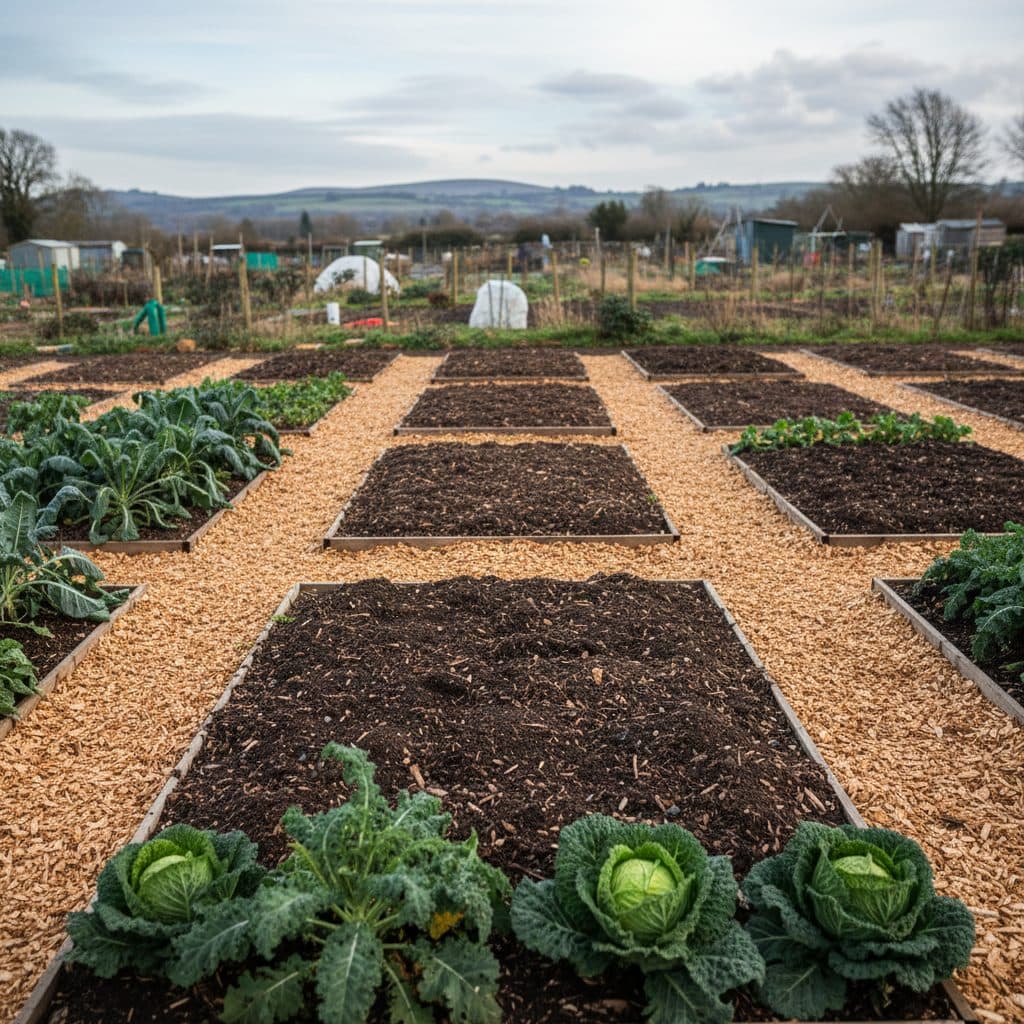
Key takeaways
- Setting up a no dig allotment allows you to establish productive growing beds over grass and perennial weeds without rotavating or double-digging.
- Corrugated cardboard provides light deprivation that exhausts persistent weeds while earthworms break down the organic matter beneath.
- Apply a 10 to 15 cm layer of well-rotted compost over cardboard for new beds, followed by an annual autumn mulch of 3 to 5 cm.
- Permanent woodchip or bark pathways prevent soil compaction in planting areas and define distinct growing zones across the plot.
- Taproot weeds like dock and dandelion require initial trowel removal of crowns, while running grasses decay rapidly beneath cardboard.
- Direct sowing into surface compost allows immediate planting of potatoes, courgettes, squash, and broad beans in the first season.
Quick answer: To convert an overgrown UK allotment plot to no-dig, mow the vegetation flat, lay thick unwaxed cardboard with generous 15 cm overlaps, and cover it with 10 to 15 cm of well-rotted compost. Plant hardy crops like squash, potatoes, or brassicas directly into the surface compost while the cardboard suppresses weeds and enriches the soil beneath.
Taking on a traditional council allotment plot in the UK often means facing a dense mat of couch grass, stinging nettles, creeping buttercup, and mare's tail. The conventional advice has long been to hire a heavy rotavator or spend months double-digging the soil, but mechanical tilling chops perennial root networks into hundreds of viable fragments, multiplying your weed problem within weeks.
Adopting a no dig allotment method preserves the natural soil structure, protects mycorrhizal fungi, and creates fertile vegetable beds with significantly less physical strain. By working from the surface downward, you build up biological activity and suppress dormant weed seeds that would otherwise germinate when turned up to the light.
Whether you have just signed the tenancy on a neglected five-rod plot or want to transition existing cultivated beds, this guide outlines the systematic conversion process tailored for UK growing conditions.
+-------------------------------------------------------------+
|             NO-DIG ALLOTMENT BED CONVERSION PROFILE         |
|                                                             |
|   [Surface]   3 - 5 cm Annual Autumn Compost Dressing      |
|   [Year 1]    10 - 15 cm Initial Well-Rotted Compost Layer  |
|   [Barrier]   Double Layer Overlapping Brown Cardboard      |
|   [Subsoil]   Undisturbed Native Soil & Smothered Weeds     |
|   [Paths]     Permanent Paths Clad in 5 - 8 cm Woodchips    |
+-------------------------------------------------------------+
How do you clear an overgrown allotment plot without digging?
The first stage of converting an allotment is assessing the weed profile and reducing surface biomass. You do not need to strip the turf or excavate topsoil, as decomposing vegetation returns valuable nitrogen and organic matter to the soil food web.
- Cut down top growth: Use a brushcutter, scythe, or heavy lawnmower to cut the existing grass and weeds down as close to ground level as possible. Leave the chopped residue in place if it is free of mature weed seed heads, or rake it into a central compost pile.
- Remove woody debris and hazards: Clear away bramble stumps, hidden stones, broken glass, and metal debris commonly found on neglected allotment sites.
- Address persistent taproots and invasive perennials: Cardboard completely blocks sunlight, smothering annual weeds and starving couch grass, docks, and dandelions over several months as earthworms digest the cellulose. However, deep-rooted perennials like field bindweed (*Convolvulus arvensis) and mare's tail/horsetail (Equisetum arvense*) will pierce cardboard and find the edges: pull or trowel out shoots the moment they appear through the mulch, and never let them establish green leaves.
- Water dry ground thoroughly: If you are converting ground during a dry spell in late summer, soak the cut vegetation thoroughly before laying cardboard. Cardboard requires moisture to initiate microbial breakdown and attract earthworms from lower soil horizons.
For managing large plots with heavy weed burdens, techniques detailed in our guide on sheet mulching with cardboard for weed control provide reliable suppression strategies.
What type of cardboard and compost should you use on UK plots?
The success of your no dig beds depends on using suitable sheet barriers and clean organic mulches.
Sourcing and preparing cardboard
- Use plain, unprinted corrugated brown cardboard boxes from local shops, bicycle stores, or allotment deliveries.
- Remove all plastic packing tape, shipping labels, and metal staples before laying.
- Avoid glossy printed boxes or waxed produce cartons, which resist water and take years to decompose.
- Overlap all edges by at least 15 to 20 cm. Weeds quickly find gaps between narrow seams, so generous overlaps are essential around bed perimeters.
Selecting compost for allotment beds
A new no-dig bed requires an initial 10 to 15 cm layer of organic matter to provide an immediate root run for crops.
- Municipal green waste compost (PAS 100 certified): Often available in bulk bags or loose tipper loads through local council schemes. It provides an economical base volume for large plots.
- Well-rotted horse or farmyard manure: Ensure manure has rotted for at least six to twelve months until it smells sweet and earthy. Before accepting manure or bulk green waste from a farmer or contractor, verify it is free of persistent pyralid herbicides (such as clopyralid and aminopyralid), which survive composting and will cup and stunt sensitive crops like tomatoes, potatoes, peas, and beans (see persistent herbicide compost contamination).
- Homemade allotment compost: Use aerated bin compost to top-dress established beds in autumn.
+-------------------------------------------------------------+
|               COMPOST REQUIREMENTS FOR NEW BEDS             |
|                                                             |
|   BED SIZE          DEPTH      APPROXIMATE VOLUME REQUIRED  |
|   --------          -----      ---------------------------  |
|   1.2 m x 3 m Bed   15 cm      0.54 cubic metres (540 L)    |
|   1.2 m x 6 m Bed   15 cm      1.08 cubic metres (1080 L)   |
|   Standard 5-Rod    10 cm      6 to 8 bulk bags (total)     |
+-------------------------------------------------------------+
How do you lay out beds and pathways on a UK allotment?
Standard UK allotment plots are traditionally measured in rods or poles (one rod equals approximately 25 square metres). Planning a sensible bed layout prevents foot traffic on growing areas and streamlines maintenance throughout the season.
+-------------------------------------------------------------+
|               ALLOTMENT BED AND PATH LAYOUT                 |
|                                                             |
|   +-------------------+  Path (45 cm)  +------------------+ |
|   |  No-Dig Bed #1    |  [Woodchips]   |  No-Dig Bed #2   | |
|   |  Width: 1.2 m     |  ...........   |  Width: 1.2 m    | |
|   |  Length: 5 to 10 m|  ...........   |  Length: 5 to 10m| |
|   +-------------------+  ...........   +------------------+ |
+-------------------------------------------------------------+- Standardise bed widths: Keep beds to a width of 1.2 metres (4 feet). This dimension allows you to reach the centre of the bed comfortably from either side without ever stepping onto the cultivated compost.
- Design practical pathways: Make paths 45 to 60 cm wide for foot access, and ensure at least one main central path is 90 cm wide to accommodate a standard allotment wheelbarrow.
- Mulch paths with cardboard and woodchips: Lay cardboard directly over the grass paths and cover it with 5 to 8 cm of coarse woodchips or bark. This keeps pathways clean, suppresses walking-zone weeds, and feeds fungal networks that benefit adjoining beds.
- Skip wooden edges: Traditional timber edging boards rot within three to five seasons and create damp harbourage for allotment slugs and snails. Open-edged compost beds hold their shape naturally once earthworm activity consolidates the perimeter.
What should you plant during your first season?
You can plant into a newly made no-dig bed immediately after spreading the compost. The choice of first-year crops helps condition the bed while cardboard softens underneath.
- Potatoes: Maincrop and early potatoes thrive in surface compost. Part the compost, make a small slit in the underlying cardboard if it is still firm, and set seed tubers in place. As shoots grow, mound with additional compost or clean straw instead of soil.
- Squash and pumpkins: Winter squash and courgettes produce broad foliage canopies that cast deep shade, suppressing any weed shoots trying to emerge around the edges.
- Broad beans and peas: Legumes establish sturdy root systems quickly and fix atmospheric nitrogen in nodules along their roots. For planting schedules, consult our guide on growing broad beans.
- Brassicas: Sturdy winter cabbages, purple sprouting broccoli, and kale establish firm root anchorage in dense compost layers.
- Climbing beans: Erect cane wigwams directly through the compost into the subsoil to grow climbing runner beans along your main plot boundary.
+-------------------------------------------------------------+
|             FIRST-YEAR ALLOTMENT PLANTING CHOICES           |
|                                                             |
|   CROP CATEGORY     SUITABLE SPECIES        BENEFIT         |
|   -------------     ----------------        -------         |
|   Heavy Feeders     Squash, Courgettes      Dense weed shade|
|   Root Conditioners Potatoes, Leeks         Breaks barrier  |
|   Nitrogen Fixers   Broad Beans, Peas       Soil enrichment |
|   Leafy Brassicas   Kale, Winter Cabbage    Cold season cover|
+-------------------------------------------------------------+
How do you maintain no-dig allotment beds across the seasons?
Maintaining a no-dig plot requires far fewer labour hours than traditional mechanical digging, but regular surface attention keeps beds productive year after year.
Seasonal routine
- Spring: Lightly hoe or hand-weed the compost surface on sunny days to dislodge windblown annual weed seedlings before they develop true leaves. Rake the surface level and sow seeds into shallow drills.
- Summer: Harvest crops cleanly by cutting stems at ground level instead of yanking entire root balls, leaving fibrous root systems to rot in place and create natural aeration channels.
- Autumn: Clear spent crop residues onto the communal compost heap or into an on-site bin built following principles from our small-space composting guide. Spread an annual 3 to 5 cm layer of compost across every bed before winter rains arrive.
- Winter: Allow winter frosts and earthworm activity to incorporate surface compost into the topsoil. Soil remains covered and protected from heavy winter rain leaching nutrients.
Maintaining surface cover and leaving soil horizons undisturbed builds a moisture-retentive texture that resists drought and supports consistent yields.