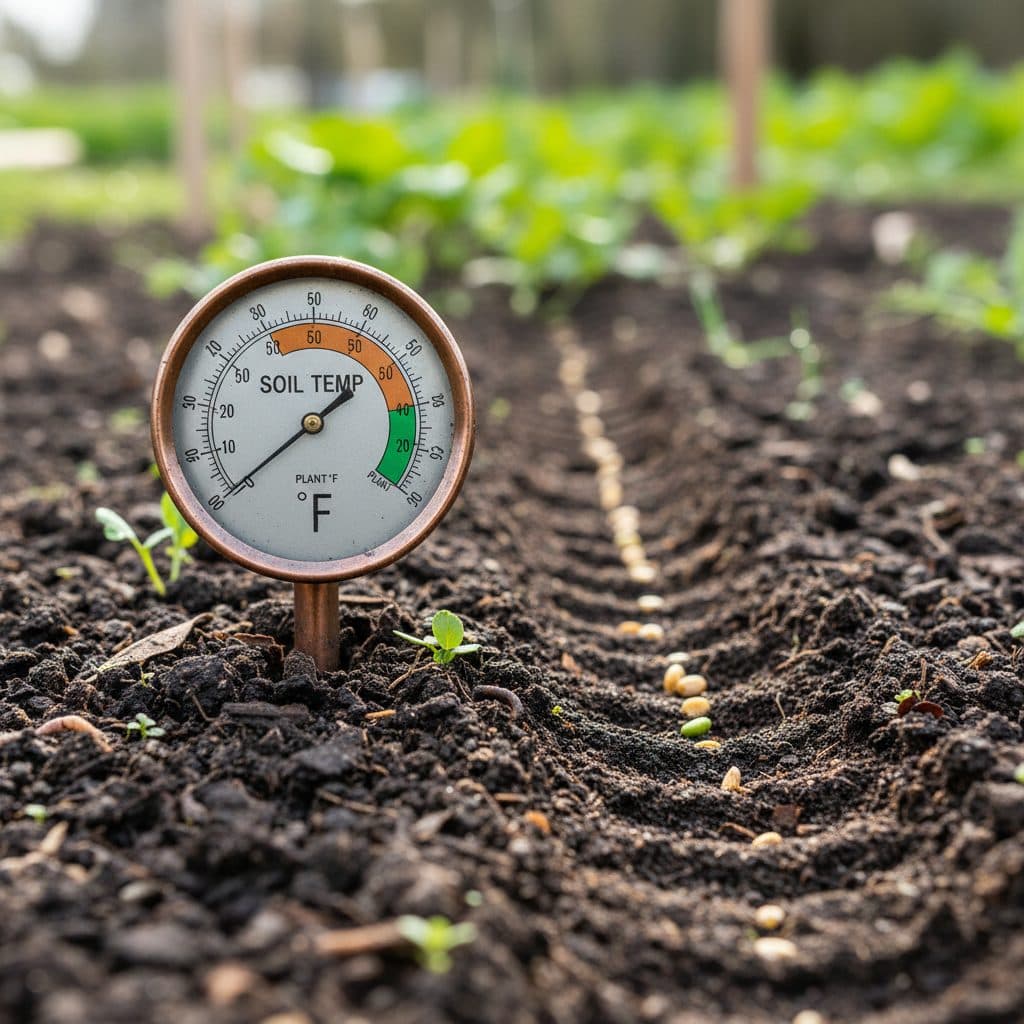
Key takeaways
- Seeds germinate in response to subterranean soil warmth and moisture at planting depth, not ambient afternoon air temperature.
- Cool-season crops (spinach, peas, radishes) germinate in soil as cool as 40°F to 45°F (4.4°C to 7.2°C), while warm-season nightshades and cucurbits require 60°F to 70°F (15.5°C to 21.1°C).
- Measure soil temperature 2 to 4 inches (5 to 10 cm) deep at 8:00 AM across three consecutive days to establish your baseline minimum temperature.
- Sowing into cold, waterlogged soil stalls germination, causing seeds to rot and exposing emerging shoots to damping-off fungi.
- Accelerate spring soil warming by raking back thick winter mulches, building raised beds, or laying black plastic tarps two weeks prior to sowing.
- Transplant warm-season tomatoes and peppers only after nighttime soil temperatures consistently hold above 60°F (15.5°C).
Quick answer: For reliable seed germination, verify soil temperature with a probe thermometer 2 to 4 inches (5 to 10 cm) deep. Sow cool-season crops (peas, spinach, radishes) when soil reaches 45°F (7.2°C), root crops and brassicas at 50°F (10°C), beans and corn at 60°F (15.5°C), and warm-season crops (tomatoes, peppers, melons, squash) only once soil consistently exceeds 65°F to 70°F (18.3°C to 21.1°C).
Every spring, eager gardeners rush to plant seeds outdoors as soon as the first warm, sunny weekend arrives. However, air temperature is a deceptive metric. While afternoon air may reach a pleasant 70°F (21°C), the soil just beneath the surface may remain a chilling 45°F (7°C), locked in winter cold.
Understanding soil temperature for planting is the single most reliable predictor of seed germination speed and seedling vigour. Seeds are biological capsules that require a specific biochemical threshold of thermal energy to activate metabolic enzymes and initiate cell division.
This guide covers minimum, optimum, and maximum germination temperatures, thermometer best practices, and bed-warming techniques for direct-sown seeds and transplants.
+-------------------------------------------------------------+
|              SOIL TEMPERATURE GERMINATION BANDS             |
|                                                             |
|   SOIL TEMP RANGE    THERMAL CATEGORY   EXAMPLE CROPS       |
|   ---------------    ----------------   -------------       |
|   40°F - 50°F        Cool-Season Early  Spinach, peas, kale |
|   (4.4°C - 10°C)                                            |
|                                                             |
|   50°F - 65°F        Cool-Season Main   Carrots, beets,     |
|   (10°C - 18.3°C)                       brassicas, parsnips |
|                                                             |
|   65°F - 80°F        Warm-Season Main   Tomatoes, beans,    |
|   (18.3°C - 26.7°C)                     cucurbits, peppers  |
|                                                             |
|   80°F - 90°F        Heat Lovers        Okra, sweet potato, |
|   (26.7°C - 32.2°C)                     watermelons, corn   |
+-------------------------------------------------------------+
How do you accurately measure garden soil temperature?
Checking soil temperature requires a simple probe thermometer and consistent timing:
+-------------------------------------------------------------+
|                 SOIL THERMOMETER PROTOCOL                   |
|                                                             |
|   STEP              RECOMMENDED PROCEDURE                   |
|   ----              ---------------------                   |
|   1. Instrument     Use a dial or digital probe thermometer |
|   2. Depth          Insert 2 to 4 inches (5 to 10 cm) deep  |
|   3. Timing         Read between 8:00 AM and 9:00 AM        |
|   4. Location       Test both shaded and sunny bed sections |
|   5. Duration       Average readings over 3 consecutive days|
+-------------------------------------------------------------+- Timing matters: Soil reaches its lowest diurnal temperature in the early morning just after dawn, and its highest in late afternoon. Always take readings between 8:00 AM and 9:00 AM to capture the baseline minimum temperature your seeds must endure overnight.
- Probe depth: Insert the metal stem to the depth where seeds will reside, typically 2 inches (5 cm) for direct-sown seeds, or 4 inches (10 cm) for transplant root balls.
- Wait for stabilization: Leave analog dial thermometers in the earth for at least two minutes until the needle stops moving before recording the value.
To understand wider plant development timelines following emergence, see our guide to vegetable growth stages explained.
What are the minimum and optimum temperatures for common vegetables?
Every vegetable species operates within a specific minimum threshold (below which germination fails or takes weeks), an optimum range (where germination occurs rapidly with high percentages), and a maximum limit:
+-------------------------------------------------------------+
|              VEGETABLE GERMINATION TEMPERATURE CHART        |
|                                                             |
|   CROP              MINIMUM       OPTIMUM RANGE    DAYS (OPT|
|   ----              -------       -------------    ---------|
|   Spinach           35°F (1.7°C)  50-70°F (10-21°C) 5 - 7   |
|   Peas (English)    40°F (4.4°C)  55-75°F (13-24°C) 6 - 9   |
|   Lettuce           35°F (1.7°C)  55-70°F (13-21°C) 4 - 7   |
|   Radish            40°F (4.4°C)  60-85°F (15-29°C) 3 - 5   |
|   Carrot            45°F (7.2°C)  65-80°F (18-27°C) 6 - 10  |
|   Beet              45°F (7.2°C)  65-85°F (18-29°C) 5 - 8   |
|   Broccoli/Cabbage  45°F (7.2°C)  65-85°F (18-29°C) 4 - 6   |
|   Sweetcorn         55°F (12.8°C) 75-90°F (24-32°C) 4 - 6   |
|   Green Beans       60°F (15.5°C) 70-85°F (21-29°C) 6 - 8   |
|   Tomato            55°F (12.8°C) 70-85°F (21-29°C) 6 - 8   |
|   Cucumber / Squash 60°F (15.5°C) 75-90°F (24-32°C) 3 - 5   |
|   Pepper & Eggplant 60°F (15.5°C) 75-90°F (24-32°C) 6 - 9   |
|   Melon / Okra      65°F (18.3°C) 85-95°F (29-35°C) 4 - 6   |
+-------------------------------------------------------------+
The consequences of planting too early
Planting seeds at their bare minimum temperature threshold is often counterproductive:
- Beans planted at 60°F (15.5°C) may take 16 days to emerge and suffer from seed corn maggot damage, while the same seed sown at 75°F (24°C) will pop up vigorously in just 6 days.
- Slow-emerging seeds are vulnerable to soil-dwelling pathogens like Pythium and Rhizoctonia, leading to poor stand counts and patchy beds.
- Sweet corn hybrids: Standard sweet corn (su) germinates from 50°F to 55°F (10°C to 13°C), but modern sugary enhanced (se) and supersweet (sh2) hybrids need soil of at least 60°F to 65°F (15.5°C to 18°C) to avoid rotting in cold spring ground.
For timing specific root crops in cold ground, see our guide to growing parsnips.
What are the rules for transplanting warm-season nightshades and cucurbits?
Transplanting seedling root balls into cold soil creates severe physiological shock, even if ambient air feels warm:
+-------------------------------------------------------------+
|                 TRANSPLANT SOIL THRESHOLDS                  |
|                                                             |
|   CROP             MIN SOIL TEMP    SIGNS OF COLD SHOCK     |
|   ----             -------------    -------------------     |
|   Tomatoes         60°F (15.5°C)    Purple leaves (P lock), |
|                                     stunted main leader     |
|   Peppers/Eggplant 65°F (18.3°C)    Leaf yellowing, blossom |
|                                     drop, root stunting     |
|   Cucurbits        65°F (18.3°C)    Sudden wilt, root rot   |
+-------------------------------------------------------------+- Phosphorus lockout: When tomato roots sit in soil below 55°F (12.8°C), root metabolism slows dramatically, preventing phosphorus uptake. Leaves turn dark purple along the undersides of the veins, and vegetative growth completely stalls.
- The 60°F rule: Never transplant tomatoes until the soil temperature at 4 inches (10 cm) depth reliably exceeds 60°F (15.5°C) for three straight mornings.
- The 65°F rule: Hold bell peppers, hot peppers, and eggplants under shelter until soil reaches 65°F (18.3°C); cold soil stunts pepper root systems permanently.
To pair warm-season crops with regional calendar dates, consult the zone 9 planting schedule and UK allotment techniques for growing courgettes.
How do you warm garden soil faster in early spring?
You do not have to wait passively for the sun to warm your beds. Applying active bed management can raise soil temperatures by 5°F to 10°F (3°C to 6°C) two to three weeks earlier in the season:
+-------------------------------------------------------------+
|                 SOIL WARMING STRATEGIES                     |
|                                                             |
|   METHOD            THERMAL GAIN        MECHANISM           |
|   ------            ------------        ---------           |
|   Clear Plastic     +8°F to +12°F       Greenhouse effect   |
|   Black Silage Tarp +5°F to +8°F        Radiant absorption  |
|   Rake Back Mulch   +4°F to +6°F        Direct sun exposure |
|   Raised Bed Form   +3°F to +5°F        Rapid water drainage|
+-------------------------------------------------------------+- Rake back heavy winter mulch: While thick straw mulch protects soil from winter erosion, it acts as an insulating blanket in spring, preventing solar radiation from penetrating the ground. Rake winter mulch into the pathways two weeks before planting to expose bare dark soil to direct sunlight.
- Build permanent raised beds: Raised beds drain excess cold meltwater quickly. Because dry soil requires substantially less energy to warm up than saturated, waterlogged soil, raised beds warm up 7 to 10 days earlier in spring.
- Pre-warm with plastic sheeting or tarps: Laying clear polyethylene plastic sheeting or black silage tarps tightly over prepared beds two weeks prior to seeding captures solar heat, warming the top 4 inches (10 cm) of soil rapidly while suppressing early spring weed flushes.
For commercial and market gardeners planning high-density early spring bed flips, see how to start a market garden.